Spas, resorts and hospitality venues understood before anyone else that well-being depends not just on a service, but on the overall quality of the experience. From light to temperature, from materials to silence, from the presence of water to the connection with nature, every element contributes to a sense of balance. It is precisely in …
Spas, resorts and hospitality venues understood before anyone else that well-being depends not just on a service, but on the overall quality of the experience. From light to temperature, from materials to silence, from the presence of water to the connection with nature, every element contributes to a sense of balance.
It is precisely in these places, designed to slow down the pace of life and put the body and senses back at the center, that a new idea of well-being is taking shape. Wellness design is now moving beyond the spa and becoming a benchmark for interior design, hospitality and contemporary living spaces.
The point is not to turn every room into a spa, but to understand what makes those experiences so effective: a sense of proportion, attention to detail, the tactile quality of surfaces, carefully calibrated lighting, acoustic comfort, the presence of natural elements and the ability to build a slower, more mindful relationship with space.
Design thus takes on a role that goes beyond aesthetics. It can encourage rest, simplify everyday gestures, support self-care rituals and create spaces that truly welcome the people who live in them.
An armchair can restore the value of a break, a lamp can change our perception of time, a rug can introduce a more intimate, sensory dimension, and well-designed technology can make a healthy habit feel natural.
The new luxury of living grows out of this attention. Not from accumulation, but from the ability to choose a few well-designed pieces that genuinely improve the experience of a space.
The ten design icons that follow embody this shift: objects that bring into homes, hotels and hospitality spaces some of the principles that have made spas and wellness destinations true laboratories of contemporary living.
Wellness design as a tool for well-being: what does well-being mean in design?
More than a style, well-being represents a new approach to design. It is a way of conceiving spaces in which aesthetics, functionality and wellness work together to improve the experience of the people who use them.
Architecture and interior design have always had the power to influence human behavior. Today that awareness has become even more central. Design is no longer limited to defining the form of a room; it also considers how natural light moves through a space, how materials feel to the touch, acoustic comfort, air quality, the connection with nature and the small daily rituals that contribute to our balance.
It is a design language that looks at the person before the object. That is why homes, hotels, resorts and spas alike are showing a growing interest in authentic materials, calibrated lighting, natural surfaces, sensory comfort and furniture built to last.
In this context, design stops being merely an aesthetic statement and becomes an ally of well-being. Every design choice can shape an experience: a seat that invites you to pause, a light that follows the rhythms of the day, an object that makes self-care easier. Because true luxury today is not about filling spaces, but about designing environments that quietly improve our quality of life.
1. The armchair for taking a break
Lounge Chair & Ottoman by Charles and Ray Eames for Vitra

Every space devoted to well-being, from a spa to a boutique hotel, sets aside a place for taking a break. A comfortable seat, a quiet corner, softer light: simple elements that create the conditions for slowing down.
Designed in 1956 by Charles and Ray Eames, the Lounge Chair & Ottoman is still one of the most accomplished expressions of this principle. Produced by Vitra, it was conceived as a contemporary reinterpretation of the traditional English club chair, combining comfort, craftsmanship and balanced proportions.
Its strength lies not only in its iconic form, but in the way it defines a personal space. Reading, listening to music, looking out at the landscape or enjoying a few minutes of silence come more naturally when the setting truly invites you to do so.
In a daily life dominated by speed, a break is no longer empty time but a form of self-care. The Lounge Chair embodies exactly this understated luxury: finding your own rhythm again through an object designed to cradle the body and free the mind.
2. The tap that turns hydration into a daily ritual
Quooker Fusion Square with CUBE system

One of the principles behind spaces devoted to well-being is valuing the simplest gestures. Drinking water, making tea or an infusion, filling a water bottle: everyday actions that, when made easier by design, become part of a more mindful routine.
The Quooker Fusion Square with CUBE system captures this philosophy perfectly. A single tap delivers cold, hot, boiling, filtered still and sparkling water, while cutting down on plastic bottles and simplifying daily tasks.
More than a piece of technology, it represents a different way of living in the kitchen: not as a purely functional space, but as a room where design supports well-being through essential gestures repeated every day.
3. The bookcase that makes room for knowledge
Random by MDF Italia

Reading is also one of the rituals of well-being. In an age dominated by screens, setting aside time to open a book means slowing down, stimulating the mind and allowing yourself space to concentrate.
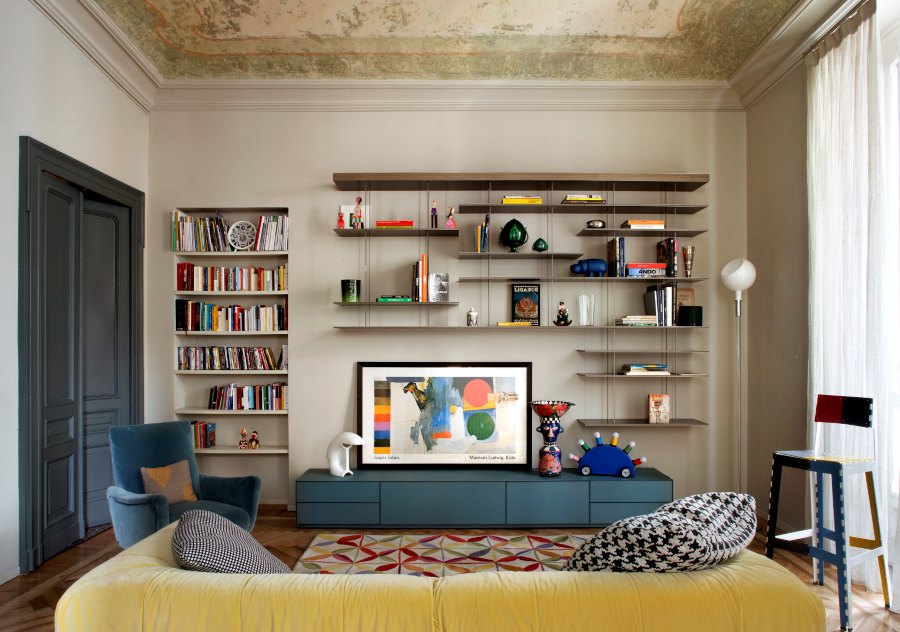
Designed by Neuland Industriedesign for MDF Italia, Random is one of the most iconic bookcases in contemporary design. Its irregular sequence of shelves creates a visual balance that turns a plain wall into a true piece of domestic architecture.
Its role goes beyond holding books. It displays passions, gathers memories, showcases meaningful objects and encourages you to build a space that tells the story of the people who live there. Because well-being also comes from the cultural richness of the spaces we choose to live in.
4. The rug that turns material into experience

The Tactile collection by Ilaria Franza for Mohebban
In design focused on well-being, wellness is not only about what we see. It involves the body, touch and the way we move through space. The rug therefore takes on a broader role: not just a decorative surface, but an element that sets the mood, dampens noise and introduces a more intimate, sensory dimension.
This is the thinking behind Tactile, the capsule collection designed by the artist Ilaria Franza for Mohebban. The collaboration translates the language of her paintings into textiles, expanding how they are perceived through the texture of the yarns, raised surfaces and variations in material. The image is no longer just looked at: it can be walked on and physically felt.
Abstract compositions and layered colors become rugs with remarkable visual depth, in which wool, bamboo silk, viscose and other fibers create irregular, soft and lively surfaces. The collection comes in several colorways, including Gold, Blue, Rose, Black, Caramel and Green, designed to suit different spaces and design sensibilities.
In a home, a hotel suite or a relaxation area, a rug from the Tactile collection creates a place within a place: it gathers the space together, invites you to slow down and puts contact with materials back at the center.
This is where design meets well-being most authentically: when beauty does not stay at a distance, but becomes an experience felt with the whole body.
5. The lamp that follows the rhythm of the day
Bellhop by Flos

Light is one of the most powerful tools in design. It can aid concentration, create intimacy or ease the transition from daily activities to rest.
Designed by Edward Barber and Jay Osgerby for Flos, Bellhop was created for the hospitality world and takes its name from the bellhop, the hotel porter who discreetly accompanies guests. Its pared-back design and soft, shielded light make it ideal for creating relaxing atmospheres without glare.
It is not just an iconic lamp, but an example of how lighting can contribute to the well-being of a space. Because designing light ultimately means designing the way we experience time.
6. The diffuser that gives a space its own scent identity
Stile Aramara by Culti Milano

Walking into a spa or a luxury hotel is an experience that immediately engages all the senses. Of these, smell is perhaps the most evocative: a scent can bring a place back to mind even years later.
With Stile Aramara, one of the most iconic fragrances by Culti Milano, design enters an invisible yet deeply distinctive dimension. Its citrus notes, combined with spicy and woody accents, help define the character of a room without overpowering it.
In contemporary design, scent becomes an element of interior design on a par with light, materials and furniture: a detail that completes the experience of a space.
7. The kettle that restores the value of the tea ritual

Plissé by Alessi
Every culture of well-being values small daily rituals. Making tea, a herbal infusion or a tisane means allowing yourself a mindful pause, slowing down and devoting a few minutes entirely to yourself.
Designed by Michele De Lucchi for Alessi, the Plissé kettle expresses this philosophy through a language that combines function and formal research. The pleats on its surface recall the world of fashion and turn a household appliance into an elegant presence on the kitchen counter.
Even the simplest objects can help make a gesture we repeat every day feel special.
8. The vase that brings the lightness of glass into a room
Fazzoletto by Fulvio Bianconi and Paolo Venini for Venini

In spaces focused on well-being, nature is not expressed only through plants. It can also appear in light, in reflections and in the sensory quality of the materials chosen to accompany it.
The Fazzoletto (“handkerchief”) vase, designed by Fulvio Bianconi and Paolo Venini for Venini, is one of the most recognizable icons of Murano glass. Its soft, irregular shape, formed by hand by a master glassblower, recalls fabric caught in a breeze and makes each piece slightly different from the next.
It is precisely this controlled imperfection that gives it such a living presence. The glass catches the light, alters its reflections and interacts with flowers without being reduced to a mere container. Placed in a home, a spa or a hotel, it brings a poetic element into the space that slows the gaze and draws attention back to the material.
In wellness-focused design, even a vase can play a precise role: welcoming nature and turning it into an everyday visual experience. The Fazzoletto fulfills this role through a form that seeks not geometric perfection, but the spontaneity of the gesture and the lightness of movement.
9. The bathtub that turns the bathroom into a wellness experience
Reflex by antoniolupi

The best spas and luxury hotels have taught us that the bathroom can be far more than a functional space: it is a place devoted to time, silence and regeneration. This philosophy now also finds expression in contemporary homes, where well-being comes from the quality of the design.
Reflex, the freestanding bathtub by antoniolupi, interprets this vision through an essential, timeless language. Its soft lines and monolithic volume engage with the architecture of the room, turning the bathroom into a space to be enjoyed and not just used.
More than a piece of furniture, Reflex becomes the focal point of a daily ritual. Immersion in water invites you to slow down, carve out a moment of self-care and restore balance between body and mind, bringing into the home the same sense of calm found in the best wellness destinations.
It is also through objects like this that design proves its worth: not simply by fulfilling a function, but by improving the quality of the experience and of the time we spend in the spaces we live in.
10. The mirror that invites the eye to linger
Christine by Fiam Italia

In well-being-oriented design, every element contributes to how a space is perceived. Even a mirror can change the quality of a room, amplifying natural light, creating depth and offering a different relationship with its surroundings.
Designed by Helidon Xhixha for Fiam Italia, the Christine mirror turns curved glass into a sculptural surface that reflects light in a dynamic, never predictable way.
It is not just an accessory, but a piece that invites you to pause, look and perceive the space more attentively. Because well-being also comes from spaces that move us without excess.
Bonus: the sofa on our cover, Camaleonda by Mario Bellini for B&B Italia

If one object sums up the new way of thinking about comfort, it is the Camaleonda, designed by Mario Bellini in 1970 and reissued by B&B Italia in 2020.
More than fifty years after its debut, it remains one of the most coveted sofas in the world thanks to an insight that anticipated contemporary design: modularity. Each element can be combined, separated and reconfigured to suit the needs of the people using the space, turning the living room into a dynamic, flexible, ever-evolving environment.
Its generous shapes and deep padding invite relaxation, conversation and time spent together. It is not just an icon of Italian design, but a project that perfectly embodies the concept of well-being: creating spaces that adapt to people, not the other way around.
That is why we chose the Camaleonda for the cover of this article. Better than any other object, it shows that the true luxury of living lies not in ostentation, but in design’s ability to improve quality of life through ideas that remain relevant even after more than half a century.
Design as an experience of well-being
The ten icons in this selection show how contemporary design is evolving toward a new idea of luxury. A luxury that has nothing to do with accumulating objects, and everything to do with creating experiences through space.
Whether it is a private home, a spa, a boutique hotel or any other hospitality venue, the principle remains the same: design achieves its highest purpose when it improves the quality of life of the people who use the space.
Seen this way, an armchair, a lamp, a rug or even a simple tap stop being mere objects. They become tools through which design expresses a new idea of well-being: more mindful, more sensory and deeply connected to the way we choose to inhabit the world.