The woman on Fornasetti plates is Lina Cavalieri. Discover Piero and Barnaba, Tema e Variazioni and the Milan atelier’s furniture, wallpaper and interiors.
A face returns, different every time. On Fornasetti plates, Lina Cavalieri’s portrait becomes an experiment without a prescribed ending: change one detail and everything we see can change with it.
Fornasetti is the Milanese atelier founded by Piero Fornasetti, the artist and decorator who lived from 1913 to 1988. The woman on its celebrated plates is Lina Cavalieri, an opera singer and the subject of Tema e Variazioni, the series begun in 1952. Today, the work continues with his son Barnaba, the atelier’s artistic director. Drawing, printing, craft and furniture define a production that also includes lamps, trays, vases and decorative surfaces.
Many people recognise the eyes before they recognise the name: a precisely drawn face on pale porcelain, an image that seems to look back at the room. Yet stopping at the plates means remaining at the threshold of a much wider repertoire. Furniture carries imaginary architecture, surfaces suggest depths they do not physically possess, and landscapes move from paper to walls.
Who was Piero Fornasetti?
Piero Fornasetti was born in Milan in 1913 and died there in 1988. His practice moved between painting, graphic work, decoration and objects. The documentation for La Folie pratique at the Musée des Arts Décoratifs in Paris traces his studies at Brera, his participation in the 1933 Triennale and his encounter with Gio Ponti.
The atelier’s official chronology places the beginning of its history in 1940. The artist’s biography and the business’s history should be kept distinct. Fornasetti names a person, an archive and a continuing production that extends beyond the founder’s lifetime.
The collector’s curiosity offers a way to understand the method. A project can begin by returning to an image, changing its scale or setting it beside something unexpected. Invention lies not only in producing a new subject, but also in recognising a fragment and transforming the relationships around it.
An archive is not a list of products
The repertoire includes more than 13,000 drawings, paintings, models, objects and references. That figure describes an archive, not 13,000 currently available products. Treating the two as equivalent would reduce a working collection of ideas to a commercial inventory.
An image can recur on different supports without becoming the same design. A flat plate, a curved vase and the front of a cabinet ask different things of a drawing. Scale, edges, joints and the position from which an object is seen influence how the image is read.
The archive consequently serves as material for interpretation. Its continuity does not depend on repeating an identical object forever, but on finding new relationships between a familiar image and a particular surface. That distinction helps explain why the atelier’s identity remains recognisable across very different categories.

Who is the woman on Fornasetti plates?
The face belongs to opera singer Lina Cavalieri. Piero Fornasetti made her likeness the subject of Tema e Variazioni in 1952. The official account describes more than four hundred variations, beginning with the image associated with plate number one.
The series is not a visual biography of the singer. Her face becomes a starting point for changes in detail, framing and context. The recognition of the underlying image makes each variation legible: the viewer sees both the repetition and the departure from it.
A small alteration can change the mood of the entire object. The face can appear familiar and strange at once, moving between portrait, graphic sign and imagined character. The pleasure of the series lies in that tension, rather than in finding one definitive version.
Decorative plates are not automatically dinner plates
The official description of Tema e Variazioni plate number one identifies a 26-centimetre ornamental plate with a wall-mounting system. That information should not be replaced by an assumption based on the object’s shape. A plate can be designed to hang on a wall rather than serve food.
For any individual product, check the intended use and care instructions. What is true of one ornamental plate need not describe every other item in the catalogue. Decoration, material and format alone do not establish suitability for food contact or a particular cleaning method.
As an interior element, the plate also changes the scale of an image. It can be seen as a single object or as part of a group, with the gaps between pieces contributing to the composition. The wall becomes a support for relationships between objects, not simply a surface to fill.
Gio Ponti and the Architettura cabinet
The collaboration with Gio Ponti is central to understanding the furniture. In Architettura, the cabinet’s structure and the image on its front work together. A drawn façade suggests a building while doors, hinges and storage preserve the object’s domestic function.
The result is not just an ordinary cupboard with a decorative picture attached. Its outline, subdivisions and the architectural drawing change the way the whole volume is perceived. The piece can be read as furniture and as an imaginary building at the same time.
This relationship is worth placing beside the history of designer sideboards and cabinets. Storage furniture has often carried more than a practical role: it can establish a room’s proportions, express a designer’s language and concentrate attention on a particular surface.

Craft, printing and hand decoration
Screen printing, painting and handwork are part of the atelier’s production. The official description of plate number one specifies hand decoration in Milan. That does not mean every line is freely redrawn from scratch on every object. Hand-decorated and individually improvised are not interchangeable descriptions.
A repeated design can involve skilled craft. Control of a surface, the execution of a process and the consistency of the result all require knowledge. Seriality and manual work do not necessarily cancel each other out; in this context they operate together.
The distinction recalls questions raised by the history of Alessi: an object can have a recognisable design language while depending on manufacturing choices that are less immediately visible. Understanding those choices makes the object more interesting, not less.
Barnaba Fornasetti and a living repertoire
Barnaba Fornasetti is the founder’s son and the atelier’s artistic director. That documented role should not be turned into an unsupported statement about ownership percentages. Artistic direction concerns the continuation and interpretation of the work.
The archive is not an untouchable inventory. New contexts, supports and combinations allow its images to remain active. Continuity involves choices: which drawing to revisit, how to position it and how its meaning changes when it moves into a different kind of interior.
That approach explains why Fornasetti can be encountered in a small object, a substantial piece of furniture or a room. The recognisable image provides a connection, but the scale and use of the support transform the encounter each time.

Fornasetti in interiors: the Milan hotel suite
At Mandarin Oriental, Milan, the Fornasetti Suite opened in 2015. Barnaba was invited to participate within the hotel project by ACPV, Antonio Citterio Patricia Viel, bringing references to the 1950s into the interior.
The ensemble includes the Architettura trumeau, a Palladiana chest, an Ultime Notizie table, Capitello chairs and Nuvolette wallpaper. The interest lies in their relationship: furniture, imagery and surfaces are not independent accessories, but parts of a shared atmosphere.
In the Duomo Room at the Seta restaurant, Duomo Sommerso reinterprets the 1951 screen showing Milan’s cathedral underwater. A familiar urban monument enters an unexpected setting. The transformation demonstrates how a drawing can change the perception of a room without becoming a literal architectural reconstruction.
Wallpaper: think about the whole wall
A Fornasetti pattern should be assessed in relation to furniture, openings and the room’s proportions. A sample shows the drawing, but not necessarily the rhythm it creates across a full surface. Repetition can intensify a motif, while a doorway or tall cabinet can interrupt it.
Begin by deciding which element will lead the composition. A visually dominant wall may benefit from quieter neighbouring surfaces, but that does not mean every other element must be minimalist. What matters is the hierarchy between images, materials and objects.
Our guide to wallpaper brands provides a broader context for that choice. The important question is not only who makes a pattern, but what happens when it becomes part of a particular room.

A service room with Clouds at Highgate Hill
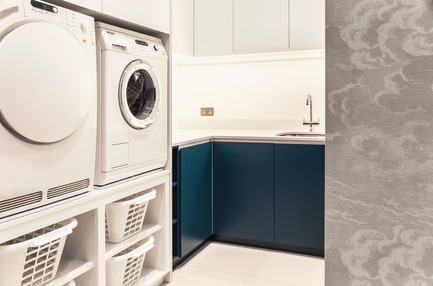
In LLI Design’s Highgate Hill project in London, Fornasetti Clouds wallpaper by Cole & Son appears in the laundry. Blue cabinetry and the cloud drawing establish a distinct character in a room whose primary role is practical.
This example challenges the assumption that a strongly authored surface belongs only in a reception room. The image can accompany everyday work. The effect depends on the relationship with the cabinetry and the room’s scale, rather than on turning a utility space into a theatrical set.
The Mallorca project is in Beirut
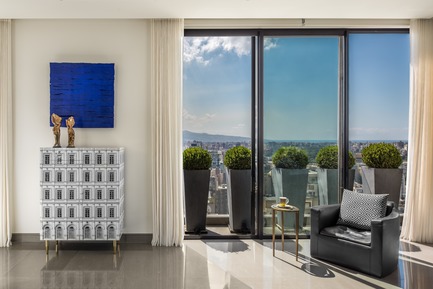
Mallorca is the name of Askdeco’s project in Beirut, not an indication that this interior is on the Spanish island. The 2019 press dossier shows a Fornasetti cabinet in a living room with a large window, pale surfaces and blue artwork.
The cabinet brings a concentrated graphic presence to that setting. It does not require every surrounding object to repeat the same repertoire. The room allows different visual languages to coexist while giving the furniture enough space to be read as a complete object.
Vintage, authenticity and provenance
An authentic contemporary Fornasetti piece is not automatically a 1950s object. Equally, an old or visibly used item is not authentic merely because it looks aged. Period, maker, technique, provenance and any restoration need to be considered separately.
For a vintage purchase, examine the documentation and available certification rather than relying on a familiar face or motif. The image is recognisable, but recognition alone does not establish who made the object, when it was produced or how it has been altered.
Where to encounter Fornasetti in Milan
Before visiting, check current information and distinguish a shop from an exhibition space or workshop. An address associated with the atelier is not necessarily a place that welcomes visitors without an appointment. A broader itinerary can include other design and furniture showrooms in Milan.
Fornasetti’s lasting interest is that an image can participate in the design of an object rather than arrive as decoration after everything else is decided. A face, a façade or a cloud changes with its support. In daily life, that familiar image can continue to reveal a detail we had not noticed before.