Frescoed halls, miles of shelving, wood paneling, baroque domes and chandeliers now coexist with suspended structures, vast glass facades, wood, steel and spaces designed to be explored freely. Some libraries look like true museums, while others have become icons of contemporary architecture. Ultimately, the most beautiful libraries in the world also tell the story of …
Frescoed halls, miles of shelving, wood paneling, baroque domes and chandeliers now coexist with suspended structures, vast glass facades, wood, steel and spaces designed to be explored freely. Some libraries look like true museums, while others have become icons of contemporary architecture.
Ultimately, the most beautiful libraries in the world also tell the story of our relationship with knowledge. For centuries, books were precious objects to be safeguarded inside palaces, monasteries and universities. In today’s cities, by contrast, the library has become an increasingly open place: a space for reading and studying, but also for meeting people, working, attending events and simply spending time.
From Venice to Budapest, from Coimbra to Prague, all the way to Seattle, Helsinki, Doha and Tianjin, we have selected 20 extraordinary libraries for their architecture and design.
They are very different places, united by a single idea: making the value of knowledge visible through space.
When a library looks like a museum
In some cases, simply calling them libraries feels like an understatement.
In Europe’s great historic libraries, painting, sculpture, architecture and the decorative arts all took part in a single cultural project. The richness of these interiors was not merely aesthetic: it symbolically expressed the prestige attached to books and learning.
Contemporary libraries speak a different language, but the principle is not so far removed.
What has changed are the materials and, above all, the way people use these buildings. Monumentality often gives way to transparency, flexibility and a closer relationship with the city. The shelves themselves become architectural elements, reading rooms turn into landscapes, and the boundaries between library, cultural venue and public space grow increasingly blurred.
It is precisely this meeting of architecture and reading that makes some libraries destinations worth visiting regardless of the books they hold.
1. Biblioteca Nazionale Marciana, Venice: knowledge at the heart of the Renaissance
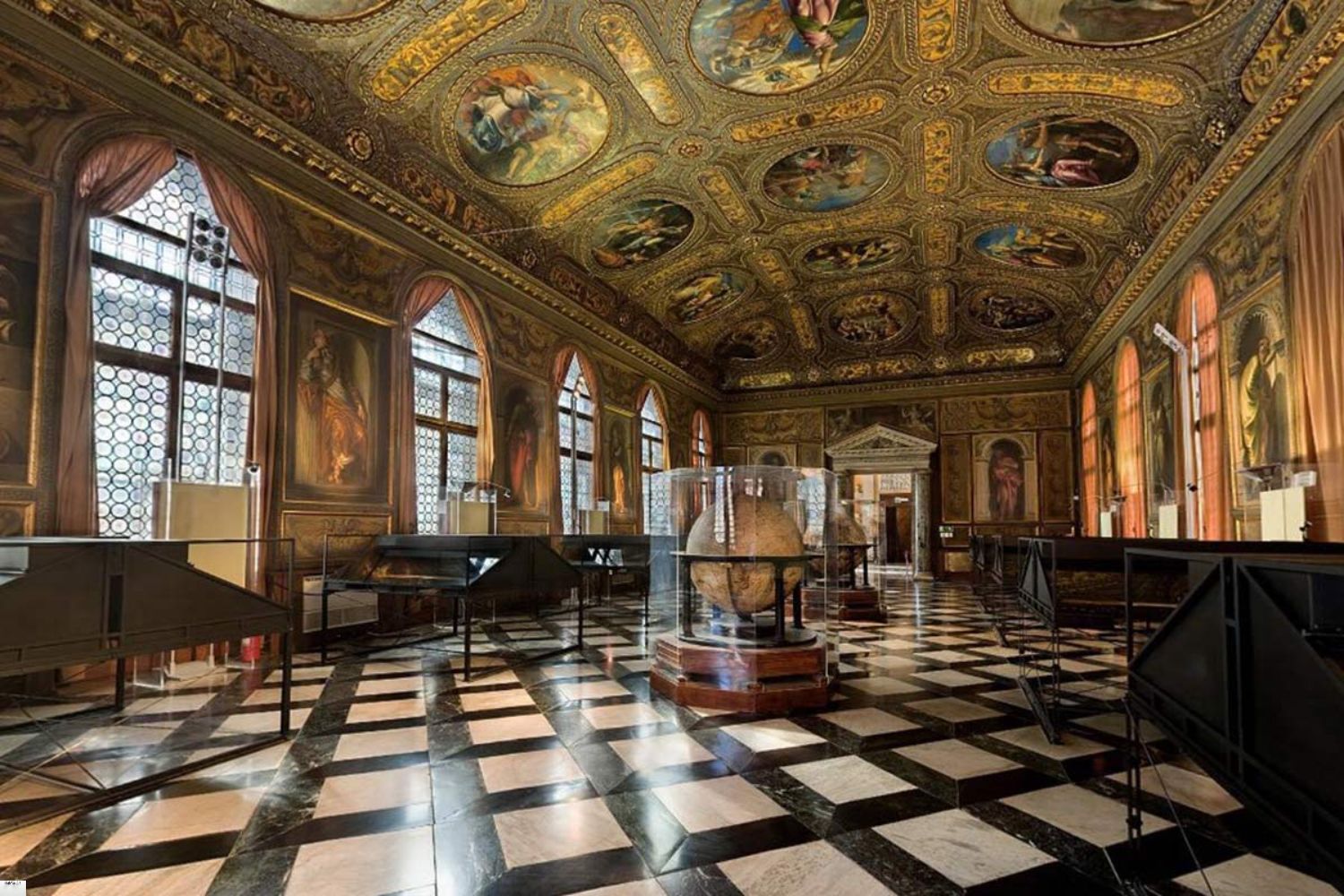
Venice, Italy — Jacopo Sansovino and Vincenzo Scamozzi
In Venice, a walk across Piazza San Marco is enough to see how closely culture, art and power have historically been intertwined.
The Biblioteca Nazionale Marciana, also known as the Libreria di San Marco, was created to provide a fitting home for the precious collection of manuscripts that Cardinal Bessarion donated to the Republic of Venice in the 15th century.
To house it, the Venetian Republic commissioned Jacopo Sansovino to design a new building on the Piazzetta San Marco, opposite the Doge’s Palace. Construction began in 1537 and the work was later continued by Vincenzo Scamozzi.
The classical architecture of the facade hints at the splendor inside. The Salone Sansoviniano and the monumental halls hold works and decorations linked to some of the great names of Venetian painting, including Tintoretto, Veronese and Titian.
Here, library and museum are not two separate worlds. Books, painting, sculpture and architecture all contribute to the same story of knowledge.
That is one reason the Marciana remains one of Italy’s most captivating libraries and the ideal starting point for this journey.
2. Admont Abbey Library: the light of the Baroque
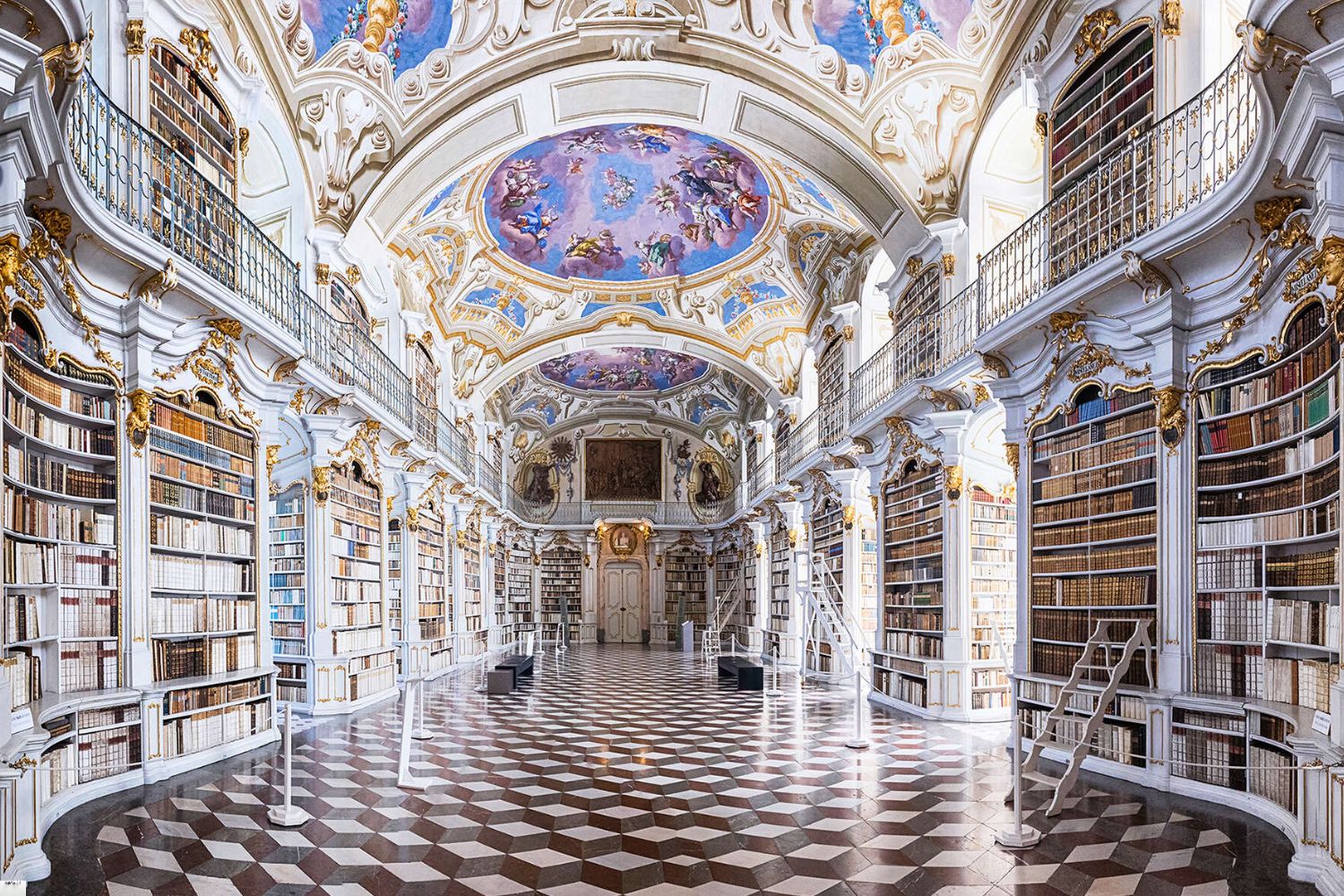
Admont, Austria — Josef Hueber
White, gold, frescoes and thousands of volumes.
The library of Admont Abbey, in the Austrian region of Styria, is one of the images that best capture the idea of a library that looks like a museum.
The great hall was completed in 1776 to a design by Austrian architect Josef Hueber and is considered the largest monastic library hall in the world. It stretches roughly 70 meters in length and displays more than 60,000 volumes.
Yet its identity comes above all from light and from the dialogue between different art forms.
The pale surfaces amplify the brightness, while the seven domes frescoed by Bartolomeo Altomonte depict the progress of human knowledge. Add to these the sculptures by Josef Stammel and the grand bookcases that set a steady rhythm throughout the space.
The result is one of the great masterpieces of the European late Baroque.
Admont seems to remind us that, for at least part of Western history, safeguarding books also meant building a space worthy of the knowledge they contained.
3. Biblioteca Joanina: Portuguese Baroque meets the book
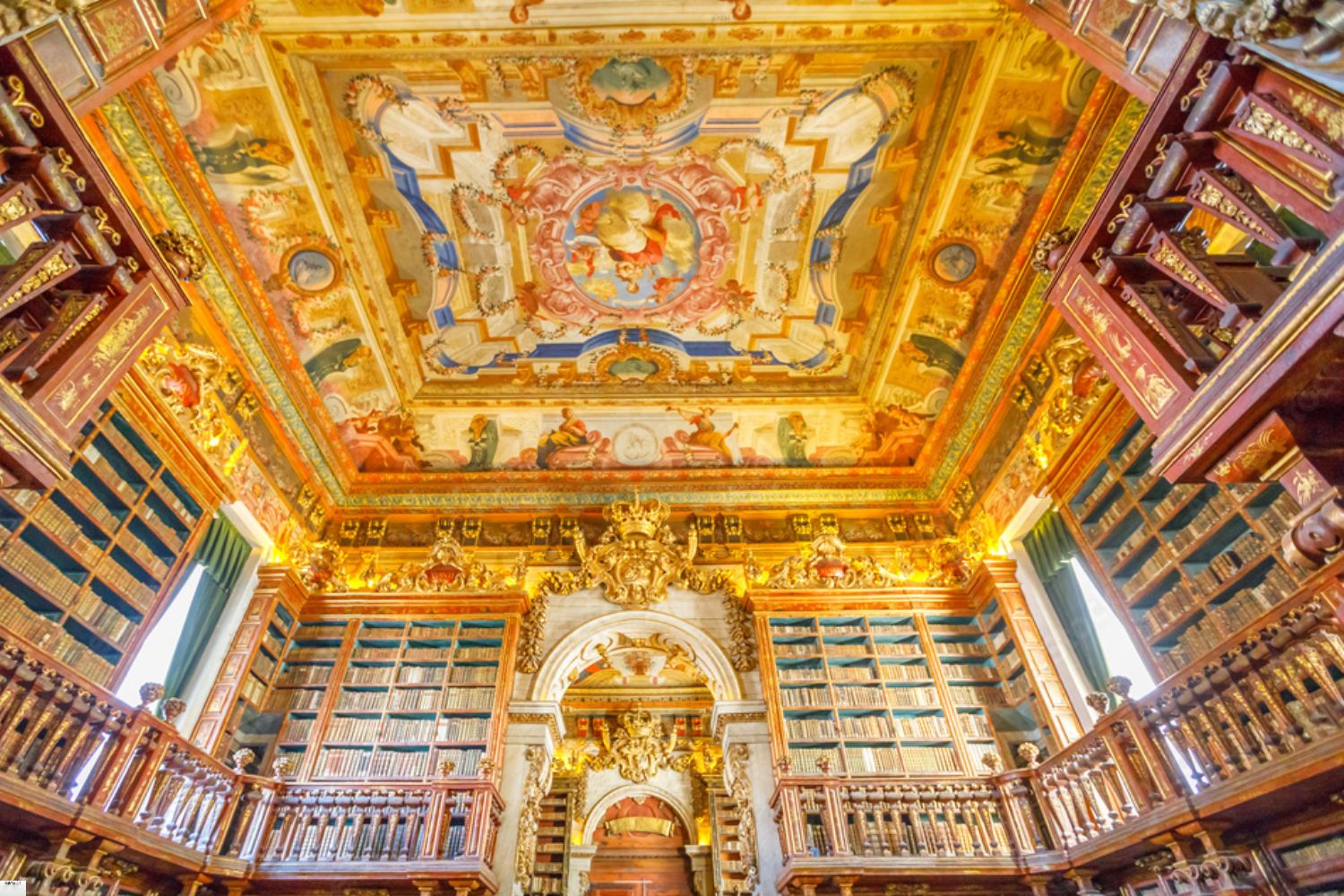
Coimbra, Portugal — University of Coimbra
Tucked inside the University of Coimbra is one of the most spectacular historic libraries in Europe.
The Biblioteca Joanina was built in the 18th century during the reign of King John V of Portugal, after whom it is named. Construction began in 1717 and produced what still looks today like a true palace dedicated to books.
The main floor is organized into three interconnected rooms.
Wooden shelving runs along the walls and changes color from one room to the next: black, red and green backgrounds are enriched with gilding, ornaments and baroque motifs. Look up, and the painted ceilings complete a composition in which hardly a single surface seems left to chance.
And yet all this decorative richness never upstages the books.
That is perhaps the Joanina’s most compelling quality: the ornament does not hide the library, it celebrates it.
In any selection of the most beautiful libraries in the world, Coimbra is a must.
4. Strahov Library: two halls, two ideas of beauty
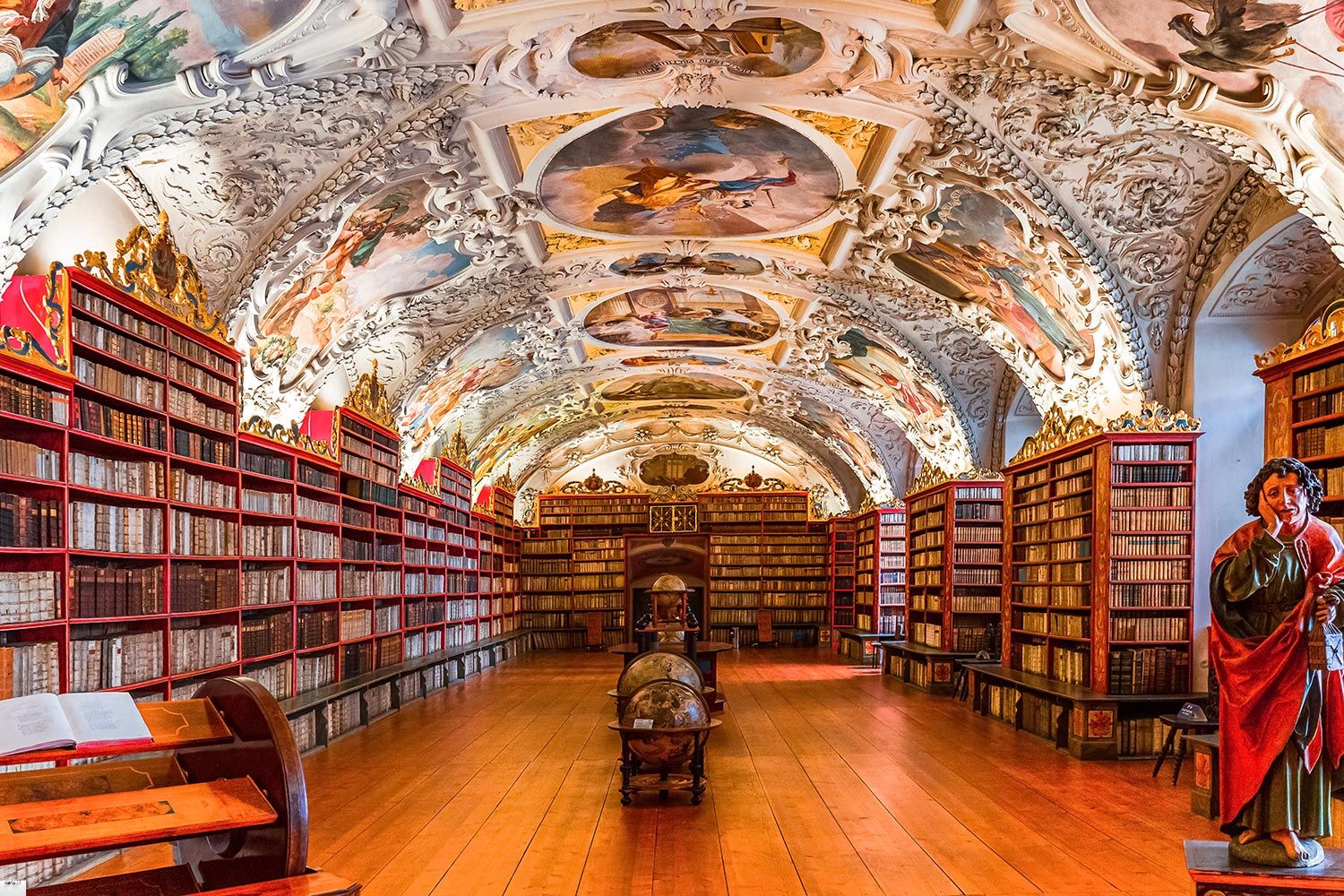
Prague, Czech Republic — Strahov Monastery
Some places seem built specifically to feed our imagination of the perfect library. The library of Strahov Monastery in Prague is one of them.
The complex preserves two particularly famous rooms: the Theological Hall and the Philosophical Hall.
The first dates from the second half of the 17th century and features stuccowork, historic shelving and painted decorations devoted to themes of wisdom and religious knowledge.
About a century later came the Philosophical Hall, with even more monumental proportions. Tall walnut bookcases rise to the upper gallery, while the vast ceiling fresco visually expands the space.
Even access to the books becomes part of the architecture: spiral staircases hidden behind fake book spines lead to the upper levels.
Strahov needs no contemporary special effects. Its wonder comes from the layering of books, wood, painting and time.
5. Austrian National Library: an imperial hall for 200,000 books
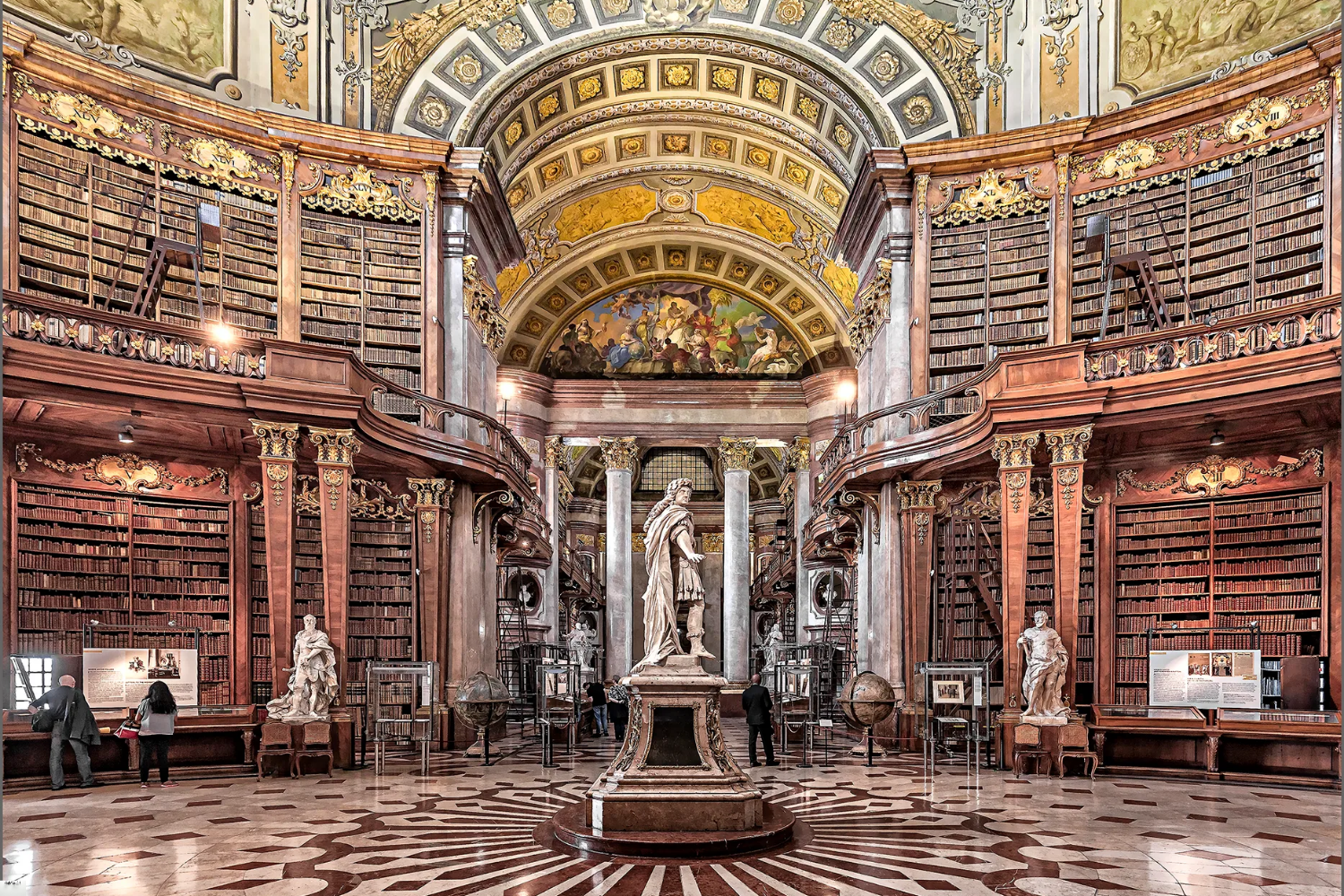
Vienna, Austria — State Hall
If there is one place where a library literally takes on the proportions of a palace, it is the State Hall of the Austrian National Library.
Built in the 18th century as part of the Habsburgs’ former Court Library, the monumental hall stretches almost 80 meters in length.
Dark wood shelving, stone floors, gilded decorations and statues create a solemn perspective that culminates in the great central dome frescoed by Daniel Gran.
The hall holds around 200,000 historic volumes, along with the famous library of Prince Eugene of Savoy and four large Venetian globes.
Here, the architecture makes no attempt to be neutral.
Every element helps convey the grandeur of the collection and, at the same time, that of the power that assembled it.
It is one of the clearest examples of a library becoming the physical embodiment of knowledge.
6. Metropolitan Ervin Szabó Library: reading in the rooms of a palace
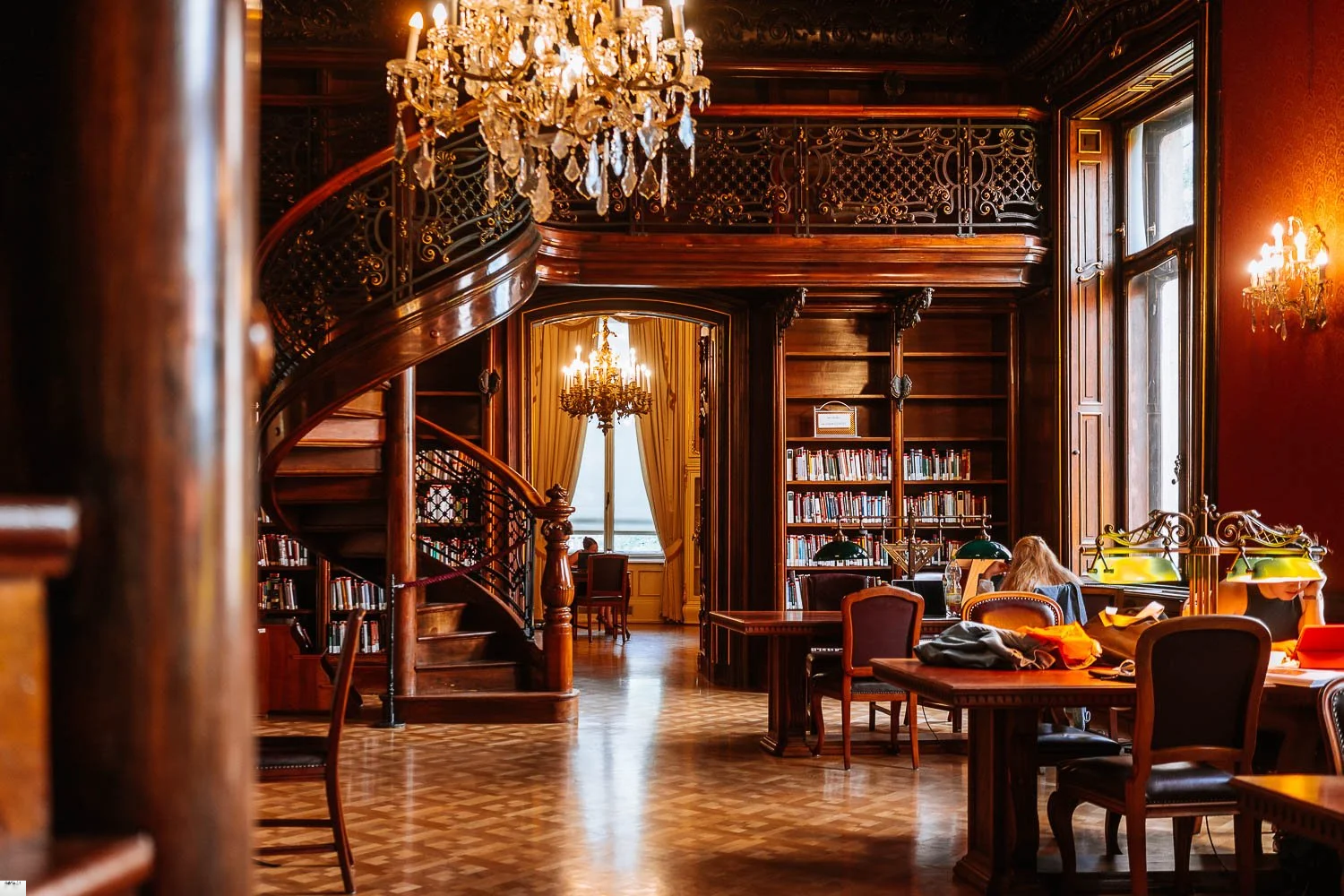
Budapest, Hungary — Wenckheim Palace, Artúr Meinig
Some libraries are built to be monumental; others occupy buildings that were born that way.
The Metropolitan Ervin Szabó Library in Budapest firmly belongs to the second category.
Its central branch includes the Wenckheim Palace, built in 1889 as an aristocratic residence to a design by Artúr Meinig. The city bought the palace in 1927 and, after a lengthy conversion, the library opened to the public in 1931.
Much of its charm comes precisely from the coexistence of a modern library’s functions with the historic rooms of the former mansion.
Wood paneling, stucco, chandeliers, large mirrors, parquet floors and fireplaces form the backdrop to tables, books and people studying.
The result feels surprisingly natural.
There is no sense of visiting a palace artificially turned into a library. Rather, it feels as if reading has simply found its place in these rooms.
It is perhaps one of the most literal examples of a library that looks like a museum: a place where you can sit down and read inside the rooms of a neo-baroque residence.
7. The Long Room, Trinity College: the quintessential library
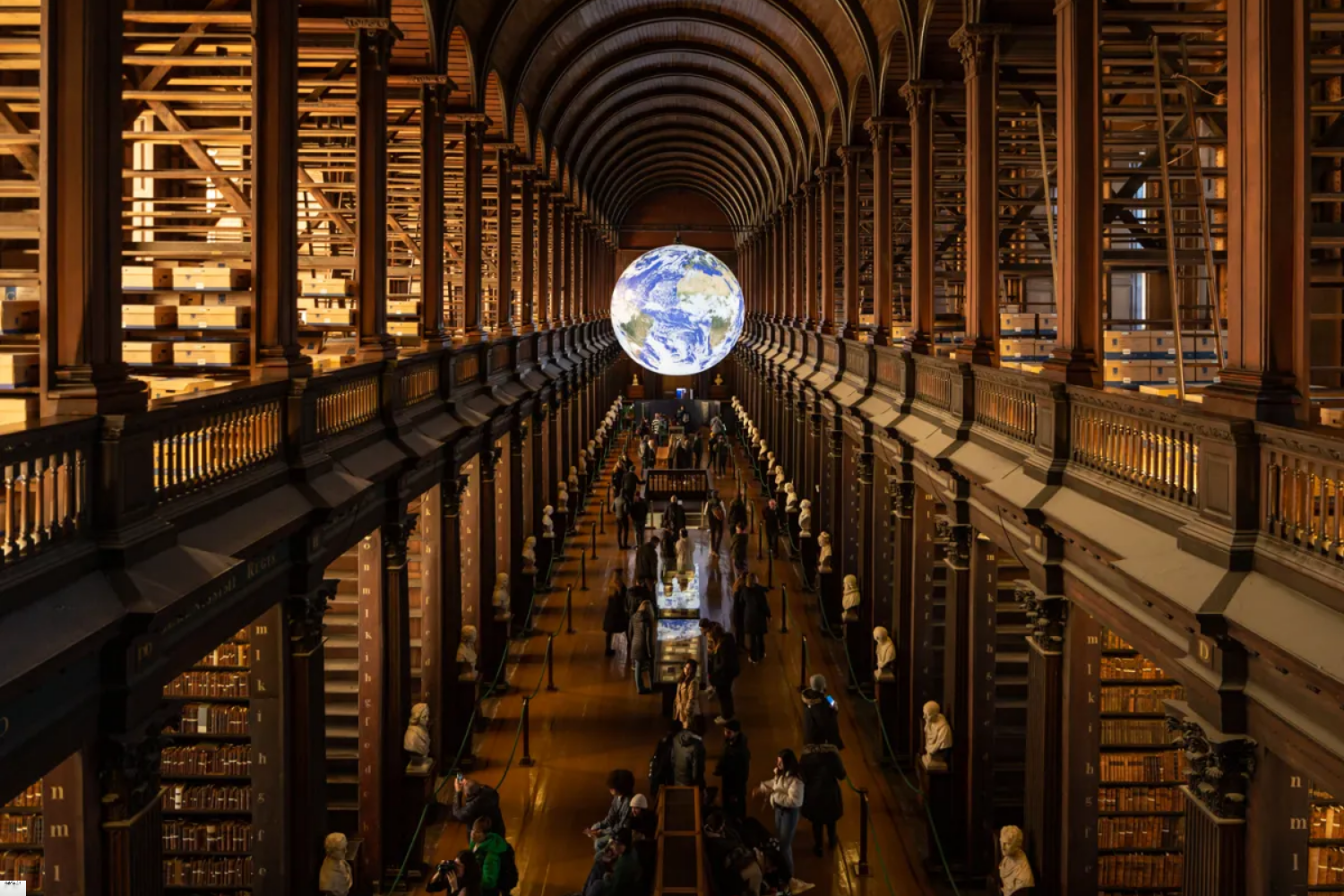
Dublin, Ireland — Trinity College
A long perspective of wooden shelves, marble busts and antique books.
Over time, the Long Room at Trinity College Dublin has become more than a library: it is one of the most recognizable visual expressions of the very idea of a historic library.
It is part of Trinity College’s Old Library, an 18th-century building that holds some of the university’s most precious collections.
The hall runs lengthwise beneath a great timber barrel vault, punctuated by regular rows of bookcases. The busts placed along its length heighten the sense of being in a space suspended between library, gallery and place of memory.
In recent years, the value of both the collections and the building has made an extensive conservation program for the Old Library necessary.
Temporary changes linked to protecting the collections aside, the Long Room remains one of the most famous library spaces in the world.
Here, beauty comes not from decorative excess but from rhythm, proportion, material and repetition.
8. George Peabody Library: a cathedral of books in Baltimore
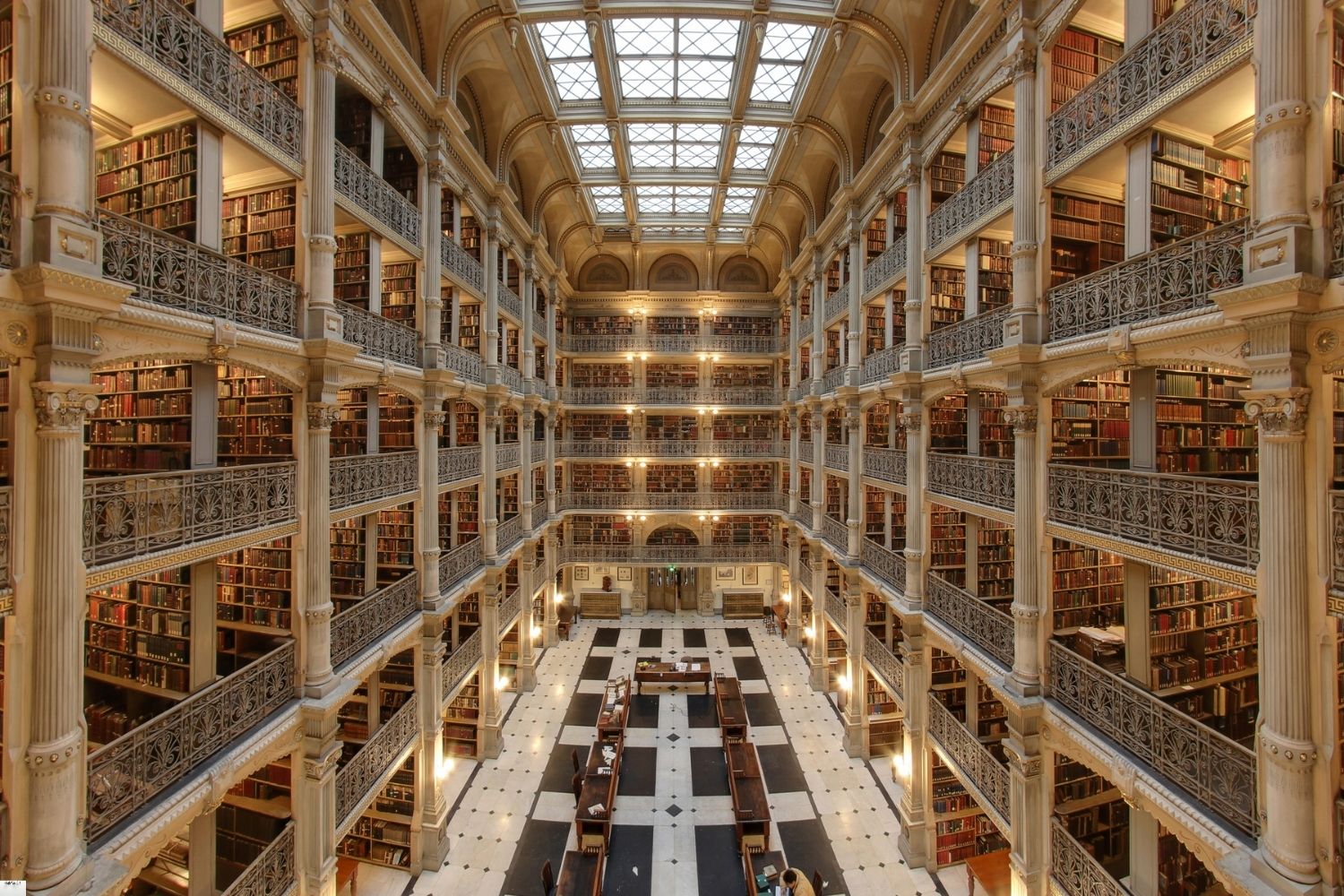
Baltimore, United States — Edmund G. Lind
Looking up from the central hall of the George Peabody Library, the books seem to take over the entire architecture.
The library, part of Johns Hopkins University, is famous for its spectacular 19th-century atrium.
Five tiers of cast-iron balconies rise around the perimeter toward a large skylight that brings natural light all the way down to the ground floor.
Slender columns, ornate railings and the orderly pattern of the shelves create a monumental interior without making it feel heavy.
It is one of those cases where the structure needed to organize the books becomes the main decorative element in its own right.
Unsurprisingly, the Peabody is often described as a cathedral of books.
And that is exactly the impression it gives: the verticality of the space invites you to look up, just as you would inside a great religious building.
9. Real Gabinete Português de Leitura: a monumental library in the heart of Rio
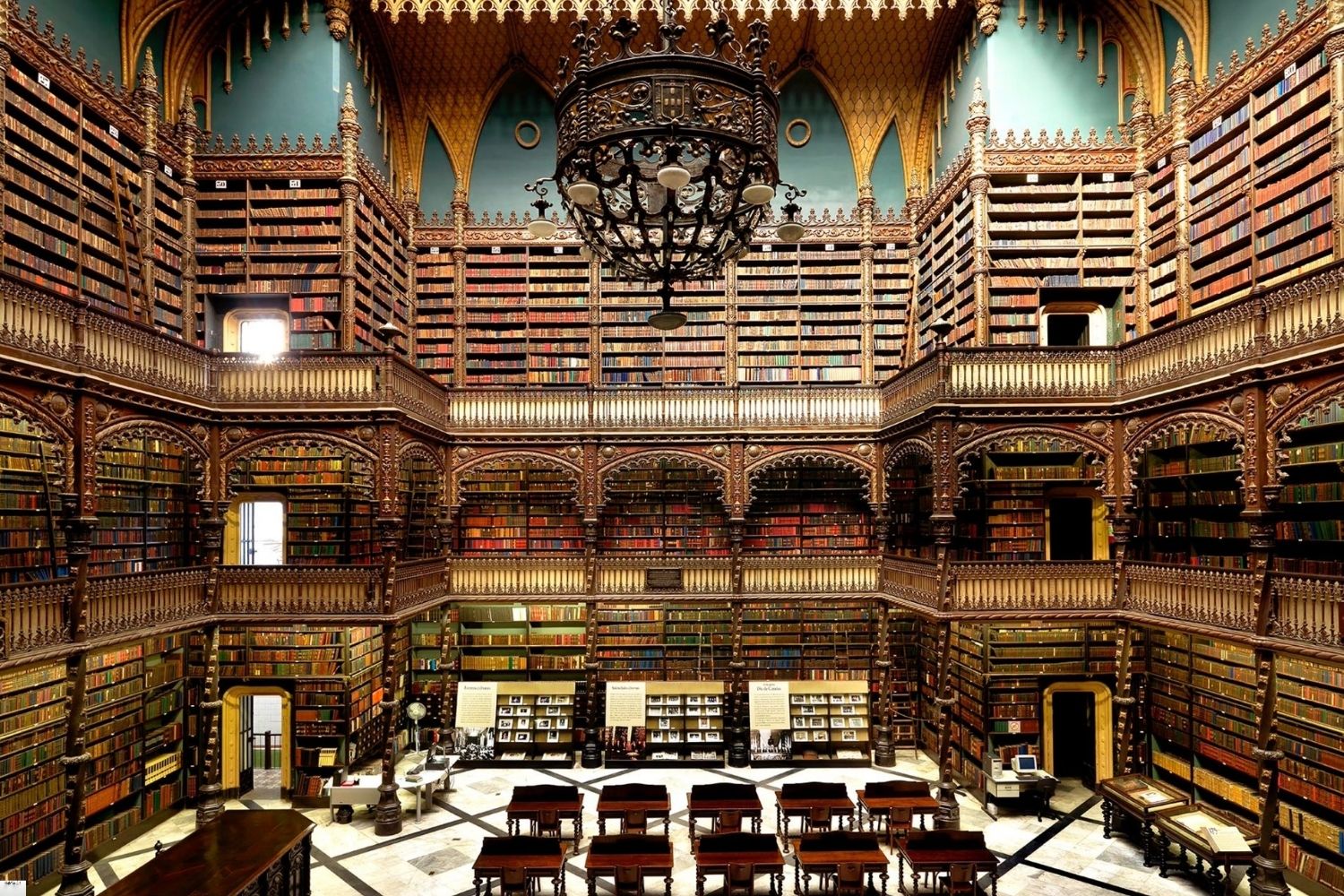
Rio de Janeiro, Brazil — Rafael da Silva e Castro
Among the buildings of Rio de Janeiro’s historic center, the Real Gabinete Português de Leitura (Royal Portuguese Reading Room) holds one of the most astonishing library interiors in the Americas.
The institution was founded in 1837 by the city’s Portuguese community, while the current building was constructed in the second half of the 19th century and inaugurated in 1887.
Portuguese architect Rafael da Silva e Castro designed it in the Neo-Manueline style, inspired by Portugal’s architectural tradition.
But it is the great interior hall that truly takes your breath away.
Wooden shelves climb several levels up the walls to meet a large central skylight. Columns, balustrades, ornaments and thousands of book spines form an almost continuous surface.
The result is a dense, vertical, theatrical interior.
While many contemporary libraries strive for transparency, the opposite happens here: the books themselves clad the architecture.
10. Stadtbibliothek Stuttgart: minimalism becomes a library
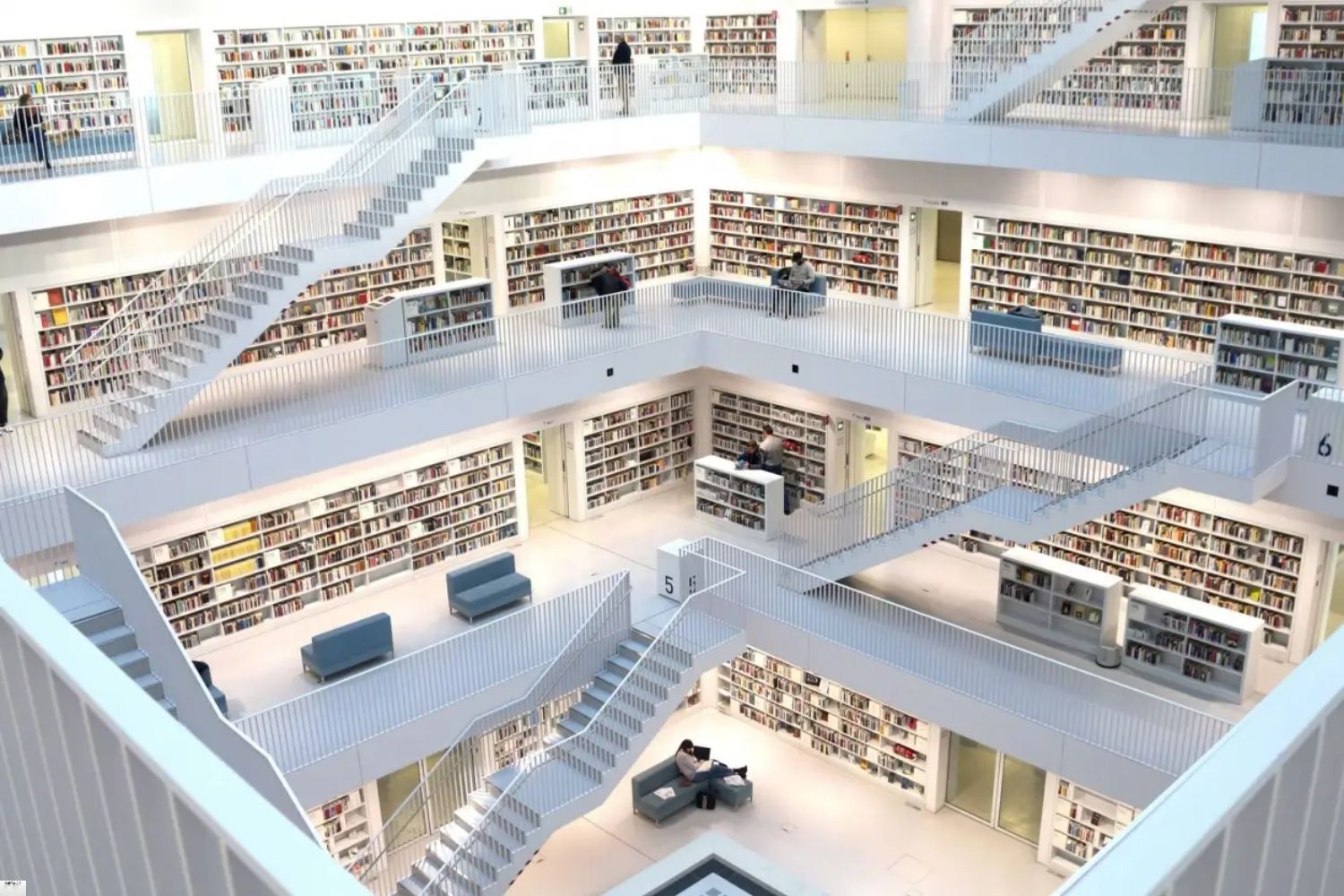
Stuttgart, Germany — Eun Young Yi
After the opulence of the historic libraries, the Stuttgart City Library (Stadtbibliothek) seems to belong to another universe.
Designed by architect Eun Young Yi and opened in 2011, it appears from the outside as a large, rigorous cube.
Inside, color all but disappears.
White walls, white stairs, white balconies. It is mainly the books and the people that break the neutrality of the space.
The heart of the building is organized around a large central void, while the reading hall rises vertically through levels linked by stairs and galleries.
The geometry is precise, almost abstract.
This apparent simplicity is exactly what makes the building one of the best examples of contemporary library design: the architecture forgoes decoration and lets light, proportion and circulation shape the space.
It is a library that resembles not a historic museum, but perhaps a contemporary art gallery.
11. Oodi Central Library: Helsinki’s public living room
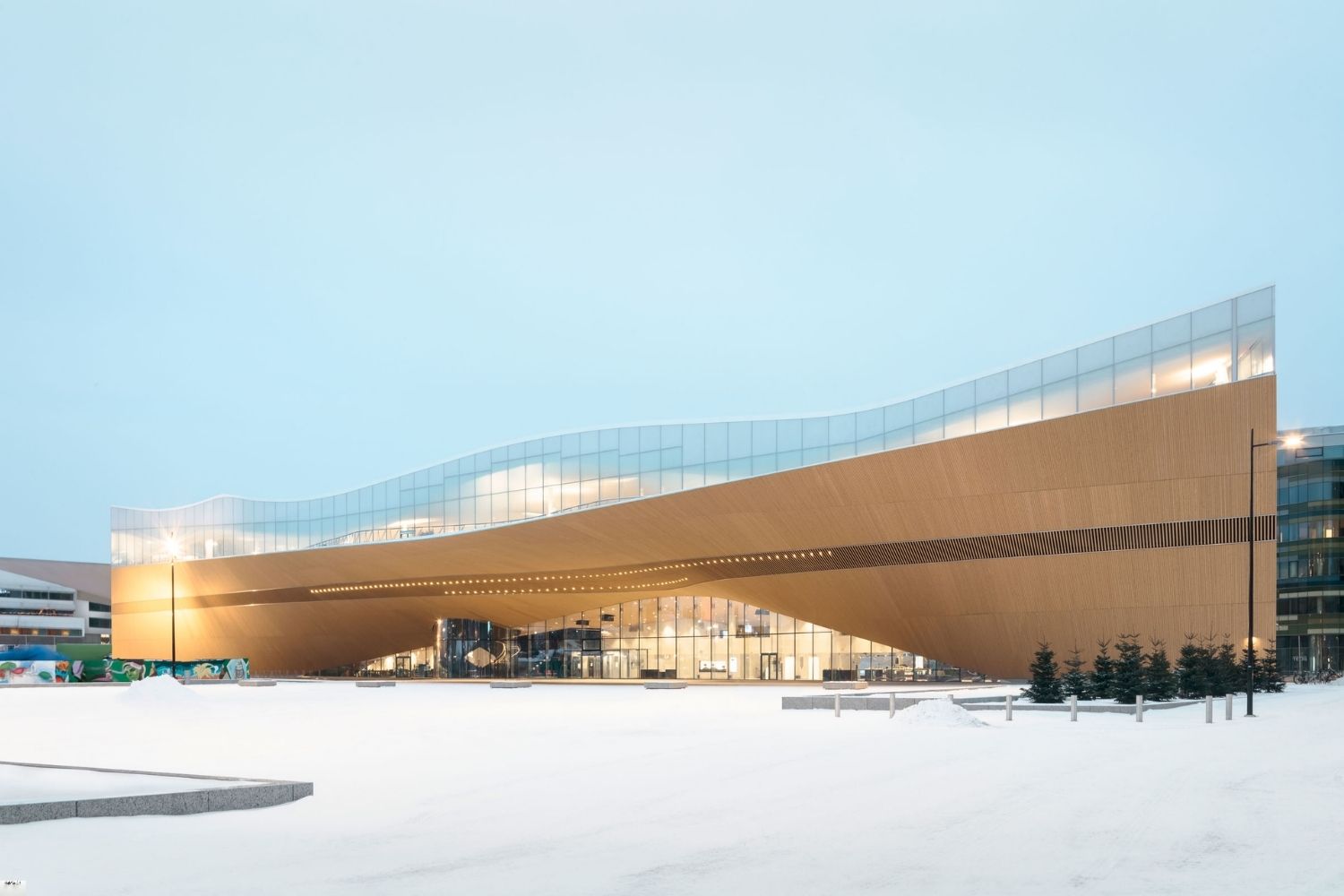
Helsinki, Finland — ALA Architects
In Helsinki, the library project started from a very contemporary question: what can a library be when it no longer serves only to store books?
The answer is Oodi.
Helsinki Central Library Oodi, designed by ALA Architects and opened in 2018, occupies a symbolic site in the center of the Finnish capital, facing the Parliament building.
Its long timber facade lifts upward to create a soft, welcoming architecture, far removed from the traditional institutional image.
The building’s three levels each have a distinct character.
The ground floor is lively and open to events. The middle level houses spaces for working, meeting, making and experimenting. The top floor is home to Book Heaven: a vast, light-filled landscape beneath an undulating ceiling, with low shelves, seating, reading areas and views over the city.
Oodi shows that the beauty of a contemporary library does not have to depend on monumentality.
It can also come from a quality that is harder to photograph: making people feel free to use the space as they wish.
12. Seattle Central Library: rethinking the library for the digital age
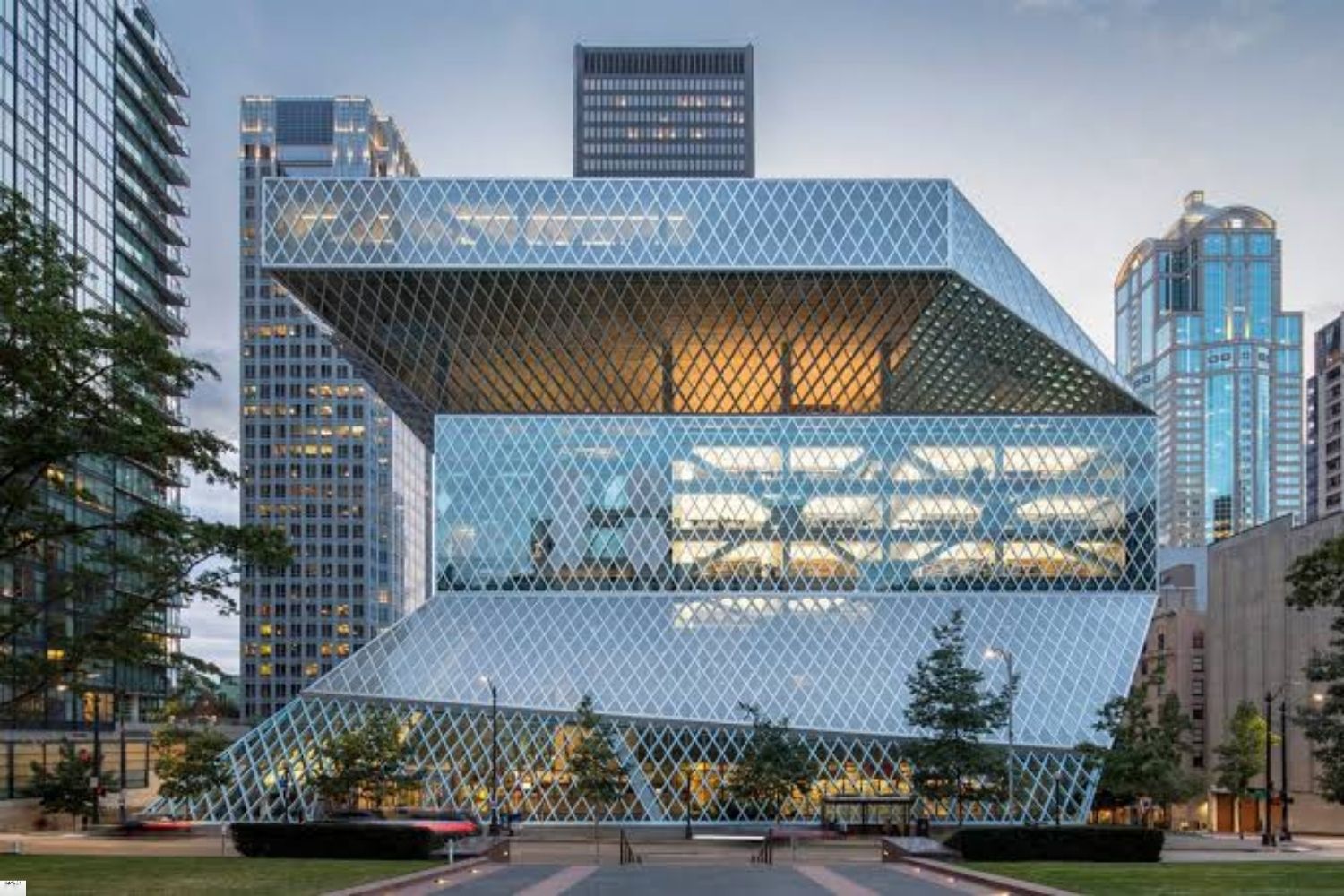
Seattle, United States — OMA + LMN
When the Seattle Central Library was completed in 2004, it immediately stood out as something radically different from the traditional library.
The design by OMA and LMN, led by Rem Koolhaas and Joshua Prince-Ramus, starts precisely from the transformation in the way we produce and use information.
The building is recognizable for its geometric steel-and-glass envelope, but its internal organization is the most interesting part of the project.
Different functions are distributed across platforms and in-between spaces, creating very different environments.
One of the most innovative features is the Books Spiral, a continuous ramp designed to organize the collection while avoiding the traditional fragmentation across separate floors.
The library thus becomes a true information infrastructure.
Not a monument built around books, but a spatial machine designed to make knowledge accessible and navigable.
13. Biblioteca Vasconcelos: a suspended landscape of books
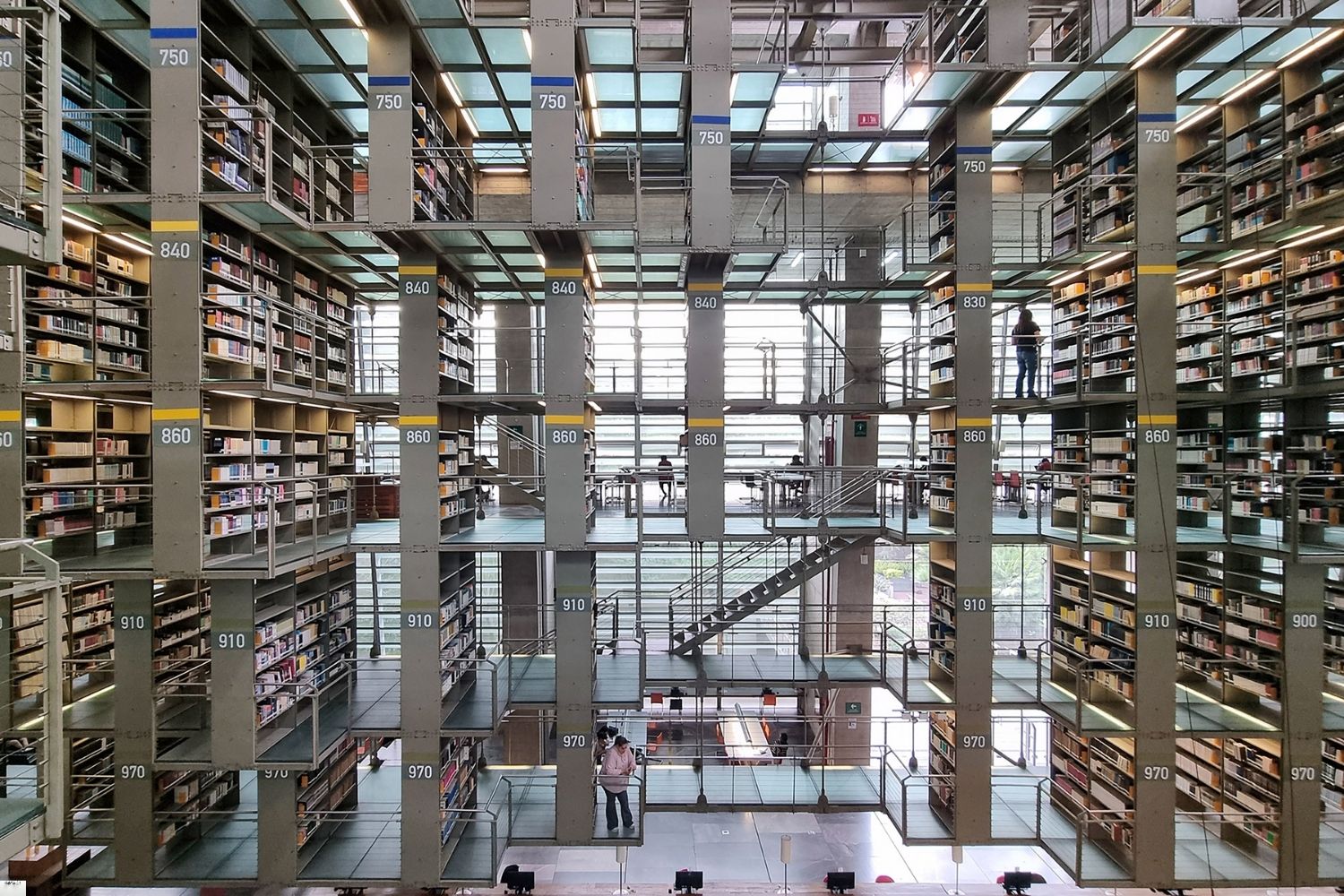
Mexico City, Mexico — Alberto Kalach / TAX
Stepping into the Biblioteca José Vasconcelos means briefly losing your sense of distance.
In the gigantic central volume, suspended metal bookshelves multiply across different levels. Walkways, stairs, glass and steel structures create an almost dizzying depth.
The design by the studio TAX, led by Alberto Kalach, grew out of the idea of linking two systems: a library and a botanical garden.
Outside, the building is surrounded by greenery; inside, the vast structure shields the reading rooms from direct sunlight while keeping them bright.
It is a library that gives physical form to the immensity of knowledge.
The books are not hidden away in rooms or corridors, but displayed in a vast three-dimensional landscape that visitors move through.
An almost cinematic space, yet built around a very practical principle: organizing an enormous amount of information and making it legible.
14. Tianjin Binhai Library: shelves become landscape
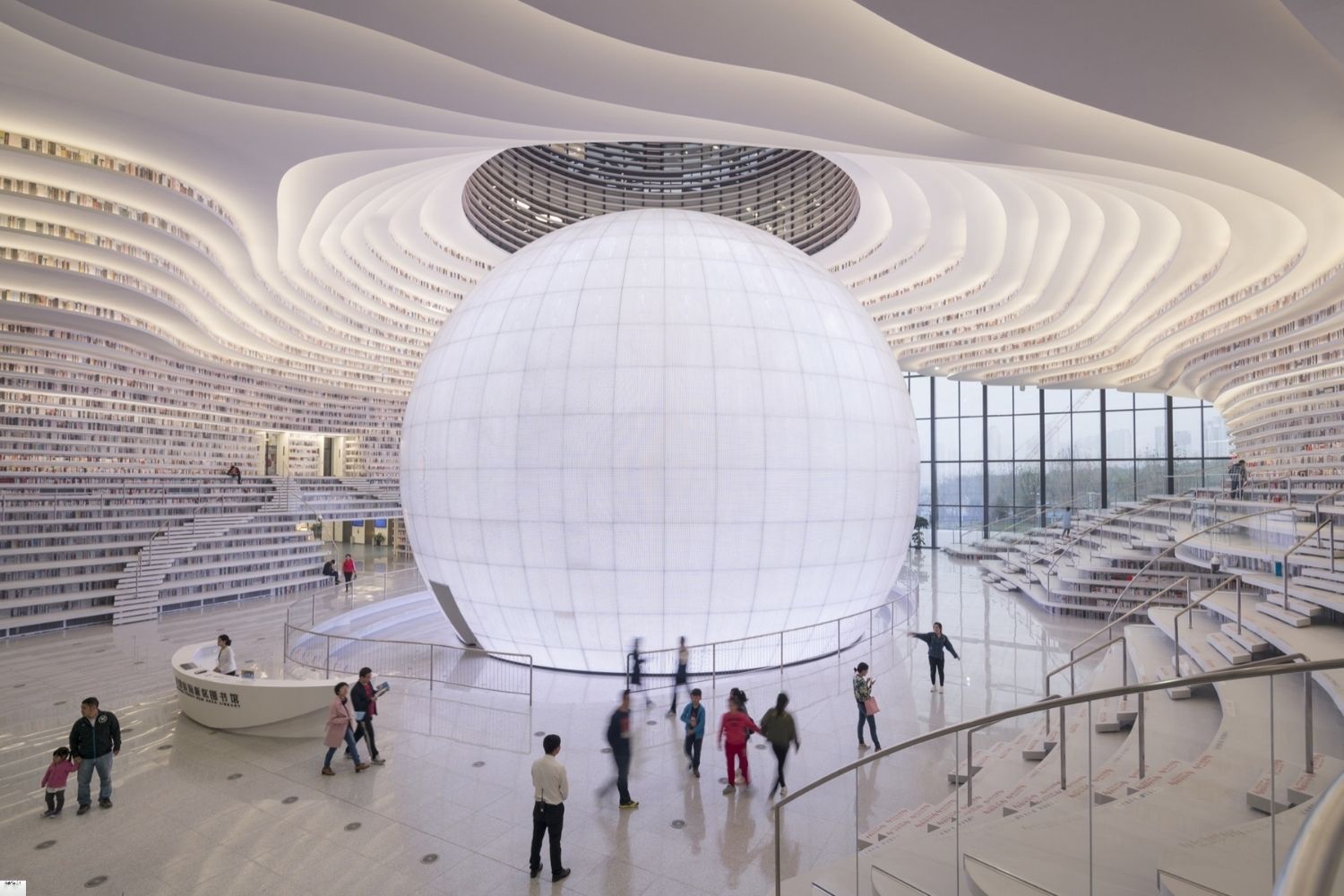
Tianjin, China — MVRDV + TUPDI
A large white sphere seems to watch everyone who enters. All around, rows of undulating surfaces rise from floor to ceiling like a gigantic artificial topography.
The Tianjin Binhai Library, completed in 2017 by MVRDV together with the Tianjin Urban Planning and Design Institute, quickly became one of the most photographed libraries in the world.
The building covers about 33,700 square meters.
At the center of the atrium sits the spherical auditorium, nicknamed The Eye. Around it, continuous surfaces turn the shelves into terraces, seating, pathways and parts of the architecture itself.
The central space thus works as a landscape to be inhabited.
The images that went viral, however, can create a small misunderstanding: in the upper sections, not every visible row actually holds books; part of the effect is achieved with printed graphic surfaces.
It is an interesting detail because it also says something about our relationship with architecture today: buildings designed to be used, but inevitably also destined to be photographed and shared.
15. Qatar National Library: a single space for more than a million books
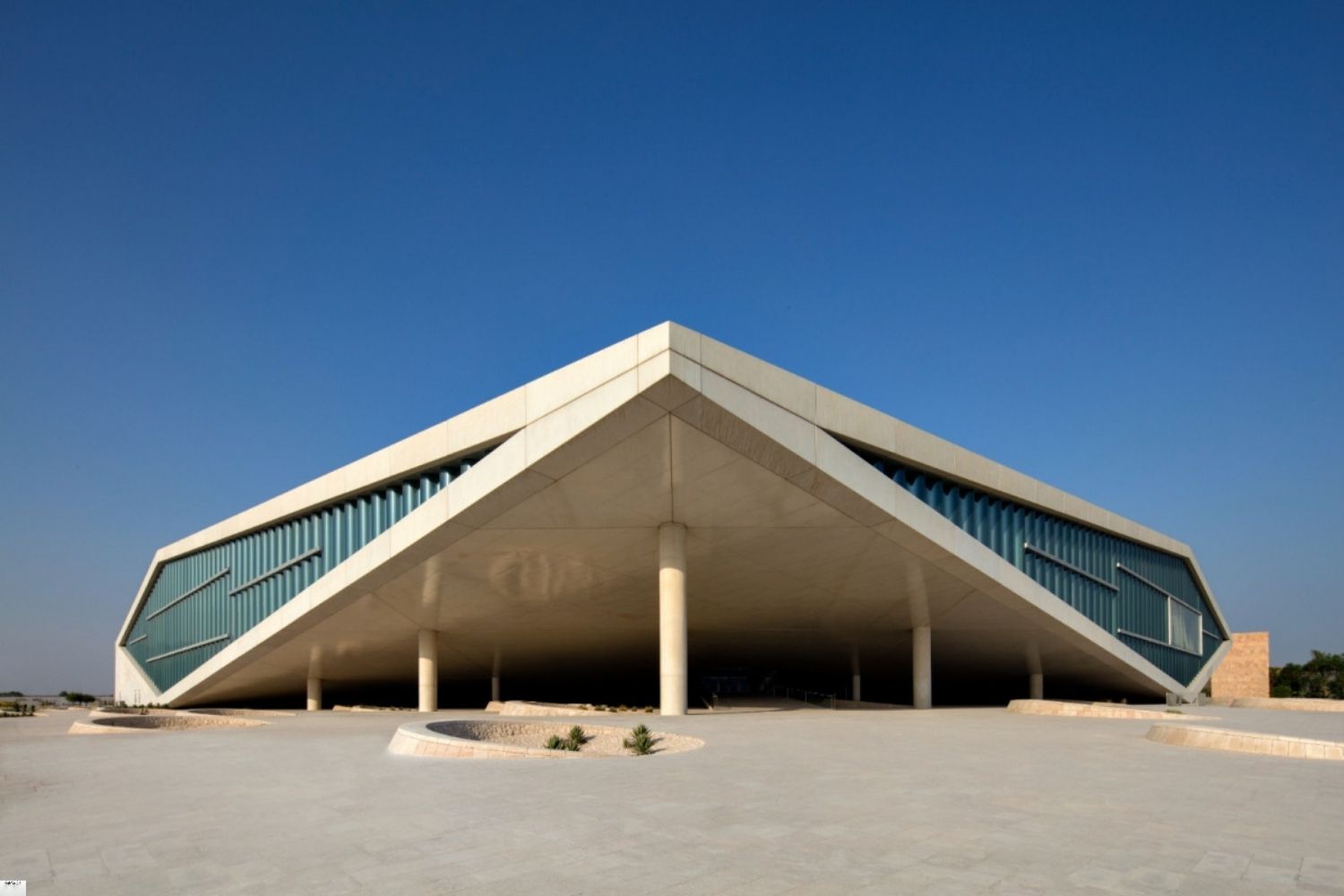
Doha, Qatar — OMA
At the Qatar National Library, almost everything can be taken in at a single glance.
Designed by OMA in Education City, Doha, the building avoids the traditional sequence of rooms and corridors and instead creates one enormous interior landscape.
The corners of the building appear to lift upward, while shelves and reading areas are arranged on separate but visually connected terraces.
The library holds more than a million books and brings together a national library, a public library, a university library and a heritage collection in the same complex.
At the heart of the building, set below the level of the main space, lies the Heritage Library, which preserves texts and manuscripts related to Arab and Islamic civilization.
The contrast is telling.
Above, contemporary knowledge is displayed in an open, continuous space. Below, historical heritage is safeguarded almost like an archaeological excavation.
It is a project in which the bookshelf stops being a simple piece of furniture and becomes part of the architecture.
16. Bibliothèque nationale de France – Richelieu: the grand return of the Salle Ovale
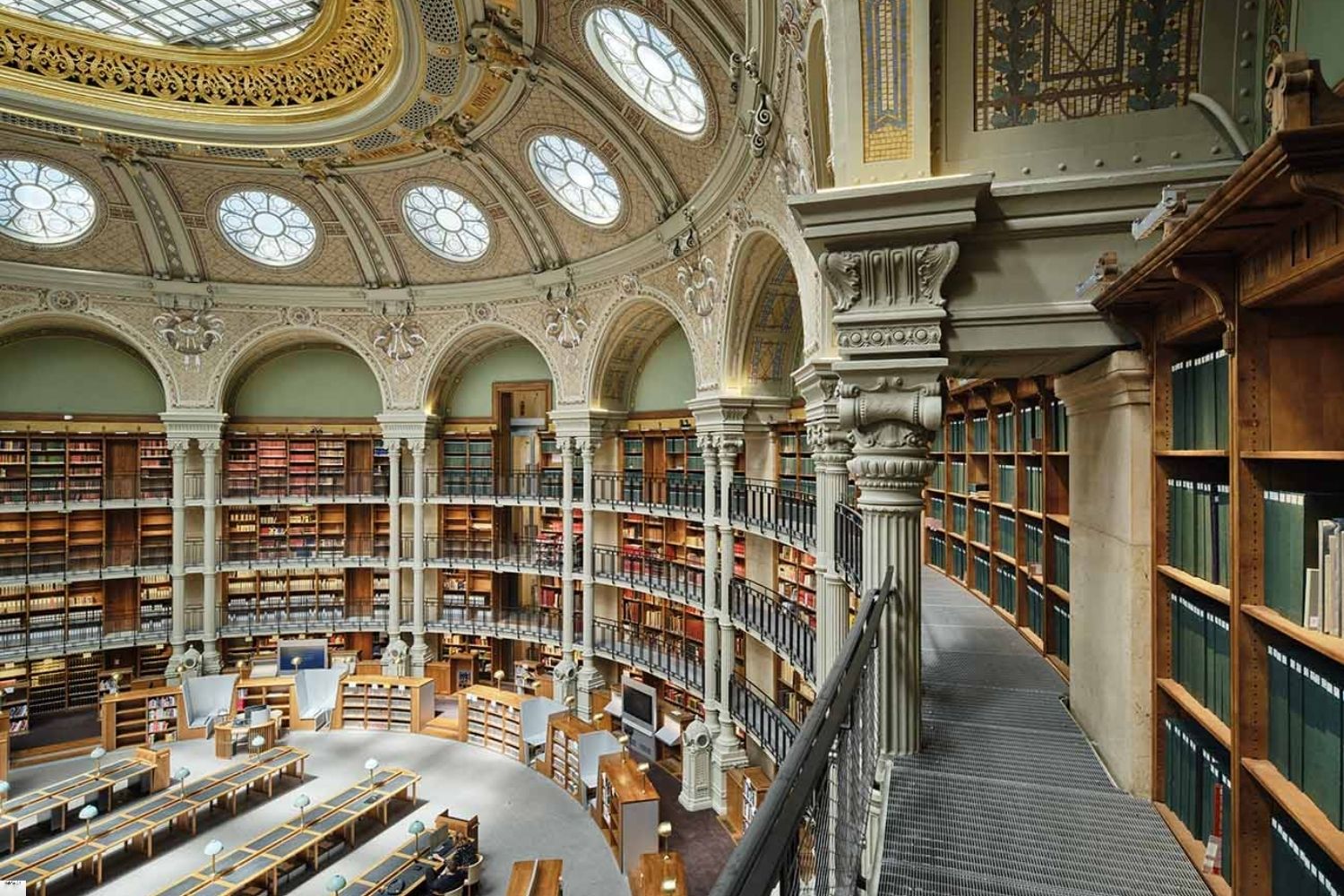
Paris, France — Jean-Louis Pascal and Alfred Recoura
In the heart of Paris, the Richelieu site of the Bibliothèque nationale de France is home to one of the most spectacular reading rooms in Europe.
The Salle Ovale is the result of a long design history. Work began in 1897 under architect Jean-Louis Pascal and was completed in 1932 by Alfred Recoura. Following a major restoration, the room reopened to the public in 2022.
Its proportions immediately explain its monumentality.
The room measures more than 43 meters long and almost 33 meters wide, and reaches a height of 18 meters. Above the great reading room opens a monumental central glass roof surrounded by gilded decoration, while sixteen glazed oculi punctuate the upper walls between mosaics and shelving.
Despite its size, the space retains a surprising lightness.
Light pouring in from above fills the entire volume and turns tables, books and architecture into an almost theatrical composition.
Since its restoration, the Salle Ovale has become a symbol of the Richelieu site’s new openness to the city.
It is a place that proves a great historic library can be restored without becoming a frozen monument, remaining instead a space that people genuinely use.
17. Beinecke Rare Book & Manuscript Library: a tower of books inside a marble box
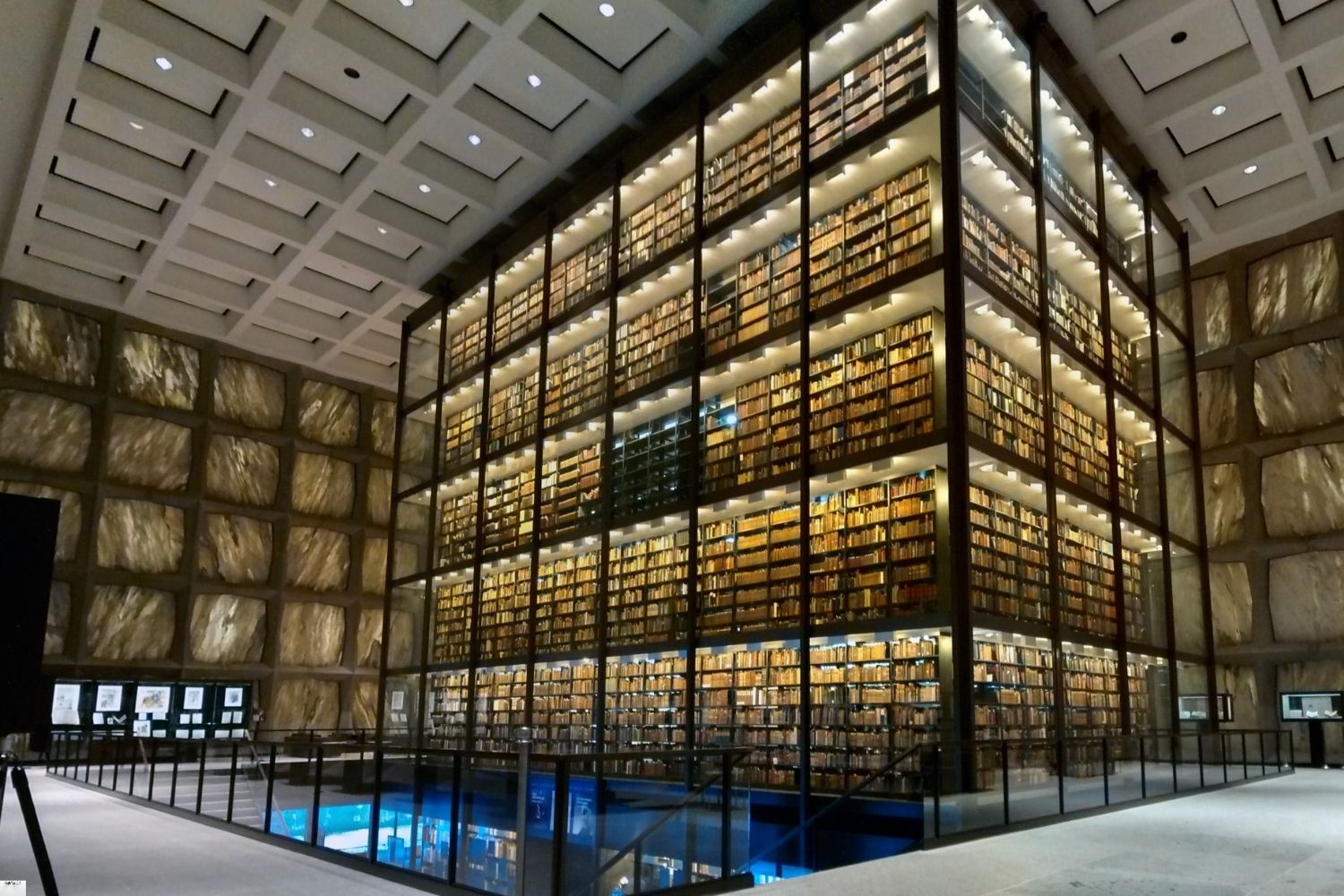
New Haven, United States — Gordon Bunshaft / Skidmore, Owings & Merrill
From the outside, it looks almost impenetrable.
Yale University’s Beinecke Rare Book & Manuscript Library, opened in 1963 and designed by Gordon Bunshaft of Skidmore, Owings & Merrill, is one of the most recognizable masterpieces of American modernist architecture.
The facade is built as a structural grid clad in thin panels of translucent marble.
The choice is not purely aesthetic.
The marble protects the precious collections from direct sunlight while letting in a soft, diffused glow that changes in intensity throughout the day.
It is once you step inside, however, that the building reveals its most spectacular image.
At the center of the great hall rises a six-story glass tower holding thousands of rare books. The shelves seem suspended inside a gigantic museum display case.
Here, the book literally becomes an exhibit.
The Beinecke thus overturns the traditional relationship between library and collection: instead of hiding the volumes away in archives, it makes them the visual heart of the architecture.
It is a library that resembles a museum, an archive and a modernist cathedral all at once.
18. Tama Art University Library: Toyo Ito’s arches turn the library into a landscape
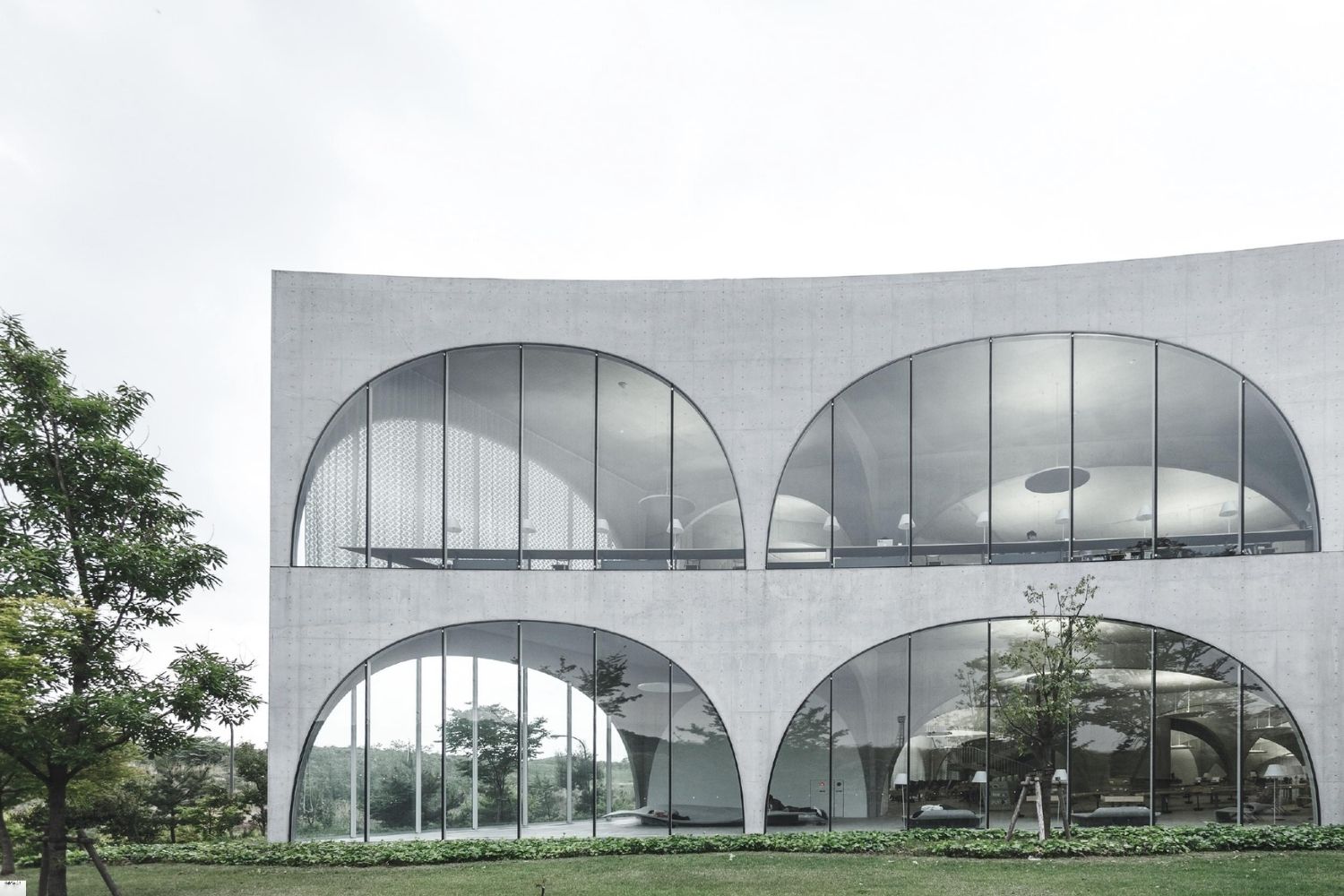
Hachioji, Tokyo, Japan — Toyo Ito & Associates
At the Tama Art University Library, the structure does not simply enclose space: it draws it.
Designed by Toyo Ito for the Hachioji campus and completed in 2007, the library sits on gently sloping ground on the outskirts of Tokyo.
The feature that immediately defines the building is a seemingly irregular sequence of large concrete-clad steel arches.
Their spans vary considerably and intersect along curving lines, creating a succession of spaces that hardly ever need to be separated by walls.
Shelves, tables, reading areas and pathways thus coexist within a single fluid space.
The ground itself is part of the design. On the lower floor, the floor gently follows the slope of the campus, while large glass walls maintain a constant visual connection with the landscape outside.
Toyo Ito originally imagined an almost underground library, like a cave.
That intuition is still legible in the finished building.
The arches seem to form an artificial forest or a great contemporary cavern, where people move freely among books, other readers and light.
It is a library whose monumentality comes not from its size, but from the continuity of its space.
19. Cuypers Library: reading inside the Rijksmuseum
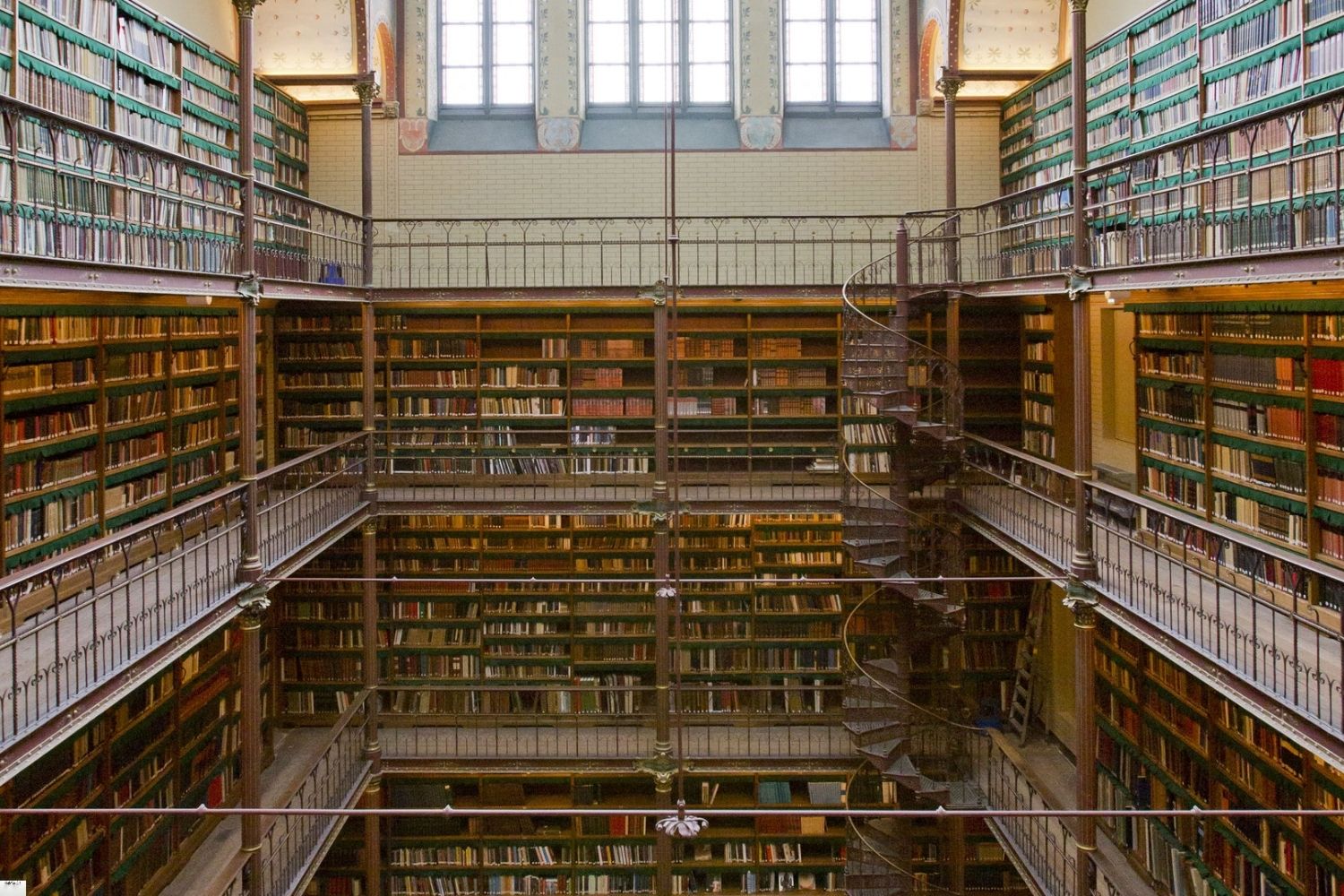
Amsterdam, Netherlands — Pierre Cuypers
Few libraries embody the idea of a library that looks like a museum more literally.
The Cuypers Library is located inside Amsterdam’s Rijksmuseum and is an integral part of the design Pierre Cuypers conceived for the great Dutch museum.
Today it is the oldest and largest art history library in the Netherlands.
The reading room rises vertically through several levels of shelving, galleries and iron structures, creating a perspective that constantly draws your eye upward.
Above it all, a large skylight dominates.
When the library was designed, the use of natural light was a particularly modern choice: it allowed people to read during the day without relying on gas lighting or candles.
Cuypers also worked on the perception of space, using proportions and details that visually accentuate its height.
The result is an interior in which architecture, books and art history become almost indistinguishable.
And perhaps that is precisely what makes it so special.
At the Rijksmuseum, visitors do not simply move from the artworks to the library: the library itself becomes part of the museum experience.
20. Exeter Library: Louis Kahn and the architecture of silence
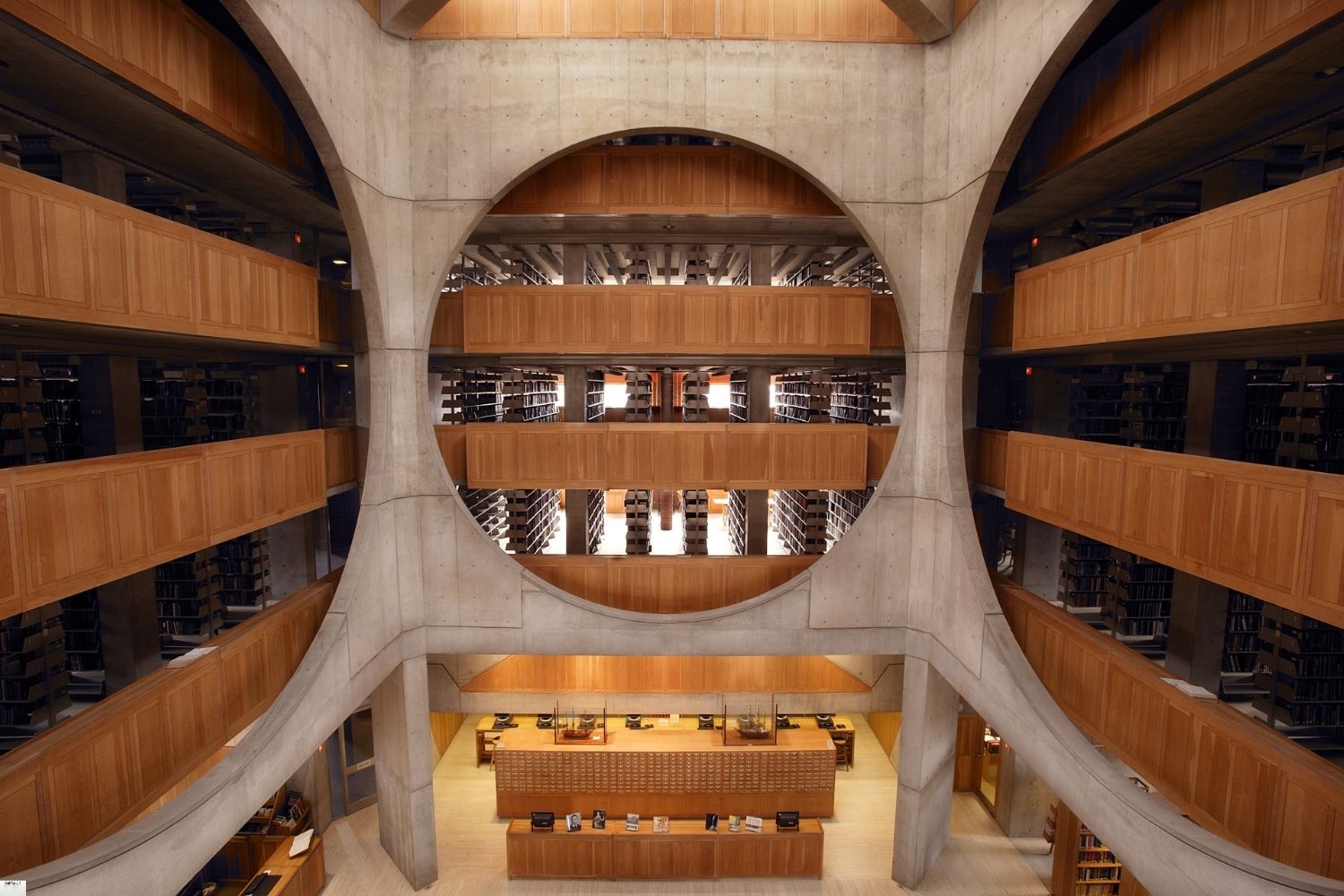
Exeter, United States — Louis I. Kahn
From the outside, it is a rigorous brick building.
Inside, the Class of 1945 Library at Phillips Exeter Academy in New Hampshire, designed by Louis I. Kahn and completed in 1972, reveals one of the most powerful spaces in 20th-century library architecture.
The heart of the building is a large central concrete hall that rises vertically through several levels.
Huge circular openings cut into the walls offer glimpses of the shelves and reading areas arranged all around. Light from above enters the central void and constantly changes the character of the concrete surfaces.
Kahn thus creates a very precise sequence.
At the center is the monumental, collective space. The closer you get to the perimeter of the building, the more intimate the architecture becomes.
Along the windows are small wooden tables and reading carrels, conceived almost as individual retreats.
It is precisely this interplay between monumentality and contemplation that makes Exeter extraordinary.
The library does not seek spectacle through decoration or eccentric forms.
It achieves it through proportion, material and light.
And it brings this journey to a fitting close, showing that after centuries of frescoes, domes, monumental bookcases and futuristic architecture, a library can still move us through something very simple: creating the right place to stop and read.
From baroque libraries to the new public squares of knowledge
Placing these 20 most beautiful libraries in the world side by side reveals a transformation that goes far beyond architectural style.
In Admont, Coimbra, Vienna and Prague, knowledge is expressed through magnificence. The book is a precious object and the library takes on the solemnity of a palace.
In Budapest, the transformation runs the other way: the palace itself becomes a library, letting everyday life into rooms once reserved for the aristocracy.
In Stuttgart, ornament virtually disappears.
In Seattle, the library becomes a system for organizing information. In Tianjin and Mexico City, shelves form true landscapes. In Doha, the book becomes part of the architecture, while in Helsinki the very idea of the library changes: from a place for consulting books to a public space for the city.
These are different ways of answering the same question: what form should a place dedicated to knowledge take?
Why we still need libraries
It might seem like a paradox.
We live in an age when an almost infinite amount of text and information can be reached from a screen we carry in our pockets. And yet we keep restoring old libraries and building new ones, often entrusting them to some of the finest contemporary architects.
Perhaps because a library has never been just a container for books.
It is a place that makes knowledge physical.
It lets us move through it, search for it, share it. It lets us be alone without necessarily being isolated, and study alongside people we do not know. It lets us see thousands of books and understand at once that what we know is only a tiny fraction of what exists.
The shelves change, the materials change and the way we read changes.
But from the baroque domes of Admont to the white, undulating ceiling of Oodi, the same insight remains: knowledge needs places too.
And when architecture and reading truly come together, those places can become some of the most beautiful in a city.
What are the most beautiful libraries in the world?
There is no universal ranking of the most beautiful libraries in the world, but some places inevitably appear among the great examples of library architecture. They include the Admont Abbey Library, the Biblioteca Joanina in Coimbra, the Strahov Monastery Library in Prague, the State Hall of the Austrian National Library in Vienna, the Metropolitan Ervin Szabó Library in Budapest, the Long Room at Trinity College Dublin and the Real Gabinete Português de Leitura in Rio de Janeiro.
Among the most significant contemporary libraries are Oodi in Helsinki, the Stadtbibliothek Stuttgart, the Seattle Central Library, the Biblioteca Vasconcelos in Mexico City, the Tianjin Binhai Library, the Qatar National Library and the Bibliotheca Alexandrina in Egypt.
What is the most beautiful library in Europe?
Choosing the most beautiful library in Europe is, of course, subjective.
For baroque splendor, the Admont Abbey Library in Austria and the Biblioteca Joanina in Coimbra, Portugal, are among the most spectacular contenders. The State Hall in Vienna and the Strahov Library in Prague are two other essential examples of the monumental library.
For those who prefer contemporary architecture, Oodi in Helsinki and the Stadtbibliothek Stuttgart show two completely different ways of interpreting the reading space in the 21st century.
Which libraries look like museums?
Some historic libraries have interiors so rich that they could easily be mistaken for museum galleries.
The most spectacular include the Biblioteca Joanina in Coimbra, the Admont Abbey Library, the State Hall in Vienna, the Strahov Library in Prague and the Metropolitan Ervin Szabó Library in Budapest, housed in the former Wenckheim Palace.
In these places, architecture, painting, the decorative arts and book collections form a single environment.
What are the most beautiful modern libraries?
The most beautiful modern libraries in the world include the Seattle Central Library by OMA and LMN, Oodi by ALA Architects in Helsinki, the Stadtbibliothek Stuttgart by Eun Young Yi, the Biblioteca Vasconcelos by Alberto Kalach, the Tianjin Binhai Library by MVRDV, the Qatar National Library by OMA and the Bibliotheca Alexandrina designed by Snøhetta.
What makes them interesting is not just their visual impact. Each offers a different response to the transformation of the contemporary library, which is becoming less a repository of books and more a cultural, social and urban space.