The Organic Modern style combines the clarity of contemporary lines with natural materials, tactile textures, soft forms and a palette built around warm, earthy tones. It does not, however, simply mean creating an entirely beige home, nor does it describe a historical style with a precise origin or manifesto. It is better understood as a …
The Organic Modern style combines the clarity of contemporary lines with natural materials, tactile textures, soft forms and a palette built around warm, earthy tones. It does not, however, simply mean creating an entirely beige home, nor does it describe a historical style with a precise origin or manifesto. It is better understood as a term within contemporary interior design used to describe spaces where essential architecture and organic materials coexist without decorative excess. Wood, stone, linen, ceramics, mineral surfaces and sculptural furniture can all play a role, but the final result depends above all on proportion, light, contrast and the quality of the surfaces.
What is Organic Modern style?
In international design media, the term organic modern has been used for several years to describe interiors that combine modern forms with materials connected to the natural world. Houzz was already describing it in 2018 as a balance between modern lines, natural forms and neutral palettes, while Livingetc connects it with influences from Scandinavian minimalism, Mid-Century Modern and a particular focus on craftsmanship, texture and organic shapes. In 2026, the term continues to appear in design publications, including in discussions of contemporary kitchens and interiors where stone, wood, ceramics and sculptural forms soften highly refined architectural spaces.
It is therefore more accurate to consider Organic Modern a contemporary design language rather than a rigidly defined style. It can work in a modern apartment, a mid-century house or a more traditional building because it does not depend on one specific type of architecture.
A useful example is the work of Sarah Sherman Samuel, described by Architectural Digest in 2026 through the expression organic modernism: natural materials, texture and clean lines are combined without eliminating colour, art or personality. It is a useful counterpoint to the idea that Organic Modern inevitably means ecru walls, a cream sofa and a travertine coffee table.
The principles of Organic Modern style: less decoration, more materiality
The starting point remains modern: clear forms, generous negative space, defined visual hierarchies and a limited number of deliberately chosen elements.
The organic component prevents this discipline from becoming cold. Surfaces gain texture, timber reveals its grain, stone shows natural variation, fabrics introduce irregularity and furniture can move away from strict orthogonal geometry towards softer curves and asymmetrical forms.
Livingetc highlights precisely this contrast between rectilinear architecture and sculptural furniture or lighting: curves and straight lines work best when they are placed in dialogue, rather than when every element becomes uniformly rounded.
For this reason, a convincing Organic Modern interior does not need to turn every object into an “organic” shape. A curved sofa can feel more powerful against a linear wall; an irregular timber table can work particularly well beside a highly precise kitchen.
The Organic Modern colour palette is not just beige
Neutral colours are certainly central, but reducing Organic Modern interiors to a sequence of beige tones can flatten the space.
The base can be built around warm white, ivory, sand, cream, greige, taupe and mineral greys, while deeper tones can be introduced through materials and accessories: walnut brown, earth, terracotta, ochre, olive green, sage green or almost-black accents.
Livingetc describes Organic Modern interiors through neutrals and earthy shades, while Architectural Digest, discussing the evolution of warmer interiors, highlights the use of darker woods, earthy tones, ochre, terracotta and stones with a stronger chromatic presence.
Colour should therefore work through tonal layering. A room with cream walls, an oak floor, a walnut table, clay-coloured ceramics and a dark green artwork can feel far more Organic Modern than an entirely beige interior.
Controlled contrast helps avoid a showroom effect.
Wood, stone, linen and mineral surfaces: which materials to choose
Materiality is probably the element that most clearly separates Organic Modern style from a more abstract form of minimalism.
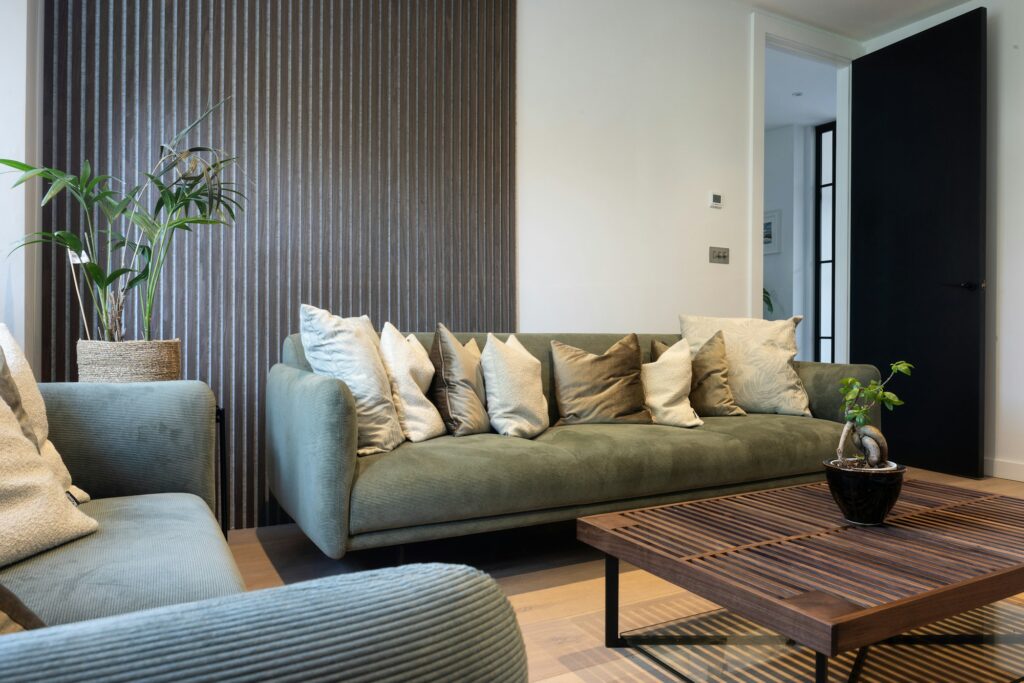
Wood can appear in flooring, tables, wall panelling or furniture. It does not necessarily have to be pale: oak, ash and natural timber tones work well, but darker woods can add depth and visual structure.
Natural stone introduces tonal variation and a surface that is rarely perfectly uniform. Travertine, marble, limestone and other stones can be used for tables, consoles, fireplaces or architectural elements; the principle matters more than the individual stone variety.
For textiles, linen, wool and fibres with visible texture help soften the contrast between smooth walls and furniture.
Textured plaster, mineral-based finishes, ceramics, terracotta and worked surfaces can also add depth. Livingetc, for example, refers to plaster-like walls and linen curtains used to filter natural light within Organic Modern interiors.
The most useful rule is to avoid introducing too many different materials. It is generally more effective to use a limited palette of materials repeated throughout the home, allowing continuity to emerge through material rather than perfect uniformity.
Organic shapes without turning the home into a set
Curved sofas, oval tables, enveloping armchairs and coffee tables with irregular geometries have become strongly associated with Organic Modern style.
Their design function, however, is specific: to interrupt the rigidity of architectural lines.
Organic forms can be created through soft curves, asymmetry, rounded profiles and full sculptural volumes, but they are most effective when alternated with more linear elements. Livingetc connects this combination with contemporary interest in sculptural furniture that highlights both its physical volume and the empty space around it.
It is therefore often better to choose one large, well-proportioned sculptural seat than to fill a room with arches, curved niches, round tables, wavy mirrors and accessories all using the same visual vocabulary.
When every element tries to become a focal point, the sense of naturalness disappears.
Natural light is part of the composition
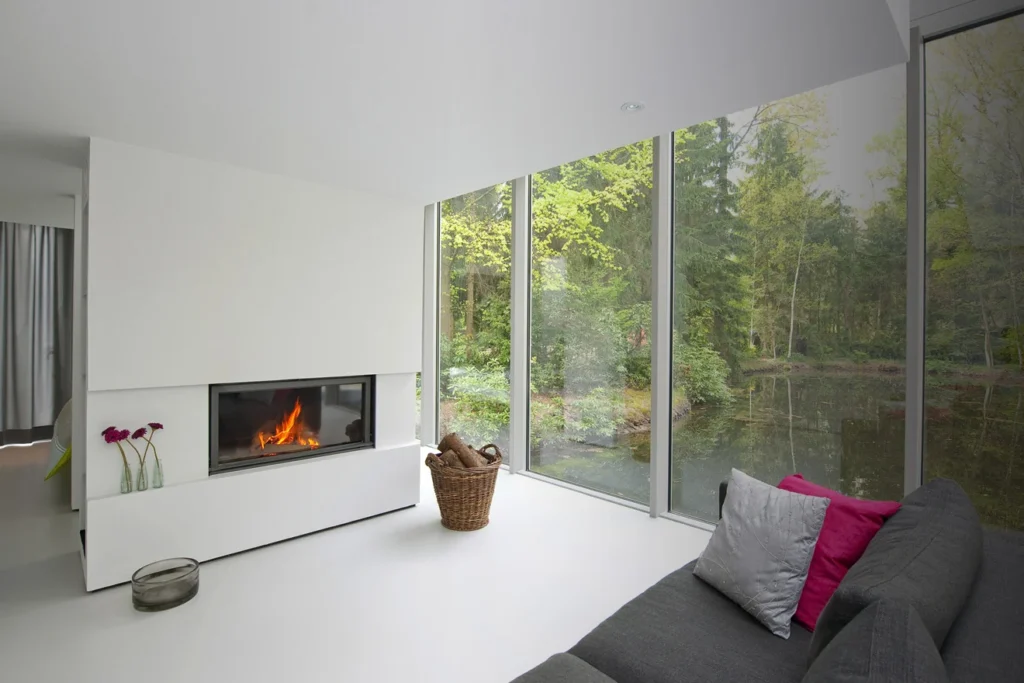
Organic Modern interiors are often associated with houses featuring vast glazed surfaces and dramatic landscapes, but living in a villa surrounded by nature is certainly not a requirement.
Light matters above all because it reveals texture, grain and variations in materials. A textured wall changes throughout the day; a linen curtain filters sunlight differently from a heavy drape; matt stone reacts to light in a different way from a polished surface.
Where possible, a visual connection with terraces, gardens or vegetation naturally reinforces the design. Plants can also be used, but they should not become compulsory fillers: one well-proportioned plant often works better with this language than numerous small pots distributed around the room. Livingetc includes both greenery and light-filtering textiles among the elements commonly found in Organic Modern interiors.
In the evening, layered lighting works particularly well, using floor lamps, wall lights and indirect sources rather than relying entirely on one uniform central ceiling light.
How to choose Organic Modern furniture
Furniture should have simple yet recognisable forms.
In a living room, a generously proportioned sofa can be paired with a wood or stone coffee table in a freer geometry. In the dining area, a tactile table can be balanced with very clean-lined chairs. A sculptural armchair can become the focal point without requiring numerous surrounding accessories.
It is not necessary to buy only new furniture. Warm minimalism and Organic Modern both share an interest in handcrafted and vintage pieces, as well as materials that reveal the passage of time; Architectural Digest has noted how furniture from different periods and surfaces with patina can bring depth even to highly minimal compositions.
This also helps avoid one of the weakest effects of social-media interiors: a home assembled entirely from objects belonging to the same collection.
Art and objects: empty space matters as much as what is displayed
An Organic Modern space should not be devoid of objects, but careful editing is essential.
Handmade ceramics, sculpture, photography, abstract paintings, books and objects collected over time can interrupt the neutrality of the base. They do not necessarily need to belong to the same colour palette.
A colourful artwork can work particularly well precisely because it contrasts with calm architecture.
The composition should leave intentional areas of empty space. A shelf with three well-spaced objects allows their shape and material to be read clearly; the same surface filled with fifteen small accessories moves the interior towards a completely different visual language.
Organic Modern style room by room
Living room
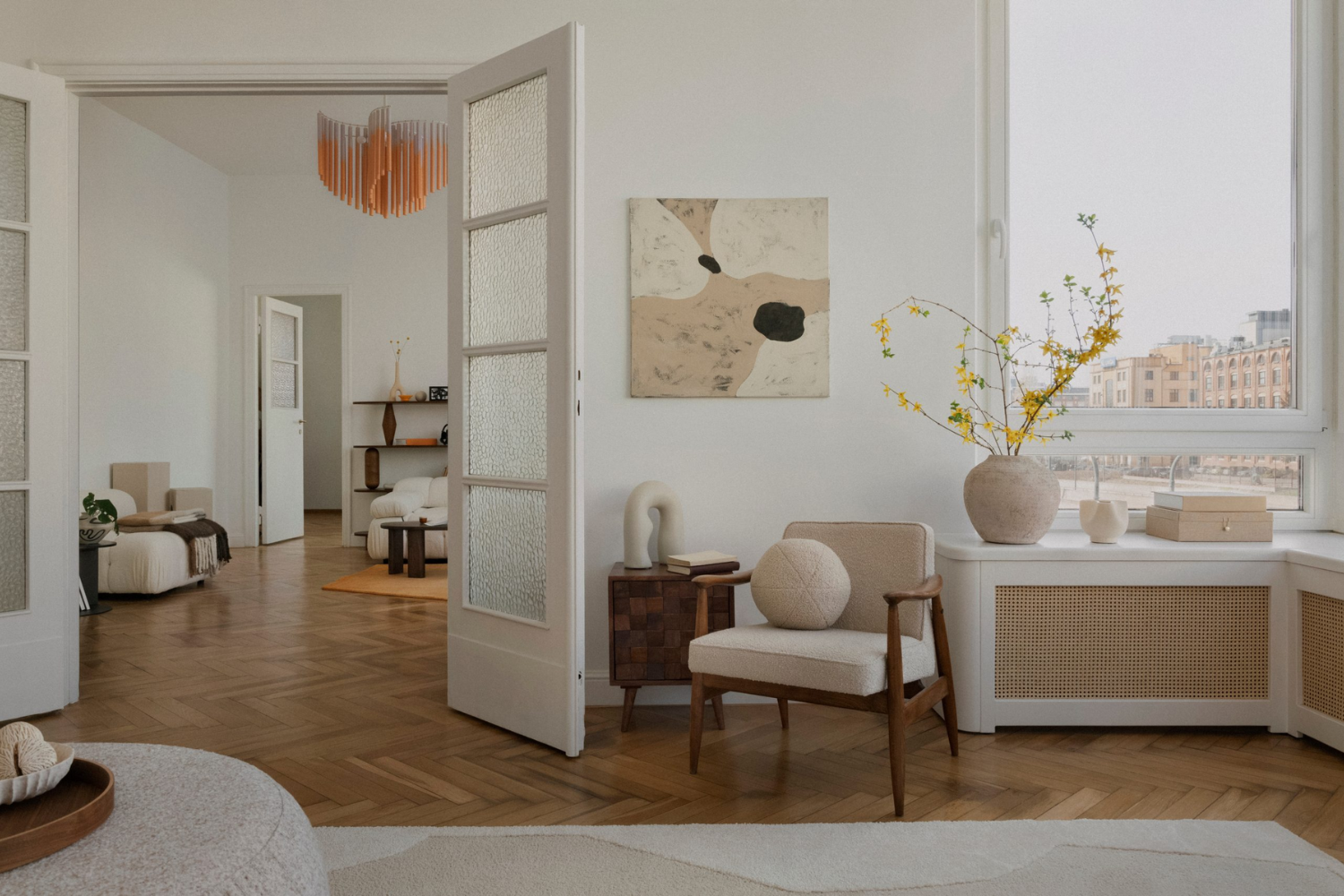
In the living room, it is useful to begin with the largest volumes: sofa, rug, table and lighting. A light or earthy-toned sofa, a textured wool rug and one or two elements in wood or stone may be enough.
Walls do not necessarily have to be white: warm plaster finishes, mineral beiges or very pale earth tones can give the room greater depth.
Kitchen
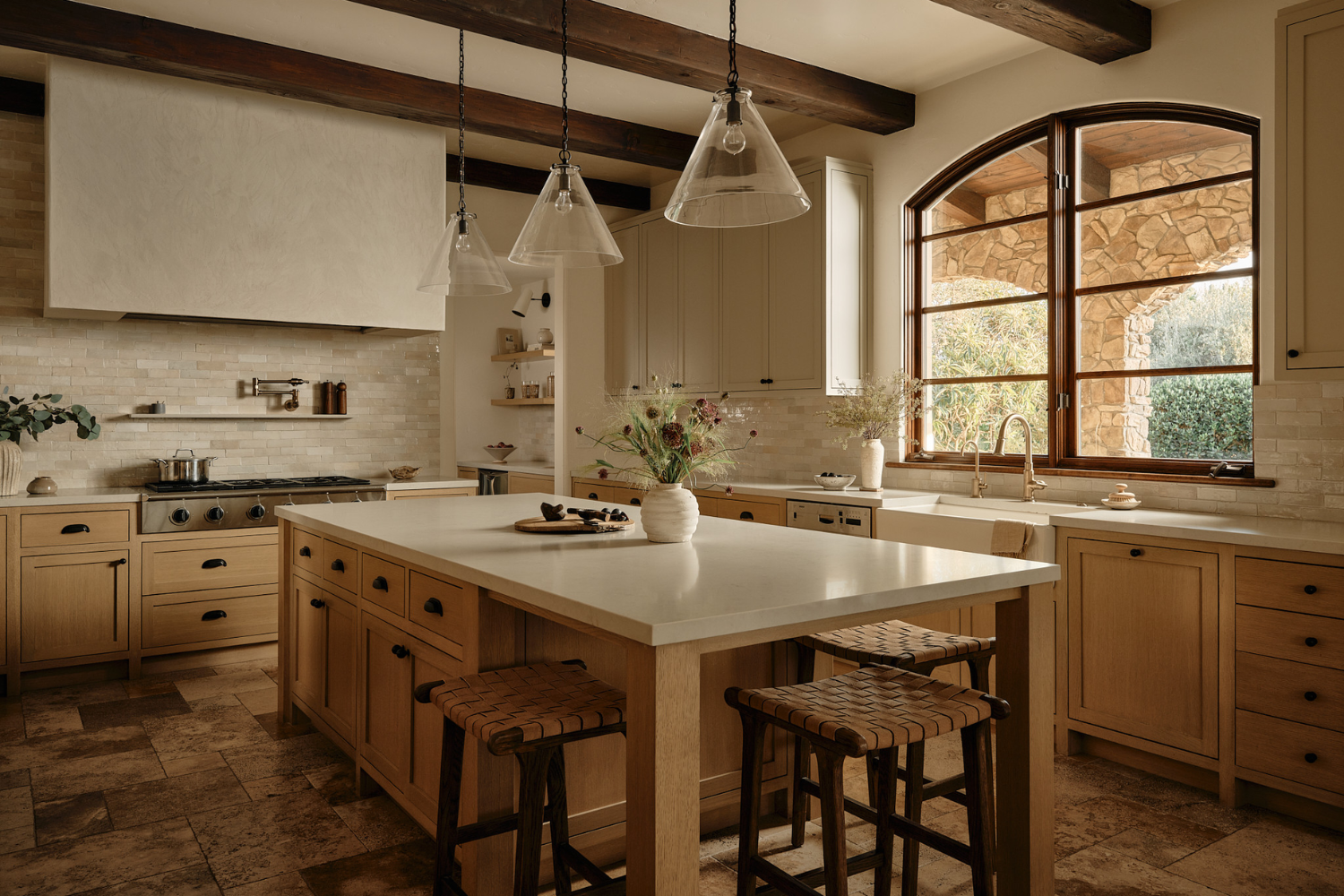
The kitchen requires greater discipline because it already contains many technical elements.
Timber cabinetry, stone surfaces and metal details can work with a highly restrained design. Here it is particularly important to avoid adding “natural” decoration afterwards: materiality should be integrated into the architecture of the kitchen, rather than simply placed on top of it.
Bedroom
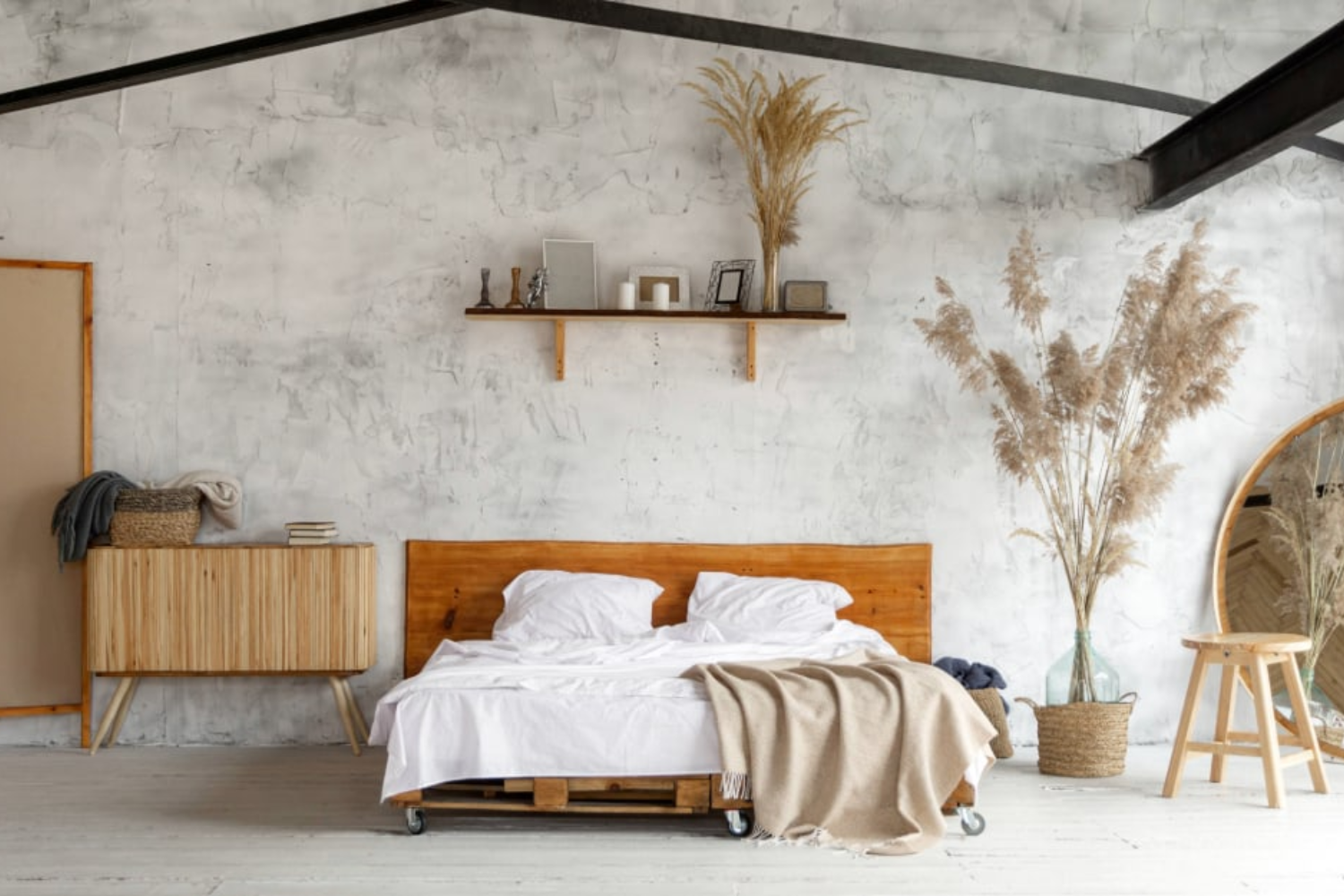
In the bedroom, Organic Modern style can become softer. Linen, wool, timber, sheer curtains and an upholstered headboard can establish the character without requiring a large amount of furniture.
A tonal palette works well, but it can be interrupted by a darker bedside table, an artwork or a sculptural lamp.
Bathroom
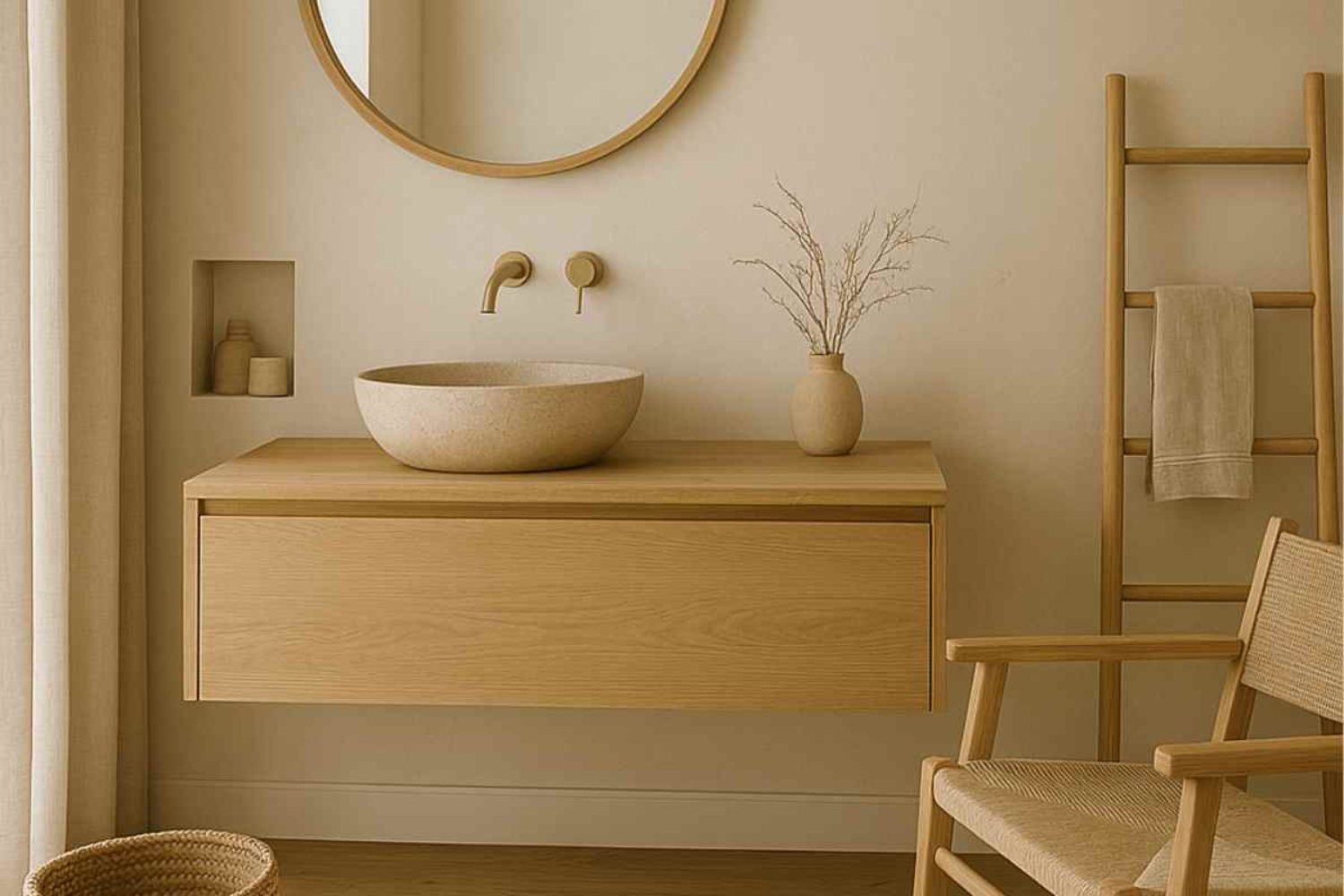
In the bathroom, the style can emerge through stone, timber suitable for the environment, ceramics and continuous surfaces.
An entirely beige room is not necessary: dark tapware, deeper wood tones or more strongly veined stone can give the composition greater structure.
Organic Modern vs Japandi, Wabi Sabi and warm minimalism
These design languages can overlap visually, but they are not interchangeable.
| Style | Defining element | Main difference |
|---|---|---|
| Organic Modern | Modern design + natural materials + sculptural forms | More flexible in its use of curves, textures and furniture from different periods |
| Japandi | Combination of Japanese and Scandinavian design | Greater emphasis on simplicity, function, craftsmanship and controlled composition |
| Wabi Sabi | Japanese aesthetic connected with imperfection, time and materiality | It did not originate as a Western interior decorating style |
| Warm minimalism | Minimalism made more liveable through warmth and texture | Generally remains more closely connected to the discipline of minimalism |
Japandi is defined by Architectural Digest as a meeting of Japanese sensibilities and Scandinavian design; natural materials and restraint make it visually close to Organic Modern, but its cultural genealogy is more specific.
Wabi Sabi requires even greater care. The Smithsonian places wabi and sabi within Japanese aesthetic traditions and connects them with ideas of rustic elegance, time and material culture: reducing them simply to a beige palette means losing much of their original significance.
Warm minimalism, by contrast, retains the editing and reduction associated with minimalism but introduces timber, stone, textiles, patina and warmer colours. It is probably the design language closest to Organic Modern, although the latter tends to give more space to organic forms, sculptural elements and explicit references to nature.
Mistakes that turn Organic Modern into a simple beige aesthetic
The first is removing contrast completely. If walls, flooring, sofa, rug, curtains and accessories all share the same tone, the room can lose depth.
The second is trying to simulate naturalness through a checklist of supposedly essential products: a bouclé sofa, travertine coffee table, irregular vase and potted olive tree do not automatically create a coherent interior.
The third is confusing “natural” with “rustic”. Timber does not necessarily have to be rough and stone does not have to dominate the room. Organic Modern maintains a very clear contemporary component.
The fourth is overusing curves. An organic form works through contrast, not through constant repetition.
The fifth is forgetting real life. An interior designed only to look calm in photographs can become impractical if it does not provide enough storage, durable surfaces, appropriate lighting and space for personal objects.
The Organic Modern style becomes more convincing when it is treated as a balance between opposites: precision and irregularity, modern lines and natural materiality, solid forms and empty space, neutral colours and contrast, contemporary objects and pieces with a history. It is precisely this tension that separates Organic Modern from the uniform image of the “beige home” and makes it a useful design language for creating natural interiors without sacrificing the clarity of contemporary architecture.