Polished, honed or brushed: three Bianco Carrara finishes show how the same stone changes with light and touch. Differences to assess on samples, without confusing appearance with performance.
Polished, honed or brushed: the finish of a natural stone changes its relationship with light, touch and maintenance, and is a design decision distinct from choosing the material.
The veining remains recognisable, but the room changes. A polished slab captures the window; a honed one lets the stone’s pattern take centre stage; a brushed one asks to be viewed from the side as well, where light meets texture. When choosing a covering, its finish deserves the same attention as its colour.
To bring this difference into focus, we take a single reference: Bianco Carrara, which manufacturers’ catalogues document in polished, honed and brushed versions. The comparison concerns the finishes available on the same type of marble. Veining, selection and treatment can still vary within the same commercial designation, which is why comparisons should always be made using samples from the actual supply.
Stone finishes and light: comparing three surfaces
Imagine a surface close to a window. To compare three finishes correctly, you need the same viewing position, the same light and the same final treatment: three photographs taken under different conditions risk attributing to the finish what actually depends on exposure.
Bianco Carrara’s pale background and grey variations allow us to observe the relationship between natural pattern and worked surface without changing colour family. “The same stone” does not mean uniformity: before deciding, it matters to see the selection actually proposed for the project.
Polished: reflection enters the composition
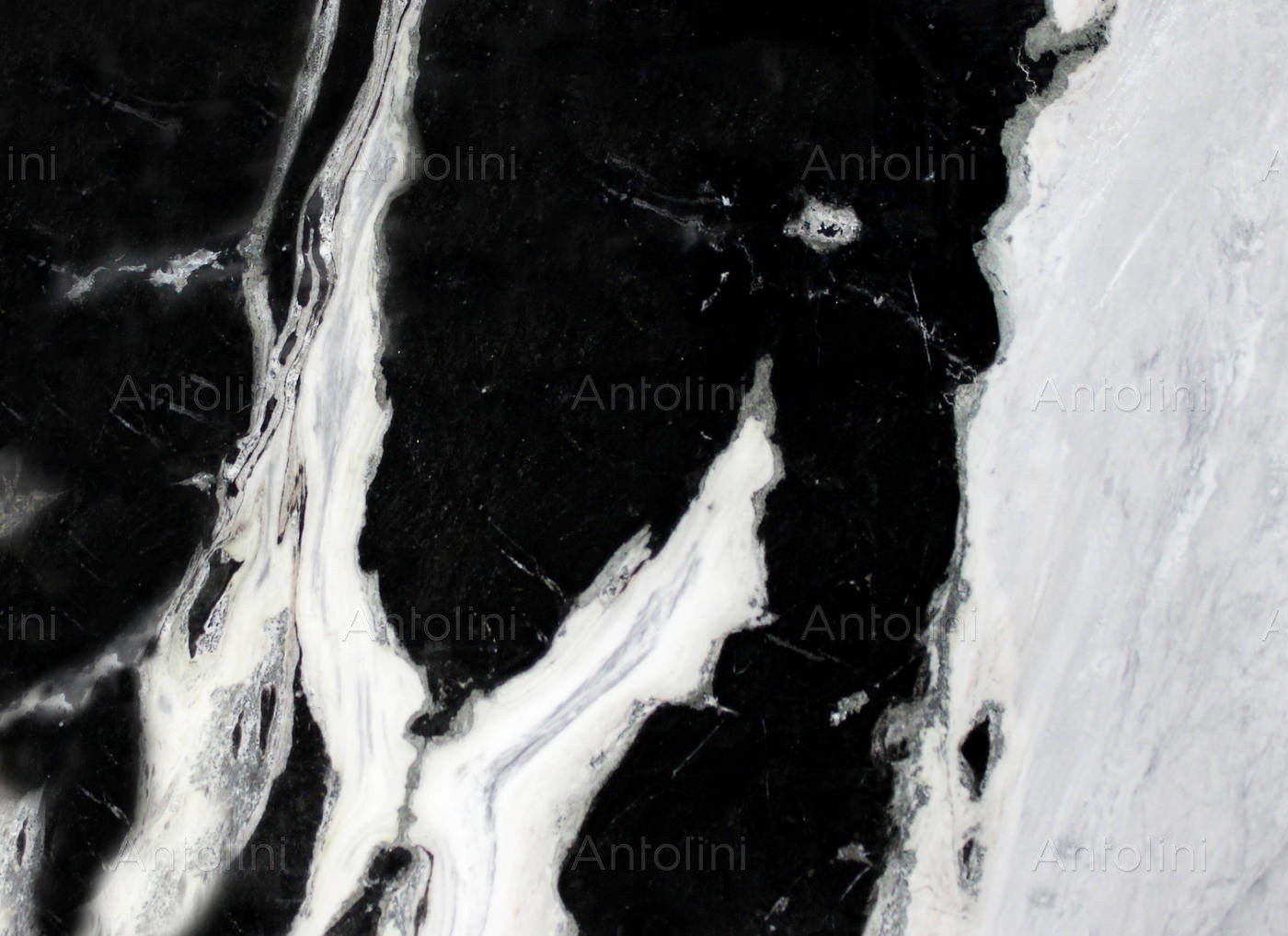
Polishing produces a smooth, lustrous surface. Marble thus contributes to the room’s appearance through what it reflects: a window, a lamp, the silhouette of a piece of furniture. The decision is how much space to give this second image in relation to the veining.
On a freestanding side table, it can become an accent; across a whole wall, it changes how openings and light sources are perceived. It is worth testing the sample vertically or horizontally according to its intended use. Its effect on a supplier’s counter does not automatically convey that of a wall lit from the side.
Honed: a smooth, more matt surface
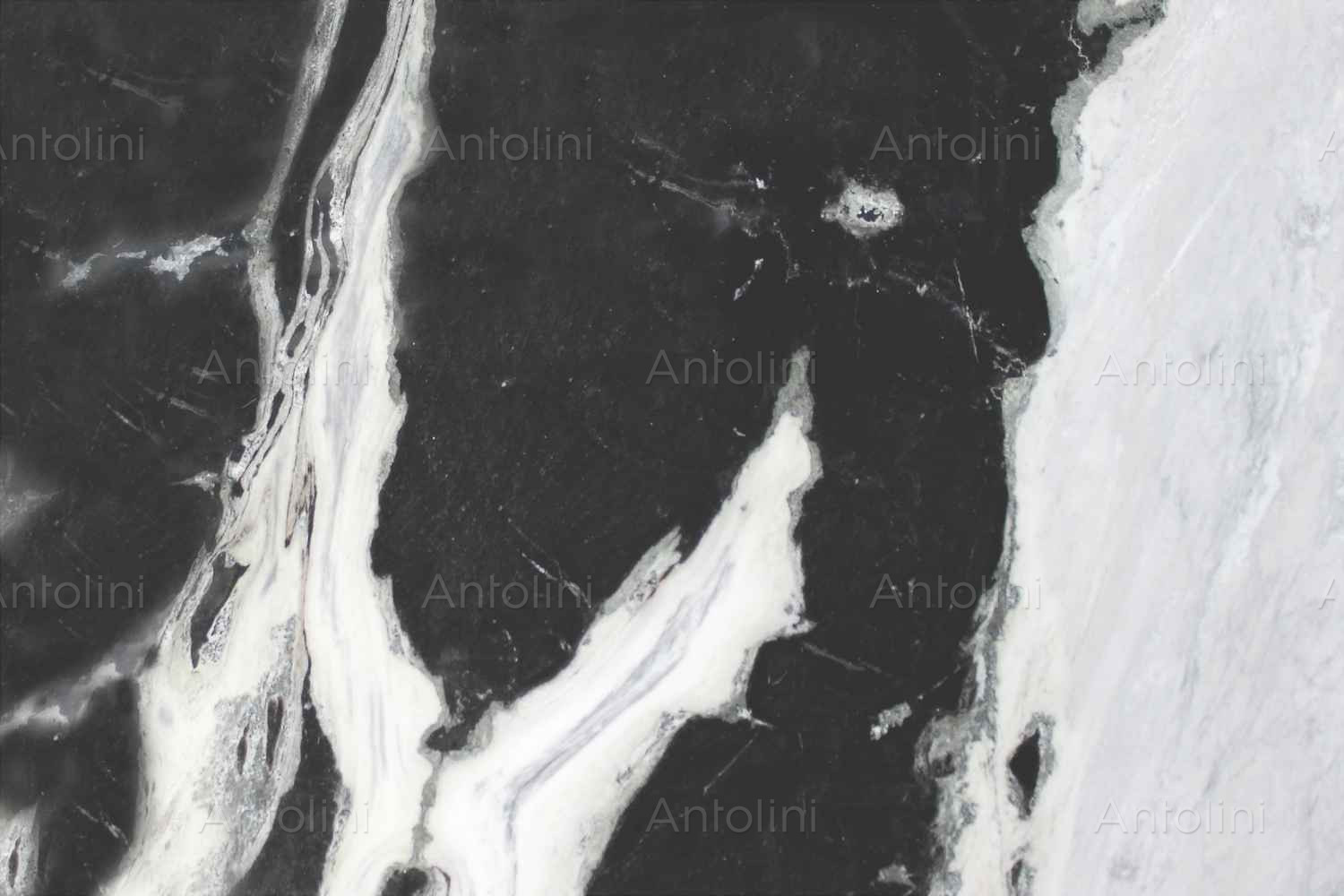
In the vocabulary of commercial finishes, honed describes a surface that is smooth and matt compared with a polished one. It remains distinct from brushed: choosing a less reflective appearance does not imply wanting a texture perceptible to the touch.
This is an interesting direction when a project seeks continuity between floor, threshold and wall covering, or wants another element to provide the luminous focal point. Lacquered furniture, the glass of a lamp or a metal can become more noticeable beside a quieter-looking stone. It is a compositional choice, not an automatic rule of style.
Brushed: the pattern gains texture
Brushing works the surface with abrasive brushes and can produce a slightly undulating texture, connected to the different responses of the material’s constituent parts. Manufacturers’ technical sheets distinguish precisely this process from smooth polished and honed surfaces.
To assess it, you need to move closer. A frontal photograph can convey its colour without rendering its surface variation; grazing light helps reveal it. In a project, this introduces a different question: do we want a surface to perceive from a distance, a material to touch, or both?
Stone finishes in the showroom: the comparison to make
| Finish | Character to observe | What to check on the sample |
|---|---|---|
| Polished | Smooth, lustrous surface | Reflections of windows and lamps in the intended position |
| Honed | Smooth, more matt surface | Degree of mattness, pattern and final treatment |
| Brushed | Texture and slight surface relief | Intensity of the process, feel and cleanliness of the detail |
The three labels are no substitute for sampling. “Honed” can correspond to different grit grades; brushing can be more or less pronounced. Asking for the exact processing sequence allows you to compare specific proposals and avoid a situation in which the approved sample and the supplied material present two different surfaces.
What a stone finish does not resolve
A matt marble should not automatically be considered stain-resistant. A textured surface should not be chosen as slip-resistant on tactile impression alone. Floors, showers and worktops require data relevant to the specific supply and intended use, along with installation and maintenance guidance.
Staining, chemical alteration and scratching are different phenomena. The supplier should clarify which substances to avoid, which products to use and what the proposed treatment can actually protect against. Promising a stone unaffected by everyday life would be misleading; it would be equally reductive to consider every mark incompatible with a good interior.
In an intensively used kitchen, willingness to accept changes in the surface is part of the design. In a bathroom, the choice should be coordinated with water, cleaning products and construction details. The desired finish is the starting point of a technical discussion, not its conclusion.
Design combinations before applying labels
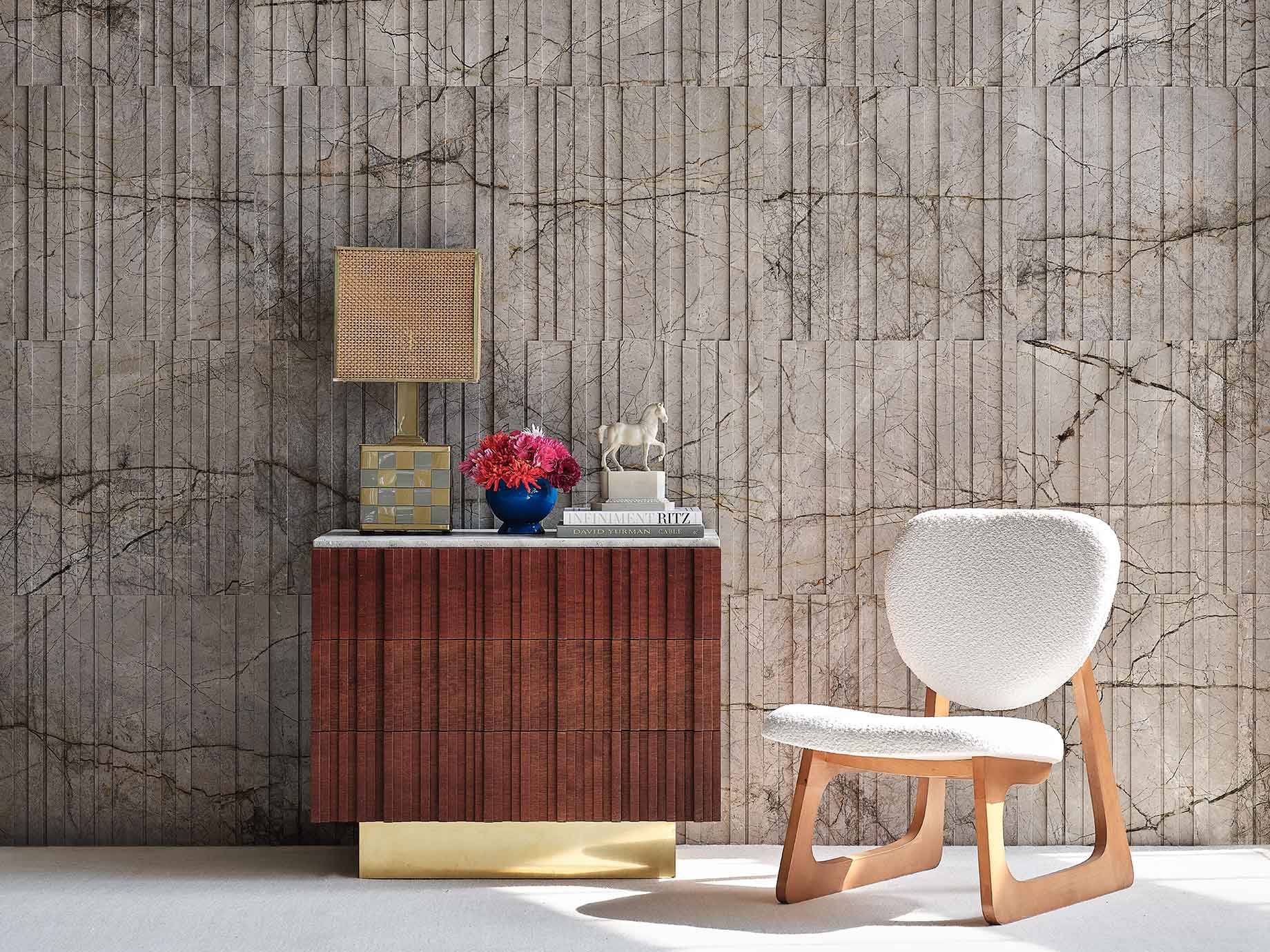
Polished does not demand a classical interior; brushed does not impose a rustic setting. It is more useful to work through relationships: a reflective surface beside a crisp textile, a matt stone close to a lustrous metal, a pronounced texture against a uniform frontage.
Format also changes the reading. A small surface allows the veining to be concentrated; a wall calls for thought about joints, direction and the sequence of slabs. Edges, returns and cuts should be assessed with the same care given to the principal face.
Anyone still choosing the material can compare travertine in interiors and Rosso Levanto as a presence of colour. These are complementary readings: changing stone and changing finish are two distinct decisions, not to be conflated through hasty sampling.
The question to take to the supplier
Our feature on Marmomac 2026 explores directions in natural stone for interiors; the finish is where those directions become concrete design choices.
The useful question to take to a manufacturer is simple: can we see this same selection, with the proposed treatment, in all three finishes? From there, the design becomes concrete again. We observe the actual light, edge, feel and maintenance requirements; we choose what presence to give the stone in the room.