Rosso Levanto marble in interior design is recognisable for its dark red to purplish background, crossed by white calcite fractures and, in some selections, green inclusions associated with serpentinite. The word “marble”, however, is primarily a commercial designation: geologically, Rosso Levanto is an ophicalcite breccia, also known as Breccia di Levanto, formed within the Ligurian …
Rosso Levanto marble in interior design is recognisable for its dark red to purplish background, crossed by white calcite fractures and, in some selections, green inclusions associated with serpentinite. The word “marble”, however, is primarily a commercial designation: geologically, Rosso Levanto is an ophicalcite breccia, also known as Breccia di Levanto, formed within the Ligurian ophiolitic sequences. Historically quarried around Levanto and Bonassola, it is now used for flooring, wall cladding, bathrooms, worktops and furniture. Its contemporary appeal lies largely in its colour: it can become the visual focus of a room or appear in much smaller doses alongside timber, metals and pale stone.
What is Rosso Levanto really, and where does it come from?
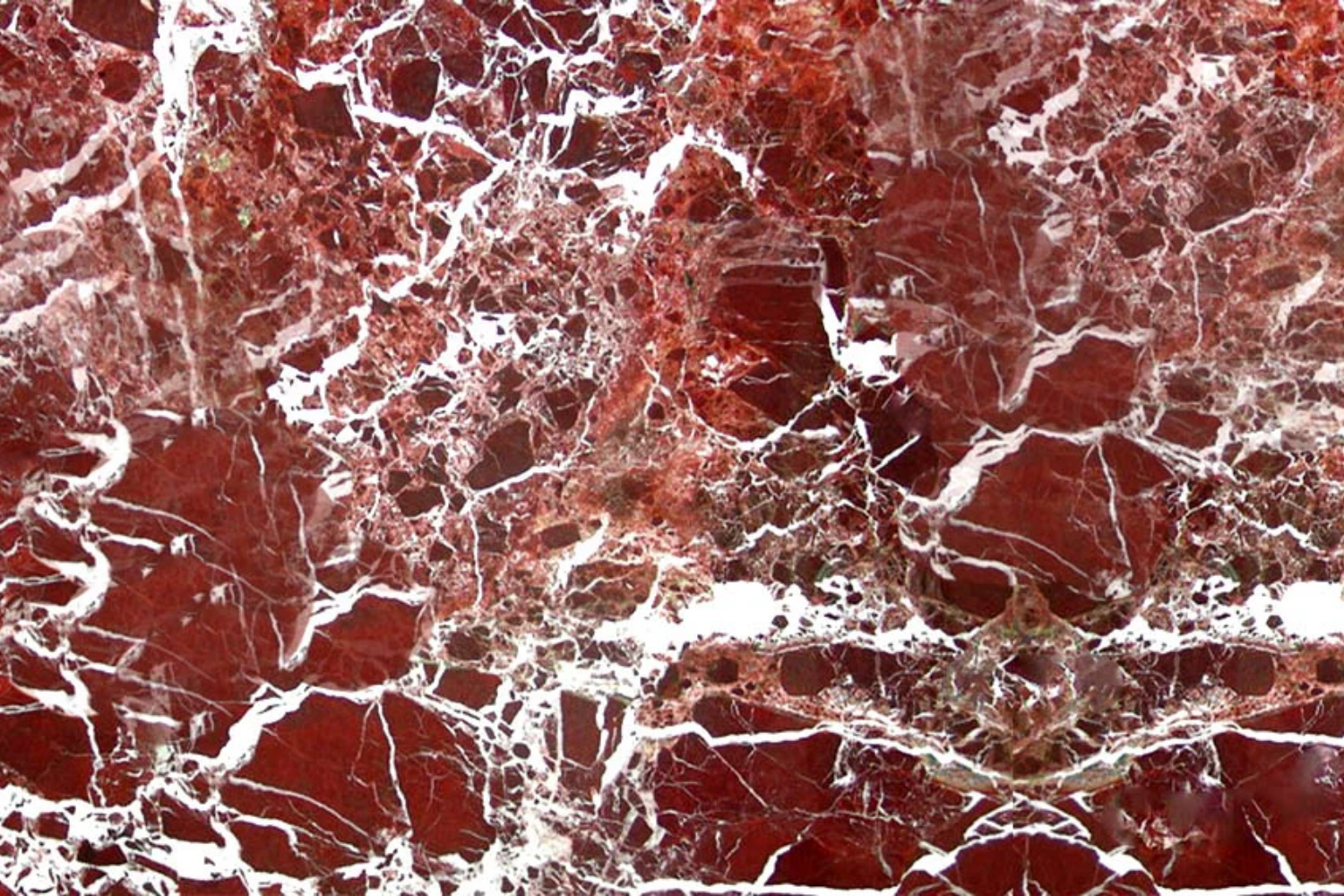
Rosso Levanto is the commercial name of an ornamental stone historically associated with eastern Liguria, particularly the area around Levanto, Bonassola and other outcrops along the La Spezia Riviera. The Liguria Region Geosite Register identifies the Reggimonti quarry in Bonassola as one of the material’s principal extraction sites.
From a geological perspective, it is more accurate to refer to it as Breccia di Levanto, belonging to the ophicalcites. The rock consists of fragments of ophiolitic material, mainly serpentinite, crossed and cemented by networks of carbonate veins, predominantly calcite. In certain areas, the serpentinites underwent haematitisation, responsible for the stone’s distinctive red colouring.
This explains why describing it simply as “red marble” is useful commercially but incomplete from a petrographic point of view. Mineralogical collections and studies of decorative stone also classify it as ophicalcite or red ophicalcite breccia, rather than a calcitic marble in the strict geological sense.
A Ligurian stone with a history far older than contemporary design
Interest in Rosso Levanto did not begin with contemporary interiors.
The “Leonardo da Vinci” collection of ancient marbles documents evidence of its use as far back as the Etruscan period and traces its subsequent spread during Roman times and, later, within Ligurian architecture. Extraction increased again over the following centuries, and between the nineteenth and twentieth centuries the stone became widely used for cladding, architectural elements, furniture and decorative objects.
This historical layering is also important when interpreting its use today. Rosso Levanto belongs to the Italian tradition of polychrome stone, but it does not have to be treated in a classical way. Its almost wine-coloured background and fractured pattern work equally well with highly restrained geometries.
In 2026, for example, MAWD introduced Rosso Levanto tables into the Grand Salon of L’Appartamento 2026, pairing them with burgundy upholstery, textiles, gold-toned elements and warm surfaces. The result uses red as an extended colour family rather than as a single precious accent.
Colour and veining: why every slab looks so different
Rosso Levanto is not chromatically uniform.
Its background can range from deep red and burgundy to purplish red. Irregular and often sharply defined white calcite veins cross the darker field, together with green areas or traces related to the serpentinite component. The distribution of haematite contributes to the rock’s red colouring.
It is precisely this brecciated structure that distinguishes Rosso Levanto from many red marbles with a more uniform pattern. Some slabs are crossed by a dense pale network; others feature broader expanses of red interrupted by only a few major fractures.
For a design project, this means that selecting the individual slab matters far more than simply choosing the commercial stone name. Photographs and small samples may be insufficient when the material is intended for a large wall, kitchen island or dining table. Cassina explicitly notes in its product documentation that the actual pattern and finish can vary because of the natural character of the raw material.
Polished, honed or brushed: how the finish changes Rosso Levanto
The finishes most commonly offered for Rosso Levanto are polished and honed, while some stone manufacturers also provide brushed surfaces. Margraf, for example, lists polished and honed finishes among its options, while Ziche Marmi also offers brushing.
A polished surface increases reflectivity and makes the contrast between the burgundy background and white veining particularly pronounced. It is suitable when the decorative character of the stone is intended to be emphasised.
A honed finish reduces reflections and gives the colour a more matt, material quality. In a contemporary interior, this can be useful when Rosso Levanto occupies a large surface and the aim is to avoid making it excessively glossy.
Brushing introduces a stronger tactile quality, but it should be assessed on the actual sample: the same block can change considerably in character depending on the degree of finishing.
Floors and wall cladding: when a large surface really works
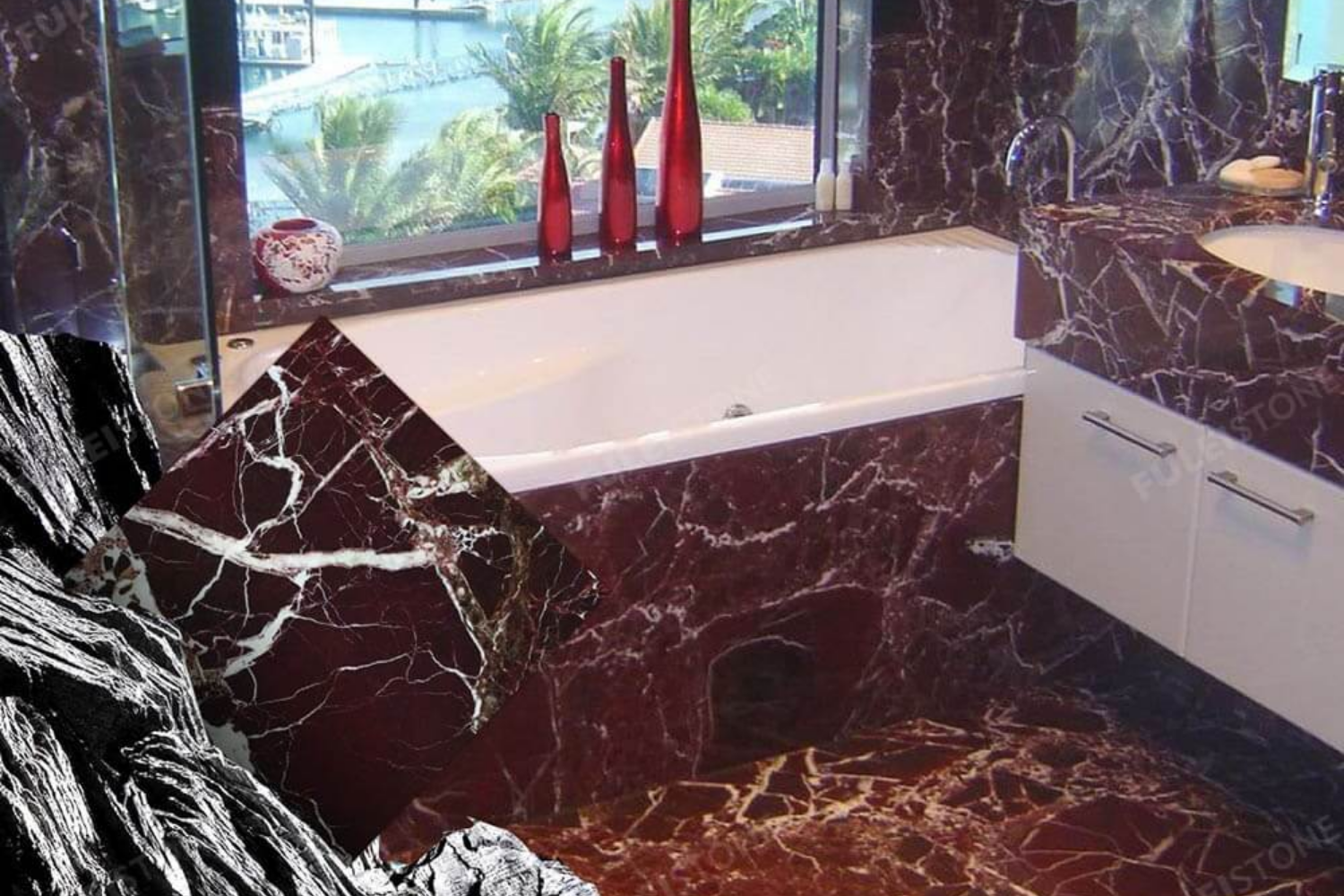
Rosso Levanto can be used for floors, wall cladding and staircases; commercial stone documentation continues to list these among its standard applications.
Across a large surface, however, the colour becomes a genuine architectural element.
A floor entirely finished in Rosso Levanto creates a dark and visually powerful base. It works best when walls and furniture do not compete with the same intensity. Alternatively, the stone can be used for bands, thresholds, inserts or defined zones, drawing on a logic also found in the Italian tradition of polychrome flooring.
An interesting example is Casa Muliniera GF in Verona, completed in 2025: the project retains the existing Rosso Levanto flooring and places it in dialogue with resin interventions and contemporary colours instead of treating it as a surface that needs to be neutralised.
Rosso Levanto in the bathroom: one strong surface is better than five competing effects
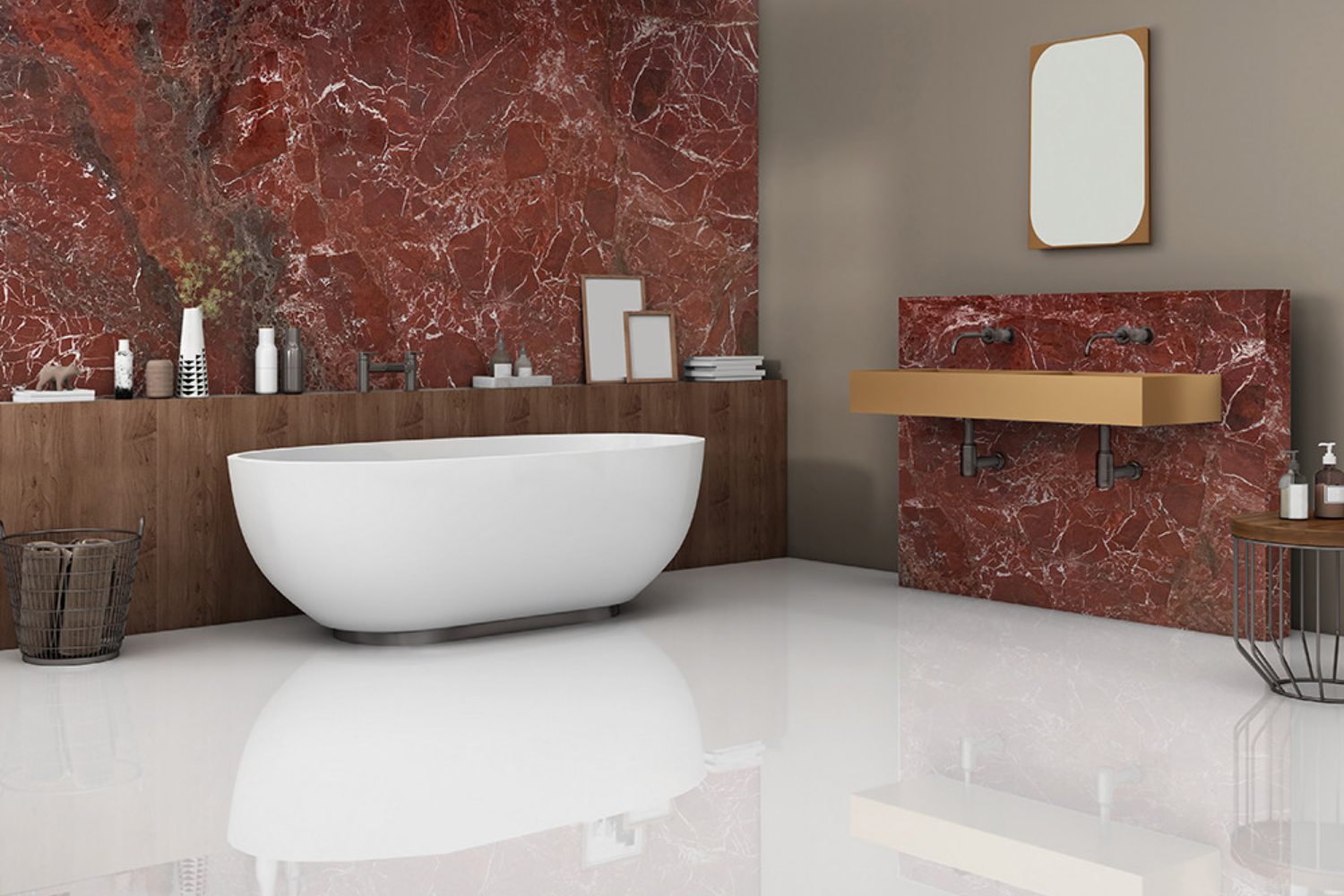
The bathroom is one of the spaces where the material can be used with particular intensity.
A wall behind the basin, shower cladding, a vanity top or a cabinet front can exploit the contrast between deep red, pale ceramics and metal.
Using it on every surface is possible, but it completely changes the perception of the room. Flooring, walls and basin in the same material create an immersive interior; limiting it to one horizontal surface or a single wall preserves a greater sense of lightness.
When specifying it for a bathroom, it is also important to remember that Rosso Levanto contains significant carbonate components. The Natural Stone Institute’s general guidance for acid-sensitive stone recommends mild, non-acidic cleaning products and advises against vinegar, lemon and other substances that can dull or etch the surface.
Rosso Levanto can work in the kitchen, but it is not an invulnerable material
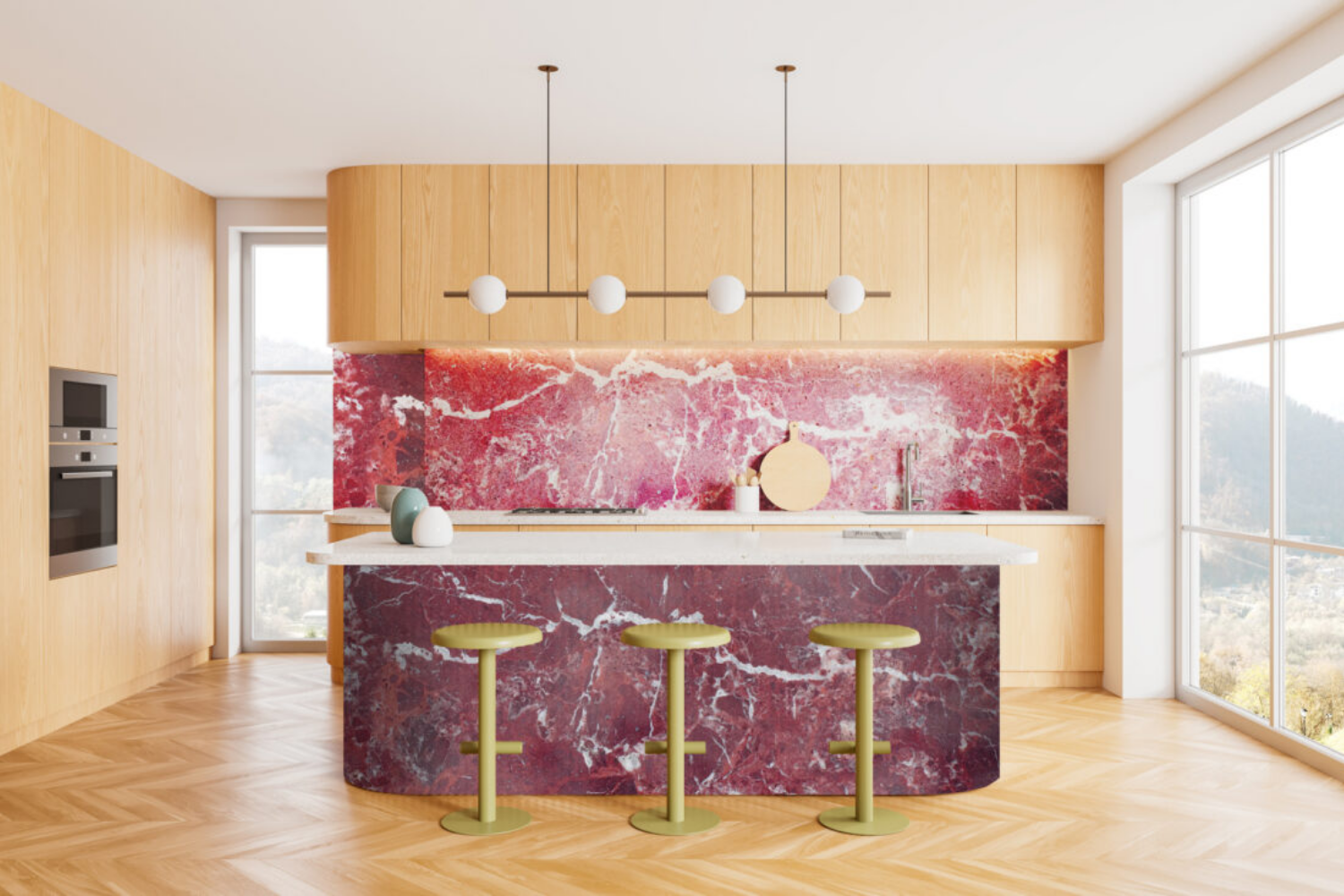
Rosso Levanto is also used for worktops, splashbacks and kitchen islands.
In 2025, the Margo Antis by Euromobil project, designed by Roberto Gobbo with the company’s R&D team, used Rosso Levanto for the island worktop and sides, pairing it with bronze-coloured metallic lacquers and smoked glass.
It is an effective example because the stone is not added as a small decorative detail: it defines the central volume of the kitchen.
From a practical perspective, however, the calcitic component needs to be considered. As with other natural stones containing calcium carbonate, acidic substances can dull or etch the finish. Wine, citrus fruits and condiments should therefore be removed promptly, and routine cleaning should follow the instructions provided by the manufacturer or stone specialist.
Impregnating treatments do not make the stone completely stain-proof either: the Natural Stone Institute specifies that they may improve resistance to staining but cannot eliminate the possibility entirely.
Tables and small furniture: the easiest way to introduce Rosso Levanto
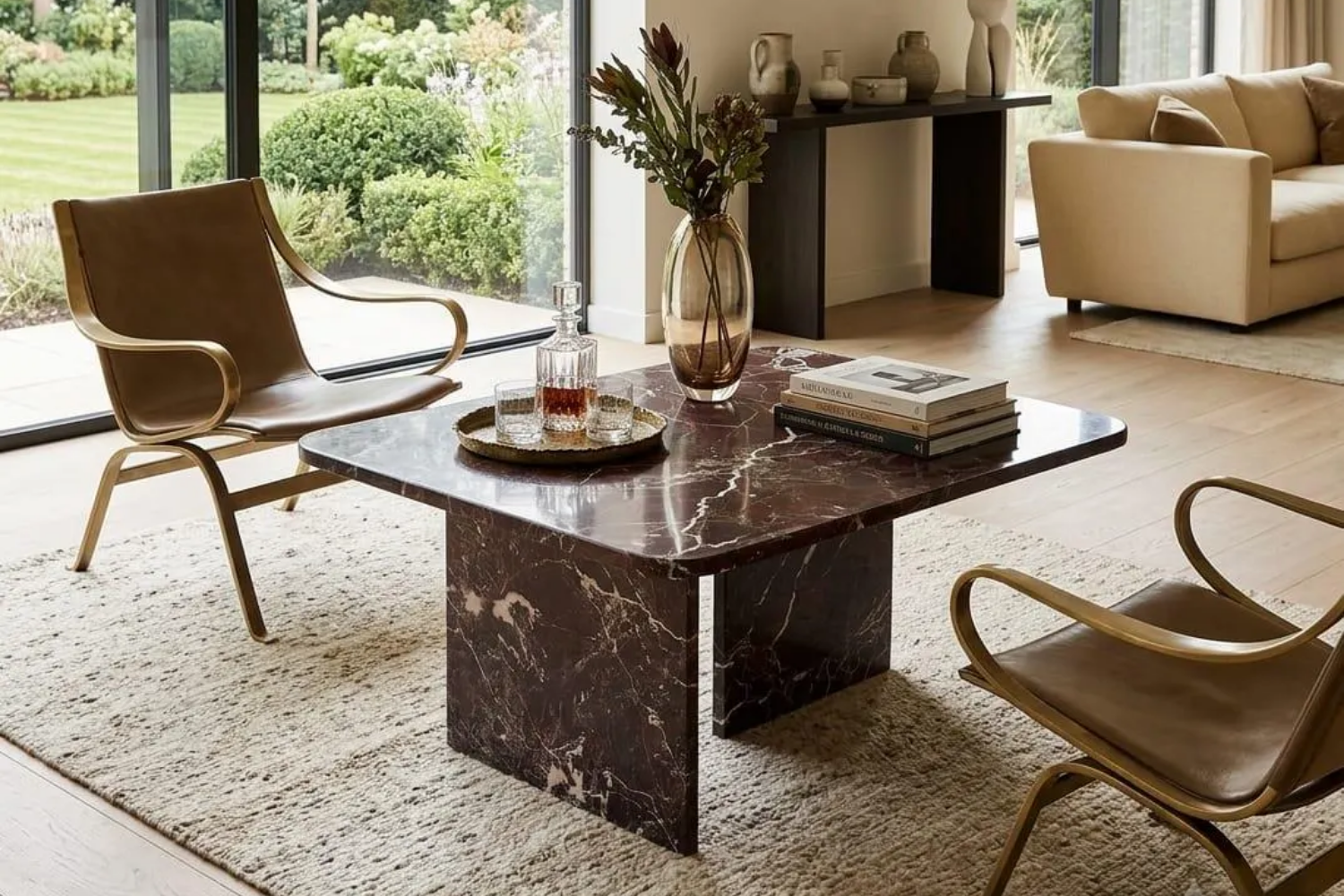
Those who do not want to commit to floors or walls can introduce Rosso Levanto through a single piece of furniture.
Today, the material appears in designer tables and occasional tables with very different visual languages. Ordinal Low, designed by Michael Anastassiades for Cassina in 2024, is available in Rosso Levanto alongside other natural stones; the design uses the same marble for both the top and legs, finished with a matt polyester coating.
Patricia Urquiola’s Sengu family for Cassina also includes Rosso Levanto among its top options.
This scale is particularly well suited to the material: a low table makes it possible to appreciate the stone’s pattern up close without allowing the red to dominate the entire room.
A console, occasional surface or small worktop can perform the same role.
Which colours and materials work with Rosso Levanto?
The most immediate approach is to pair it with quieter materials.
Oak, walnut and dark-toned timbers echo the warmth of the red without imitating it. Walnut in particular creates a deep, compact palette, while pale oak increases the contrast.
With travertine, lime finishes, beige and cream-coloured stones, Rosso Levanto becomes the main chromatic focus. Paired with stainless steel or burnished metals, it takes on a more graphic character.
Green deserves particular attention. It is not unrelated to the stone, as green traces can already occur naturally within its composition. Olive, sage and dark green can therefore create dense but coherent palettes. Architectural Digest has also observed the return in contemporary interiors of Milanese-inspired combinations based on deep greens, wine reds and dark woods, with references to the material culture of Italian modernism.
White, finally, works when the aim is to make the calcite network stand out clearly.
How much Rosso Levanto should you use without overwhelming the interior?
The issue is not the red colour itself. It is the number of surfaces competing for attention at the same time.
A large Rosso Levanto wall can define the identity of a living room on its own. If the same room also includes decorative flooring, a highly saturated sofa, strongly figured timber and multiple polished metals, the stone loses its hierarchical role.
An effective strategy is to decide whether the stone should function as architecture or accent.
If it is architectural, it can occupy an island, wall or floor while the other materials create visual pause around it.
If it is an accent, a side table, vanity top or niche may be enough.
In the Grand Salon designed by MAWD for L’Appartamento 2026, a third approach is used: red is intentionally repeated across marble, burgundy sofas and textiles, creating a tonal palette rather than an isolated contrast.
How to clean and maintain Rosso Levanto
Maintenance should be cautious and appropriate to the specific finish.
For routine cleaning, water and pH-neutral cleaners suitable for natural stone are preferable. Dust, sand and abrasive particles should be removed regularly from floors because they can mark polished surfaces.
The Natural Stone Institute also recommends blotting spills promptly and avoiding acidic cleaners on stones containing carbonate components. For protective treatments, the supplier and installer should confirm whether the specific stone and application require an impregnating sealer: not every surface needs the same treatment.
On tables or kitchen worktops, coasters and protective mats are useful, particularly around citrus fruits, wine and other potentially aggressive substances.
Authentic Rosso Levanto, Rosso Lepanto and similar stones: pay attention to commercial names
Provenance becomes important here.
The museum housing the “Leonardo da Vinci” collection notes that historic Ligurian production is now more limited and that a stone of Turkish origin marketed as Rosso Lepanto has also become widespread as an alternative in the stone trade.
This does not mean that an alternative stone is necessarily inferior in quality. It means that geological origin and commercial designation should not be confused.
If a project specifically requires Ligurian Rosso Levanto, it is advisable to ask the supplier for the origin of the block, material documentation and photographs of the available slabs.
Other red stones, from Rosso Francia to Rosso Verona, can create similar palettes, but they belong to different geological and chromatic families. They are not equivalent substitutes and should be selected for their own specific character.
The most common mistakes when using Rosso Levanto in interiors
The first is simply calling it marble without understanding what is being specified. Rosso Levanto is a commercial name; geologically, it is an ophicalcite breccia.
The second is choosing the material from a photograph. The proportion of white, green and red can vary significantly from one slab to another.
The third is assuming that a dark stone necessarily requires a classical interior. Cassina’s tables, Euromobil’s kitchen and contemporary interiors using Rosso Levanto demonstrate otherwise.
The fourth is combining too many statement materials. Rosso Levanto already contains enough colour and pattern to carry a composition.
The fifth is confusing mechanical strength with surface invulnerability. A stone can be compact and suitable for architectural use while still having a finish that is sensitive to acids, abrasion or staining.
Rosso Levanto marble in interior design works best when it is treated as a material rather than simply as a symbol of luxury. Its identity comes from the meeting of Ligurian geology, colour and fracture: a purplish-red background interrupted by calcite and, at times, the green of serpentinite, making every slab different. In contemporary interiors it can cover an entire wall or be reduced to the top of a small table. The most interesting choice depends less on quantity than on the precision with which colour, finish, light and surrounding materials are brought into relation.