From September 14 to 18, 2026, the London Design Festival hosts an exhibition on Sugarcrete. From acoustic panels to its first buildings, this research brings agriculture and architecture closer together.
Sugarcane leaves behind a fiber that can enjoy a second life in a building. It is called bagasse, the residue of sugar processing, and it is the basis of Sugarcrete, the sugarcane building material at the center of an exhibition opening today, September 14, at the VitrA London Specification & Design Hub during London Design Festival.
The show, open until September 18, brings together samples and research. It is presented in London by VitrA and based on work developed by the University of East London with engineering firm AKT II and industry partners. The program offers a chance to take a close look at a decisive shift in contemporary design: finding a construction use for what a production chain leaves unused. Full details are in the official exhibition program.
How agricultural fiber becomes a building material
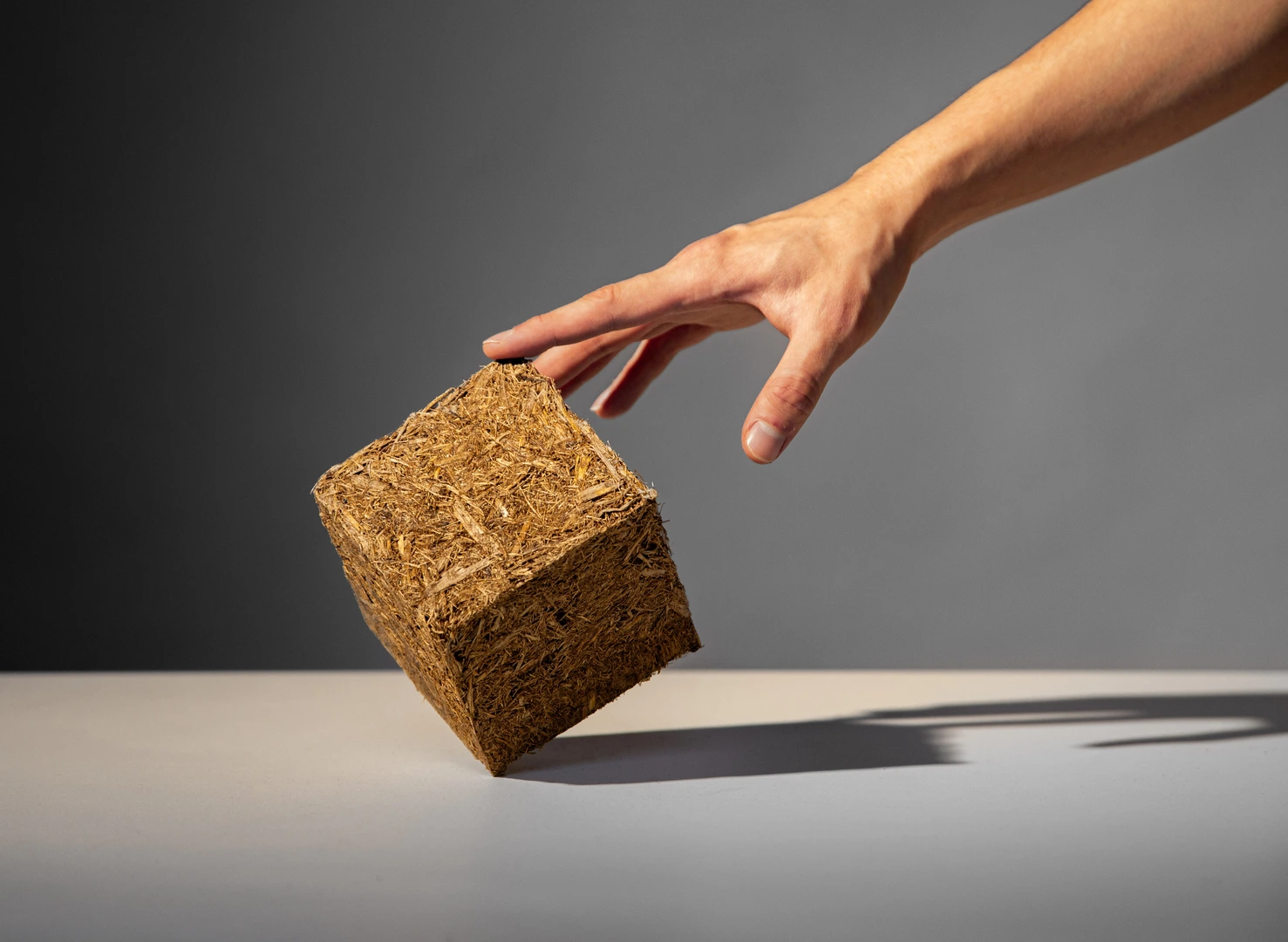
Sugarcrete combines residual sugarcane fibers with mineral binders. The University of East London’s documentation describes research into several components: insulating panels, lightweight blocks and solutions also intended for structural use. The university reports tests on mechanical, thermal and acoustic properties and on fire performance; results and applications should be read in relation to each specific component.
In the photographs released for the exhibition, the acoustic panels have textured surfaces, shaped profiles and earthy tones. The fiber remains visible. For an interior designer, that is already a design consideration: choosing a material also affects how a wall catches the light, adds depth and contributes to the character of a room.
The interesting question, then, is the gap between the sample and the specification. An interior panel and a masonry block do different jobs. They need documented performance, installation details, compatibility with other materials and a supply chain able to guarantee continuity. That is where promising research can turn into a genuine design choice.
From the lab to the communities that build
The London exhibition builds on long-running experimentation. In an update published on April 9, 2026, UEL describes the work in India of co-creators Alan Chandler and Armor Gutierrez Rivas: meetings with schools, communities and production partners, following the completion of a first school building in Sugarcrete.
In Hisar, in the Indian state of Haryana, a collaboration with the Paryatan Foundation focuses on developing the Aavishkaram Centre, an educational and community space. The process described by the university includes a hands-on workshop in which students, teachers, builders and residents worked with the blocks, combining them with earth- and lime-based techniques. This is an ongoing process, distinct from completed projects.
This step deserves as much attention as the material’s composition. Taking a product out of the lab means building skills: who prepares it, who installs it, who understands its limits. The opportunity to involve local communities adds a dimension to the project that a simple product data sheet struggles to convey.
Is Sugarcrete sustainable? It depends on the place
UEL presents Sugarcrete as a lower-carbon alternative to some conventional materials and links the research to regions where sugarcane is grown. The stated advantage therefore belongs to a system of production and use, and needs to be assessed under real-world conditions.
For designers working in Italy, the most useful lesson is the method: recognize an available resource and design the process that makes it usable. Before choosing a material for its environmental credentials, you need to know where it comes from, how it is processed and how far it has to travel. Even a plant residue requires a full life-cycle assessment.
The exhibition provides a starting point for that conversation. On Tuesday, September 15, there is a talk with Alan Chandler and David Watson of AKT II from 1 to 5 p.m., followed by a presentation of the research from 5:30 to 7:30 p.m. Both are opportunities to put questions about the material directly to the people developing it.
The exhibition is at 64 Turnmill Street, London, from September 14 to 18, 9 a.m. to 5 p.m. local time. Admission is free; VitrA asks visitors to register their interest for the talks. Up-to-date information is available on the London Design Festival event page.
Lead image: Sugarcrete acoustic panels, photo Cassandra Stuyt. Material photographs released by VitrA and London Design Festival; they do not show the exhibition installation.