At the editorial desk of Archi&Interiors.com, our ongoing dialogue with Italian design brands offers a daily, living observatory shaped over time through conversations, materials, new catalogs, collections, presentations, and in-depth analysis. Every day, we follow what is moving in the world of Italian furniture, interior design, and spatial planning with a perspective born from the …
At the editorial desk of Archi&Interiors.com, our ongoing dialogue with Italian design brands offers a daily, living observatory shaped over time through conversations, materials, new catalogs, collections, presentations, and in-depth analysis. Every day, we follow what is moving in the world of Italian furniture, interior design, and spatial planning with a perspective born from the intersection of different forms of expertise: journalism, design culture, and a close knowledge of the language of interiors and the transformation of living spaces.
For us, observing a new product does not simply mean registering its arrival. It means understanding whether it carries a real design vision, whether it introduces an interesting solution, whether it updates a material, a function, a proportion, or a way of living. Some products stand out because of their shape, others because of the intelligence of the system behind them, and others still because of their ability to interpret a contemporary need with precision. This is exactly where editorial work becomes useful: selecting, analysing, contextualising, and sharing with readers what truly deserves attention in contemporary Italian design.
Those who follow Archi&Interiors.com are interested in design, interior design, and architecture not as a purely aesthetic exercise, but as a cultural, design-driven, and emotionally resonant field. That is why new products should not simply be seen. They should be observed carefully, admired for what they express, and explored for what they reveal about the present and future of living.
This column begins from that idea. It is a space designed to collect and focus on design products, systems, and collections that are worth following closely. In this first edition, we have selected 14 Made in Italy design novelties from the 2025–2026 catalogs: seating, tables, systems, surfaces, lighting, and bathroom solutions that, each in their own way, are helping reshape the contemporary interior project.
Seating, tables, lighting, surfaces and systems: furniture trends worth watching
Across the new 2025–2026 catalogs, the landscape of Italian furniture continues to evolve in layered and interesting ways. Some products immediately attract attention with the strength of their image. Others stand out for their design balance. Others deserve a closer look because of how precisely they interpret the present moment in contemporary living. In this selection, we have gathered 14 proposals by Italian companies that, each with a different language, reflect some of the central directions in today’s interior design: modularity, material research, evolved comfort, visual lightness, the value of surfaces, and the return of detail as an element of identity.
From here on, our attention turns to products and collections that ask not only to be noticed, but also to be understood. Because the most interesting furniture trends are not necessarily the loudest ones, but those that add something meaningful to the way we imagine, design, and inhabit space.
Accento, Plissé: a rechargeable table lamp with a light and contemporary design
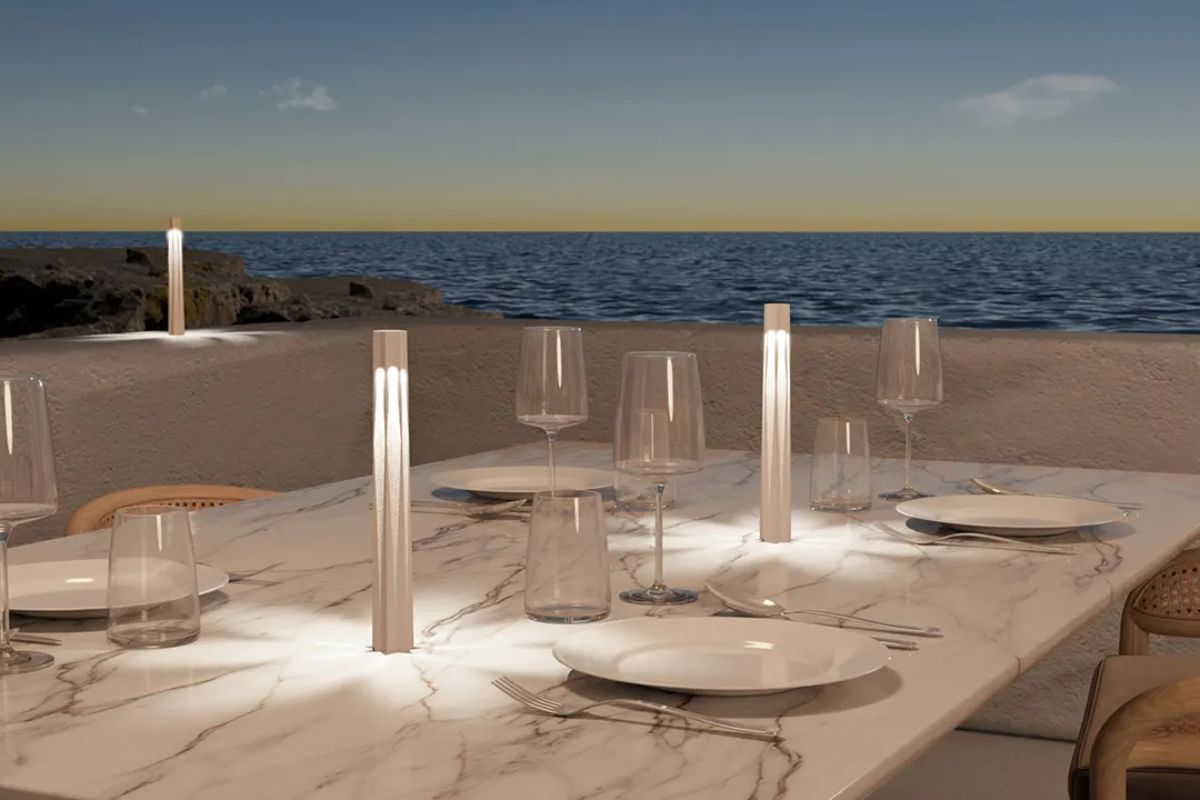
Among the novelties that best express a freer, lighter, and more contemporary idea of lighting, Plissé by Accento, designed by Masina Studio and introduced by the brand as a 2025 launch, deserves particular attention. The lamp explores the idea of folding in both name and form, turning it into an object that is slim, discreet, and immediately recognisable. From a technical perspective, it brings together several elements that are especially relevant in today’s interiors: wireless charging, touch dimming, diffused light designed for visual comfort, a Multi Jet Fusion 3D-printed structure, and a declared minimum battery life of six hours. The brand also presents it as a solution suited to both residential and contract settings.
What makes Plissé interesting, however, is not just the sum of its features. What stands out is the way it interprets one of the clearest trajectories in contemporary living: the desire for lighting that is less fixed, easier to move, and better able to accompany different uses and atmospheres without giving up quality or formal presence. In this sense, Plissé does not rely on spectacle. Instead, it works through measured elegance, something many Italian design brands are now pursuing with increasing precision. It is a quiet novelty, but one that speaks a very current language.
Bontempi, Kaleido: a sculptural table that turns the base into architecture
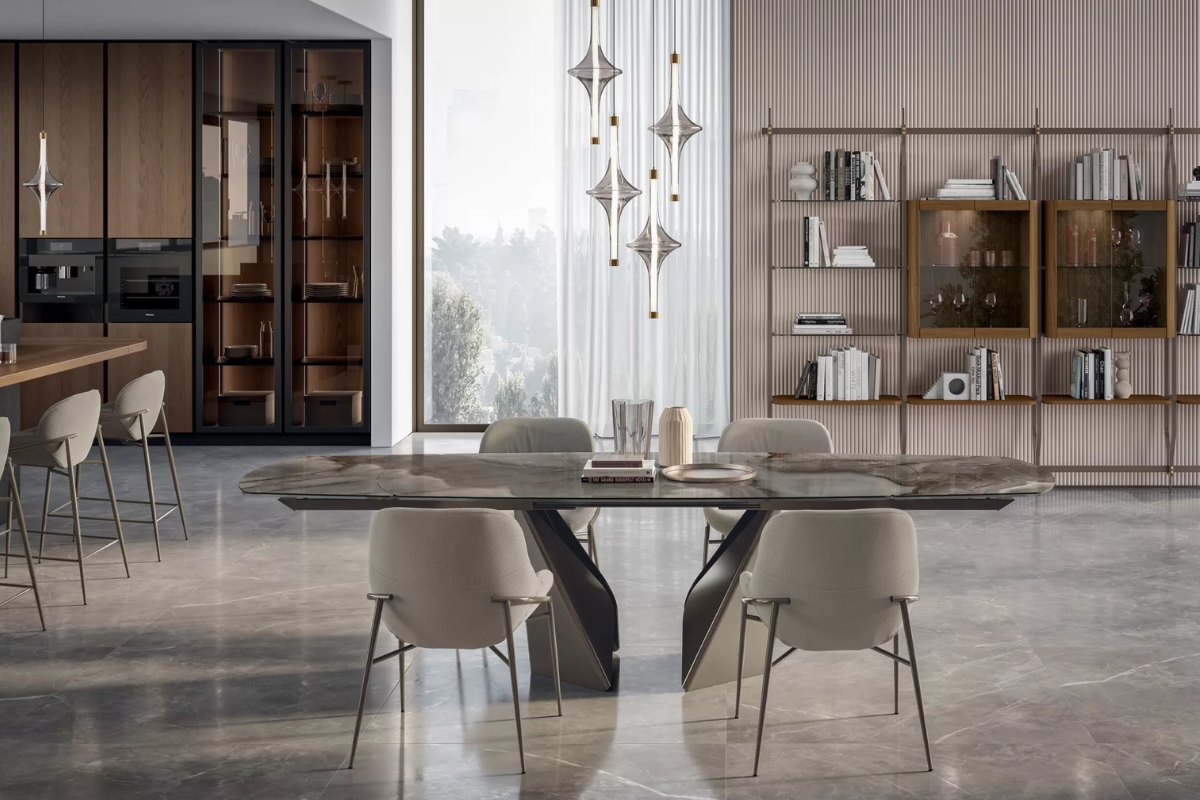
With Kaleido, Bontempi places a table at the centre of the dining space that works through presence, proportion, and structural force. The project stands out for its sculptural triangular-section base, designed to support tops in different shapes and sizes, while also offering a high degree of customisation through two- or three-element base configurations. In 2025, the product also received the IDA Bronze Award, further strengthening its position among the most interesting proposals of the moment.
What makes Kaleido worth watching is the way it restores the table to a fully architectural role. It does not try to disappear into the room, nor does it aim to become so light that it turns neutral. Instead, it embraces a strong presence built on balance, plastic tension, and the ability to organise the space around it. At a time when many interiors are once again embracing furniture with a stronger identity, Kaleido responds to that need with clarity, translating it into an object that combines function, monumentality, and restraint.
Tonin Casa, Ablos: a curved glass table that combines material, light and visual lightness
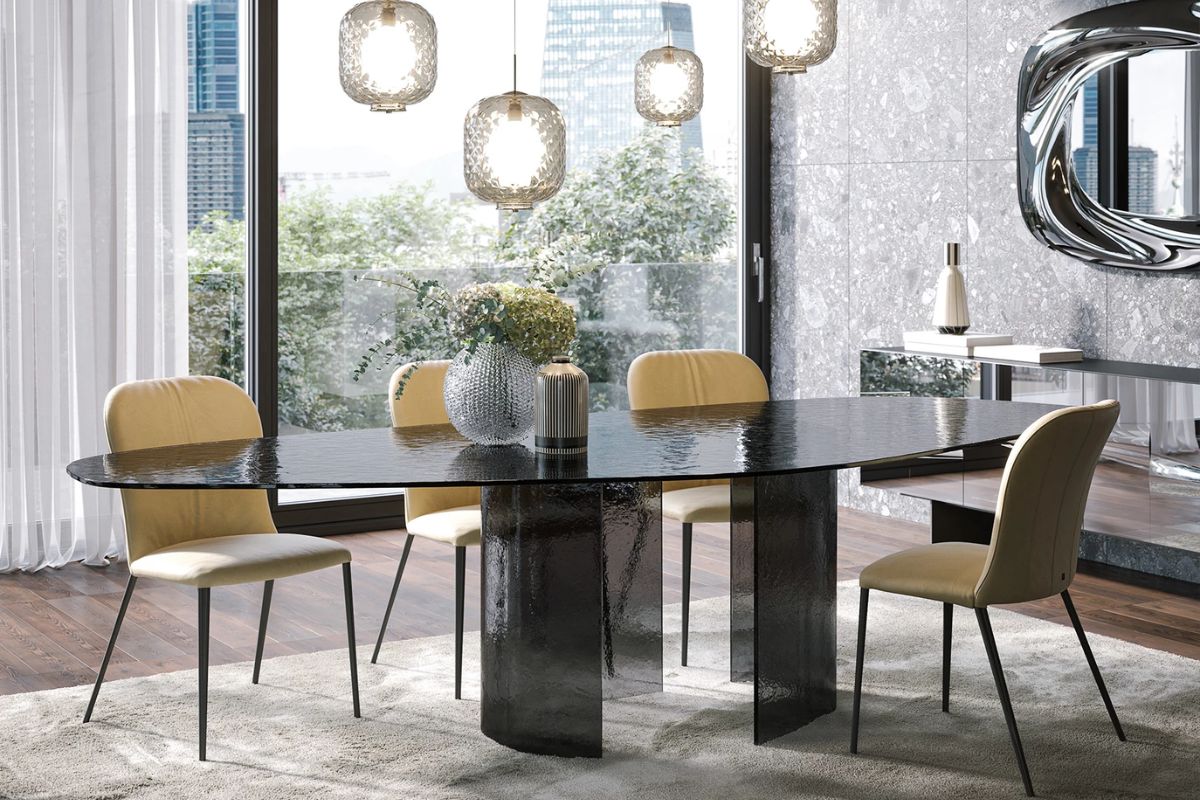
With Ablos, Tonin Casa presents a table that uses glass in a particularly expressive way. Designed by Andrea Andretta Studio and included among the brand’s 2025 novelties, the project is built around two hammered curved glass slabs that form the base and support an asymmetrical top, also in hammered glass. The result is a composition shaped by reflections, transparency, and luminous vibration, capable of changing perception according to light conditions and point of view.
The strength of Ablos lies in the fact that it does not use glass merely to lighten volume, but to create atmosphere. It is a table that introduces a highly sophisticated visual lightness into the living or dining area without losing character. It belongs in this selection because it clearly reflects one of the most interesting directions in contemporary interior design: a moment in which material is no longer celebrated for weight or mass, but for its ability to generate light, movement, and depth within a space.
Hidra, Bounce BN75: a countertop basin with soft lines for a more contemporary bathroom
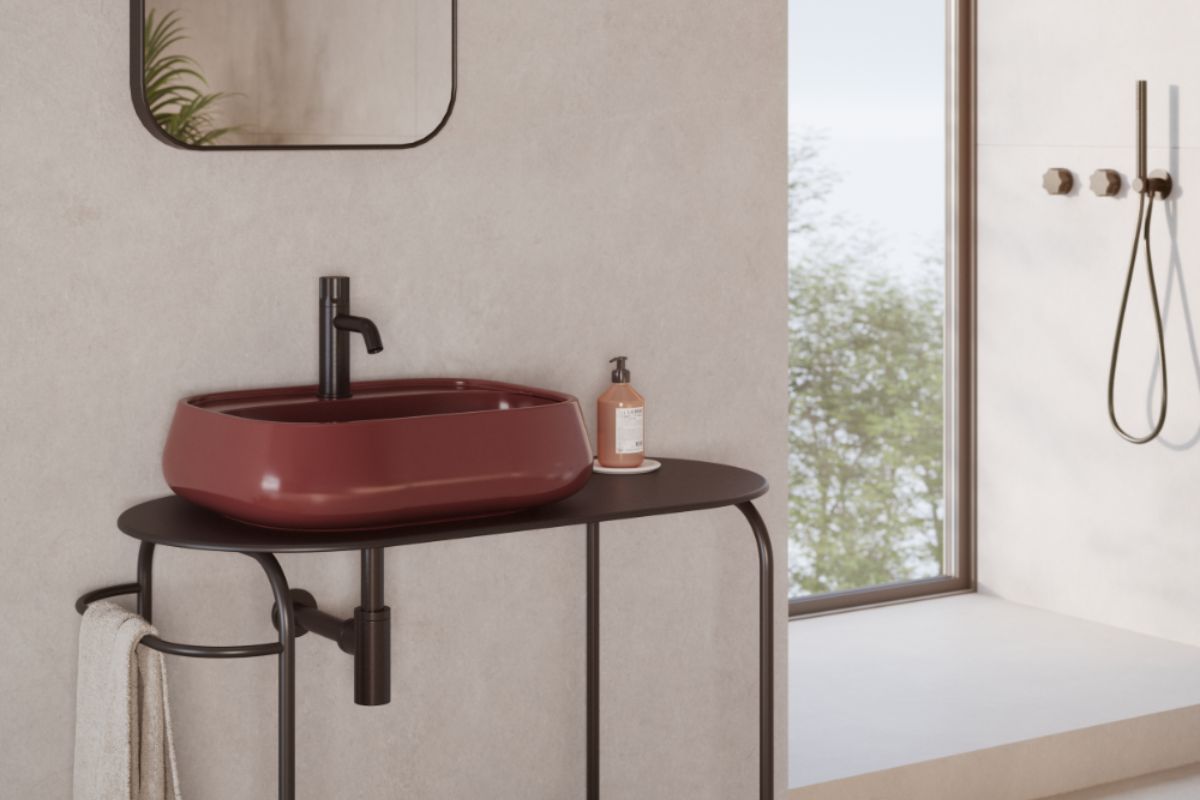
With BN75 from the Bounce collection, Hidra introduces a countertop basin that interprets the bathroom through a softer, more fluid language. The Bounce collection itself is based on a light and flowing gesture: lines become rounded, surfaces soften, and ceramic takes on a more welcoming and approachable presence. In the BN75 model, this formal direction is paired with a broad colour range that goes beyond white, opening up to matte finishes and more expressive shades.
What makes Bounce BN75 interesting is the way it presents the bathroom as less technical and more integrated into the wider language of interior design. Soft forms and colour help shift the basin from a purely functional element to a presence that contributes to the overall atmosphere of the room. It belongs in this selection for exactly that reason: it shows how sanitary ceramics are also evolving toward a more domestic, design-led, and contemporary sensibility.
BertO, IGGY: a modular sofa for a new way of living in the contemporary lounge
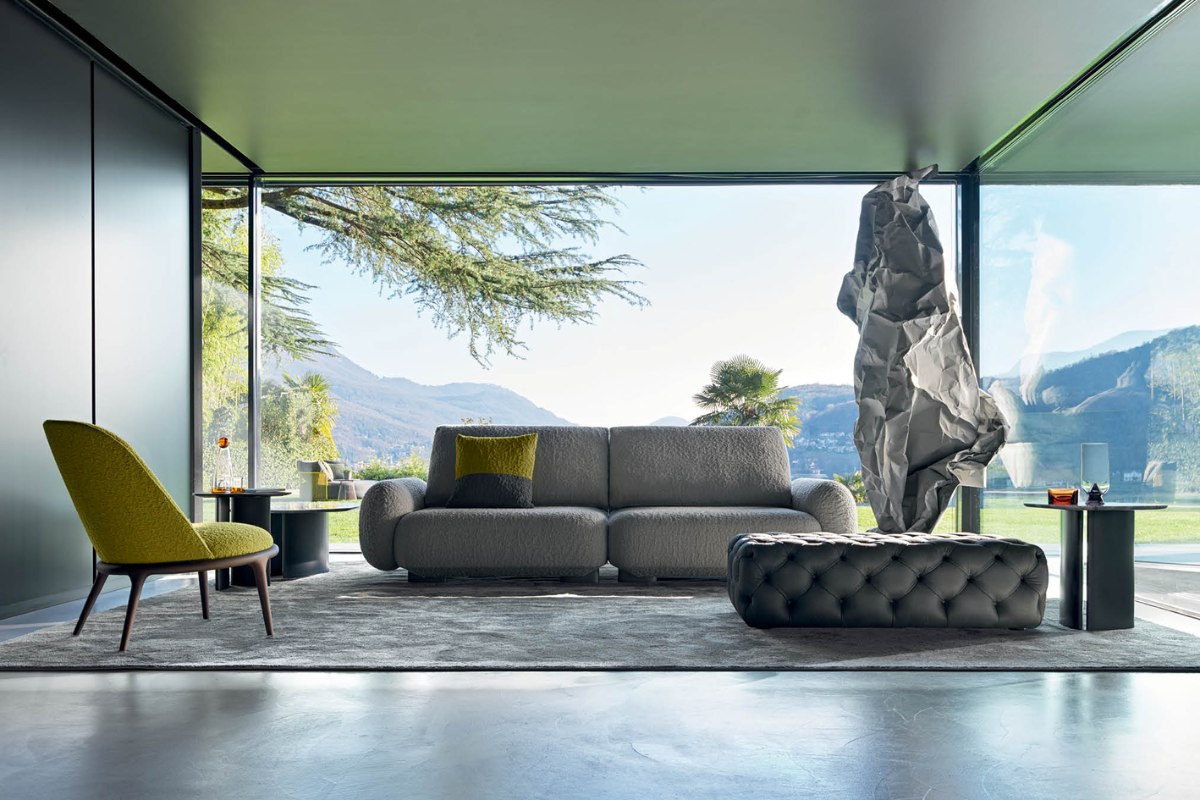
With IGGY, BertO presents an upholstered system that approaches modularity in an open and highly contemporary way. Designed by Castello Lagravinese Studio, the sofa was selected for the ADI Design Index 2025 and is built around 25 elements, including seats, backrests, and armrests, which can be freely combined to create different compositions. The system is completed by the Dive Console, conceived as an integral part of the project. BertO also highlights its attention to materials and the use of the Eco Seal Master system, which eliminates harmful solvents.
The most interesting aspect of IGGY is that it does not use modularity as a marketing formula, but as a concrete response to a more fluid, less static, and more personal home. Contemporary living spaces increasingly call for systems that can adapt to different lifestyles without losing formal coherence. IGGY fits naturally into this selection because it interprets precisely that need: a sofa that does not impose a single form, but instead helps shape a domestic landscape that is more flexible, evolving, and aware.
Cerasa, Honey Modern Take: bathroom furniture defined by essential lines, compact proportions and material depth
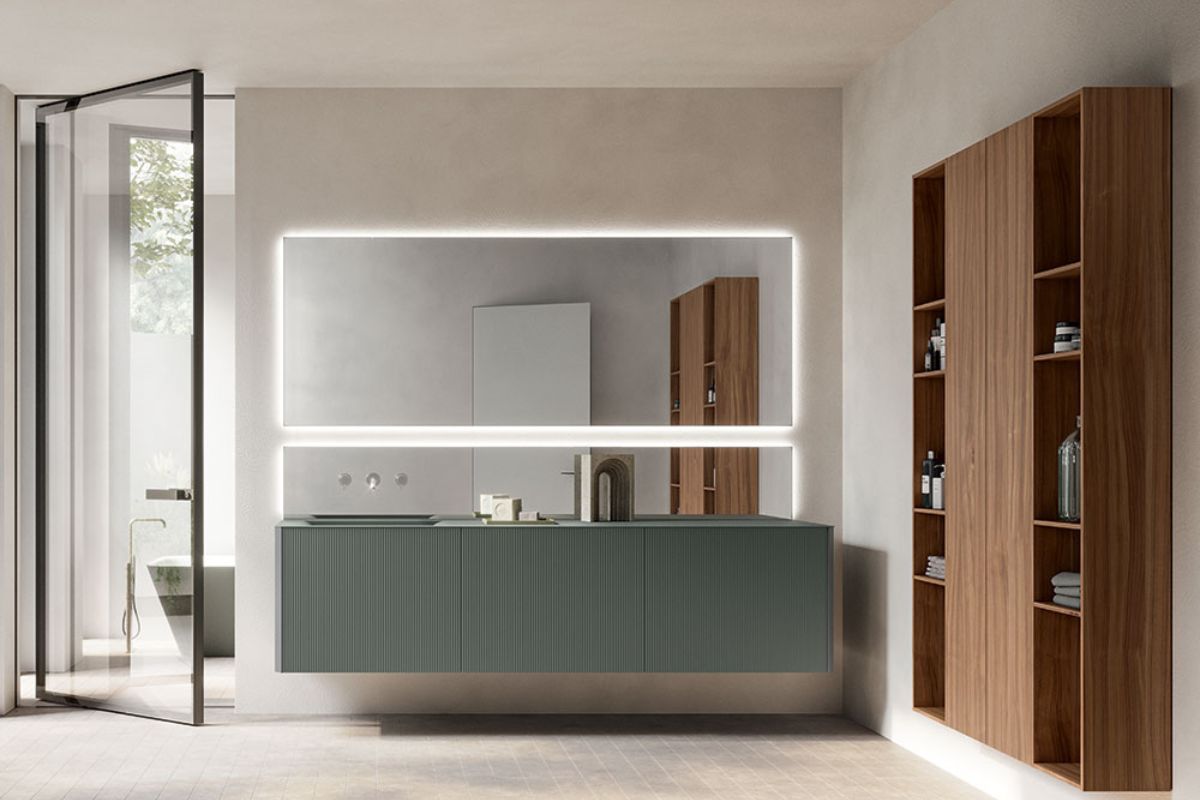
With Honey Modern Take, Cerasa updates an already recognisable collection through an evolution focused on lightness, functionality, and clarity of line. The innovations introduced in 2025 concern very concrete aspects: units are now also available in a 36 cm depth, a new push-to-open opening system has been added, and new Resina Paint and Deckblend inserts have been introduced on the metal front panel. The project maintains the material character of the Honey collection, while orienting it toward a more essential language that is also better suited to compact spaces.
What makes Honey Modern Take particularly successful is that innovation does not come through an emphatic gesture, but through the refinement of the system itself. At a time when bathroom design increasingly calls for precision, modularity, and careful space optimisation, this proposal manages to bring together compact dimensions, material richness, and clear identity. It is a novelty that speaks to a more mature design culture, where every detail helps shape a space that feels ordered, coherent, and well balanced.
Milano Bedding, Rufus: a design sofa bed that combines comfort, balance and understated presence
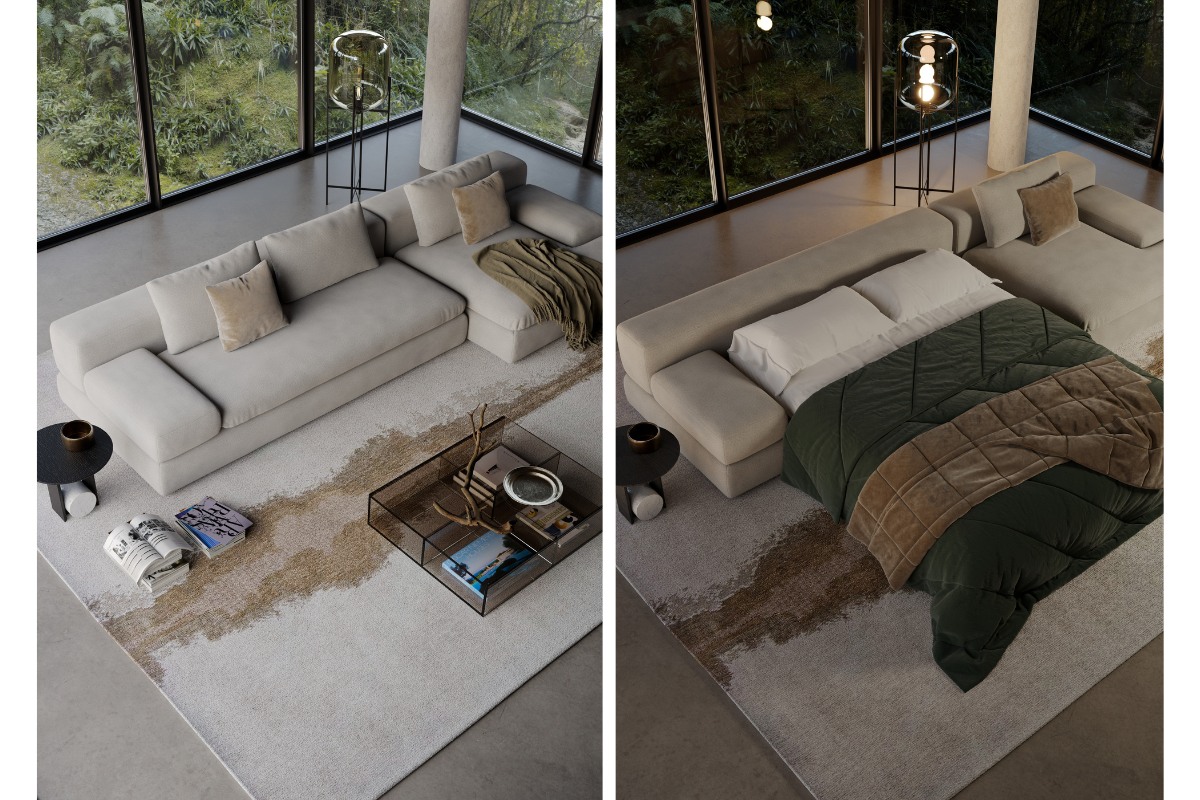
With Rufus, Milano Bedding continues its work of redefining the sofa bed as a true design object. Designed by Christophe Pillet and presented at Salone del Mobile 2025, the project stands out for its modern and minimal line, its low structure that almost touches the floor, and its generous yet controlled proportions. The model is available in fixed, convertible, or chaise longue versions, with a wide range of fully removable covers conceived for both residential and contract spaces.
What makes Rufus interesting is its ability to combine comfort, balance, and formal discretion. It does not aim for surprise, but instead works through proportion, proximity to the floor, and quality of presence, showing how even a highly functional product can enter contemporary interiors with elegance. It belongs in this selection because it confirms a clear direction: today, even the most pragmatic furniture typologies are being rethought with greater care, becoming fully part of the narrative of contemporary living.
Ronda Design, Caddy Fireplace: a modular metal wall system with an integrated fireplace
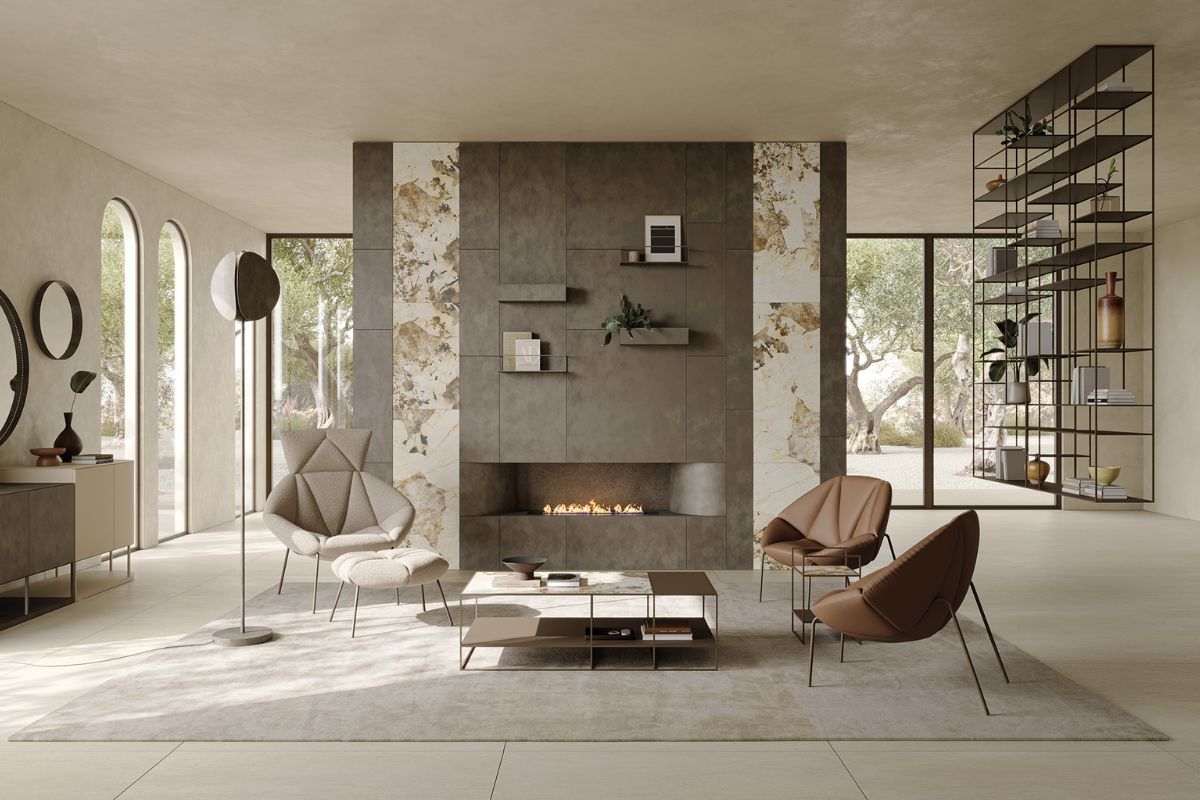
With Caddy Fireplace, Ronda Design develops a reflection that is becoming increasingly relevant in interior design today: the wall not as a simple backdrop, but as an active system capable of organising space and becoming an architectural presence. The brand presents the fireplace as an integral part of the Caddy system, a modular structure of metal panels that can be combined with shelves and repositionable magnetic accessories. What emerges most clearly is the idea of a free, customisable composition built through variable geometries and a material, metal, that Ronda continues to explore in the new BE YOUNIQUE catalog presented for 2025.
Caddy Fireplace is a strong proposal because it interprets one of the most evident shifts in contemporary interiors: the desire for surfaces that do not simply close or divide, but add function, atmosphere, and identity. Fire, inserted into a modular and magnetic system, is no longer only an emotional or decorative element. It becomes the centre of a wall that works as a design device. It is precisely this hybridisation between technique, material, and scenography that makes the product particularly interesting today.
Tonelli Design, Wonderwall: a glass wall covering with strong architectural impact
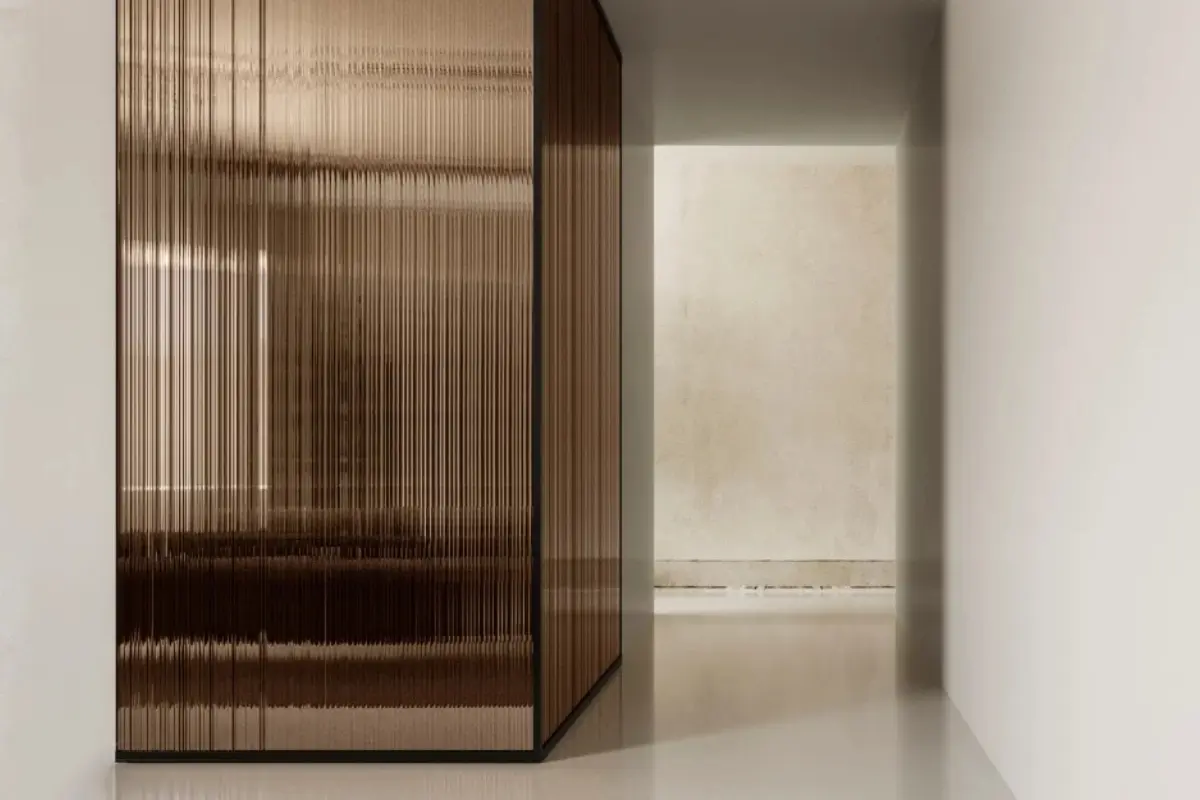
With Wonderwall, Tonelli Design takes glass beyond the dimension of the furnishing accessory and turns it into a true architectural surface. The system consists of tempered fused glass wall cladding, completed by black lacquered metal fixing profiles and the possibility of integrating dimmable LED lighting along the upper and lower edges. The result is a wall that does not simply finish or enclose a room, but actively transforms its perception, creating depth, reflection, and atmosphere.
Wonderwall’s distinctive quality lies in the way it reinterprets glass: not as a merely elegant or transparent material, but as a medium for visual construction. Here, the surface gains real design weight. It becomes presence, scenography, and an element capable of filtering light and giving rhythm to the room. At a moment when many interiors are seeking more sophisticated, immersive, and sensitive finishes without slipping into decorative excess, this proposal stands out because it offers a measured yet highly expressive solution. That is also why Wonderwall belongs among the most interesting design novelties to watch: it shows clearly how glass can once again become a protagonist in contemporary interior design, but with a more mature, architectural, and engaging language.
WallyArt, Louise: washable decorative wallpaper with light tones and a strong material sensibility
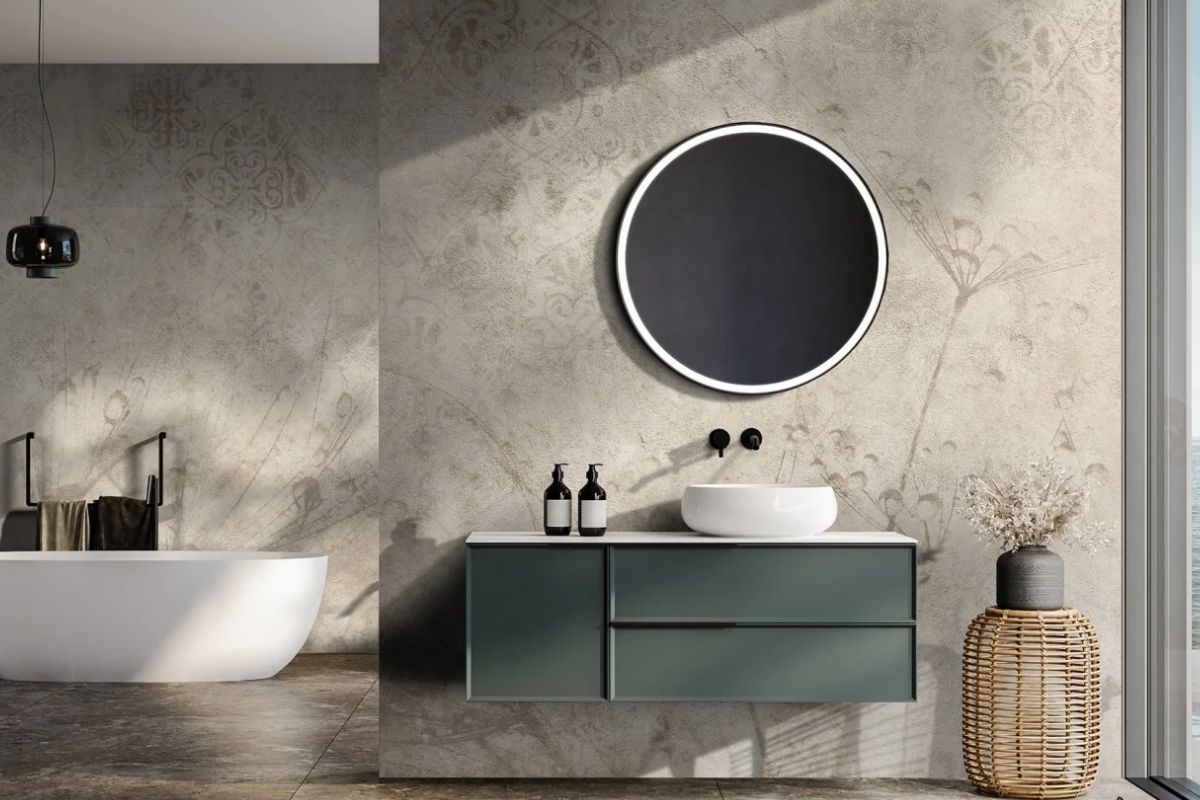
With Louise, WallyArt presents a washable TNT wallpaper that works on the wall through a delicate yet highly recognisable language. The design combines light colour tones, soft textures, stylised majolica elements, and dandelion motifs, creating a surface that does not dominate the space, but accompanies it with restraint. The product belongs to LaCollezione and is also available in fibreglass for use in humid environments such as bathrooms, showers, and kitchens, an aspect that significantly expands its design potential.
What makes Louise a novelty worth selecting is that it interprets wall decoration in a more mature way than many purely scenic proposals. Here, the wall is not overloaded with superfluous effects, but becomes a sensitive presence capable of introducing rhythm, visual lightness, and a certain atmospheric depth. At a time when interior design is looking for more expressive yet also more elegant and versatile surfaces, Louise shows clearly how contemporary wallpaper can return to the forefront without becoming excessive.
Agape, Sei: a modular wellness system for the bathroom, sauna and relaxation area
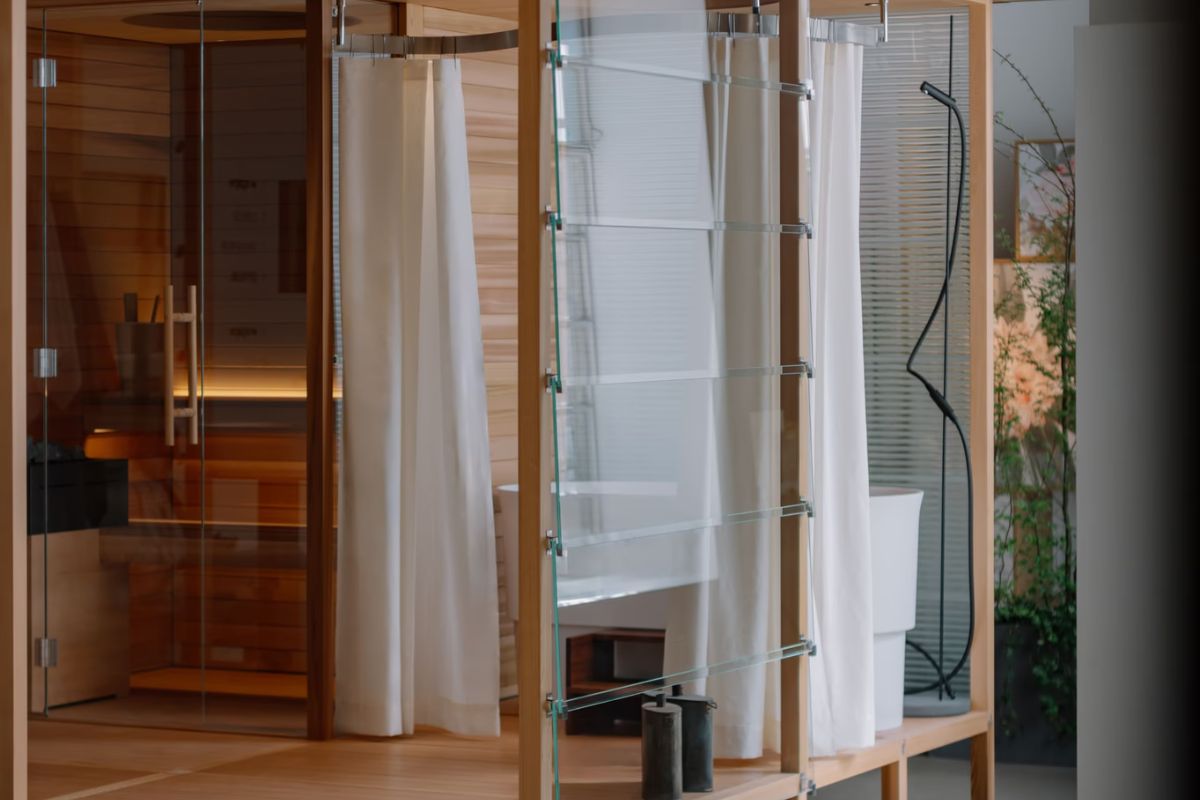
With Sei, Agape expands the bathroom project until it becomes a true domestic wellness space. It is not a single product, but a complete modular system built around a 6×6 cm solid wood structure and designed to accommodate different functions such as a sauna, bathtub, washbasin, relaxation area, and light fitness zone. Designed by Nicholas Bewick in collaboration with Cesare Roversi and Effe, the project stands out for its ability to bring order to very different needs within a coherent, clean, and architectural language.
What makes Sei particularly interesting is that it shifts the focus from the individual product to a broader vision of living. Here, the bathroom is no longer simply a room to equip, but becomes a micro-architecture dedicated to wellbeing, self-care, and a slower, more conscious daily life. At a time when interiors are increasingly seeking continuity between comfort, function, and perceptual quality, Sei stands out as one of the most significant novelties because it interprets wellness not as a separate luxury, but as an integral part of the contemporary design project.
Cristina Rubinetterie, Blade: a sharply defined tap with a contemporary design language
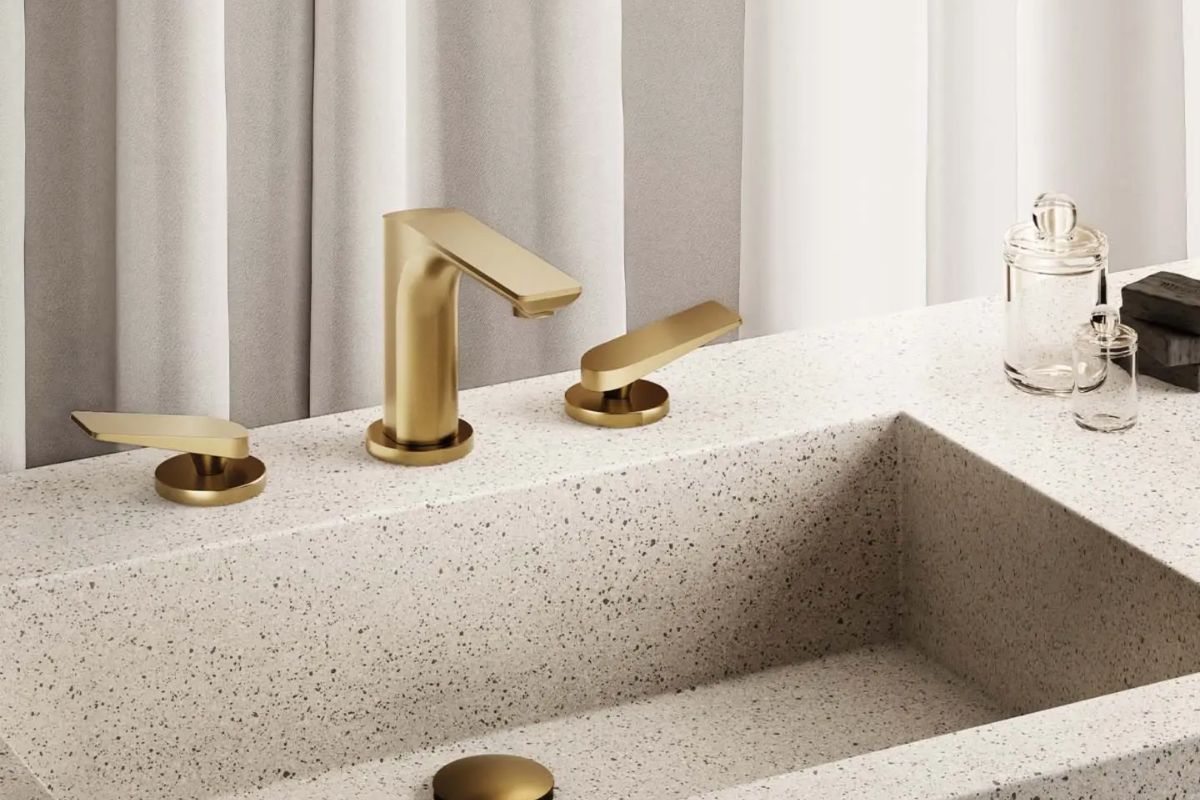
With Blade, Cristina Rubinetterie brings to the bathroom a cleaner, more precise, and more recognisable idea of tap design. Created by Alessandra Bertini – Phicubo, the collection stands out for sharp cuts that sculpt the form of the mixer and for a lever positioned above the body of the tap, conceived as a thin sign, almost like a blade, capable of giving the product an immediate identity. Its character is reinforced by the wide range of available finishes, from chrome to matte black, as well as various metallic and PVD interpretations.
What makes Blade an interesting novelty to include is the way it transforms a technical element into a genuine design presence. In today’s contemporary bathroom, even the mixer contributes to the atmosphere: it is no longer just a functional component, but a detail that can influence the visual balance of the room. Blade works precisely on this threshold between function and identity, with a sharp yet measured language capable of adding character to the water point without weighing it down. It is a proposal that clearly shows how tapware is increasingly becoming part of the overall narrative of the interior.
Boffi, Cove Kitchen: a sculptural kitchen by Zaha Hadid Design defined by fluidity and conviviality
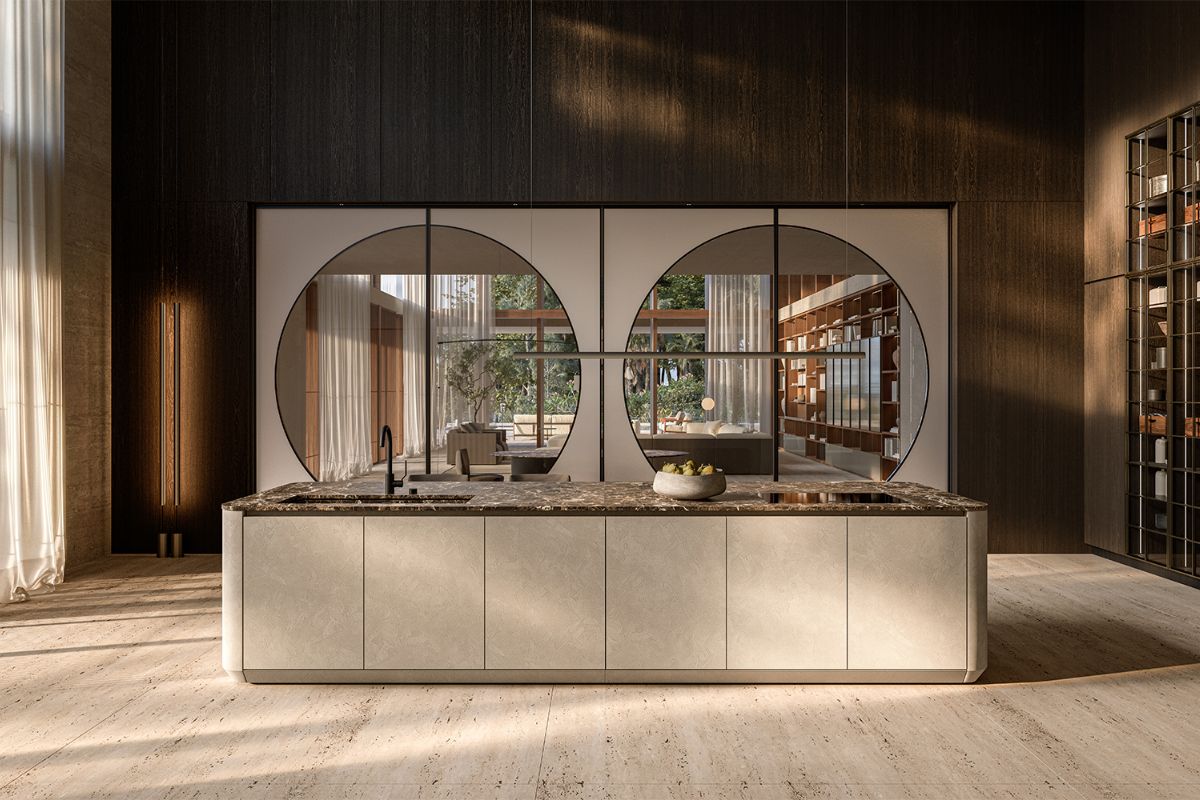
With Cove Kitchen, Boffi presents a kitchen that brings a strongly architectural image into the interior. Designed by Zaha Hadid Design, the project was first launched in 2017 as a limited edition, renewed in 2024 for Boffi’s 90th anniversary, and updated again in 2025 with new finishes for doors and worktops, as well as the introduction of a full-length snack counter on the rear side. Its forms remain fluid, sinuous, and almost monolithic, transforming the kitchen into a presence that goes beyond function to become an active part of the spatial composition.
What makes Cove Kitchen still highly relevant today is its ability to combine formal research with everyday life. Here, the kitchen is not conceived as a simple technical volume to be equipped, but as an element that organises the environment, makes it more fluid, and reinforces its convivial dimension. Zaha Hadid’s signature is recognisable in the dynamic lines, but the most interesting point lies elsewhere: this kitchen continues to show how a product can evolve over time without losing its original strength, renewing its role within the contemporary interior project.
Poltrona Frau, DressCove Night System: a modular wardrobe and walk-in closet system shaped by quiet luxury
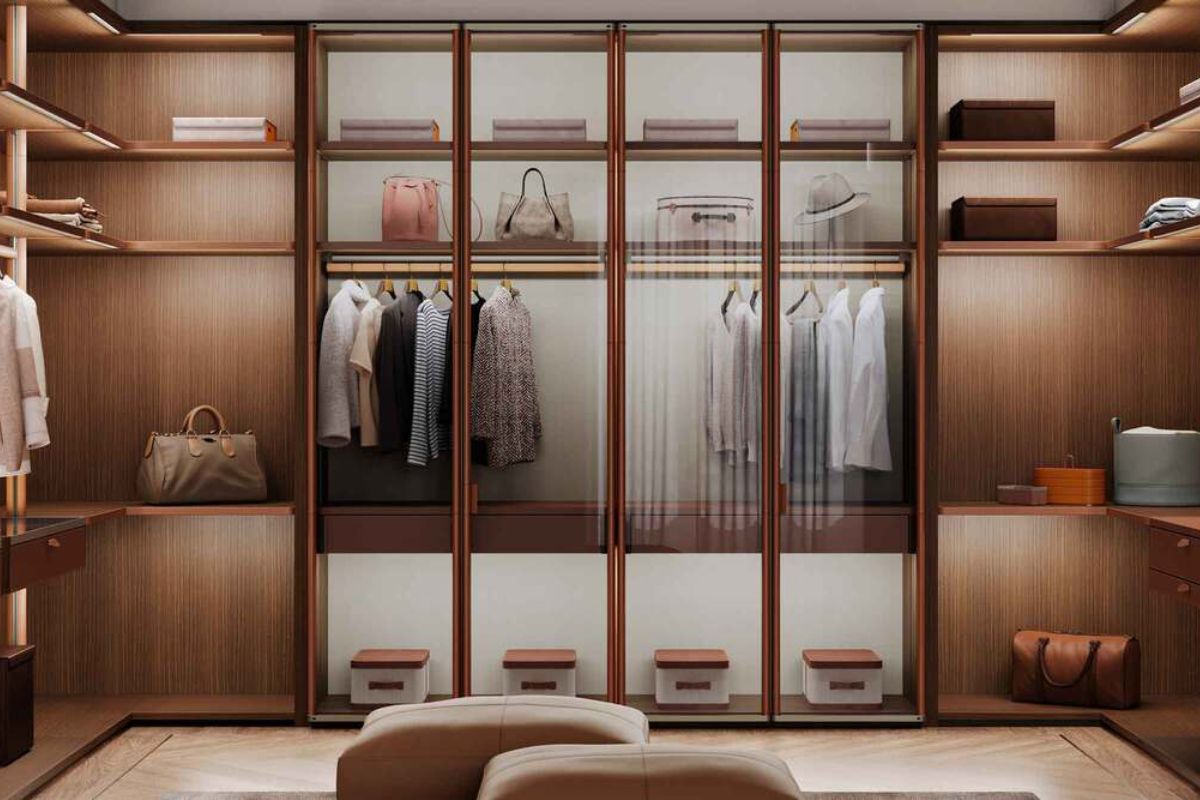
With DressCove Night System, Poltrona Frau opens a new chapter in the night area by entering the world of modular wardrobes and walk-in closets. Designed by Dante Bonuccelli, the system translates into this field a precise vision of living: order, material continuity, attention to detail, and perceptual quality. It is not just about storing or organising, but about shaping an intimate and personal space with the same care now applied to the living room or kitchen. Finishes, proportions, and craftsmanship all contribute to defining an ensemble that is measured, elegant, and conceived to bring value even to an area of the home often considered secondary.
What makes DressCove Night System particularly interesting is exactly this shift in perspective. The wardrobe area is no longer treated as a purely technical zone, but becomes a full part of the interior design project, a place where function and atmosphere find a more mature balance. Poltrona Frau interprets this transformation through a coherent language made of rigour, softness, and understated luxury. That is why DressCove Night System fits naturally among the novelties worth watching: it reflects one of the most meaningful changes in contemporary interiors.