Fluted glass is a translucent glass characterised by a surface with linear ribs, usually vertical, that distort the view through the pane and diffuse light. In interiors, it is particularly useful when the aim is to separate spaces without completely closing them off visually: doors between kitchens and living rooms, glass partitions, furniture, walk-in wardrobes …
Fluted glass is a translucent glass characterised by a surface with linear ribs, usually vertical, that distort the view through the pane and diffuse light. In interiors, it is particularly useful when the aim is to separate spaces without completely closing them off visually: doors between kitchens and living rooms, glass partitions, furniture, walk-in wardrobes and bathrooms can all receive light while maintaining different levels of visual screening. The fluted texture, however, does not automatically make the glass private, safe or acoustically performing. These characteristics depend on the pattern, the viewer’s distance and, above all, the composition of the pane: annealed, tempered, laminated or incorporated into more complex glazing systems.
What is fluted glass and why does it change the perception of space?
Fluted glass belongs to the broader family of patterned or textured glass. During production, the glass passes through rollers that imprint a texture onto the surface; Saint-Gobain describes its DECORGLASS as glass produced by passing the material between engraved rollers, while Pilkington defines texture glass as rolled glass with a pattern impressed onto one of its surfaces.
With fluted glass, the texture follows a predominantly linear pattern. The AGC Imagin catalogue, for example, includes Flutes and Flutes Mat, confirming that the general term fluted glass covers products with different geometries, surface finishes and levels of translucency.
From a design perspective, the most interesting aspect is what happens between transparency and opacity. The glass continues to transmit light, but the ribs refract and distort what lies beyond the surface. The space behind remains perceptible through presence, colour and movement, while details and outlines become less legible.
Light and privacy: fluted glass filters the view rather than removing it
The word “privacy” should be used with caution. Manufacturers themselves classify decorative glass according to different levels of obscuration, meaning how effectively the pane makes it difficult to see through. Pilkington, for example, uses a scale from 1 to 5 within its Texture Glass range, while AGC specifies that the degree of translucency and visual screening depends on the structure of the pattern.
This means that there is no universal privacy level for fluted glass.
A person standing very close to the pane may remain easier to recognise than someone positioned several metres further away. The lighting contrast between the two spaces also changes perception: a backlit person may still appear as a silhouette even behind strongly textured glass.
For a hallway door, this may be perfectly sufficient. For an en-suite bathroom, meeting room or any space requiring genuine visual screening, however, it is better to test a sample at the actual viewing distance and under the lighting conditions expected in the project.
Fluted glass doors: how to preserve light between rooms
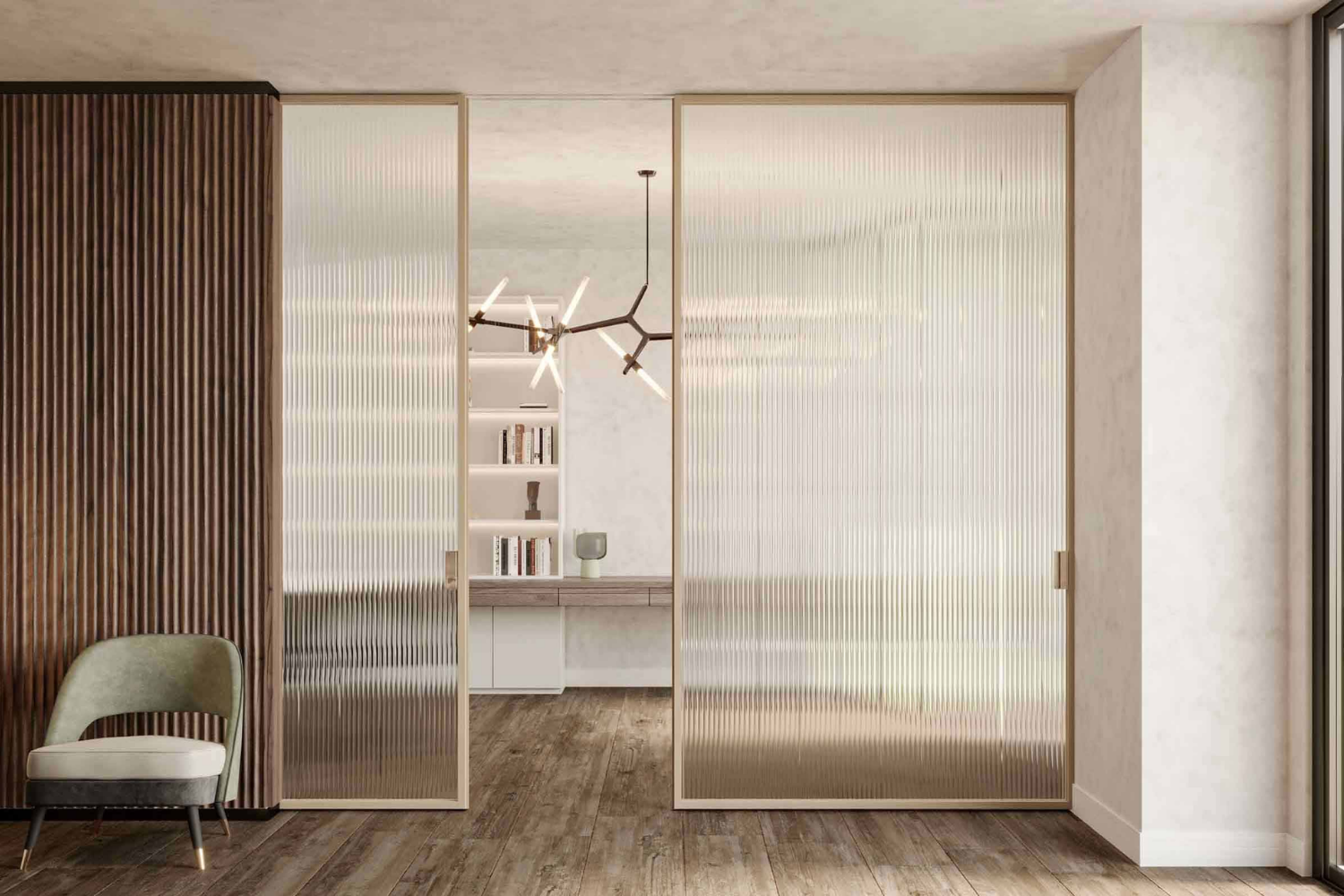
Doors are one of the most effective applications because they allow two functions to be separated without completely interrupting the passage of light.
Between the kitchen and living room, a sliding fluted glass door can visually contain the working area while avoiding the effect of an opaque wall. In the Caco Apartment by ponto.d, published by ArchDaily, sliding timber and fluted glass doors separate the living room from the study and the kitchen from the laundry, preserving natural light and a sense of openness.
The choice of frame significantly changes the result. A slim, dark metal profile makes the geometric rhythm of the door more legible; natural aluminium or steel can give it a more technical character; timber, by contrast, softens the industrial reference and creates a more tactile relationship with the surrounding materials.
Vertical fluting also tends to emphasise the height of the opening. For this reason, on full-height doors it is often more effective to avoid too many horizontal transoms and allow glass and frame to read as a single surface.
Glass partitions: separating functions without building a wall
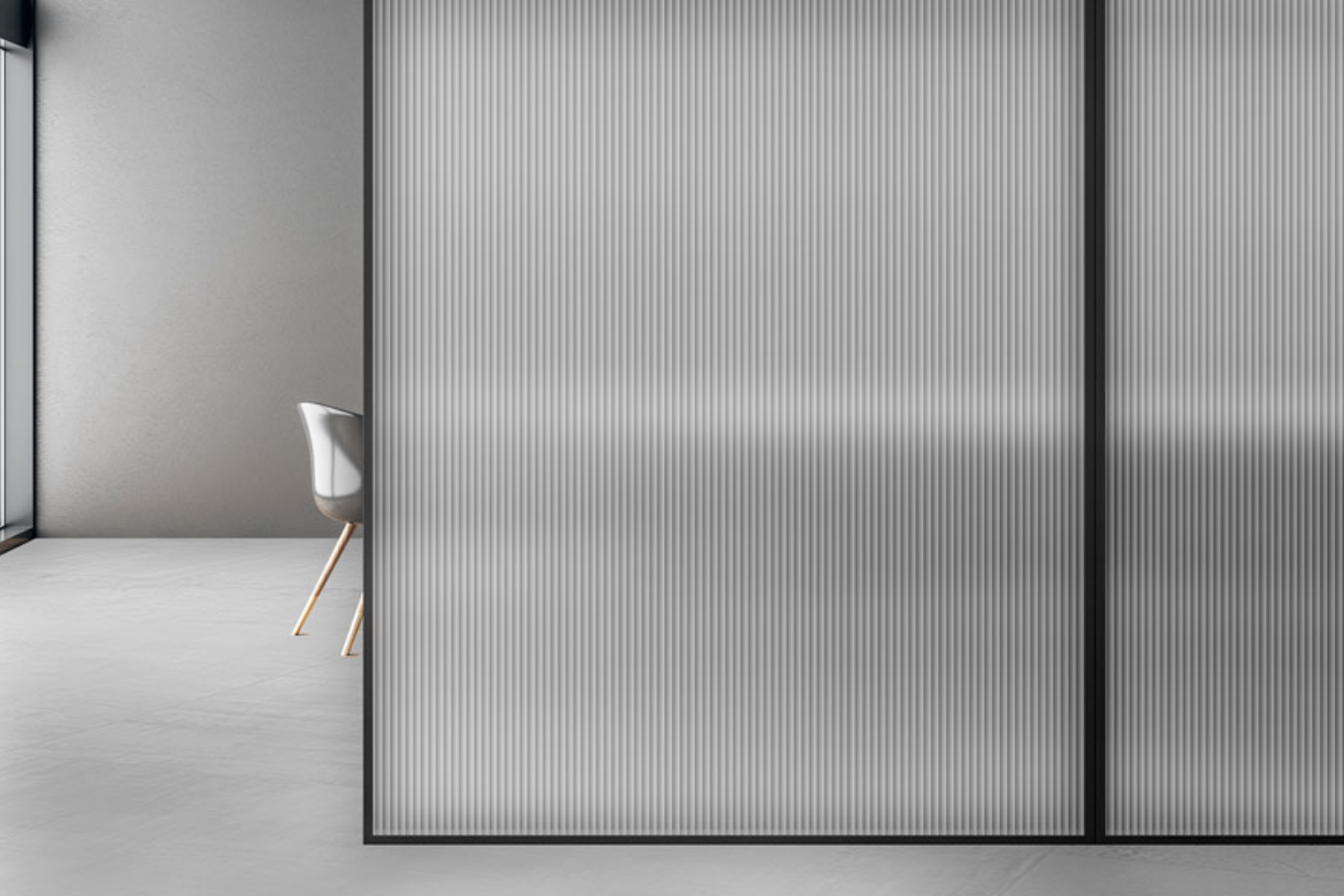
In partitions, fluted glass becomes a genuine tool for organising space.
It can separate an entrance from a living room, a study from the main living area, a kitchen from a dining space or a bedroom from a bathroom without creating the hard division of a plasterboard wall. The surface still suggests depth, movement and light coming from the adjoining room.
Villa Sipat & Sauh by Arkana Architects uses a translucent timber and fluted glass partition between the kitchen, dining area and living room: the division defines the different spaces while maintaining a filtered visual relationship between them.
A different approach appears in the Living Without Boundaries Apartment by A I M, where a band of fluted glass incorporated into a volume finished in iron and lime allows natural light to reach a laundry room positioned inside the block. Here, the glass is not simply a decorative wall: it becomes an entry point for daylight into an otherwise enclosed space.
Fluted glass in the kitchen: cabinet doors, pantries and partitions
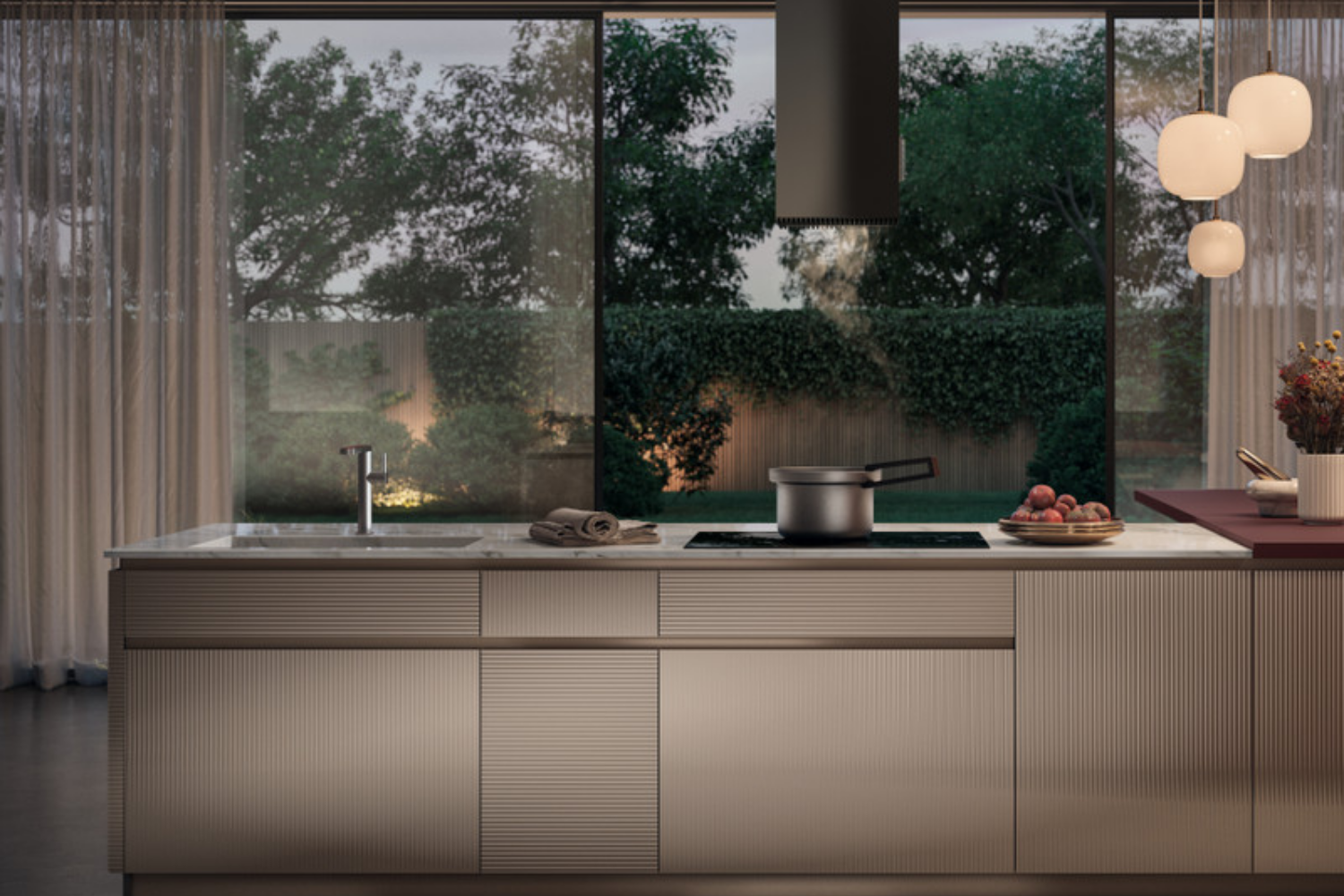
In the kitchen, fluted glass can operate at two very different scales.
The first is architectural: large doors or partitions between the kitchen, living room and laundry. In Apê Galeria by Lez Arquitetura, the kitchen can be opened or separated from the dining area through sliding steel and ribbed glass doors, making the relationship between the two rooms adjustable throughout the day.
The second concerns cabinetry. Fluted glass fronts on wall units, display cabinets and tall units allow crockery and objects to remain partially visible without exposing them with the clarity of transparent glass. The effect works particularly well when integrated lighting is installed inside the cabinet: light passes through the glass while bottles, plates and containers become blurred shapes.
It is worth remembering, however, that a textured surface can retain dirt more easily than completely smooth glass. Close to hobs and areas particularly exposed to grease, the orientation of the textured face should also be considered from a cleaning perspective.
Furniture and display cabinets: revealing without putting everything on show
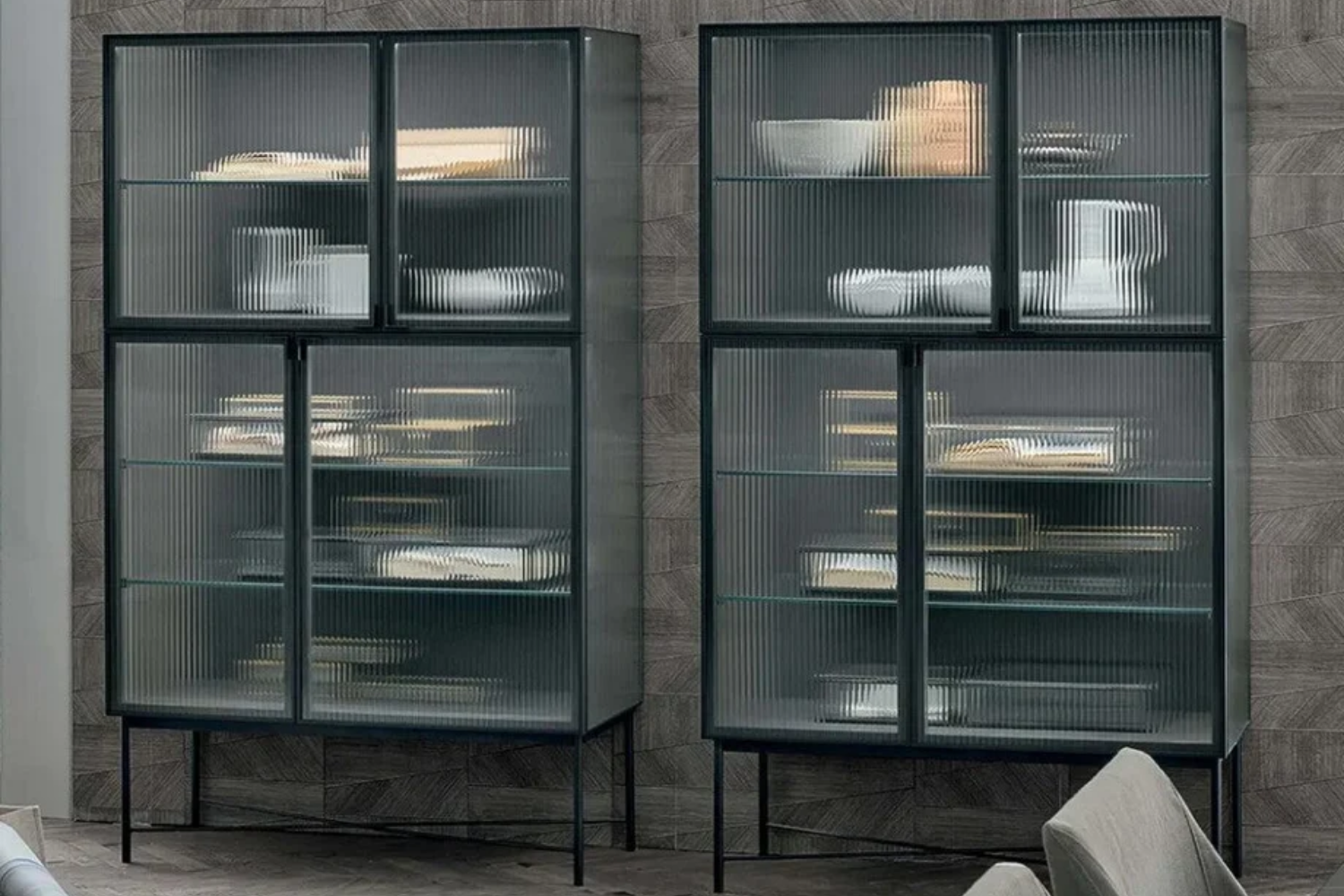
In furniture, the main advantage is not necessarily privacy, but controlled visual permeability.
In 2026, ArchDaily collected several Brazilian interiors in which reeded glass is used for kitchen and wardrobe doors. In the JMR Apartment by Prototype, for example, it appears both in partitions and kitchen fronts; in the Lido 501 Apartment by Atelier Aberto Arquitetura, it helps differentiate the kitchen cabinetry from the other joinery elements.
It is particularly useful when the aim is to lighten a large full-height furniture composition. Alternating opaque fronts with fluted glass breaks up the visual mass of the joinery without introducing the visual clutter that a fully transparent display cabinet can create.
In bathrooms, privacy and safety must be considered separately
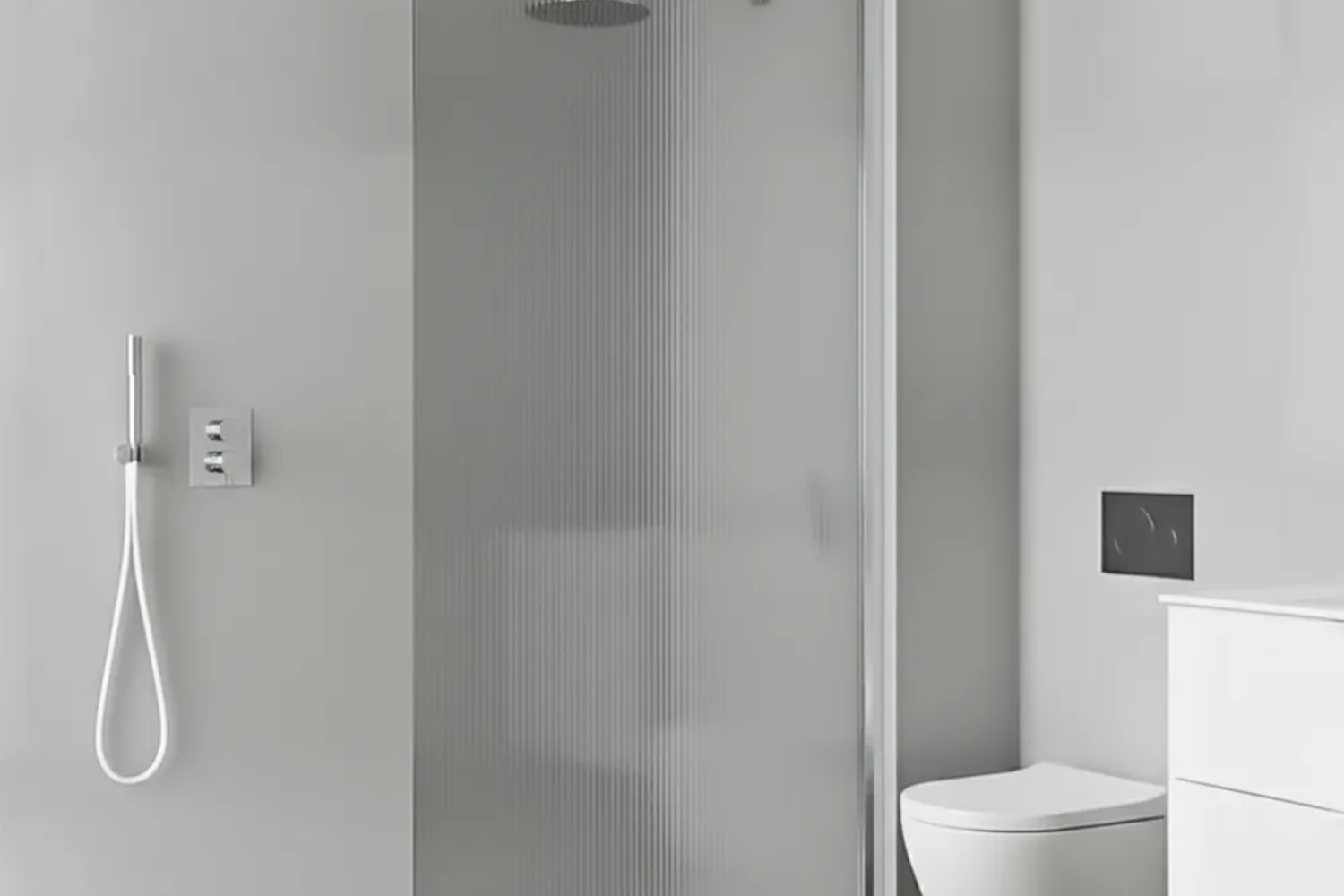
Its ability to diffuse the view makes fluted glass a natural choice for showers, doors and partitions between bedrooms and bathrooms.
In the DT Apartment by Traama Arquitetura, the walls between the main bedroom and bathroom were replaced with metal partitions containing fluted glass, allowing more natural light into the bathroom while maintaining a degree of visual separation between the two spaces.
This is where safety also becomes important.
The fact that a glass pane is fluted relates to its texture, not to its ability to resist impact. In doors, showers, full-height glazing and other locations exposed to accidental impact, the specified product and glass composition must comply with the requirements applicable to that position and use. Pilkington notes that impact-resistance classification depends precisely on the dimensions and location of the pane.
Tempered or laminated glass: what actually changes?
Tempered safety glass undergoes a heat treatment that increases its strength; if it breaks, it tends to fragment into small pieces rather than forming large sharp shards. Once broken, however, the pane substantially loses its function as a barrier.
Laminated glass, by contrast, is composed of two or more panes bonded together with one or more interlayers, commonly PVB. If it breaks, the fragments tend to remain attached to the interlayer. Thickness, number of panes and interlayer type are selected according to the required performance.
Not all decorative patterns can be processed in the same way. AGC indicates, for example, that some Imagin products can be tempered, while others can be assembled as laminated or insulating glass units. The check must therefore be made on the specific product reference, not on the general category of fluted glass.
The presence of metal wire does not provide an automatic shortcut either: Pilkington specifies that one of its textured wired-glass products does not have an EN 12600 impact classification and is not suitable for doors.
Does fluted glass provide acoustic insulation?
A specific acoustic performance cannot be attributed to glass simply because it is fluted.
Sound insulation depends on the complete composition of the glazing system, including glass thicknesses, any acoustic lamination, cavities and, above all, the frame, seals and joints. Pilkington notes that its textured glass can be incorporated into insulating glass units to achieve additional properties, including noise control: it is therefore the resulting system that must be assessed.
A sliding fluted glass door with perimeter gaps, for example, does not become an effective acoustic barrier simply by increasing the thickness of the pane.
How to combine fluted glass with metal, timber, stone and colour
The most obvious risk is treating fluted glass as an automatic retro reference.
Slim black frames, tightly spaced fluting and geometric modules can recall industrial glazing or twentieth-century interiors. But the same material changes completely when paired with light oak, stainless steel, natural stone, lime finishes or monochromatic surfaces.
In Segur Flat by faire, for example, fluted glass, okoumé and birch plywood and granite create a sequence far removed from the stereotypical image of a vintage glass door.
A contemporary result depends above all on restraint: fewer decorative profiles, greater attention to proportion and a texture selected for what it actually needs to filter.
How to clean and maintain fluted glass
A ribbed surface requires more attention than smooth float glass.
For patterned glass, Pilkington recommends clear, non-abrasive cleaning products; when dirt enters the recesses of the texture, a nylon brush or another suitable soft-bristled brush may be used. Products containing insoluble particles can instead become trapped in the grooves and prove difficult to remove.
When designing a kitchen, shower or piece of furniture, it is therefore worth checking which side of the pane carries the texture and whether the easier-to-clean surface can face the area most exposed to dirt and splashes.
When is fluted glass best avoided?
Fluted glass is less suitable where a completely unobstructed view is required, where the space needs genuine blackout, or where absolute privacy is expected at very close range.
It should also not be treated as a stand-alone solution for acoustic insulation, burglary resistance or safety: these functions require certified glass compositions and complete systems designed for the relevant performance.
Its most convincing quality lies elsewhere: making a boundary permeable.
A door remains a door, a partition continues to divide two functions, and a wall cabinet continues to conceal what it contains; yet light crosses the boundary and the presence of the adjoining space remains perceptible. It is precisely this intermediate condition that makes fluted glass so effective in contemporary interiors. Used with restrained framing, precise proportions and coherent materials, it stops feeling like a retro reference and becomes an architectural element capable of controlling views, light and depth.