Brutalist interiors today do not necessarily mean an entirely grey home or the indiscriminate use of exposed concrete. The historical reference is more complex: in British New Brutalism of the 1950s, structural legibility, the direct use of materials and the power of architecture as an image were central; Le Corbusier’s béton brut later helped make …
Brutalist interiors today do not necessarily mean an entirely grey home or the indiscriminate use of exposed concrete. The historical reference is more complex: in British New Brutalism of the 1950s, structural legibility, the direct use of materials and the power of architecture as an image were central; Le Corbusier’s béton brut later helped make unfinished concrete one of the movement’s most recognisable visual languages. Today, that design culture is reinterpreted through concrete, stone, timber, metal, massive volumes, sculptural furniture and light, often introducing warmth and colour precisely to prevent raw materials from becoming mere scenery.
Where Brutalism comes from and why it does not simply mean concrete
The origins of Brutalism are less straightforward than its current use in the language of interior design might suggest.
In the early 1950s, Alison and Peter Smithson used the expression New Brutalism to describe a design position that reacted against a certain normalisation of post-war modern architecture. Harvard Graduate School of Design emphasises that, for the Smithsons, it was above all an ethic rather than a style, based on the direct expression of the material and constructional conditions of a project.
In 1955, critic Reyner Banham attempted to codify this research in the pages of The Architectural Review. The three principles he identified concerned the building’s ability to create a memorable image, the clear legibility of structure and the value given to materials in their as found condition, without artificially disguising their nature.
This is essential for understanding contemporary interiors: historical Brutalism did not begin as a synonym for exposed concrete.
M+ in Hong Kong similarly recalls that the Smithsons focused on the possibility of seeing materials for what they were: timber as timber, sand as sand, structure as structure. Concrete would become fundamental to the visual identity of Brutalism, but it does not define the concept by itself.
Béton brut: what Le Corbusier’s raw concrete really means
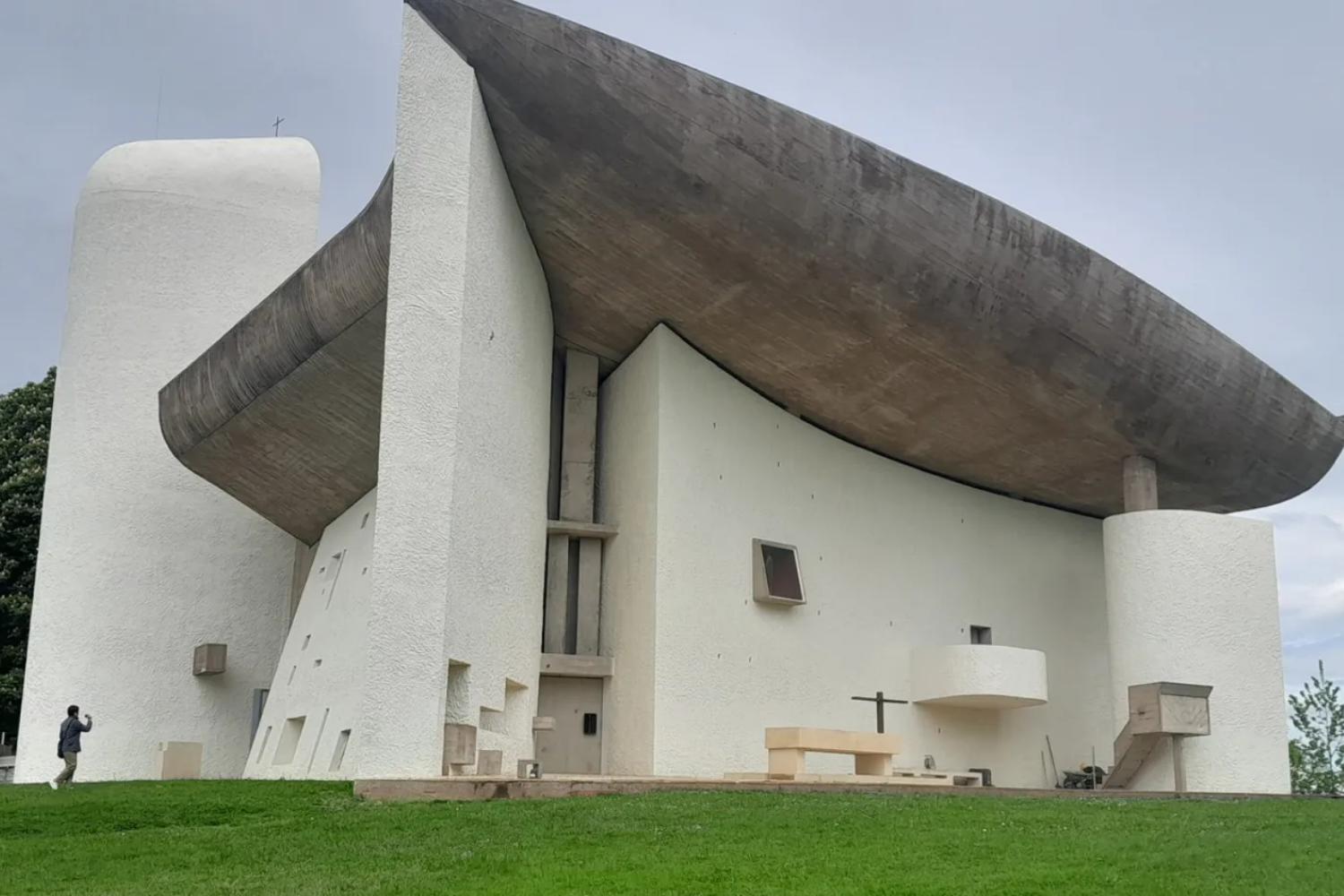
Alongside developments in Britain, the work of Le Corbusier played a decisive role in shaping the material culture later associated with Brutalism.
At the Unité d’Habitation in Marseille, designed from 1945 and inaugurated in 1952, the structure was built in cast-in-place reinforced concrete, with sections of the façades deliberately left unfinished. In his opening speech, Le Corbusier explicitly referred to the new expressive potential of béton brut.
Béton brut literally means raw concrete: a surface that retains the visible presence of construction rather than necessarily being covered with plaster, stone or another finish.
At the Maisons Jaoul in Neuilly-sur-Seine, developed between 1951 and 1955, Le Corbusier combined bands of raw concrete with brick masonry and brick vaults. This project alone demonstrates how limiting it is to associate the material experimentation of the period with a single grey material.
The relationship between béton brut and New Brutalism is therefore real, but the two cannot be completely superimposed. Architectural history continues to describe a more complex genealogy in which Le Corbusier, the Smithsons and Banham’s critical interpretation occupy related but distinct positions.
Historical Brutalism and contemporary Brutalist interiors are not the same thing
When people speak about Brutalist interiors today, the term is used far more broadly.
A 2026 apartment with a concrete ceiling, stainless-steel kitchen and oak furniture does not automatically belong to the same cultural movement as a British public building from the 1950s. It is more accurate to describe it as a contemporary reinterpretation of Brutalist language.
Several principles are generally borrowed from that history: visible structural surfaces, materials that are not excessively concealed, clear volumes, built elements with an almost sculptural presence and a reduced reliance on applied decoration.
What changes is the context.
A contemporary home requires acoustic comfort, carefully planned lighting, storage, textiles, services and different levels of privacy. The most successful interiors therefore do not attempt to reproduce a historic Brutalist building at domestic scale: they use raw materials as one component within a more complex interior system.
A survey published by ArchDaily in 2025 featuring 35 contemporary interiors shows how frequently concrete is paired with timber to create spaces where materials remain legible without sacrificing a domestic atmosphere.
Concrete, stone, timber and metal: Brutalism does not have a single palette
Concrete remains the most immediately recognisable material.
It can appear in exposed slabs, beams, columns, structural walls, floors or bespoke architectural elements, but its presence works best when it is not treated as a simple grey backdrop.
At the Beton Brut Residence by tHE gRID Architects, completed in Ahmedabad in 2022, the concrete retains impressions from the timber formwork and is combined with sandstone, Kota stone and teak. The project explicitly references Brutalism, yet uses timber, elements drawn from Indian tradition, vegetation and light to soften the perceived hardness of the envelope.
Timber does more than simply “warm up the concrete”
This expression, commonly used in interior design descriptions, is only partly accurate.
Timber changes colour temperature, tactility and perceived scale, but it can also play an architectural role by forming wardrobes, movable walls, doors, floors or continuous volumes that organise space.
In the Aurora Apartment by CoDA Arquitetura, featured by ArchDaily, three structural concrete walls are combined with a large freijó timber element that incorporates sliding doors and extends through the apartment. The timber is therefore not decoration added to a raw structure: it becomes the device that makes the structure inhabitable.
The same principle appears in the Vila Madalena Residence by Gui Mattos, published in 2024. While the exterior retains a strong concrete presence, timber covers walls and ceilings in the social areas, radically changing the domestic perception of the architecture.
Stone and metal broaden the material language
Natural stone and metal help move beyond the predictable concrete-and-timber combination.
Granite, slate, marble and matt-finished stone introduce mass and geological variation, while stainless steel, iron and galvanised sheet metal make the constructive and technical character of the interior more explicit.
In the Corner Apartment by Prokop Hartl in Prague, published in March 2026, existing concrete beams converge on a structural column that becomes the focal point of the project. Around it are natural granite, oak veneer, pine plywood and a bespoke hot-dip galvanised steel table. The result demonstrates how an interior informed by Brutalist sensibilities can have a far more complex material palette than concrete alone.
Sculptural forms matter as much as materials
A Brutalist interior is not created simply by leaving a building site looking “unfinished”.
The relationship between mass, void, geometry and function matters just as much.
A concrete staircase can be conceived as a single volume rather than as a collection of steps and balustrades. A kitchen island can resemble a carved block. A fitted wall can become an architectural body that divides space without creating a conventional room.
Sculptural strength emerges when a functional element has enough presence to organise the space around it.
This also explains why furniture suited to these interiors does not necessarily need to be Brutalist in a historical sense. A soft monolithic armchair, a table with a substantial base, a geometric light fitting or a carved timber chair can engage with the architecture through proportion and volume, rather than by imitating concrete.
Light prevents raw materials from appearing flat
Concrete changes dramatically depending on the light.
A surface illuminated evenly from the front tends to lose some of its complexity. Grazing light, by contrast, highlights joints, formwork impressions, subtle changes in level and variations within the material.
At the Beton Brut Residence, two skylights bring natural light deep into the building. One is positioned specifically to emphasise the texture left by timber formwork on the concrete.
The same principle can be applied to an apartment.
Wall washers, adjustable spotlights, floor lamps and indirect lighting can create layers without requiring additional decoration. At the same time, avoiding a single excessively cool lighting temperature is often essential to prevent concrete from becoming perceptually harsh.
Natural light can also function as colour: throughout the day, a raw wall can shift from cooler tones to much warmer shades without the material itself changing.
How to make a Brutalist interior feel more domestic
“Warming up” Brutalism does not mean covering it.
It means introducing enough contrast for the hardness of a material to feel intentional rather than monotonous.
A timber floor can coexist with raw beams; generous curtains can soften the acoustics and rigidity of large glazed areas; a rug can define a conversation zone within a large room; leather, wool, linen and other textiles introduce surfaces that absorb light rather than reflect it.
Colour also has a place.
The Concrete Apartment by Peninsula Arquitetura combines a large concrete island with timber supports, a stainless-steel technical zone and metal structures. The project shows how a raw character can emerge from the interaction between different materials, rather than from repeatedly using the same grey.
At the Tamarindo Apartment by Estúdio Minke, published in 2026, exposed concrete, existing parquet, ceramics, steel and reclaimed brick coexist with a palette that includes earthy tones and greens. It is a particularly clear example of how visible structural material can remain central within a richer chromatic environment.
Brutalism can work in a small apartment too
One of the most common misconceptions is that Brutalist interiors require double-height spaces and vast concrete walls.
In a smaller home, it is often more effective to select one or two raw architectural elements rather than extend the same material across every surface.
The Trommel Apartment by PLNLstudio in Amsterdam, completed in 2025, occupies just 60 square metres inside converted former concrete tanks. The project retains the raw material of the shell while using bespoke furniture, reflective stainless-steel elements and translucent screens to distribute light and provide storage without closing off the space.
The Capote Apartment, published in July 2026, similarly preserves part of its concrete ceiling while combining it with parquet, ceramics and a more open new layout. The Brutalist presence becomes one fragment of the apartment’s identity, rather than a theme applied to every surface.
This is a particularly useful strategy in compact interiors: an existing exposed slab, a monolithic volume, a metal kitchen or a single tactile wall can be enough.
Mistakes that turn Brutalism into a caricature
The first is assuming grey concrete is enough. Historically, New Brutalism valued structure and materials in their as found condition, not a compulsory colour palette.
The second is simulating structural material where there is no design reason to do so. A finish that reproduces formwork marks can work, but it is different from an actually cast structural surface and should be treated as such.
The third is leaving pipes, cables and services visible simply to create an “industrial” effect. Constructional legibility is not the same as randomness.
The fourth is ignoring acoustics and tactile comfort. Large hard surfaces reflect sound; textiles, curtains, rugs, upholstered furniture and acoustic panels can become necessary parts of the design.
The fifth is using furniture that is uniformly massive. If walls, floor, table, sofa and lighting all carry the same visual weight, the space loses hierarchy.
The sixth is confusing Brutalism with industrial style. Exposed pipes, brick and references to factories are frequently associated with industrial interiors; Brutalist language is more closely concerned with structure, mass, material and architectural form.
A contemporary Brutalist home can be far less grey than expected
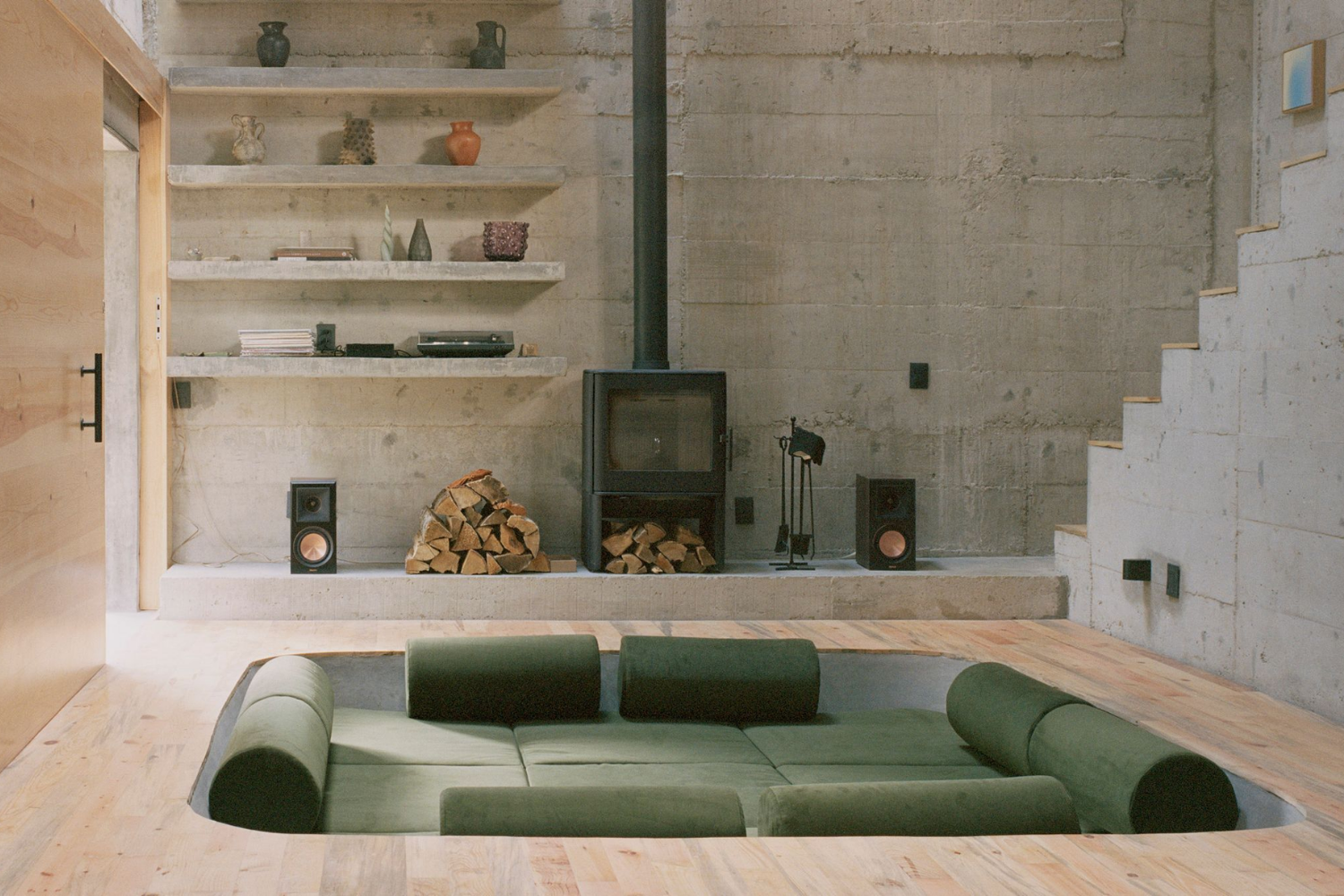
The current interest in Brutalist interiors lies precisely in the possibility of recovering certain historical principles without literally copying their appearance.
Exposed concrete and raw surfaces remain important tools, but they can be combined with oak, walnut, stone, steel, ceramics, colour, artworks and textiles. In 2026, several residential projects continue to demonstrate this approach: existing structures are left legible while new elements introduce storage, warmth, light and different levels of comfort.
This is where the contemporary reinterpretation becomes most interesting. Not in making a home resemble a Brutalist building from the 1960s, but in asking which materials genuinely deserve to remain visible, which elements can become architecture and how much decoration is actually necessary.
Historical Brutalism remains a specific phenomenon rooted in post-war architectural debate. Contemporary interiors can borrow its constructional honesty and powerful forms without turning history into a catalogue style. When this happens, even concrete stops being the absolute protagonist and returns to what it should be: one of the materials through which space is constructed.