Wood effect porcelain tiles or hardwood? Material differences, looks, performance, underfloor heating, cost per m² and the right rooms for each.
Wood effect porcelain tiles now imitate hardwood with a fidelity that seemed impossible a decade ago, yet they remain a different material. The real differences, performance, underfloor heating, cost per square metre and the right room for each: a guide to choosing like a designer.
For years the question was framed as a duel: real versus fake, noble versus practical. Wood effect porcelain tiles have changed the terms of the debate. Digital printing has brought grain, knots and shading to the surface that no longer repeat with every step. Formats have stretched until they read as planks, and textured finishes follow the pattern of the fibre. In photographs, most people can no longer tell them apart.
Yet anyone who designs interiors knows the choice is not about the image. A floor is touched with bare feet and heard when you walk. It ages, gets wet, gets scratched, and warms or cools the room. Here is the short answer. Porcelain wins where you need resistance to water, traffic and temperature swings: bathrooms, kitchens, hallways, terraces, homes with powerful underfloor heating. Hardwood wins where comfort, warmth underfoot and living material matter most, which means living rooms and bedrooms. Often the best answer is not one floor for the whole house, but the right floor for each room.
Wood effect porcelain tiles vs hardwood: what is the difference?
The difference is one of nature: hardwood is wood, porcelain is ceramic that reproduces the look of wood. Porcelain stoneware is made from a blend of clays, feldspars and sands, pressed and fired at high temperature. The result is a dense body with almost no porosity. The European standard EN 14411 places it in group BIa, pressed tiles with water absorption of no more than 0.5% by weight. Almost all wood-look porcelain is glazed. A digitally printed decorative layer sits on the body, protected by a finish that sets its feel, sheen and grip.
Solid and engineered: how hardwood flooring is made
Wood flooring falls into two broad families. Solid hardwood is the same timber from the visible face to the base, with tongue and groove joints, and is covered by EN 13226. Engineered wood, covered by EN 13489, bonds a top layer of fine hardwood to a plywood or softwood core. A two-layer board has the wear layer glued to a single backing. A three-layer board uses a cross-laminated core, which makes wide, long planks more stable. Depending on the product, the wear layer runs from about 2.5 to more than 5 millimetres. That thickness decides how many times the floor can be sanded.
Laminate and LVT only enter the comparison briefly. Laminate is a fibreboard panel carrying a photograph of wood under a protective layer. LVT (luxury vinyl tile) is a multi-layer vinyl with a printed decor. Both cost less and go down quickly, often as floating floors. However, neither has the lifespan of porcelain or the substance of real wood. They suit rentals, quick refurbishments or installation over an existing floor, as we explain in our guide to laying new flooring over old.
Do wood effect porcelain tiles really look like wood?
Yes, when they are well made and well laid. The breakthrough came with digital inkjet printing, which reproduces dozens of different faces within a single range. With more faces, the eye notices repetition less, and repetition is the first giveaway of a fake. In addition, the best collections work in relief, with brushed or hand-planed textures that follow the printed grain. At a few paces, the difference lies in the plank edges, the grout joint and raking light.
Format matters as much as graphics. The 20×120 cm plank is the most common and recalls a classic strip floor. The 30×180, 26×180 and 20×180 cm sizes evoke the wide Nordic board that now dominates organic modern interiors. Smaller formats, by contrast, are designed for herringbone and chevron. In herringbone the planks meet at right angles, in chevron the ends are cut at 45 degrees. A random plank layout, with staggered joints that never fall at the midpoint, remains the most natural.
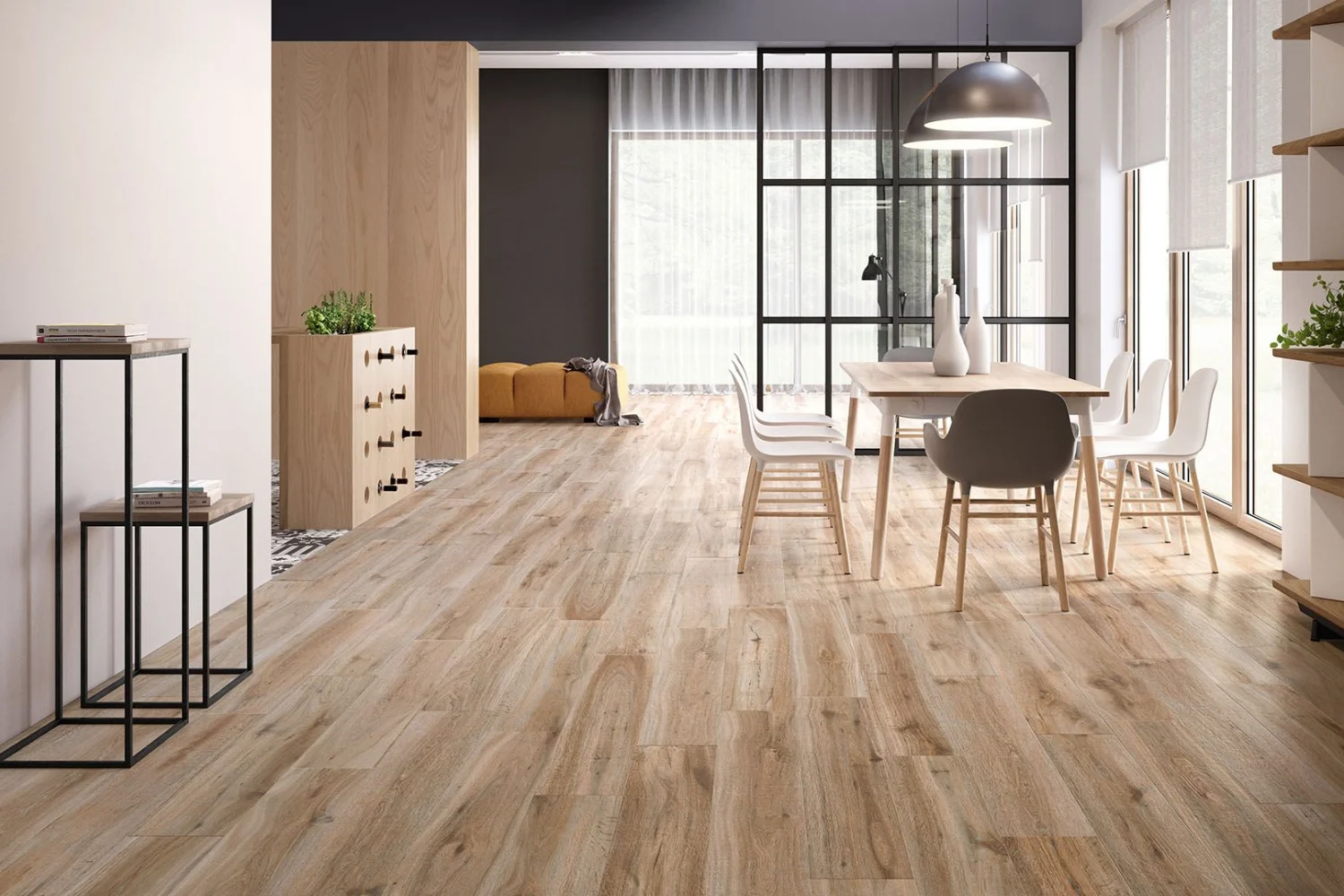
Then there is the grout joint, the real line between tile and timber. Groutless wood-look tiles do not exist. Rectified tiles allow very fine joints, but in Italy the installation standard UNI 11493-1 rules out butt-jointed laying and sets a minimum joint of 2 millimetres. Most tiling codes elsewhere follow the same logic: the floor must absorb small movements in the screed. The designer’s trick is a grout in the same tone as the plank, so the line reads as the thin shadow between two boards.
Which is more durable: porcelain or hardwood?
Porcelain is more resistant to almost everything: water, scratches, stains, sunlight and chemicals. It does not absorb liquids or swell, its colour does not fade, and it shrugs off dragged chairs and dogs’ claws. Hardwood, by contrast, is a material that reacts. It dents under a stiletto, scratches with grit from shoes, darkens and mellows in the sun, and dislikes standing water. For many people those flaws are part of its charm: a patina that tells the story of the home.
Slip resistance and R ratings
On safety, porcelain is also chosen for its slip resistance. The rating most used in Europe comes from the German standard DIN 51130, with five classes from R9 to R13. The test measures the angle at which a person in work shoes, on an oiled surface, starts to slip. Indoors, R9 or R10 is usually enough. For terraces, pool surrounds and ramps you move up to R11 or higher, with a rougher feel. Wood floors carry no such rating, but an oiled or matt lacquered finish gives adequate grip when dry.
Comfort underfoot and acoustics
Where wood wins outright is comfort. Hardwood feels warm because timber conducts little heat, while ceramic draws heat quickly from the foot. As a result, at the same air temperature, porcelain feels colder. The same applies to acoustics within the room. Footsteps on wood are soft and muffled, on porcelain they are sharper, and hard surfaces increase reverberation. Impact noise transmitted to the flat below depends mainly on the screed and acoustic underlay, which must meet national building regulations.
| Feature | Wood effect porcelain tiles | Engineered or solid hardwood |
|---|---|---|
| Water and moisture | Waterproof, suitable for showers and outdoors | Dislikes standing water, bathroom use only with suitable species and finishes |
| Scratches and impact | Highly resistant, does not dent | Scratches and dents, but can be restored |
| Sunlight | Colour stays stable | Changes tone and develops a patina |
| Slip resistance | R9 to R13 under DIN 51130 | Not rated, depends on the finish |
| Feel underfoot | Cold to bare feet | Warm and soft |
| Room acoustics | Sharp footfall, more echo | Muffled footfall, quieter room |
| Underfloor heating | Excellent output, low thermal resistance | Compatible if engineered, thin and fully bonded |
| Renewal | Cannot be refinished, only replaced | Can be sanded several times depending on wear layer |
| Outdoors | Yes, including 20 mm pavers | No, specific decking is needed |
Wood effect porcelain tiles and underfloor heating: which works better?
With underfloor heating, wood effect porcelain is the more efficient choice, but good engineered wood works well too. The key is the thermal resistance of the floor covering, meaning how much it slows heat travelling from the pipes into the room. Underfloor heating and flooring manufacturers give a limit of about 0.15 m²K/W for the whole finished build-up. Above that, therefore, the system has to run hotter, with higher bills and slower response.
The numbers explain why. Ceramic has a thermal conductivity of around 1.3 W/mK, while timber sits around 0.13 to 0.18 W/mK depending on species, roughly seven to ten times lower. For example, a 10 mm tile offers almost negligible resistance. A 10 or 14 mm engineered board still stays within the limit, provided it is fully bonded with no insulating underlay. Thick solid boards and very wide planks are more delicate, because dry heat accentuates shrinkage and gaps. Surface temperature should not exceed the roughly 29 °C set by the European standard for underfloor heating systems. In winter, relative humidity indoors should not drop much below 40%.
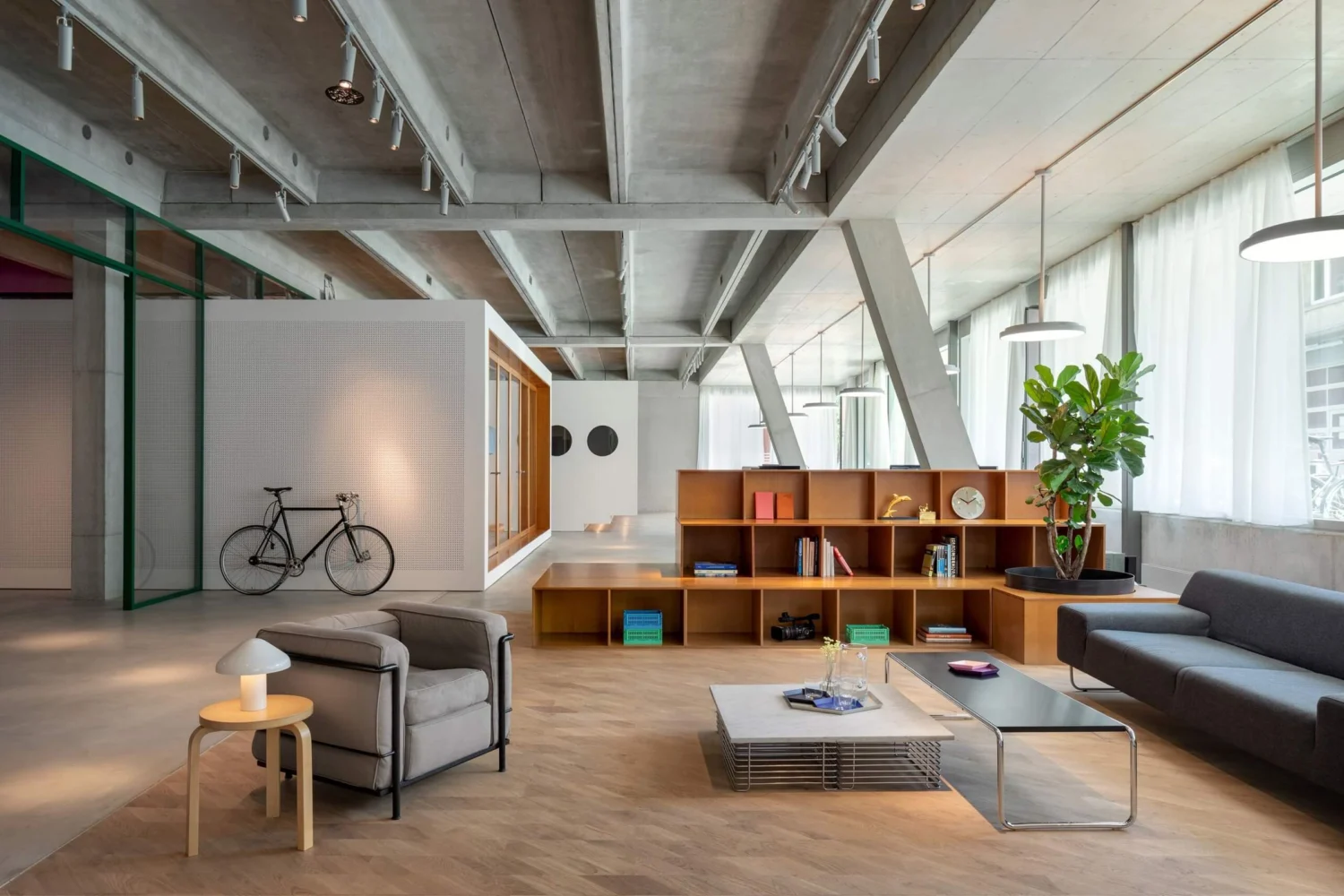
With underfloor cooling, the logic only partly reverses: porcelain also transfers coolness better, while wood softens it. Either way, choose products the manufacturer explicitly declares suitable, and have the build-up checked by a heating engineer before ordering.
How much do wood effect porcelain tiles cost compared with hardwood?
Like for like, installed wood-look porcelain usually costs a little less than quality engineered wood and much less than solid hardwood. The figures below are editorial estimates for the Italian market in 2025 and 2026, drawn from price lists and trade cost guides. Treat them as orders of magnitude: region, site and brand all move them considerably, and other European markets may differ.
Installed cost of wood effect porcelain
Mid-range wood effect porcelain tiles cost roughly 25 to 60 euros per square metre. Designer collections, large formats and 20 mm outdoor pavers go beyond 80 euros. Long planks take more care to lay than square tiles, because of cutting, flatness and stagger, at around 25 to 45 euros per square metre, more for herringbone. A realistic total is therefore 55 to 120 euros per square metre installed.
Installed cost of hardwood
Oak engineered flooring starts at around 30 to 40 euros per square metre. Wide planks, special finishes and thick wear layers reach 80 to 100 euros. Glue-down fitting adds 20 to 40 euros on average, for a total of 60 to 150 euros per square metre installed in most projects. Solid hardwood sits higher: with fitting, on-site sanding and finishing it costs around 80 to 200 euros per square metre, depending on species. For reference, laminate and LVT stay at the bottom of the scale, often under 50 euros installed. Against seamless finishes such as resin flooring or microcement, both remain competitive.
The real sum, though, is about lifespan. Porcelain asks for almost nothing after installation. Hardwood has an ongoing maintenance cost, but it is the only one of the two that can be brought back to new rather than replaced. For price bands by brand, see our guides to the best parquet brands and the best tile brands.
Where should you use wood effect porcelain and where hardwood?
Wood effect porcelain is the right answer in every wet or hard-working space, hardwood in the rooms where life is slow and barefoot.
Bathroom and kitchen
In the bathroom, porcelain has no rival: it runs up the walls, into a level-access shower and pairs with other finishes. We cover this in our guide to matching bathroom floors and walls. Wood in a bathroom is possible, with stable species such as teak, iroko or thermally modified oak and a well-kept oiled finish. It must stay clear of direct splashes, though, and never go inside the shower.
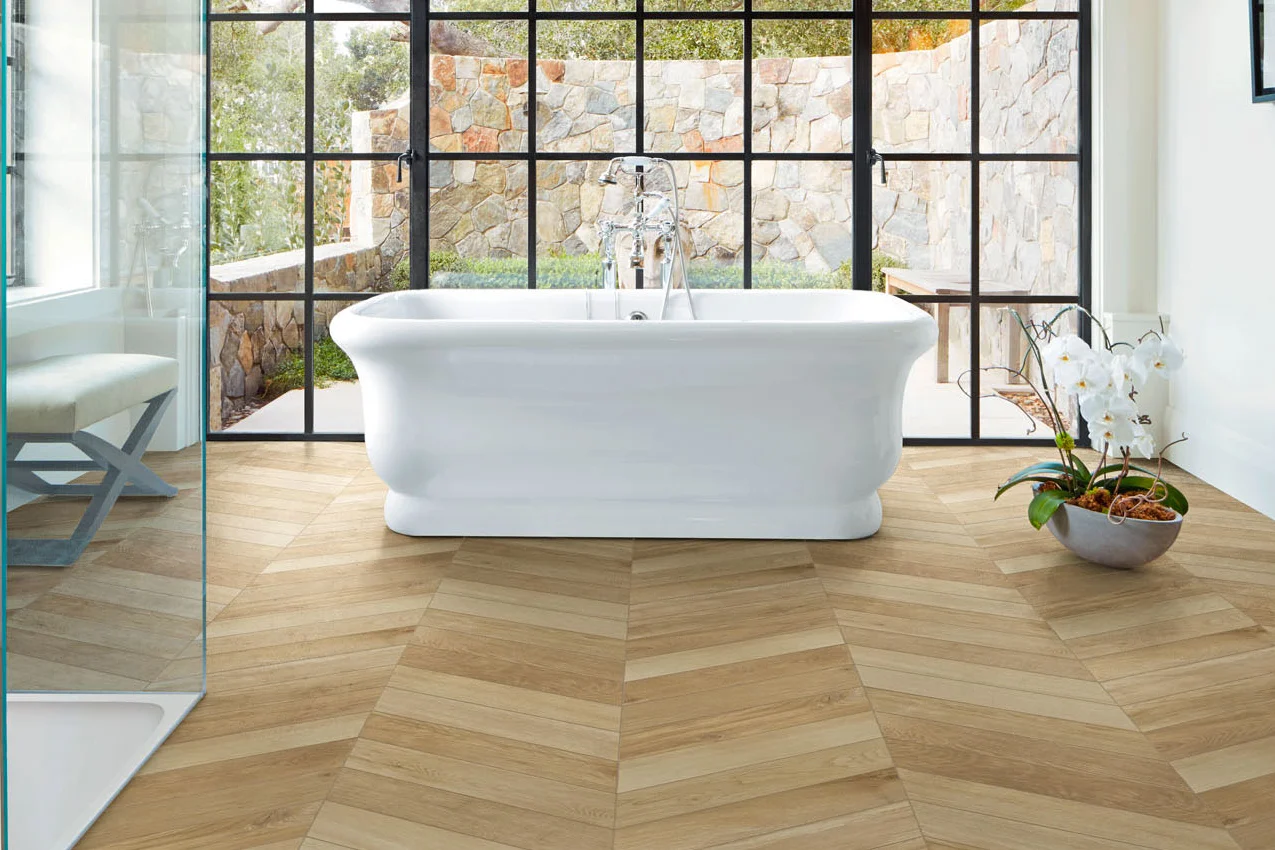
In the kitchen, porcelain copes better with dropped pans, water and oil. Moreover, it flows into the living area without thresholds, which is why it is the most common choice in open-plan spaces. Wood in the kitchen works if you accept the patina and protect the sink zone. A rug or a stone strip in front of the wet area can break it up.
Living room and bedroom
In the living room, the contest is genuinely open. Porcelain brings continuity, practicality with children and pets, and perfect performance with underfloor heating. Wood brings depth of material, perceived warmth and that muffled sound hard surfaces take away. In the bedroom, where you walk barefoot and traffic is light, wood remains the most coherent choice, not least for how it feels first thing in the morning.
Outdoors and indoor-outdoor flow
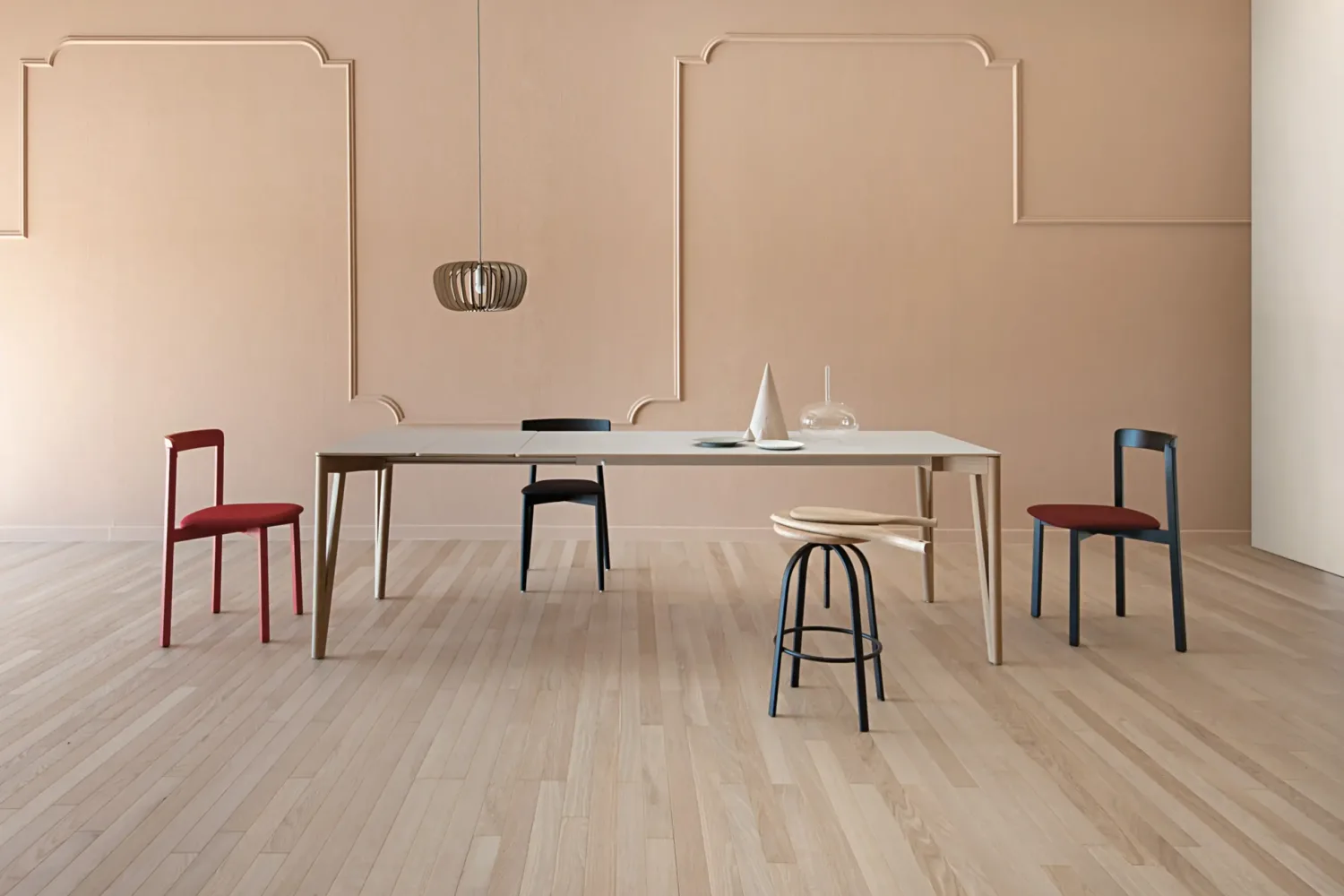
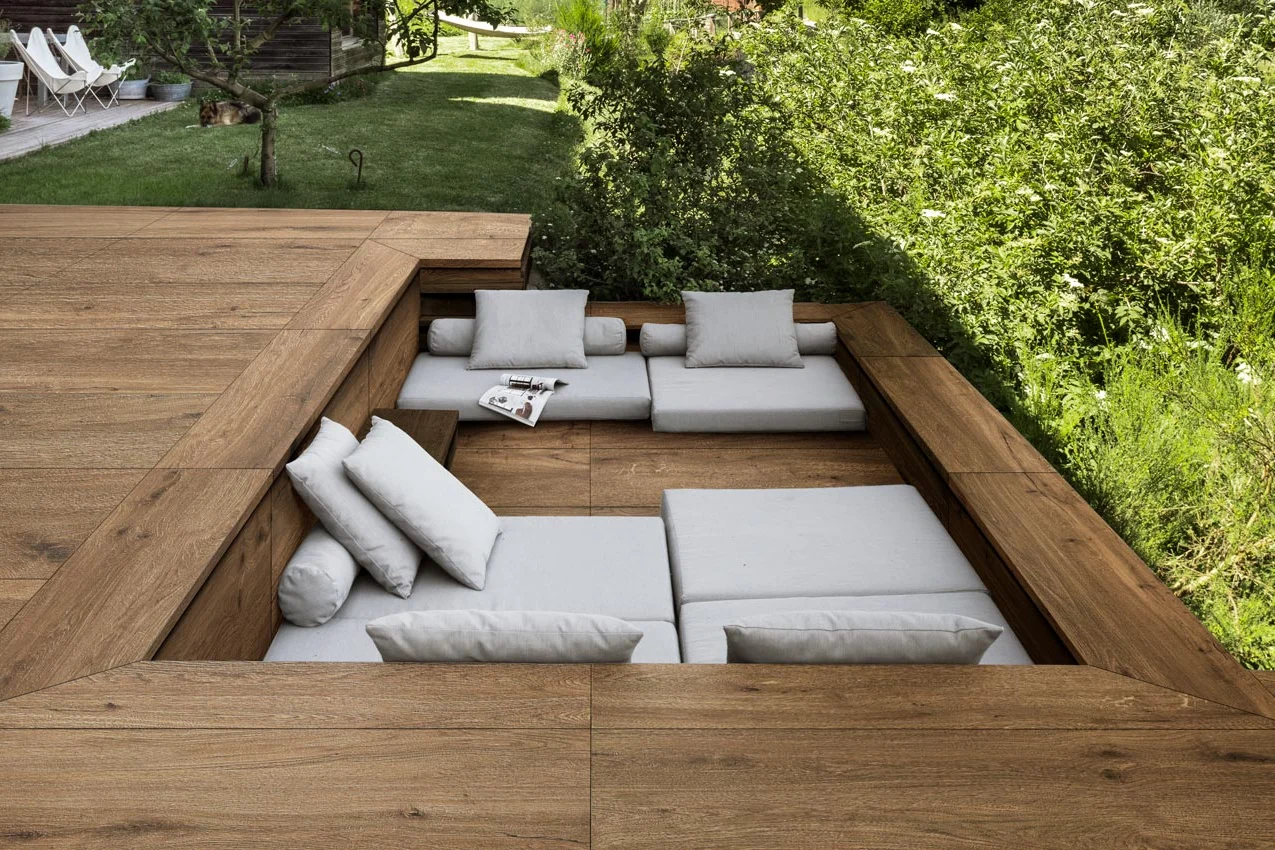
The outdoors belongs to porcelain. 20 mm pavers can be laid dry on gravel, grass or raised pedestals, and they are frost resistant. The same plank can run from living room to terrace, with a continuity wood cannot offer. It is one of the most effective ways to make spaces feel larger, as we discuss in our guide to the best outdoor flooring. The only rule is to switch finish outside, choosing the anti-slip version of the same range.
Maintenance and lifespan: how many times can hardwood be sanded?
A good wood floor lasts for generations precisely because it can be renewed; porcelain lasts as long but stays as it is. Cleaning wood effect porcelain tiles is simple: water and a neutral detergent, with no waxes or periodic treatments. After installation they need a thorough clean to remove grout residue, and over time it is wise to avoid harsh products on the joints.
Hardwood asks for a little more care. Lacquered finishes are cleaned with dedicated products and can be revived when they dull. Oiled finishes, on the other hand, need regular feeding, but allow spot repairs without treating the whole floor. When wear runs deep, the floor is sanded, removing a few tenths of a millimetre and bringing the wood back to new before refinishing. Solid hardwood can be sanded many times over its life, engineered wood usually two to four times, depending on the wear layer. Sanding and refinishing costs, as an order of magnitude, 20 to 40 euros per square metre.
Porcelain or hardwood: which is more sustainable?
Neither is sustainable by definition: it depends on origin, production and lifespan. Wood is a renewable material that stores carbon, provided it comes from responsibly managed forests. FSC and PEFC certification trace the chain of custody from forest to finished product. In the EU there is also the Regulation (EU) 2023/1115 on deforestation-free products. For medium and large operators it applies from 30 December 2026, requiring proof that timber placed on the market does not come from deforested land. Engineered wood also uses fine hardwood only on the surface.
Porcelain is energy-intensive to fire. The Italian ceramics industry, however, has invested in bodies with recycled content, waste recovery, process water reuse and cogeneration. Some collections declare certified recycled content or carry the EU Ecolabel. What weighs most in porcelain’s favour is longevity: a floor that is not replaced for decades spreads its impact over many years. Wood answers with an equally strong argument: it is renewed rather than rebuilt.
Does hardwood add value to a home?
In buyers’ eyes, a hardwood floor in good condition still signals quality. This is especially true in living areas and period homes, where restored original wood floors are often among the most appreciated features. There is no reliable data, however, putting a measurable percentage on the value hardwood adds, and a worn wood floor counts for less than well-kept porcelain. High-end wood-look porcelain, for its part, is no longer seen as a compromise. In new homes with underfloor heating it has become a valued standard specification, precisely because it lasts.
The advice is to treat the floor as part of the design rather than a separate line item. A material in tune with the architecture, the walls and the light adds more value than any label. It is the same logic behind our approach to warm stones such as travertine: a few honest materials, combined with restraint.
Mistakes to avoid when choosing a floor
The first mistake is choosing from a small sample. Wood-look porcelain should be judged on at least a square metre laid out, or across a large showroom display. Only then can you see how many faces the range has and whether repetition shows. The second is underestimating installation. Long planks on a screed that is not perfectly flat create height differences between edges, known as lippage, which raking light reveals at once. That is why fitters use levelling systems and limit the stagger to a third of the plank length, as manufacturers recommend.
The third mistake is laying wood on a screed that is still damp, a common cause of cupping and lifting: residual moisture must be measured before fitting. Another is using the same porcelain inside and out without changing to the anti-slip finish. Finally, the subtlest mistake is imitating wood at all costs. In a small bathroom or a seaside house, for instance, modern cement tiles or a textured surface may be more honest and more beautiful than faux parquet.
Wood effect porcelain tiles and hardwood: frequently asked questions
What are the downsides of wood effect porcelain tiles?
They feel cold without underfloor heating, are noisier underfoot and are unforgiving when something fragile is dropped. They cannot be refinished: a cracked tile must be replaced, so keep a few boxes from the same batch. Cheaper ranges also give themselves away through repeated patterns.
What flooring looks most like real hardwood?
After real wood, the closest match is high-end wood effect porcelain with many faces, a textured surface and long formats. Laminate and LVT reproduce the look well, but their feel and sound are further from the real thing.
Can wood-look porcelain be laid without grout lines?
No. Rectified tiles allow joints of around 2 mm, almost invisible when the grout matches the plank. Butt-jointed laying, however, is not permitted under Italy’s installation standard UNI 11493-1 and is discouraged by tiling codes generally, because the floor could not absorb movement in the base.
Can you combine porcelain and hardwood in the same home?
Yes, and it is often the best solution: wood-look porcelain in bathrooms, kitchen and terraces, hardwood in living room and bedrooms. For a smooth transition, choose related tones, match floor heights at design stage and resolve the junction with a slim profile or at a doorway.
Will wood effect porcelain tiles go out of fashion?
The risk lies not in the material but in overly distinctive choices: cold greys, exaggerated distressed effects, very strong tones. Natural oak, honey shades and random plank layouts in generous formats stay neutral and timeless, just like hardwood.