Compare six insulation board manufacturers, with practical advice on materials, thermal conductivity, thickness, prices and complete external wall systems.
Choosing insulation starts with the building, not the name printed on the board. Where the material will be installed, the available depth and the surrounding construction determine whether it is suitable. A board intended for a rendered façade is not automatically appropriate beneath a floor or inside an existing wall.
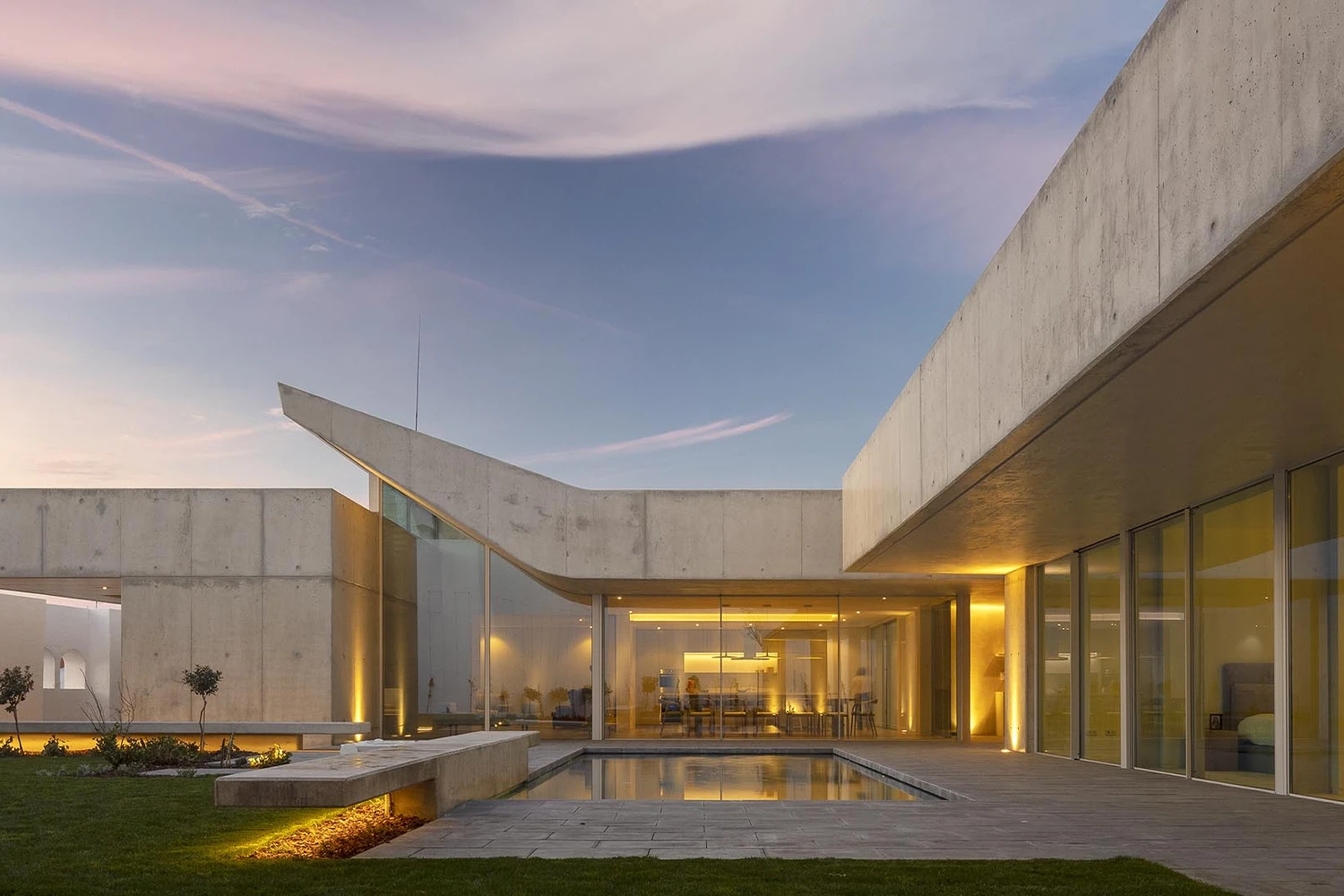
Our shortlist of insulation board brands brings together ROCKWOOL, Isover, Knauf Insulation, Stiferite, STEICO and Poron. These manufacturers offer documented options in mineral wool, PIR, wood fibre and EPS, with a particular focus here on external wall insulation. This is a product-led selection, rather than a ranking based on comparative testing. The examples reflect European specifications; local ranges, approvals and installation requirements may differ.
Start with the intended insulation application
An external thermal insulation composite system, or ETICS, combines insulation with bonding, mechanical fixings where required, reinforcement, render and construction details. A roof also needs an assessment of loading, waterproofing and moisture behaviour. A floor imposes compressive requirements, while internal wall insulation changes the conditions within the existing masonry.
Substrate, board position and build-up come before the price. Where mould or condensation prompted the work, the cause matters too: water ingress, thermal bridges, ventilation and moisture in masonry involve different remedies. One insulation layer cannot address every situation.
Six insulation manufacturers and specific boards
| Brand | Reference product | Material | λD, W/(m·K) |
|---|---|---|---|
| ROCKWOOL | Frontrock Max Plus | Stone wool | 0.035 |
| Isover | Clima34 | Glass wool | 0.034 |
| Knauf Insulation | SmartWall S C1 | Mineral wool | 0.035 |
| Stiferite | Class SK, 100 mm | PIR | 0.025 |
| STEICO | Protect L dry | Wood fibre | 0.037 |
| Poron | DualColor | Graphite EPS | 0.031 |
These figures apply to the named products, not every board made by each manufacturer. Class SK conductivity varies with thickness; the figure shown is for the 100 mm version. Thermal conductivity is a material property, not the U-value of a complete wall, and it does not summarise fire performance, acoustic behaviour or summer comfort.
ROCKWOOL: stone wool for external wall insulation
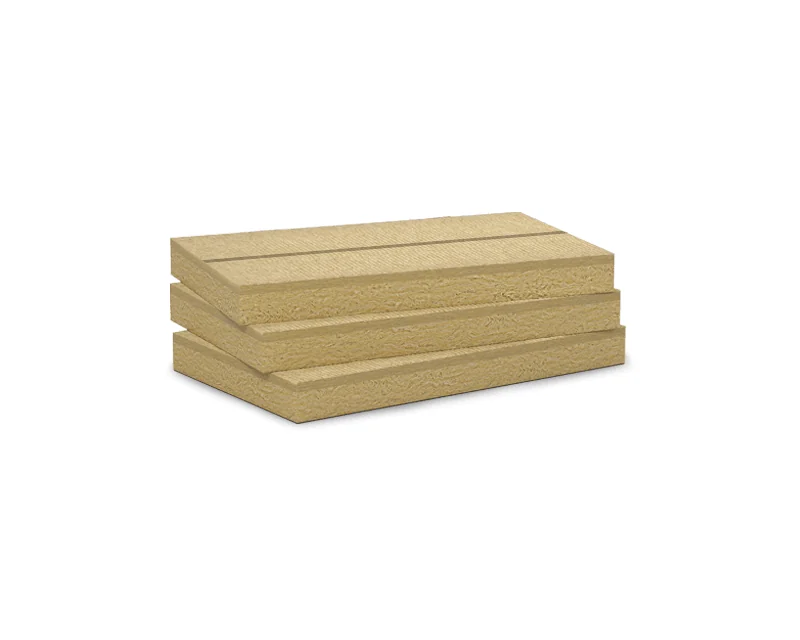
Frontrock Max Plus is an unfaced, rigid, dual-density stone wool board for ETICS. The manufacturer declares thermal conductivity of 0.035 W/(m·K) and reaction-to-fire class A1 for the board. It is a product to consider when a specification calls for stone wool supported by façade-specific documentation.
The marked, higher-density face is intended to face outwards. Product code and thickness follow the specification alongside reinforcement, fixings and finish. The fire classification of the board has to be understood within the full facade assembly.
Isover: Clima34 glass wool boards
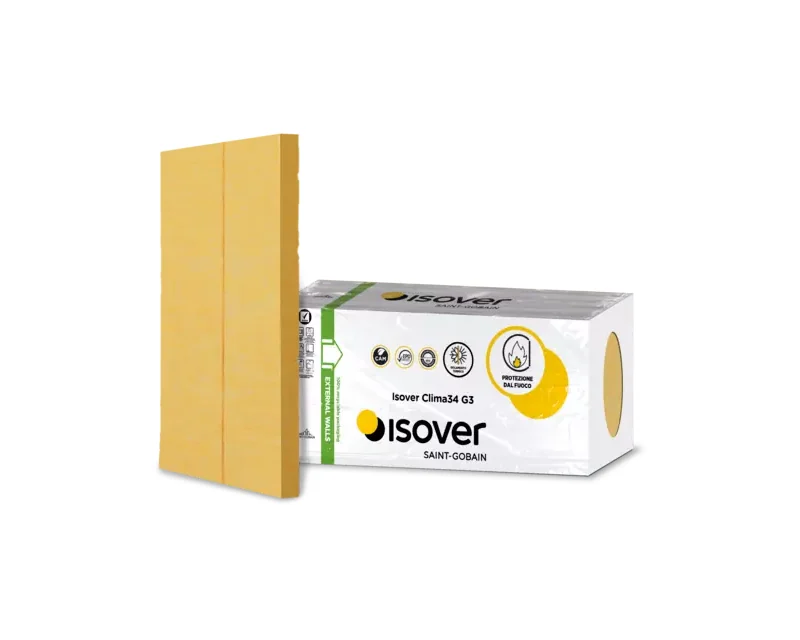
Isover Clima34 is an unfaced rigid G3 glass wool board, supplied in a 600 × 1200 mm format and different thicknesses. The Italian product documentation identifies external wall insulation and exposed soffits among its applications, for both renovation and new construction.
The declared conductivity is 0.034 W/(m·K), with reaction-to-fire class A2-s1,d0. Product identity and intended use matter: Isover has a broad range, and a cavity insulation product is not interchangeable simply because it uses the same general material. verify the exact board, coverage per pack and compatibility with the specified installation system.
Knauf Insulation: SmartWall S C1 and its prepared facing
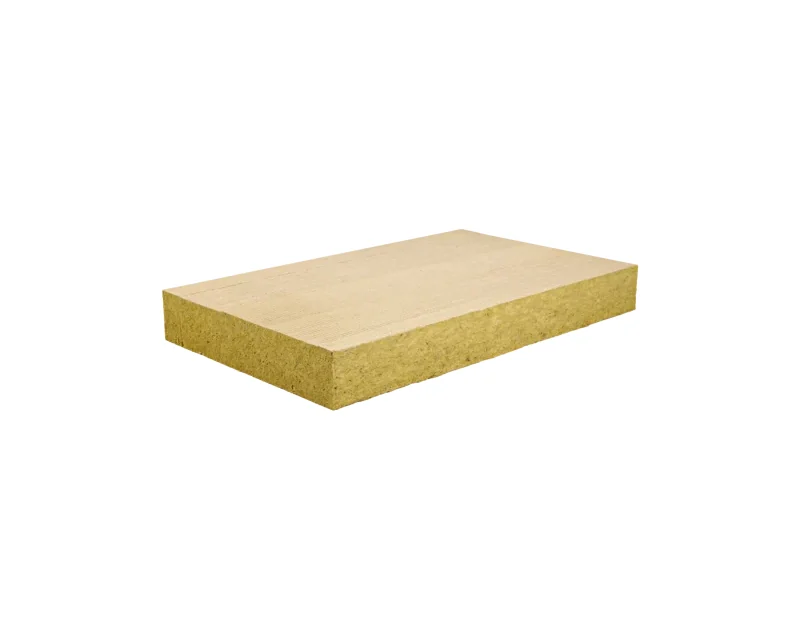
SmartWall S C1 is a Knauf Insulation board for ETICS. Its calcium-silicate facing is designed to receive the reinforced base coat within the manufacturer’s prescribed system.
The product page declares conductivity of 0.035 W/(m·K) and reaction-to-fire class A1. The prepared surface remains part of a specified installation system. Available dimensions can serve different handling needs; coating and accessories belong alongside the boards in the quotation.
Stiferite: Class SK where installation depth matters
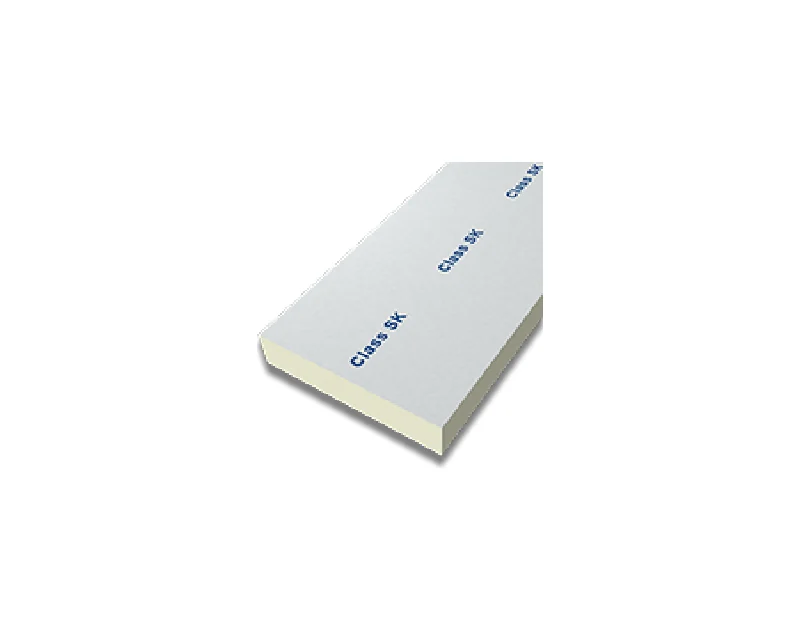
Stiferite Class SK has a polyisocyanurate, or PIR, insulation core with saturated glass-fibre tissue on both faces. It is worth comparing where the design needs to balance thermal resistance and depth, including window reveals, balcony junctions and other façade details.
The technical sheet updated in October 2025 declares conductivity of 0.025 W/(m·K) for thicknesses from 100 to 160 mm. At 100 mm, the declared board resistance is 4.00 m²K/W. Class SK is used within documented ETICS arrangements; a generic PIR board should not be combined with an arbitrary render system.
ensure the product is Class SK rather than a roofing variant. Distinguish board and assembly fire classifications: the board sheet gives Euroclass E, while the performance of a system containing it must be checked in the documentation for that specific combination.
STEICO: wood fibre as a render-carrying board
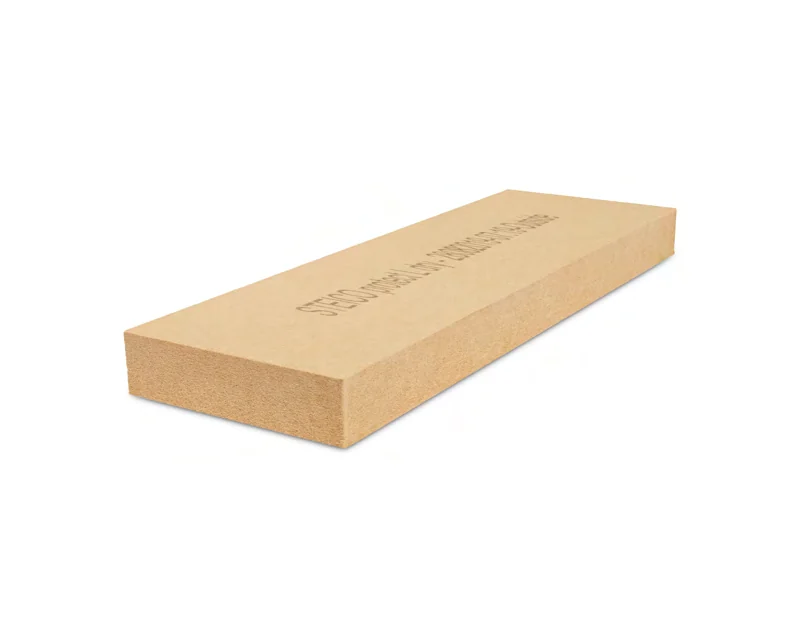
STEICOprotect L dry is a wood fibre render-carrying board for ETICS on flat mineral or timber substrates. Its European technical sheet dated September 2026 declares conductivity of 0.037 W/(m·K), an approximate density of 110 kg/m³ and reaction-to-fire class E.
Wood fibre also brings mass and heat capacity into the design discussion. Summer performance nevertheless depends on the whole construction rather than the insulation in isolation. A roof or wall needs to be assessed with its other layers and the building’s conditions.
Substrate suitability, render and protection during construction all shape the choice. The documentation limits finishes and exposure: a render-carrying board cannot simply accept any decorative covering.
Poron: DualColor graphite EPS boards
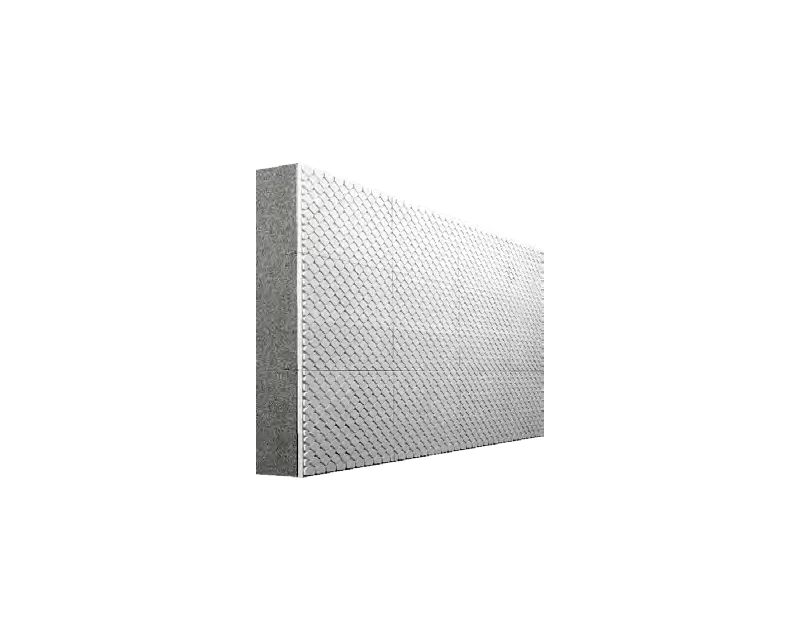
Poron DualColor represents graphite-enhanced expanded polystyrene, with a white EPS facing. Its textured surface and relief cuts form part of the board configuration for external wall insulation. The manufacturer’s documentation gives conductivity of 0.031 W/(m·K).
The board belongs in a defined system, beyond its visible colour. Its textured surface changes base-coat consumption, affecting quantities and cost. The precise variant, pack coverage and coating system need identifying; plinths and other exposure conditions require the product selected for those areas.
How to compare conductivity, thermal resistance and thickness
At equal thickness, lower conductivity provides greater thermal resistance. For a homogeneous layer, the basic relationship is R = thickness in metres / λ. As an illustrative comparison, a 100 mm layer with λ 0.025 gives R 4.00 m²K/W; with λ 0.035, the ratio is approximately 2.86 m²K/W. Purchasing decisions should use the declared resistance for the exact board thickness.
That calculation does not establish the U-value of the finished wall. Masonry, other layers, surface resistances and construction details still need to be considered. It also cannot predict a universal percentage reduction in energy bills. The required depth should follow the design objective, rather than simply the amount of space left available.
Insulation board prices and installed-system costs
An Italian offer listed 100 mm Stiferite SK in a 4.32 m² pack at €179.19 including Italian VAT, available to order: approximately €41.48/m² for the boards alone. This is an indicative reference to reconfirm, with delivery, accessories and labour assessed separately.
For a nominal 30 m² area, seven packs would provide 30.24 m² and cost €1,254.33 at that price, before allowing for cuts, wastage or ordering conditions. This is an arithmetic example, not a site quantity calculation or an average installed ETICS price. It is also specific to Italy: local taxes, distribution and delivery can change the cost considerably.
A full quotation should identify substrate preparation, insulation, adhesive, fixings, profiles, mesh, base coat, finish, scaffolding and junction details. Comparing a board-only price with an installed system creates a misleading impression of value.
Where to buy insulation boards
Typical channels include builders’ merchants, insulation specialists and the manufacturers’ professional distribution networks; selected products are also sold online. A single pack may suit a small addition, while a larger project needs coordinated availability, unloading arrangements and appropriate storage.
The specification, or the application, depth, area and substrate, gives the supplier a starting point. Code, declaration of performance, system documents and pack coverage identify the order. Accessory availability and responsibility for proposed substitutions complete the comparison.
If render forms part of the work, the choice of plaster and render products must remain consistent with the specified assembly. A product suitable elsewhere does not become compatible merely because it comes from a familiar manufacturer.
Common insulation buying mistakes
Choosing only the lowest conductivity
Conductivity matters, but intended use, moisture behaviour, mechanical properties, fire performance and installation also need comparison. The board has to work in its actual position within the building.
Assuming a vapour-open material will cure mould
Moisture management involves the whole building. Vapour permeability alone does not correct water ingress or inadequate ventilation. Internal insulation deserves particular attention to the moisture behaviour of the existing construction.
Confusing thermal insulation with room acoustic treatment
Insulation within a wall can contribute to the assembly’s acoustic behaviour, but it is different from a decorative sound-absorbing panel intended to control room reverberation. In both cases, identify the problem before selecting the material.
A useful brand comparison ends with complete, suitable options: a documented board, in the right position, with the specified components. That is what makes a manufacturer relevant beyond the name on the packaging.