At Dubai Design Week 2026, VARUSSI translates the instruction system of Kashmiri weaving into a modular, reusable, walk-in structure made from reclaimed timber.
At Dubai Design Week 2026, one piece of architecture is born from a text, though not one made of words in the usual sense. Taleem, the installation presented by the studio VARUSSI from November 3 to 8, 2026, takes its form from the system of instructions used to make the hand-knotted carpets and Kani shawls of Kashmir. A code that passes from designer to weaver, setting out colors, rhythm and repetition, has been transformed into a timber structure that visitors can step inside.
The project is part of In Other Words, the group exhibition of the Abwab program, which this year brings together five practices and treats language as gesture, image, material and space as well as text. The official Dubai Design Week project page spells out the starting point: a craft survives not only through the objects it produces, but through the knowledge that makes producing them possible. What is new here, then, is not simply the display of a traditional technique. It is the technique’s tangible, physical shift from textile protocol to architectural device.
Working Knowledge, Not a Decorative Motif
VARUSSI is a Dubai-based studio founded by Kashmiri architects Owais Asif Khan and Samreen Junaid Wani. Even the practice’s name comes from a Kashmiri word for a timber partition, a statement of interest in building elements and the memory they carry. In Taleem, this lineage steers clear of the most predictable shortcut. The project does not blow up a carpet pattern or apply its ornament to a surface; what gets translated is the logic that comes before the object.
That distinction matters for anyone designing with craft knowledge. Ornament can be lifted out of its context and consumed as an image; a system of instructions, by contrast, forces you to understand relationships, sequences and responsibilities. In traditional taleem, the design is not self-sufficient: it only becomes an object through the weaver’s interpretation. Scaled up to architecture, that relationship suggests that drawing is a form of coordination rather than a closed command, one that leaves room for the skills of the people who build.
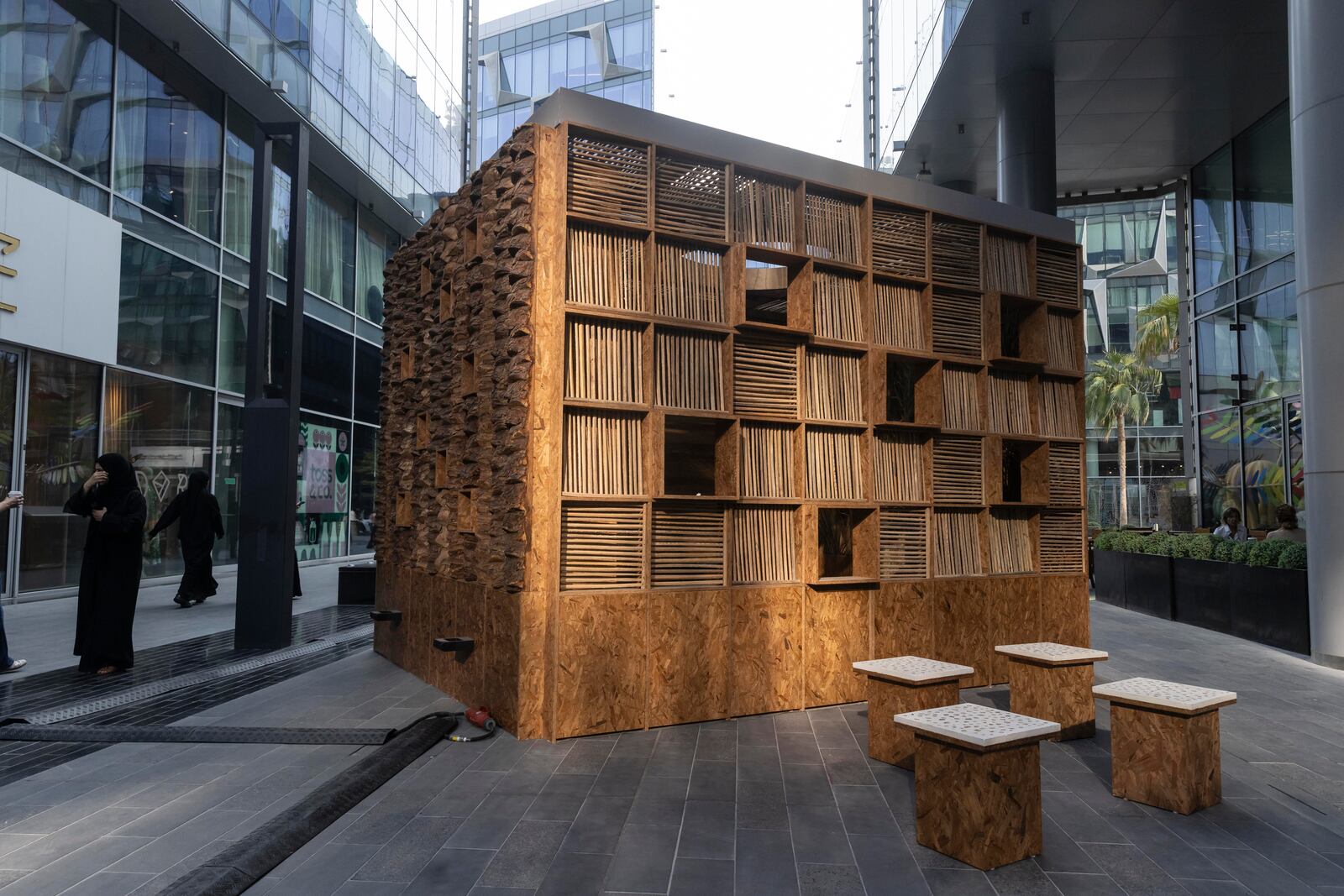
An on-site report published by The National on November 4 describes a large cubic volume, open to visitors and defined enough to create a room even within the vast atrium of Building 7. Scale is key: something that normally accompanies the close-up work of hands, threads and loom becomes a shared environment. The code is not put under glass; it is made walkable.
Reclaimed Timber as Part of the Story
The translation is not only about form. Taleem is built from beams and boards salvaged from previous construction sites, sourced, worked and assembled in the United Arab Emirates. The structure is modular and was designed to be dismantled and rebuilt after design week. Reversibility, then, is not a vague sustainability promise: it is a stated construction condition that aims to extend the life of the components beyond their first installation.
The choice fits the theme of the project. A material that has already been used carries traces that are not erased, just as the taleem system preserves knowledge because it continues to be practiced and reinterpreted. Memory and reuse meet in the same detail: one is not just about recounting the past, the other is not reduced to the quantitative recovery of material. Both depend on the ability to transform without wiping the slate clean.
For exhibition design, showrooms and temporary spaces, the implications are concrete. Planning for the second assembly from day one means designing accessible joints, replaceable components and dimensions suited to transport and storage, along with documentation that can follow the system over time. It is a less photogenic discipline than the monolithic gesture, but a more useful one for keeping ephemeral architecture from becoming waste the moment an event closes.
From Heritage to Contemporary Design at Dubai Design Week
In Other Words shifts Abwab, traditionally associated with standalone outdoor pavilions, toward an indoor group exhibition. Alongside VARUSSI, works exploring Devanagari typography, handmade paper, Arabic mark-making and fragmented text show that visual language is never neutral. As the AD Middle East roundup also notes, meaning changes as it passes through different materials and ways of making.
Against this backdrop, Taleem offers a precise lesson: heritage is most fertile when it is treated as an infrastructure of knowledge rather than a repertoire of forms to quote. It is the same reason why, in the best encounters between design and craftsmanship — as we also noted in our take on Homo Faber 2026 — value lies not only in the rarity of the object, but in the transmission of gestures, tools and criteria.
For architects and companies, the point is not to replicate taleem outside Kashmir. It is to recognize that every supply chain has its own operational languages, often invisible: assembly sequences, learned tolerances, color codes, ways of reading a material. Making them an explicit part of the design can produce more adaptable spaces and less extractive collaborations. At Dubai Design Week, a room of reclaimed timber makes exactly this visible: before form, there is always knowledge holding it together.