In the popular imagination, interior designers work on living rooms, custom kitchens and full renovations. A child’s bedroom, on the other hand, is often treated as an afterthought: it gets furnished with whatever is left of the budget, perhaps by picking pieces straight from a showroom without any real planning. That is a mistake of …
In the popular imagination, interior designers work on living rooms, custom kitchens and full renovations. A child’s bedroom, on the other hand, is often treated as an afterthought: it gets furnished with whatever is left of the budget, perhaps by picking pieces straight from a showroom without any real planning. That is a mistake of perspective, because kids’ bedroom design is one of the areas of the home that most demands professional expertise. The reason is simple: no other room has to change so much over time, adapt to such different needs or meet such specific safety requirements. A living room furnished today will most likely still work ten years from now. A kids’ room designed only for the present almost never will.
What an interior designer actually does in kids’ bedroom design
An interior designer’s job in a child’s room is not to create something theatrical, but to solve practical problems that parents, caught up in day-to-day life, often fail to see clearly.
Reading the space
The first thing a professional does is study the floor plan, taking into account variables an untrained eye tends to miss: the position of doors and windows, the direction of light at different times of day, technical obstacles such as radiators or pipes, and the minimum clearances needed to move around comfortably. These factors determine where the bed goes, where it makes sense to place the desk and where the wardrobe should not go.
Designing for every stage of childhood
A good design for a children’s room anticipates several future configurations, not just one. The designer imagines how the space will change when the child is six, ten and fifteen, and chooses furniture that allows for that evolution. It is a specific skill that requires knowledge of the modular systems on the market and the ability to think long term.
Working with the family
The briefing with the parents is a phase that is often underestimated. An experienced designer gathers information about daily routines, the child’s interests, budget constraints and the family’s aesthetic expectations. The result is a genuinely tailored design, not a standard solution.
When it makes sense to hire a professional
Not every situation calls for an interior designer. For a small kids’ room with simple needs, a good specialist retailer may be enough. There are cases, however, where professional advice makes a substantial difference.
- Spaces with unusual architectural constraints: attics, rooms with alcoves or under-stair areas, and rooms with irregular ceilings require custom solutions that are rarely found in catalogs.
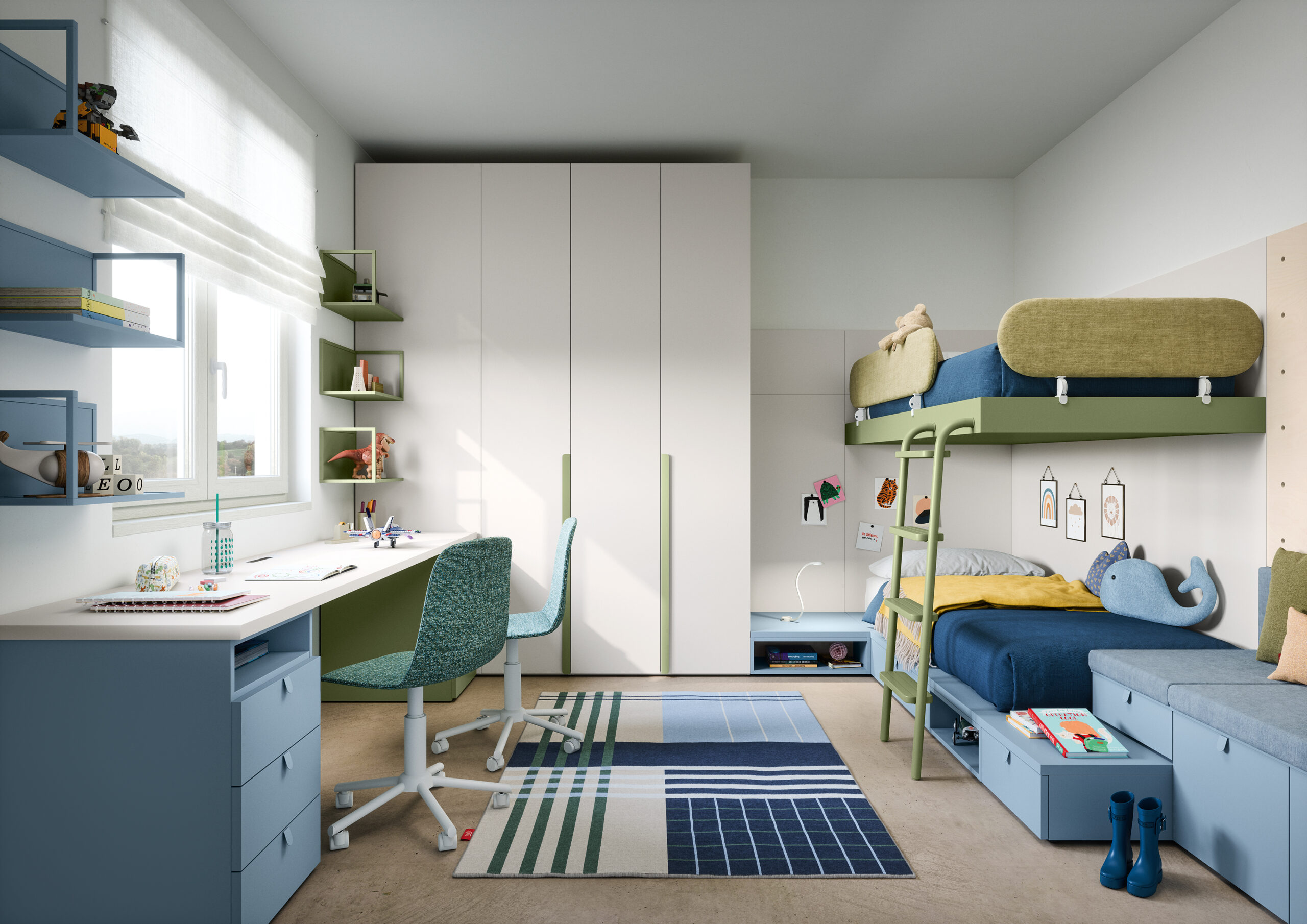
- Bedrooms shared by siblings, where each child needs a clearly defined area of their own and managing the shared space requires a delicate balance.
- Projects that need to fit the style of the whole home, typical of architect-designed apartments or renovations where overall aesthetic consistency is a priority.
- Significant budgets that deserve a proper return in terms of durability and quality, where a design mistake could end up costing more than the consultation itself.
The specialist retailer as an alternative
A practical and often overlooked alternative to an independent interior designer is a retailer specializing in children’s furniture. Professionals who have worked for years with Italian design brands have a technical knowledge of the products that few generalist designers possess: they know modular systems in detail, they know which configurations work and which do not, and they have seen hundreds of kids’ rooms come together in different settings.
Italy has a long-established tradition of companies that design home furnishings as a system rather than as a collection of individual pieces: well-known names in contemporary design, from kitchens to living rooms, have built their value around this idea. In children’s bedrooms, the same logic can be found in specialist brands such as Nidi, which offers designer kids’ bedrooms conceived as open systems, with modular furniture that can be customized in its finishes and reconfigured over time. Systems like these reach their full potential when they are designed by people who know them inside out. It is no coincidence that many companies in the sector have built networks of retailers trained specifically on their products, able to read the space, propose customized layouts and guide families through their choices.
What to expect from the consultation
Whether you work with an interior designer or a specialist retailer, the process follows the same broad steps: an initial meeting to understand needs and constraints, a site visit to measure the space accurately, a design proposal with renderings or technical drawings, a joint review, and finally the order, with precise specifications for dimensions, colors and accessories. It is a process that takes a few weeks, not a few hours, but it delivers a solid design instead of a series of rushed decisions.
Italian design: why it matters in a kids’ room too
The value of Made in Italy in children’s furniture is not just about prestige. It guarantees a controlled supply chain, with safety standards for materials that cannot always be verified in low-cost imported products. Non-toxic paints, certified low-emission panels and careful craftsmanship are all points a good consultant should flag explicitly before purchase.
An investment measured over time
Hiring a professional for a kids’ bedroom means accepting a higher upfront cost in exchange for choices that will stand the test of time. It is the opposite of the disposable-furniture mindset, but it is often the most rational option in the long run. A well-designed room stays functional for years, adapts to each stage of growing up and keeps an aesthetic value that does not fade with the first passing trend.