Seven European cafés worth visiting for architecture and interiors, from Prague’s ceramics to Vienna’s coffeehouse culture, with history and practical advice.
A café table can become a place from which to read a city. Not necessarily because the coffee is exceptional, but because a room, a window or a doorway reveals a particular way of welcoming people.
These seven beautiful cafés in Europe offer very different experiences: Parisian patisserie, Budapest’s grand interiors, Viennese coffeehouse culture, Prague’s ceramics, everyday design in Copenhagen, art in London and Venetian history. This is an editorial selection for travellers interested in architecture and interiors, not an objective ranking or a comparative test of the drinks.
Beauty does not always mean the most elaborate decoration. It can come from the relationship with a square, the spacing between tables or the way light makes a wall legible. Choose a café according to the time you want to spend there: breakfast and afternoon tea make quite different demands on a day.
1. Carette, Paris: a patisserie that belongs to its square
Carette’s story begins in 1927, when Jean and Madeleine Carette established themselves on place du Trocadéro. The business now has several locations. This selection refers to the Trocadéro address, not the café on place des Vosges: changing branches also changes the architectural setting of the visit.
The most interesting quality here is the relationship between stopping and moving through the city. A patisserie can be a self-contained destination, but at the Trocadéro it becomes part of a busy square. A table does not entirely separate you from the street. It provides a position from which to observe people passing before continuing towards the esplanade.
For anyone interested in interiors, this is a lesson in the importance of the threshold. A café’s character does not end at its door, and buying similar furniture cannot reproduce the experience. Light, sound, outlook and the approach all make a difference. Before looking for the most photographed table, decide whether you want an indoor pause or a seat closer to the life of the square.
The stop: patisserie and a hot drink, chosen from the available menu. The Trocadéro and Palais de Chaillot are natural next steps. The Eiffel Tower belongs to the wider walking route; it is not a view guaranteed from every table.
2. New York Café, Budapest: look at the depth, not just the gilding
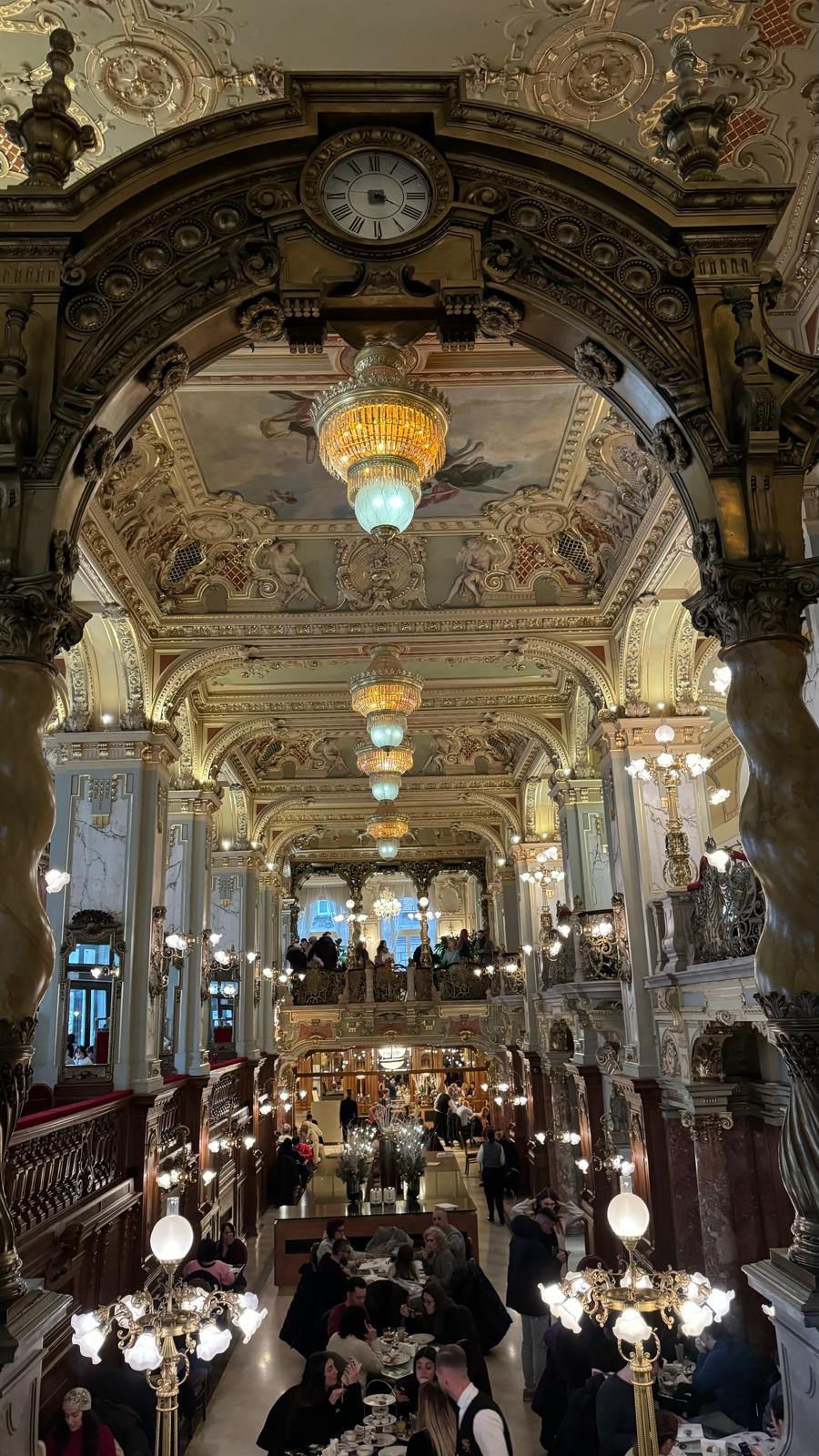
The New York Café occupies the palace opened in 1894 on Erzsébet körút. Its history is closely associated with writers and journalists, but that history is not one of uninterrupted continuity. After changes in use and fortunes, the restoration that revived the café dates to 2006. It would be misleading to imagine a room simply left untouched since the nineteenth century.
The vertical photograph reveals a succession of spaces and levels. Your eye passes through arches, chandeliers and balconies before reaching the far end. This layered depth, as much as the decoration, shapes the experience. An isolated detail may seem extravagant; within the sequence, it finds its place.
The promotional description “the most beautiful café in the world” belongs to the venue’s own story, rather than a verifiable international title. There is a more tangible reason to visit: to compare the building’s ceremonial scale with the ordinary act of sitting down for a drink.
The stop: coffee and a traditional cake available on the menu. At the check on 5 October 2026, the café admitted daytime guests in order of arrival and offered reservations after 6pm for dinner. Allowing time for a queue is more useful than planning the visit to the minute.
3. Café Museum, Vienna: Loos, Zotti and a layered interior
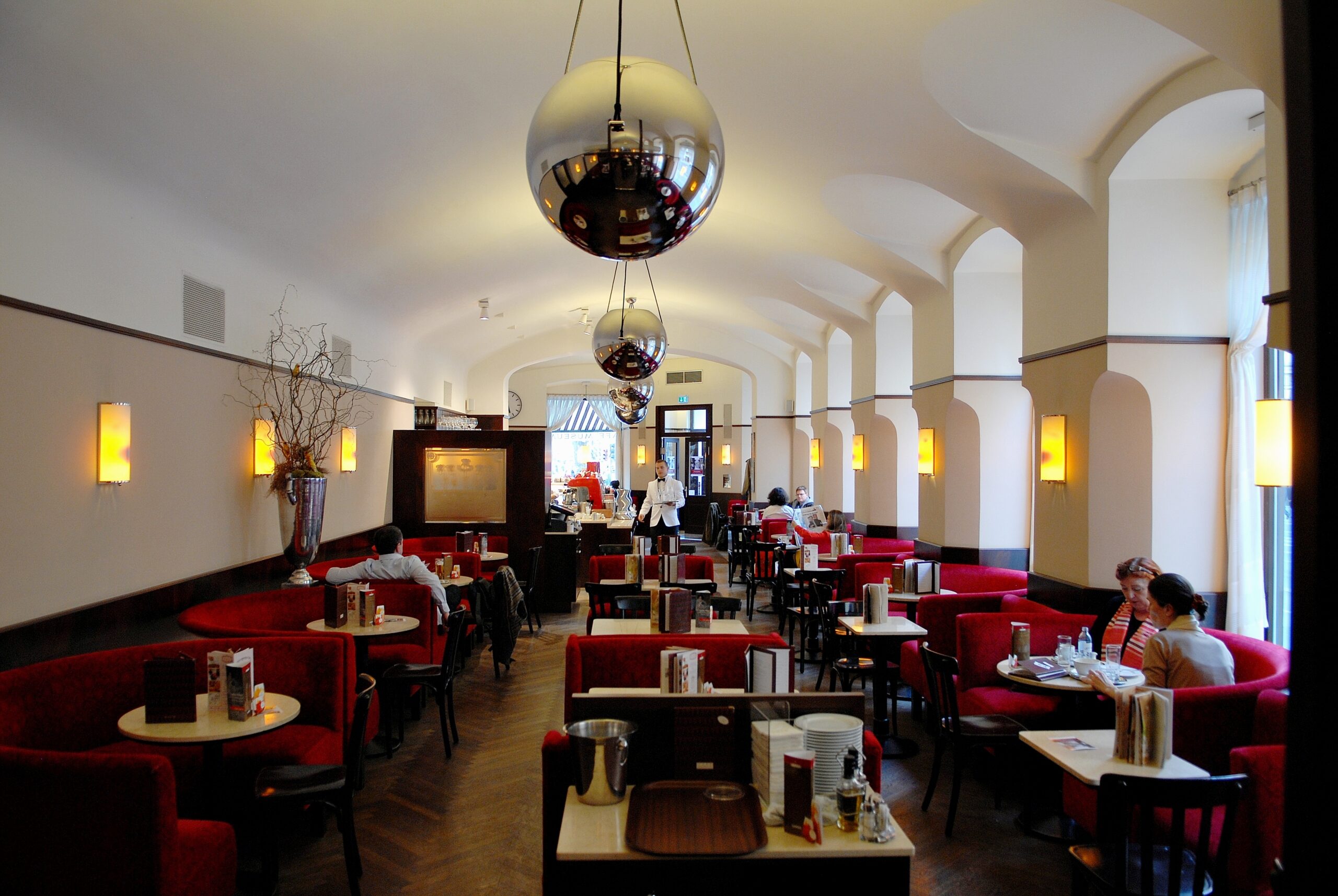
Opened in 1899, Café Museum is associated with the original design by Adolf Loos. Today’s room should not, however, be described as his interior preserved in its entirety. The story includes Josef Zotti’s redesign in 1931, a later reconstruction of the Loos arrangement and a return in 2010 to an interior inspired by Zotti’s plans, entrusted to Hans-Peter Schwarz.
The red seating and silver globe lights make the distinction easier to understand. Interior design is not only a question of how austere or decorative a room looks. It also concerns the possibility of settling in, talking and finding a comfortable position. The return to a more intimate atmosphere makes the café interesting as a case study in hospitality, as well as architectural history.
The Austrian Commission for UNESCO records Viennese coffeehouse culture in the national inventory of intangible cultural heritage, where it was inscribed in 2011. This recognises a cultural practice, not a quality label awarded to an individual cup.
The stop: a Melange and time to linger. The address at Operngasse 7 works well with a walk towards the Secession and Karlsplatz. Choosing a seat and looking at the relationship between table, lighting and circulation reveals much more than a list of famous former customers.
4. Café Imperial, Prague: when the surface shapes the room
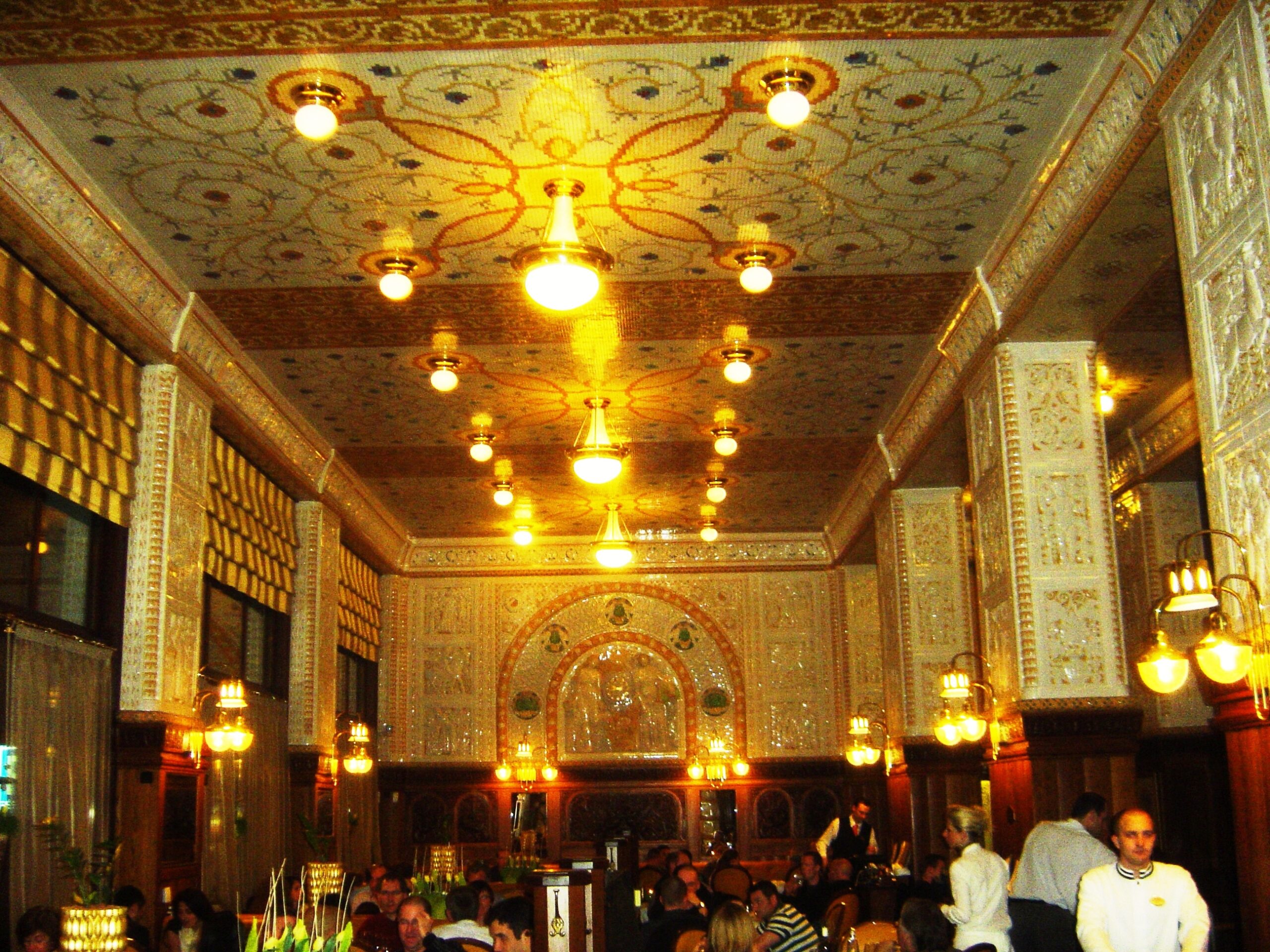
On the ground floor of Hotel Imperial at Na Poříčí 15, Café Imperial retains ceramic wall coverings and mosaic ceilings dating to 1914. They distinguish it from a room whose decoration relies only on paintings, curtains or objects placed around the space.
Look at each surface together with the geometry it covers. Walls and columns are not neutral backgrounds: the decoration follows the architecture, emphasises its changes and affects the perception of depth. From a distance, you read the whole composition. Closer up, the experience becomes more tactile, with joints, reliefs and repeated forms.
The commercial name Art Deco Imperial Hotel does not, on its own, classify every feature of the room. The café’s description also references Art Nouveau. It is more useful to observe the coexistence of these languages than to use a style label as shorthand for historical luxury.
The stop: breakfast or lunch, depending on how much time you have. Restaurant service is part of the experience; do not assume you can find an empty room for photography. The venue recommends reservations. Continue towards náměstí Republiky and the historic centre, rather than treating the café as a museum detached from city life.
5. Apotek 57, Copenhagen: understanding design by using it
Apotek 57 is inside the FRAMA Studio Store at Fredericiagade 57 in Nyboder. Opened on 1 October 2020, it is a contemporary destination, not a traditional coffeehouse that has remained in the same form for generations. The menu curated by Chiara Barla follows seasonal ingredients and preparations.
What makes it interesting is the proximity between a retail space and hospitality. Furniture and objects are experienced in a place where people eat, talk and wait. A table is more than a surface for a photograph: it has to accommodate plates, hands and movement. This offers a useful way to read design without separating it from everyday use.
Reducing the experience to “Nordic minimalism” would miss the point. It brings together materials, food, people and objects. An apparently simple interior still needs carefully judged dimensions. Its quality is not explained merely by the small number of things in it.
The stop: choose from the day’s food rather than expecting an exact dish seen online months earlier. Nyboder and Designmuseum Danmark can extend the visit. Our guide to weekends in the European design capitals also puts an individual address into the broader context of a city.
6. Sketch, London: one destination, several rooms
At 9 Conduit Street in Mayfair, Sketch brings together rooms with distinct identities, including the Gallery, Glade, Parlour and Lecture Room & Library. These are not interchangeable names. Booking one does not mean choosing another. For afternoon tea, the Gallery is one of the venue’s established settings.
The association between Sketch and India Mahdavi matters, but it does not make every photograph of the famous pink room a picture of the current interior. The art programme and installations change. Archive photographs are useful when they document a period and identify it. They become misleading when they promise a visitor a room that no longer has the same arrangement.
This offers a useful comparison with the historic cafés in the selection. Recognisability can come from continuity, or from the ability to change while retaining a coherent identity. At Sketch, art is not necessarily viewed quietly from a distance: it shares space and time with a restaurant service.
The stop: decide which room and service interest you, then check availability and booking conditions. This is not a place to treat as equivalent to a quick espresso at a counter. Mayfair and the Royal Academy provide a coherent continuation for anyone combining visual culture with a city walk.
7. Caffè Florian, Venice: time passes through the rooms
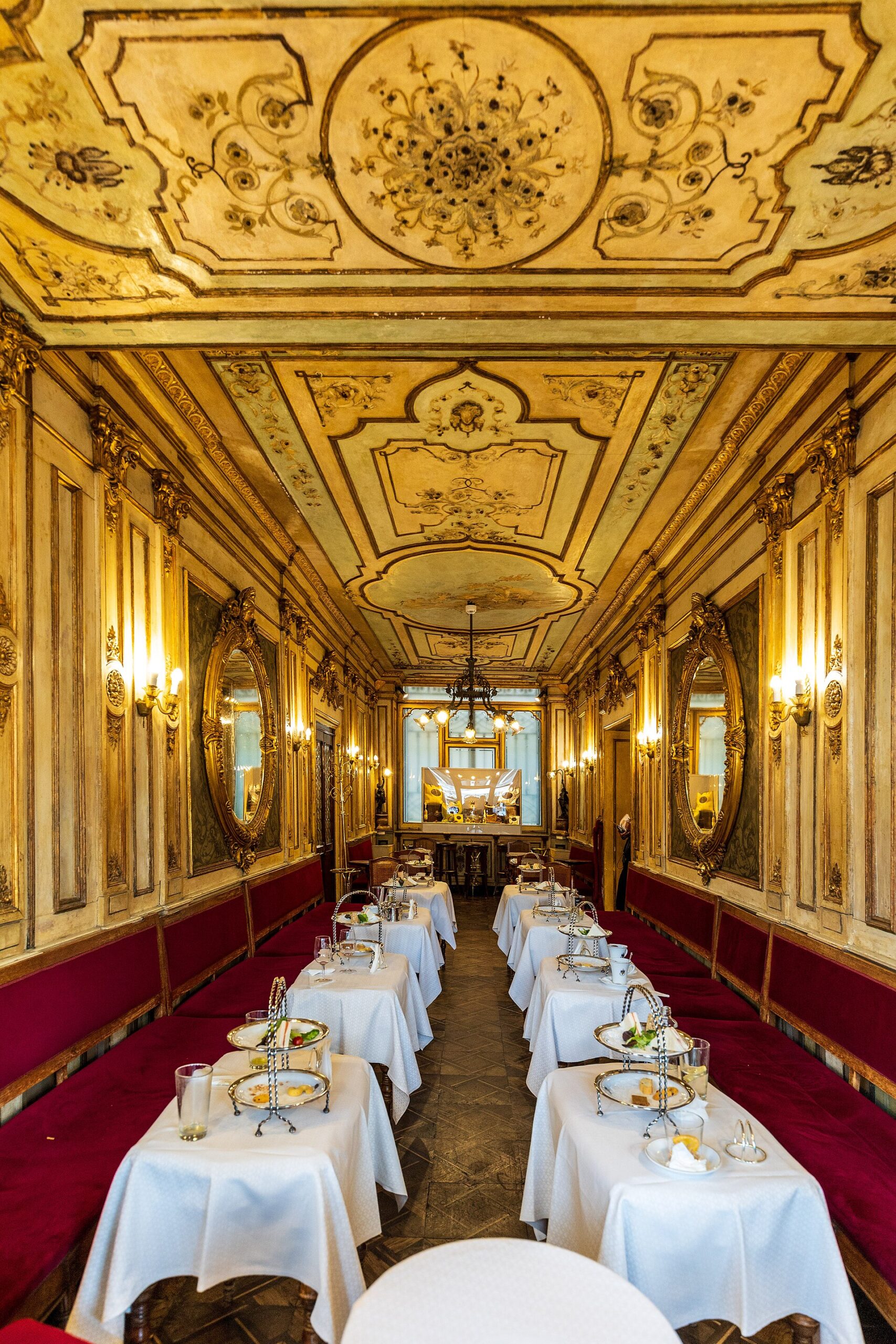
Caffè Florian opened on Piazza San Marco in 1720. The rooms that define much of its appearance, however, belong to the major intervention of 1858, directed by Lodovico Cadorin. The founding date and the date of an interior are different pieces of information. Keeping both in view tells the story without turning every feature into an eighteenth-century object.
The Chinese Room, Oriental Room, Room of the Illustrious Men, Senate Room and Room of the Seasons form a succession of spaces with distinct themes. Their interest is not only in the abundance of decoration, but in their intimate scale. The monumental square remains outside; inside, the immediate setting is a conversation and a small table.
Looking at facing mirrors or the relationship between seating and the wall takes you from the overall image to the dimensions of hospitality. This is a different perspective from reducing Florian to a list of celebrities. The place continues to work through ordinary gestures, within an extraordinary setting.
The stop: a drink and time to observe the chosen room. Outdoor tables and indoor rooms offer different experiences. Read the menu and any service charges before ordering. The Basilica, Doge’s Palace and Procuratie make it possible to continue exploring Piazza San Marco.
Which café fits your trip?
| City | Address | Reason to visit |
|---|---|---|
| Paris | Carette, Trocadéro | The relationship between patisserie and square |
| Budapest | New York Café, Erzsébet körút 9-11 | The depth and scale of the room |
| Vienna | Café Museum, Operngasse 7 | The layers of interior design |
| Prague | Café Imperial, Na Poříčí 15 | Ceramics and mosaics |
| Copenhagen | Apotek 57, Fredericiagade 57 | Furniture and everyday hospitality |
| London | Sketch, 9 Conduit Street | Art, interiors and different services |
| Venice | Caffè Florian, Piazza San Marco | Historic rooms and the life of the square |
To build a balanced day, choose a museum or neighbourhood first, then fit the café into the route. Reversing the process makes sense when the interior itself is your main destination. Either way, allow the stop its own time. Arriving, waiting, ordering and looking around take longer than the few minutes needed for a photograph.
Before sitting down: five useful checks
- Location and room: confirm the exact branch and, where there are several spaces, the room named in the booking.
- Menu and bill: check drinks, any required set menus, service and other stated charges. A beautiful room does not make the price predictable.
- Time: allow for a queue and do not book a museum immediately afterwards without considering the service.
- Accessibility: ask directly about entrances, changes in level, facilities and space available for specific requirements.
- Photography: respect guests and staff, ask before bringing out bulky equipment and keep circulation routes clear.
Questions about historic and designer cafés
Do you need to book all these cafés?
No. Policies and services vary. At Sketch, choose a room and service. Café Imperial recommends reservations. New York Café distinguishes daytime admission from dinner bookings. Check the current policy before visiting, particularly for a group or a tightly scheduled day.
Can you go in just to take photographs?
Do not assume so. These are hospitality businesses, not freely accessible museums. Asking staff is the appropriate way to establish which areas may be viewed without ordering and what photography rules apply.
Do online photographs always show the current interiors?
No. A photograph may predate a refurbishment or document a temporary installation. Sketch demonstrates why dates and context matter. Historical pictures remain valuable, provided they are not presented as a promise of what you will see today.
Historical and practical information checked on 5 October 2026. Hours, menus, services, access and installations may change; confirm them directly before travelling.