From Meda to its 2027 centenary: Cassina’s history, designers, I Maestri collection, iconic furniture and ownership, with a detailed chronology.
From a cabinetmakers’ workshop in Meda to Gio Ponti’s Superleggera, from Le Corbusier reissues to Magistretti’s sofas: the history, designers, ownership and icons of the company that celebrates its centenary in 2027.
In 1957, an ash chair weighs approximately 1.7 kilograms. Its legs have an 18-millimetre cross-section, its seat is woven by hand, and its design draws on a Ligurian tradition: the lightweight chairs of Chiavari. Gio Ponti calls it Superleggera. It is manufactured by a company in Brianza that, until a few years earlier, had been furnishing ocean liners. That company is Cassina, and according to Treccani’s Dictionary of Italian Biography, Superleggera is the piece that took the Meda firm to a new level in the world of design.
Since then, Cassina has put into production the chaise longue by Le Corbusier, Pierre Jeanneret and Charlotte Perriand, Rietveld’s Red and Blue, Vico Magistretti’s Maralunga sofa, Toshiyuki Kita’s Wink armchair and Gaetano Pesce’s I Feltri. It has won four Compasso d’Oro awards, changed ownership several times, and now belongs to the American Haworth group as it prepares for its 2027 centenary.
Cassina: a history from 1927 to the present
Cassina is an Italian furniture company founded in 1927 in Meda, Brianza, by brothers Umberto (1900-1991) and Cesare Cassina (1909-1979). It is known for its collaborations with major twentieth-century architects and for its Cassina I Maestri collection of reissued furniture. Its original business name was Ditta Cassina Amedeo; in 1935, it became Figli di Amedeo Cassina.
Its roots reach further back. The Dictionary of Italian Biography records that the Cassina family had worked as cabinetmakers in Meda since the eighteenth century, and that their uncle Gilberto had begun an early form of series production before the 1920s. The company remained on Via Solferino until the 1940s, then moved to Via Busnelli, where it is still based. Treccani’s entry on Umberto and Cesare Cassina traces the transition from artisan workshop to design company.
From ocean liners to series production
After the war, reconstruction opened up a market for commissioned furnishings. From the late 1940s through the following decades, Cassina furnished ships including the Andrea Doria, Raffaello and Michelangelo, as well as several vessels in the Costa fleet. For the Andrea Doria in 1952, the Fondazione Fiera Milano historical archive records approximately 500 pieces, including Gio Ponti’s 646 Leggera chair. Shipbuilding taught the company to collaborate with an external designer and work at scale: the experience from which its contract-furnishing business would develop.
Gio Ponti and Superleggera: the chair that changed Cassina
Superleggera, model 699, is the chair designed by Gio Ponti and manufactured by Cassina since 1957. It has a solid ash frame, a woven seat and a weight of approximately 1.7 kg, as stated by the company. It evolved from the 1952 Leggera 646 and represents the culmination of Ponti’s years of research into the Chiavari chair.
The design is a lesson in subtraction: removing every unnecessary piece of material without sacrificing strength. Ash is chosen for its flexibility, while beech provides the dense grain required for the seat frame; the legs, with their 18 mm cross-section, are machine-worked and hand-finished. The Denver Art Museum, which holds an example, describes it as the culmination of Ponti’s efforts to reduce weight and structure while maintaining strength. Our Italian-language portrait of Gio Ponti, architect of modern Italian design, follows the rest of the Milanese master’s work.
The collaboration with Ponti, which different sources date to between 1948 and 1950, paved the way for other designers. Ico Parisi and Gianfranco Frattini joined from 1954, while Carlo De Carli’s 683 chair won a Compasso d’Oro at the award’s first edition that same year.
Cassina designers: from Magistretti and Bellini to Pesce and Urquiola
The designers who have shaped Cassina’s history include, above all, Gio Ponti, Vico Magistretti, Mario Bellini, Afra and Tobia Scarpa, Gaetano Pesce, Toshiyuki Kita, Piero Lissoni and Philippe Starck, with Patricia Urquiola serving as art director since 2015. The model resembles that of a publisher: the designer brings an idea, and the company develops it into a prototype and then a production piece.
Vico Magistretti
The relationship began around the XII Triennale in 1960. In the early 1960s, Cassina put the Carimate chair into production, originally designed for the golf club of the same name. A sequence spanning two decades followed: Maralunga (1973), Fiandra, Nuvola Rossa, Sindbad (1981) and the Edison table. An article from Triennale Milano records Magistretti’s admiration for Cesare Cassina’s exceptional insight and intuition, despite his speaking only in dialect. Their relationship, also explored in our Italian-language profile of Vico Magistretti, became a case study in the bond between designer and manufacturer.
Mario Bellini
Bellini worked with Cassina on several fronts: in 1968, he designed its Milan showroom on Via Durini; in 1972, the Kar-a-sutra prototype car for MoMA’s exhibition on Italian design; and in 1977, the Cab chair. Cab’s leather skin dresses a tubular steel skeleton, and the chair entered the permanent collection of the Museum of Modern Art in New York.
Gaetano Pesce, and the confusion surrounding the Up series
With Pesce, Alessandro Mendini and Francesco Binfaré, Cassina founded the experimental workshop Bracciodiferro in 1972. For Cassina, Pesce designed the Tramonto a New York sofa (1980) and I Feltri armchair (1987), made from wool felt impregnated with thermosetting resin, a technology for which the company filed a patent. The celebrated 1969 Up series, with its vacuum-compressed armchair, is not a Cassina product. It was produced by C&B Italia, founded in 1966 by Piero Ambrogio Busnelli in a joint venture with Cassina to experiment with cold-expanded polyurethane foam. In 1973, Cesare Cassina sold his shares, and C&B became B&B Italia. That shared history is the source of the confusion.
The 1970s and 1980s: Scarpa, Deganello and Kita
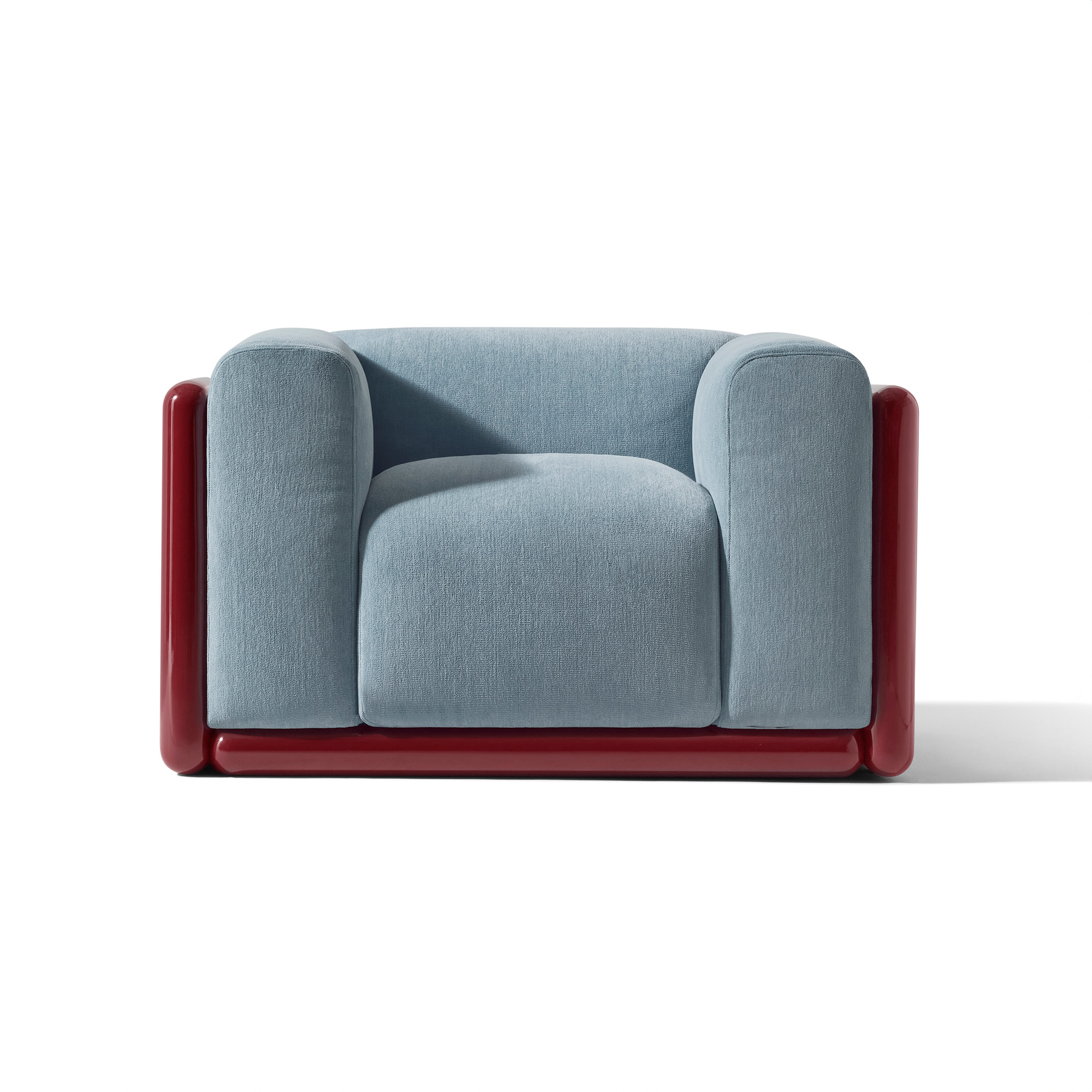
The decade opened with Afra and Tobia Scarpa’s Soriana sofa and armchair, winners of a Compasso d’Oro in 1970. Paolo Deganello’s AEO armchair with Archizoom entered the catalogue in 1973 as a manifesto of radical design. In 1980 came Toshiyuki Kita’s Wink, an almost cartoon-like seat offering numerous transformations. Piero Lissoni’s Met sofa (1996) opened a new contemporary chapter in the 1990s, followed in 2014 by the 8 sofa.
Cassina I Maestri: what the collection is and whose work it includes
Cassina I Maestri is the collection through which the company reproduces furniture by major twentieth-century architects under licences from their heirs and foundations. It began in 1965 with the first four models by Le Corbusier, Pierre Jeanneret and Charlotte Perriand, and acquired its present name in 1973 under the scholarly direction of Filippo Alison.
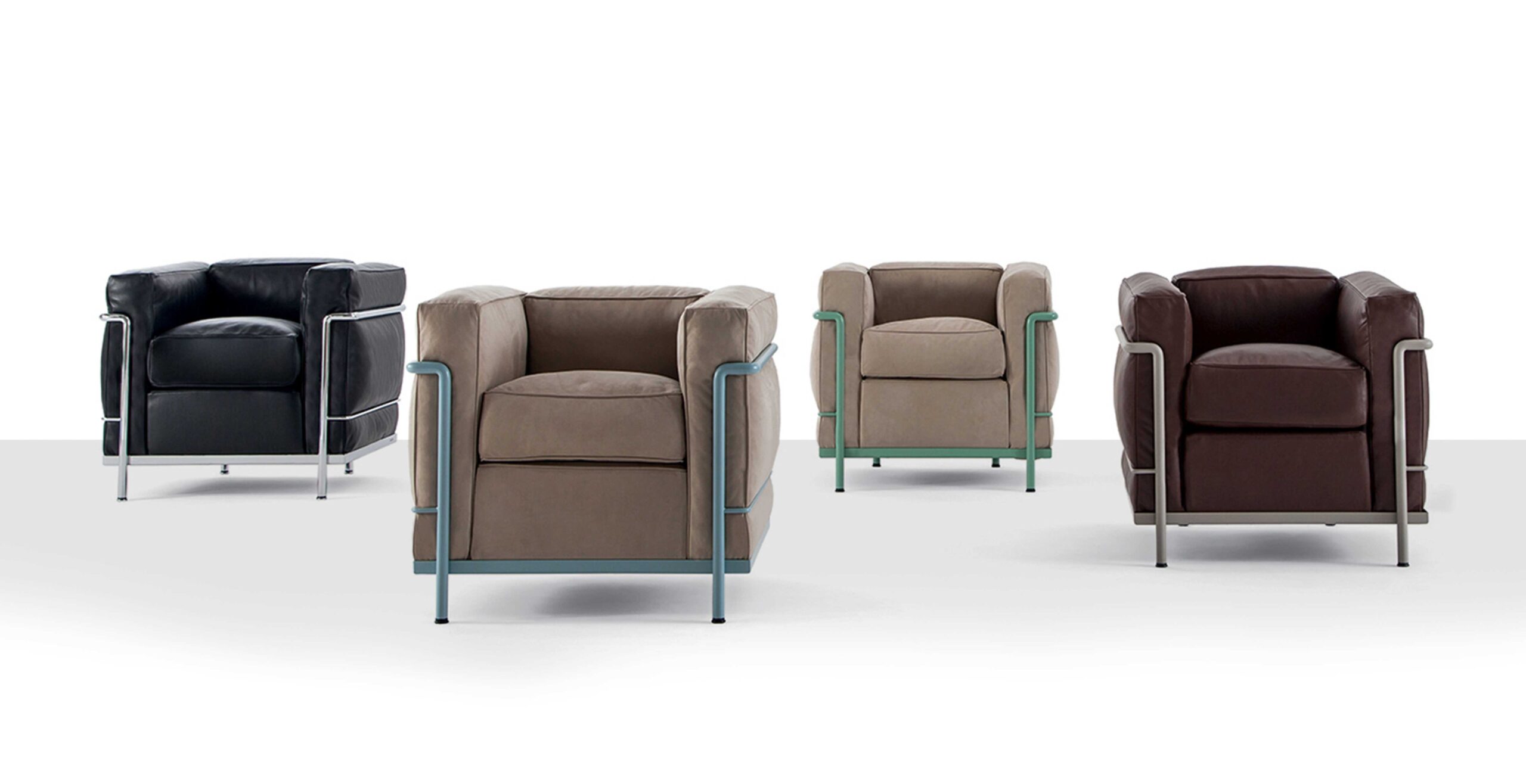
The initial core comprised the 1928 furniture family now known as LC: the continuously adjustable chaise longue presented at the 1929 Salon d’Automne, the Grand Confort armchairs and the tilting-back chair. This is the chapter of Le Corbusier’s history most visible in contemporary homes. In March 1972, Cassina announced its purchase of exclusive rights to all Gerrit Rietveld furniture from his heirs, as documented by the Rietveld Foundation. His 1918 Red and Blue has been in production since 1973, the year Charles Rennie Mackintosh also entered the collection with Hill House, designed in 1903 for the white bedroom of the house in Helensburgh.
Erik Gunnar Asplund was added over time, as were several Frank Lloyd Wright designs in the 1980s. In 2018, the Taliesin 1 armchair, originally designed in 1949, returned to production in collaboration with the Frank Lloyd Wright Foundation. Further additions included Charlotte Perriand’s own collection (2004), Franco Albini (2008, with the 1940 Veliero bookcase reconstructed in 2011), Marco Zanuso (2015), the 2019 tribute to Pierre Jeanneret, and Ico Parisi and Giacomo Balla (2020). In 2023, for the collection’s fiftieth anniversary, Vico Magistretti, Gio Ponti, Carlo Scarpa and Charles and Ray Eames also joined. Readers of our Italian-language exploration of Frank Lloyd Wright’s buildings will recognise the same geometry in these furnishings as in his houses.
Cassina icons: armchairs, sofas and chairs worth knowing
Cassina’s icons are pieces that defined an era, many of which remain in its catalogue: Ponti’s Superleggera, the LC4 chaise longue, Rietveld’s Red and Blue, Magistretti’s Maralunga and Bellini’s Cab. The table gives their designers and design dates, drawing on company specifications and museum sources. For I Maestri pieces, it also distinguishes the year Cassina began production.
| Piece | Type | Designer | Year |
|---|---|---|---|
| LC4, Chaise longue à réglage continu | Chaise longue | Le Corbusier, Pierre Jeanneret, Charlotte Perriand | 1928 (Cassina manufacturing from 1964; exclusive production rights from 1965) |
| Red and Blue | Armchair | Gerrit T. Rietveld | 1918 (Cassina production from 1973) |
| Hill House 1 | Chair | Charles Rennie Mackintosh | 1903 (Cassina production from 1973) |
| 683 | Chair | Carlo De Carli | Compasso d’Oro 1954 |
| 699 Superleggera | Chair | Gio Ponti | 1957 |
| Soriana | Sofa and armchair | Afra and Tobia Scarpa | Compasso d’Oro 1970 |
| Maralunga | Sofa and armchair | Vico Magistretti | 1973 |
| AEO | Armchair | Paolo Deganello, Archizoom | 1973 |
| Cab | Chair | Mario Bellini | 1977 |
| Wink | Armchair | Toshiyuki Kita | 1980 |
| I Feltri | Armchair | Gaetano Pesce | 1987 |
Maralunga deserves a closer look: a simple bicycle chain hidden inside its backrest allows it to be adjusted into different positions, transforming a low-backed sofa into one with a headrest. This elementary mechanical solution explains why it features in surveys of sofas that made design history, just as Superleggera and Cab recur among iconic chairs in design history.
Who owns Cassina today: from the family to Haworth
Cassina belongs to the American Haworth group, which acquired a majority stake in Poltrona Frau Group in 2014. Cassina had been part of that group since 2005; in March 2025, the division was renamed Haworth Lifestyle.
The ownership chronology follows a clear sequence. In the late 1980s, the family sold a majority stake to French investors; in 1999, control passed to Paris-listed Fimalac. In May 2005, the Charme fund acquired all of Cassina’s capital through Poltrona Frau in a transaction estimated by the financial press at approximately EUR 140 million. This created an Italian high-end furniture group, also discussed in our Italian-language history of Poltrona Frau. In February 2014, Haworth acquired 58.6% of the group, which also included Cappellini and other brands.
Meanwhile, Cassina itself grew through acquisitions: Simon International in 2013 and Zanotta in 2023. Haworth Lifestyle now brings together fifteen brands, including Poltrona Frau, Cassina, Cappellini, Zanotta and Ceccotti. It is a different model from the independent, family-owned structure of Kartell: two contrasting routes for taking Italian design to the global market.
Patricia Urquiola, art director
Patricia Urquiola was appointed Cassina’s art director in September 2015, making her debut in 2016 with the Gender armchair and Beam sofa system. In 2018, she redesigned the Via Durini showroom for its fiftieth anniversary, and in 2021 she was confirmed for a second term ahead of the centenary. Her direction introduced The Cassina Perspective, bringing I Maestri and contemporary designs into dialogue within the same interiors; at Design Week 2026, it presented the new Ardys upholstered collection.
Cassina Contract and Custom Interiors: bespoke furnishings
Cassina’s contract business, which the company now presents as Custom Interiors, creates bespoke furniture for hotels, offices and cruise ships, continuing the vocation established with post-war ocean liners. It is the less visible side of the brand, but also the one with the longest history.
The principle remains that of the 1950s: an external designer, a complex construction project, and a company capable of industrialising a one-off piece. In 2020, Cassina established Cassina LAB with POLI.design at the Politecnico di Milano, focusing on materials and sustainability. In 2021, it launched Cassina Pro, a collection conceived for hospitality and working environments. In the hotel projects covered by our editorial team, I Maestri icons often form the focal point of a lobby or suite, alongside bespoke furniture.
Compasso d’Oro awards and where to see Cassina in Italy
Cassina has received four Compasso d’Oro awards: in 1954 for Carlo De Carli’s 683 chair, in 1970 for Afra and Tobia Scarpa’s Soriana, in 1979 for Vico Magistretti’s Maralunga, and in 1991 an award to the company for its contribution to design culture.
The award was established by La Rinascente in 1954 following an idea from Gio Ponti and Alberto Rosselli, and has been managed by ADI since 1959. Its historical collection holds more than 2,300 projects in Milan. The ADI Design Museum’s page on the Compasso d’Oro explains its history and criteria. Together with Triennale’s design collections, the museum offers a setting in which to understand these pieces historically.
For the current catalogue, the principal reference is Cassina’s Milan showroom on Via Durini, opened in 1968 in the district that hosts major brands’ presentations during Design Week. Elsewhere, products are available through authorised dealers, which generally display a selection of upholstered furniture and I Maestri pieces.
Frequently asked questions about Cassina
Who founded Cassina, and where is it based?
Cassina was founded in 1927 in Meda, Brianza, by brothers Umberto and Cesare Cassina, heirs to a cabinetmaking family active since the eighteenth century. Its first business name was Ditta Cassina Amedeo, which became Figli di Amedeo Cassina in 1935. Its production facilities and headquarters remain in Meda, on Via Busnelli.
Who owns Cassina today?
Cassina has belonged to Poltrona Frau Group since 2005, when the group was controlled by the Charme fund. In 2014, the majority stake passed to the American company Haworth, which renamed the division Haworth Lifestyle in March 2025. The division brings together fifteen brands, including Poltrona Frau, Cappellini, Zanotta, acquired by Cassina in 2023, and Ceccotti.
What is the Cassina I Maestri collection?
It is a collection of licensed reissues of furniture by major twentieth-century architects. It began in 1965 with the first four models by Le Corbusier, Pierre Jeanneret and Charlotte Perriand, and received its name in 1973 under Filippo Alison’s direction. It includes Rietveld, Mackintosh, Asplund, Albini and Zanuso, among others, and since 2023 Ponti, Magistretti, Carlo Scarpa and Eames.
Is Gaetano Pesce’s Up armchair a Cassina product?
No. The Up series, designed by Gaetano Pesce in 1969, was produced by C&B Italia, the company formed in 1966 through the joint venture between Cassina and Piero Ambrogio Busnelli. It became B&B Italia after Cesare Cassina’s departure in 1973. For Cassina, Pesce designed, among other pieces, the Tramonto a New York sofa (1980) and I Feltri armchair (1987).
How much does Gio Ponti’s Superleggera weigh?
The 699 Superleggera, manufactured by Cassina since 1957, weighs approximately 1.7 kg according to the company’s specifications. Its solid ash frame has legs with an 18 mm cross-section; its seat frame is beech and the seat is woven. Ponti took inspiration from the lightweight chairs of Chiavari in Liguria, pushing their reduction of material to its limit.
Who is Cassina’s art director?
The art director is Patricia Urquiola, appointed in September 2015 and confirmed in 2021 for a second term ahead of the 2027 centenary. She debuted in 2016 with the Gender armchair and Beam system, redesigned the Via Durini showroom in 2018, and oversees The Cassina Perspective, which brings historical masters together with contemporary designers.