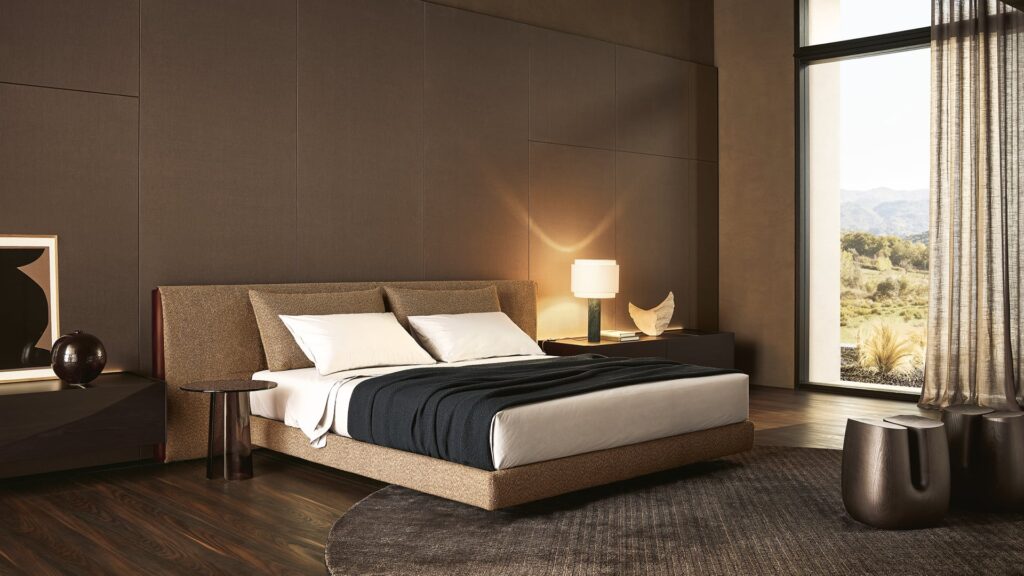
The reason mismatched nightstands are taking over the bedroom is cultural before it is aesthetic. The perfectly symmetrical bedroom has started to look impersonal, almost straight out of a catalog, while there is a growing desire for spaces that say something about the people who live in them. Studied asymmetry answers exactly that need: it …
The reason mismatched nightstands are taking over the bedroom is cultural before it is aesthetic. The perfectly symmetrical bedroom has started to look impersonal, almost straight out of a catalog, while there is a growing desire for spaces that say something about the people who live in them. Studied asymmetry answers exactly that need: it introduces personality, depth and a pleasing “collected over time” feel, as if the furniture had been gathered piece by piece rather than bought as a set.
It’s Not Clutter: It’s Intentional Balance
Be careful, though, not to confuse mismatched nightstands with improvisation. The difference between elegant asymmetry and a random pairing lies in a shared element of coherence. Designers agree: for two different nightstands to work together, they need to have something in common. It might be height — almost always the deciding detail — or a finish, a material or a color palette that ties them together. A wooden nightstand and a lacquered one can coexist beautifully if they share a tone, or if that wood is echoed elsewhere in the room.
Height deserves a special mention. Two nightstands at very different levels create an awkward imbalance, especially when they hold lamps, which end up at different heights and break the harmony around the bed. Keeping the same height, or one very close to it, is the trick that lets you take risks with shapes and materials without losing balance. Another effective device is to link the two pieces with a repeated accessory: the same lamp on both sides, for example, can reconcile even very different nightstands.
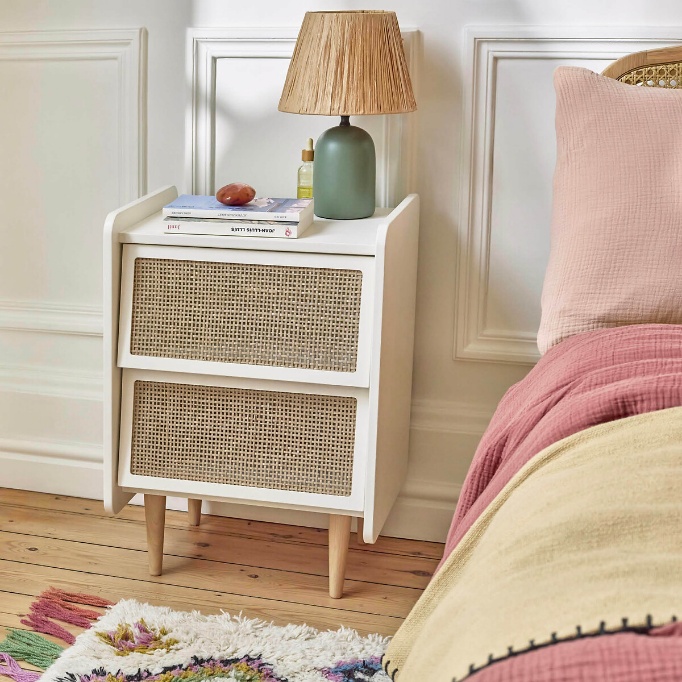
The Nightstand Becomes a Design Piece
The mismatched nightstand trend builds on another shift in 2026: the nightstand is no longer a simple box with a drawer but an expressive element of the room. Rounded shapes, tops in sculptural materials such as stone or marble, and wall-mounted models that free up the floor and lighten the look are all on the rise. In this context, choosing two different pieces is no longer a compromise but a design opportunity: you can play with a contrast of materials — a rattan front next to a lacquered wood one — while keeping things coherent with legs or details in the same color.
There is also a practical side that makes this trend appealing. Mismatched nightstands let you tailor each side of the bed to the person who uses it: a model with more drawers on one side, a pared-back surface on the other, or a single floating shelf where space is tight. Function leads form, without sacrificing looks.
When Asymmetry Also Solves the Room’s Constraints
There is one last, very practical reason mismatched nightstands are gaining ground: they are often the smartest answer to bedrooms that are not perfectly symmetrical. A window on only one side of the bed, an awkwardly placed outlet, a narrow corner or a nearby door can make it impossible to place two identical pieces. In these cases, choosing two different nightstands — perhaps a slimmer one where space is short and a wider one on the other side — turns a constraint into a style choice. It is a principle designers have applied for years: adapt the furniture to the reality of the room instead of forcing the room into a rigid scheme. The result is a space that works better and, at the same time, looks more natural and lived-in.
How to Mix Nightstands Without Getting It Wrong
If you want to experiment, the path is clear: commit to asymmetry with intention, not halfway. Either opt for a perfectly coordinated pair, or embrace the mismatched look decisively, avoiding timid solutions that just look like mistakes. The key is to set a common thread — color, height, material or lighting — and let it hold the composition together. If you want to put together your own pairing, explore a selection of nightstands and have fun finding the right combination. Because in 2026, the most successful bedroom is not the most symmetrical one, but the one that tells a story through its details.