How to choose a living room rug: placement rules around the sofa, standard sizes, clearances, materials, weaves, colour, prices and mistakes to avoid.
How to get your living room rug size right: the three placement rules around the sofa, standard sizes and how to calculate them, materials, weaving techniques, colour and price. A designer’s guide to the one piece that holds the whole room together.
For years the rug was the last thing anyone bought, once the budget had run dry, and it was almost always too small. Today the opposite is happening. In the most interesting interiors the rug is chosen alongside the sofa, sometimes before it, because it is the only element that can shape a room without building a wall. It defines the conversation area, softens acoustics, warms cold floors such as porcelain tile and stone, and brings colour and texture in a dose no painted wall can match. Get the living room rug size wrong, though, and the whole room looks undersized.
Here is the short answer. The rug should be wider than the sofa by at least 15 to 20 centimetres on each side, it should hold at least the front legs of the seating, and it should stop roughly 30 to 45 centimetres short of the walls. In an average living room with a three-seater sofa, the right size is almost always 200 x 300 cm, roughly 6’7″ x 9’10”. A 160 x 230 cm rug only works with small sofas or narrow rooms. Everything else, from fibre to weave to colour, depends on how the room is lived in.
How big should a living room rug be in relation to the sofa?
Big enough to connect the seats to one another. That is the test interior designers use, and it translates into three placement rules, from the most generous to the most compact.
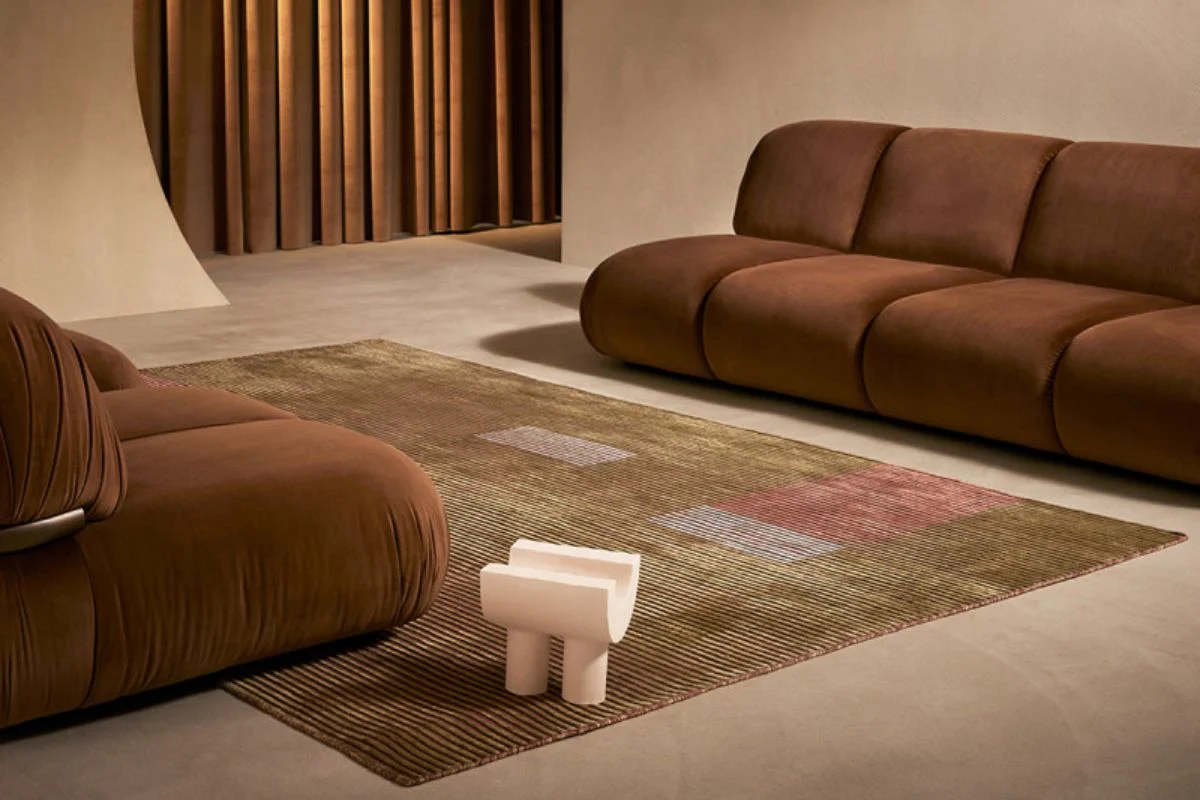
The first is all legs on the rug. Sofa, armchairs and coffee table sit entirely on the textile, which extends at least 20 to 30 centimetres beyond the back and arms. It is the most luxurious and most architectural option, because the rug becomes a room within the room. It calls for large formats, from 250 x 350 cm upwards, and suits generous living rooms and open-plan spaces.
The second, and the most common, is front legs only. The rug slips 15 to 20 centimetres under the sofa, just enough to anchor the seating visually, while the back legs stay on the floor. It is the best balance between proportion and budget: with a three-seater it usually means 200 x 300 cm.
The third is the floating rug, placed 10 to 15 centimetres in front of the sofa without touching it. It is the solution for small rooms or sofas with a solid plinth base, with one condition. The rug should never be narrower than the sofa, or it will seem to drift in the middle of the room and make the space feel smaller. Which rule to follow also depends on the seating layout: with an island arrangement, as we explain in our guide to modular sofas, the front-legs rule applies to every open side.
Living room rug size: how to calculate it from your sofa
Start from the sofa and the conversation area, not from the room. Measure the width of the sofa and add 15 to 30 centimetres on each side: a 220 cm sofa therefore needs a rug at least 250 to 280 cm wide. For depth, consider the space from the sofa to the armchairs or the piece opposite. If the front legs are to sit on the rug, allow 15 to 20 centimetres under the seat, the gap to the coffee table, usually 40 to 45 centimetres, and the coffee table itself.
A living room rug size chart
The most reliable method is still the designer’s trick: mark the outline of the rug on the floor with masking tape and live with it for a couple of days. You will notice straight away whether you trip on it, whether an armchair is left stranded, or whether a door catches the edge. The table sums up recommended sizes by type of seating for the two most common placement rules.
| Sofa or seating | Front legs on the rug | All legs on the rug |
|---|---|---|
| Two-seater (160-190 cm) | 160 x 230 cm (approx. 5’3″ x 7’7″) | 200 x 300 cm (approx. 6’7″ x 9’10”) |
| Three-seater (200-240 cm) | 200 x 300 cm (approx. 6’7″ x 9’10”) | 250 x 350 cm (approx. 8’2″ x 11’6″) |
| Four-seater or two facing sofas | 250 x 350 cm (approx. 8’2″ x 11’6″) | 300 x 400 cm (approx. 9’10” x 13’1″) |
| Corner sofa (long side 280-320 cm) | 250 x 350 cm (approx. 8’2″ x 11’6″) | 300 x 400 cm or bespoke |
| Armchairs and coffee table, no sofa | Round, 200 cm diameter | Round, 240-300 cm diameter |
With a corner sofa, align the rug with the longer side and make sure it reaches under both open sides. In a small living room, on the other hand, resist the temptation of a tiny rug. A large rug that runs under the seating unifies the space and makes it feel bigger, while a small one breaks it up.
What are the standard living room rug sizes?
The best-selling standard sizes for a living room in Europe are 160 x 230, 200 x 300 and 250 x 350 centimetres, followed by 300 x 400 cm for very large rooms. In the UK and US the equivalents are usually sold in feet, as 5×8, 6×9, 8×10 and 9×12, and they do not match metric sizes exactly. A 5×8, about 152 x 244 cm, suits a small living room with a two-seater; an 8×10, about 244 x 305 cm, sits between the 200 x 300 and 250 x 350 cm formats. Smaller formats such as 140 x 200 or 120 x 170 cm belong in bedrooms, hallways or reading corners, not in the living room.
For round rugs, the most common diameters run from 160 to 300 centimetres: 160 to 200 cm for a pair of armchairs and a side table, 240 to 300 cm for a full conversation area. When standard sizes fall short, almost every high-end maker will produce a rug made to measure in size, shape and colour. From Golran to cc-tapis, from Mohebban to Nodus, bespoke work has become a major part of their collaboration with architects and interior designers, as our selection of the best modern rug brands shows.
How far should a rug be from the walls and the fireplace?
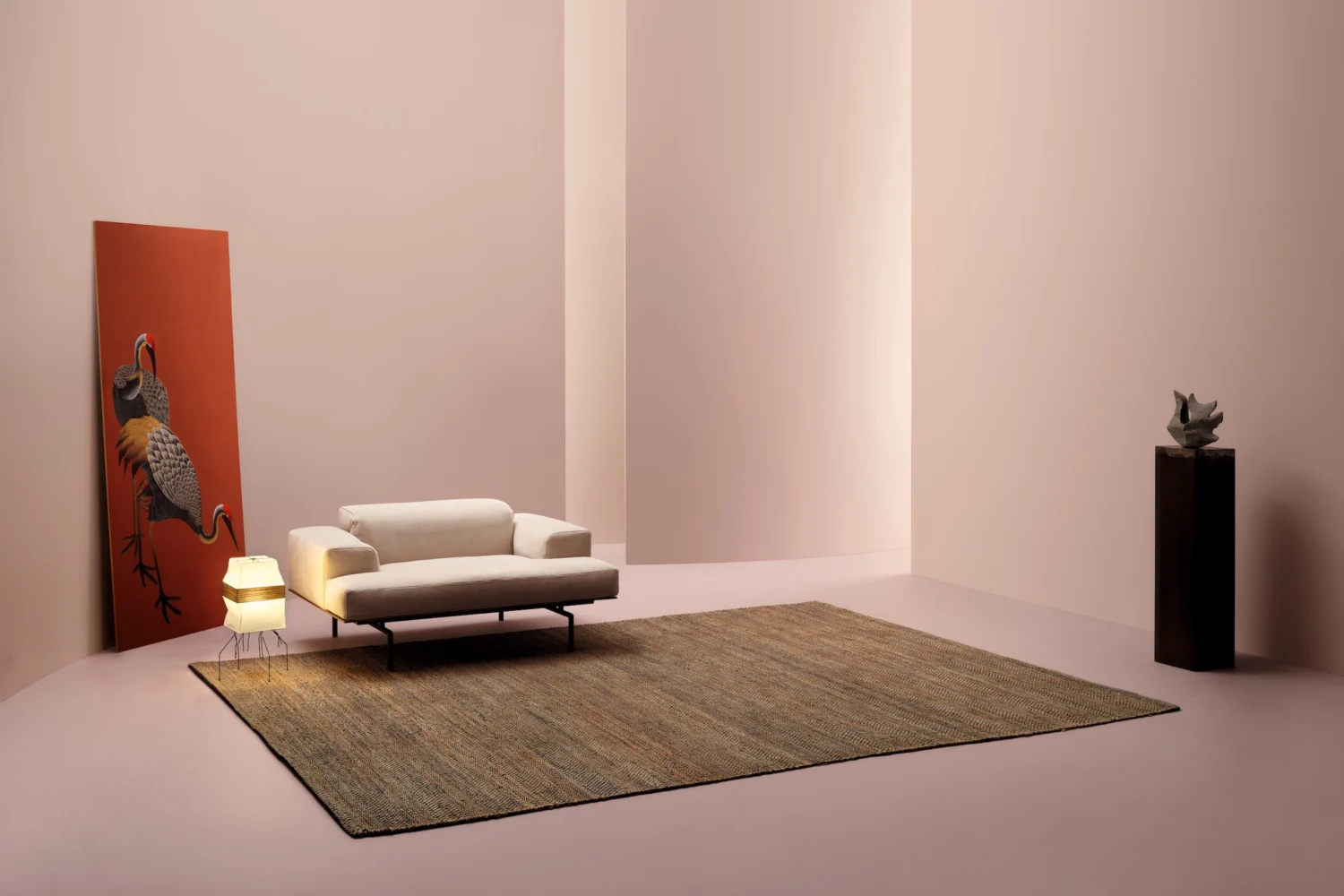
Keep the rug roughly 30 to 45 centimetres, about 12 to 18 inches, away from the walls. That strip of floor lets the room breathe and makes the rug read as an island rather than as badly cut wall-to-wall carpet. In small rooms you can go down to 20 centimetres; in very large ones, 60 centimetres or more. If the rug touches one wall and not the others, the effect is untidy. A regular border on every side works best, or at least a symmetrical one along the two long sides.
The fireplace changes the rule, because safety comes into play. In front of a wood-burning fireplace or stove the floor must stay clear, and the rug should stop short of the hearth or the non-combustible zone set out by the manufacturer and by local building regulations. Sparks are rare with closed fireboxes, but wool scorched by an ember is damage that cannot be repaired. Bioethanol and electric models need less clearance, yet the manual always has the final word. All the types, with their rules, are covered in our guide to the modern fireplace.
Rectangular, round or organic: which shape works best?
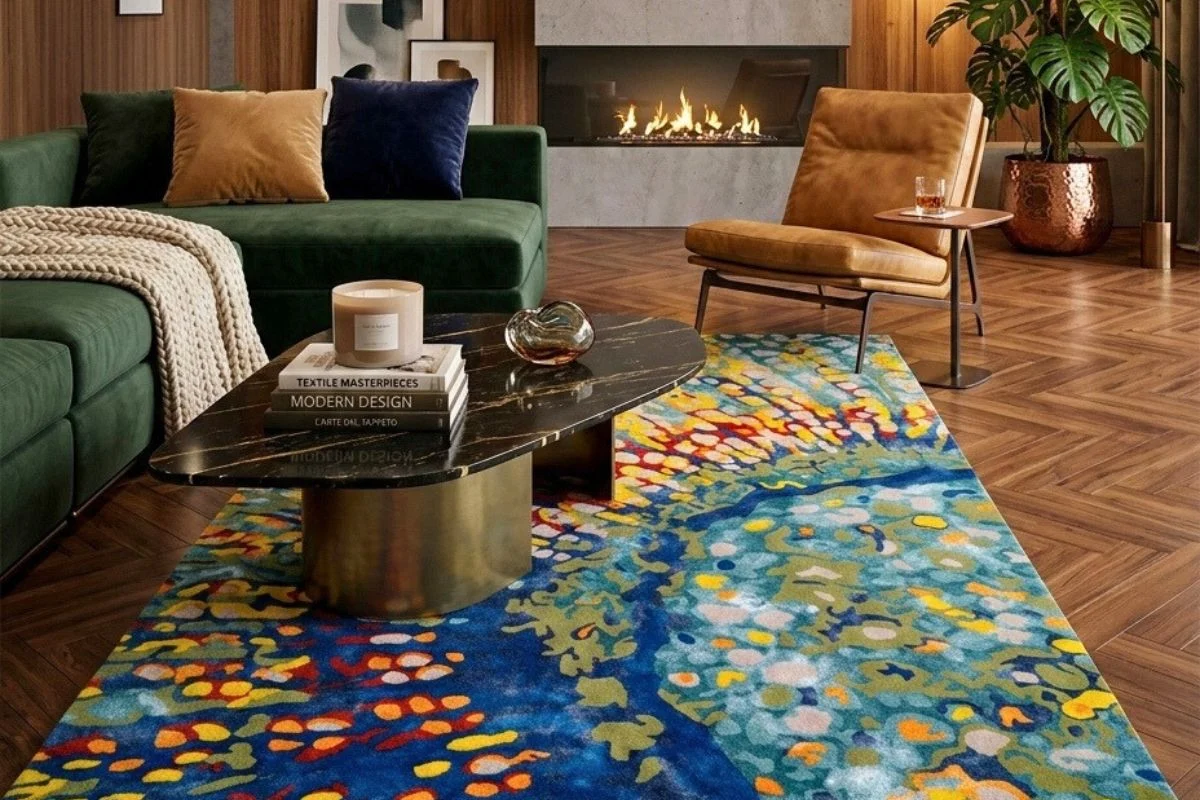
A rectangular rug is the most natural choice, because it follows the shape of the sofa and the room, and it is almost always the easiest to furnish around. A round rug softens geometry. It works under a group of armchairs, with a curved sofa or in a square room, and it helps break up a very linear space.
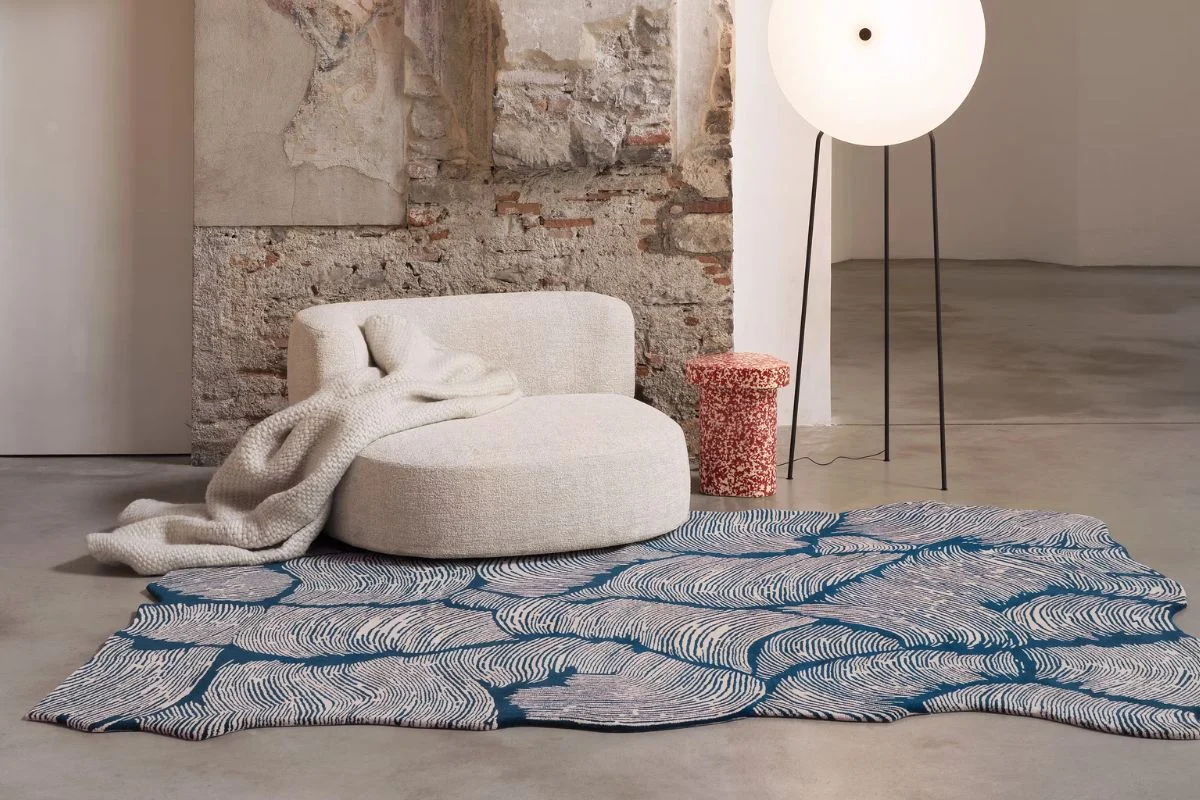
The most interesting shape of recent years, however, is the irregular or organic one: outlines that look drawn freehand, the profiles of pebbles, stones and pools of water. The rug stops being a rectangle to fill and becomes a graphic gesture, almost a sculpture on the floor. It pairs beautifully with curved sofas and textured fabrics such as bouclé, and with all the softer aesthetics described in our living room trends for 2026. The one rule is not to surround it with too many other free forms. An organic rug needs calm lines around it.
What is the best material for a living room rug?
For most living rooms, wool is the best material. It is resilient and springs back after the pressure of furniture. It stands up to foot traffic, resists dirt thanks to its natural lanolin and is naturally slow to burn. A new wool rug may shed in its first months, which is perfectly normal. New Zealand wool and Himalayan wool, widely used in designer rugs, are prized for their long fibres and softness.
Silk brings a depth and sheen no other fibre has, but it is delicate and expensive. It is often blended with wool to make a pattern glow, and it is best kept away from busy routes. Viscose imitates silk at a fraction of the price, but it crushes, marks with water and ages badly, so think twice before using it in a hard-working living room. Linen is cool and matt, ideal for flatweaves in summer houses.
Hard plant fibres such as jute and sisal bring natural texture at an accessible price, but they feel rough underfoot and dislike humidity and spills. Sisal is tougher and more even, while jute is softer and warmer in colour. Synthetic fibres, including polypropylene, polyamide and recycled PET, are the most practical. They resist stains, many are washable, and they are the basis of the outdoor rugs now moving indoors in homes with children and pets. Paola Lenti led the way with rugs in technical yarns designed to live both inside and out.
Allergies and everyday care
If you have a dust mite allergy, a rug is not off limits, but choose carefully. Low pile or flatweave rugs hold less dust and are easier to vacuum thoroughly, and washable rugs are another option. Frequent vacuuming with a high-efficiency filter matters more than the rug itself, along with periodic professional cleaning. Routine care is the same for every rug: vacuum once or twice a week in the direction of the pile, rotate the rug every six months so light and footfall wear it evenly, and blot spills at once without rubbing.
Hand-knotted, tufted or kilim: what justifies the price?
A rug’s price depends above all on how it is made, even more than on the fibre. The hand-knotted rug sits at the top. Every knot is tied by hand around the warp threads, and quality is measured in knot density. Handmade rugs range from roughly 16 to 800 knots per square inch, or from about 25,000 to well over a million knots per square metre. More knots mean sharper patterns and longer making times, often months for a single piece. The Persian, or asymmetrical, knot and the Turkish, or symmetrical, knot are the two great families, described in the entry on the Persian carpet. Density is not everything, though. In contemporary Himalayan wool rugs by makers such as Jan Kath, Nodus and Golran, the quality of the fibre and the dye matters just as much.
Hand-tufting is a faster technique. Yarn is punched into a canvas with a tufting gun, then fixed with a latex coating and a fabric backing. It allows free designs, relief and multi-level pile at lower cost, and it is the technique behind many designer rugs. It lasts less long than a hand-knotted piece and cannot be restored in the same way, but it remains an excellent choice for a living room.
The kilim, and flatweave rugs in general, have no pile. They are light, often reversible, and come from a weaving tradition that stretches from the Balkans to Pakistan, as the Wikipedia entry on the kilim explains. They are ideal under a dining table, over underfloor heating and for anyone who wants an easy-to-clean rug. Nanimarquina and Kasthall, with its Swedish weaving heritage, show how sophisticated a flat surface can be.
How much does a living room rug cost?
As a rough guide for a 200 x 300 cm rug: from about €150 to €600 for a machine-made rug in synthetic fibre or jute; from €800 to €2,500 for a hand-tufted wool rug; and from €3,000 to well over €10,000 for a hand-knotted designer wool rug, with silk blends and limited editions climbing higher still. The difference lies in hours of labour, fibre and lifespan. A good hand-knotted rug lasts for decades.
How do you choose rug colour and pattern?
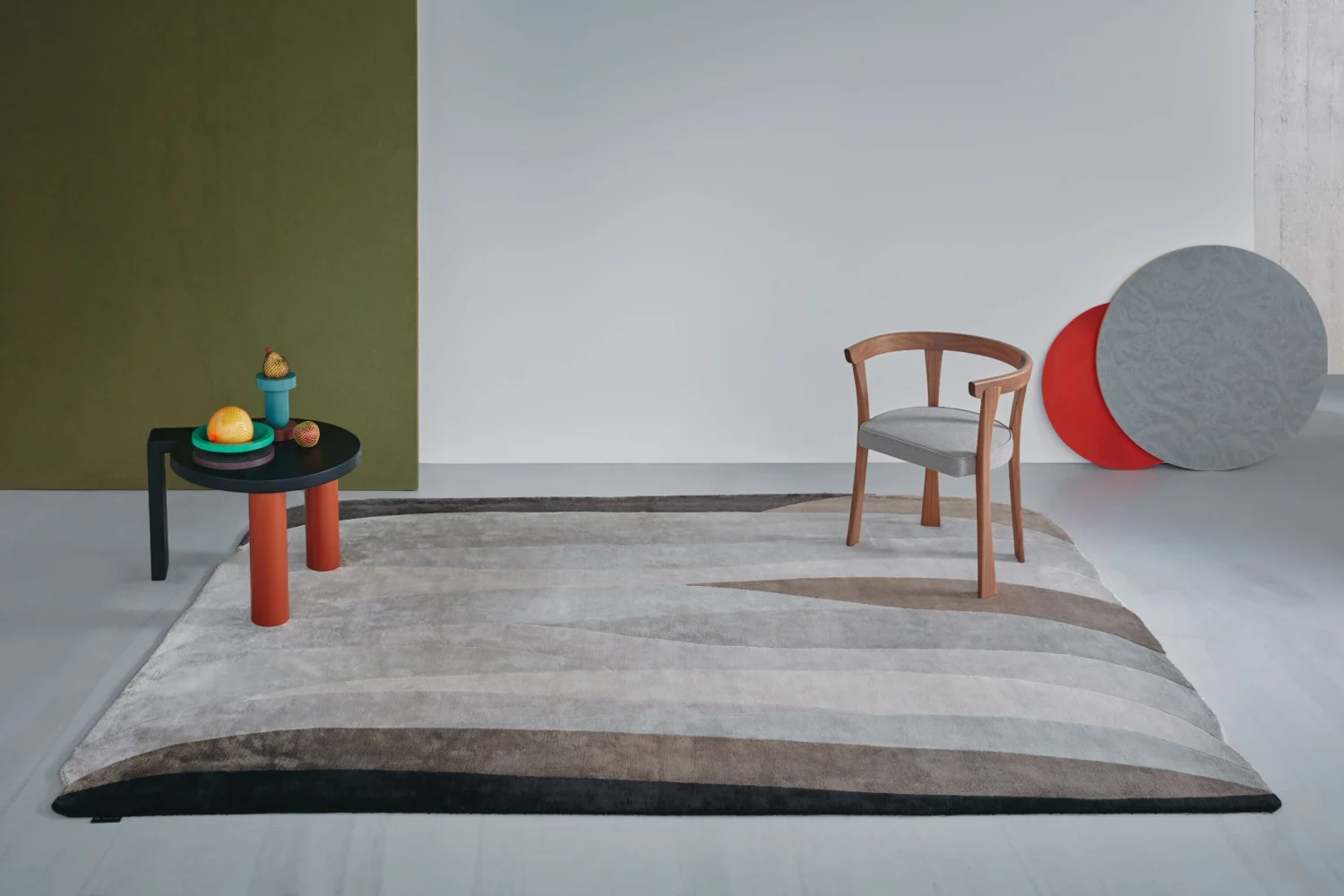
Choose colour by looking at the floor, walls and sofa together. The rug needs to stand out from the floor, in tone or in texture. Pale oak pairs well with warm neutrals, greens and deep shades. Dark wood or charcoal porcelain tile lets light, luminous rugs come into their own. Where the floor already has a strong pattern, such as encaustic tiles or veined marble, a plain rug or one with a tonal relief texture is the safer choice. With the walls, the rug can play by contrast or go tone on tone.
One simple rule keeps pattern in check: if the sofa is plain, the rug can be bold; if the sofa is patterned, the rug should calm down. Light colours make a room feel larger but show dirt, whereas mid-tones, heathered yarns and abstract designs hide everyday wear far better. A rug with a strong design can become the starting point for the whole palette, setting the colours of cushions and accents. That idea of the rug as a design statement runs through our interview with the founders of Ademi, and the mid-century modern style has always embraced it with graphic patterns and bold colour.
Rugs on parquet or tiles: do you need a non-slip underlay?
Almost always, yes. A non-slip rug underlay stops the rug from moving and prevents the ripples that cause trips. It protects the floor from abrasion and extends the life of the rug by cushioning every step. On porcelain tile and stone it is essential, because smooth surfaces let even heavy rugs slide. In return, the rug brings these cold floors the warmth and sound absorption they lack.
On parquet, choose a felt underlay or one in felt and natural rubber. Some cheap PVC or synthetic rubber pads can react with lacquers and oil finishes and leave marks that are hard to remove, so it is worth checking with the flooring manufacturer, as we explain in our guide to the best parquet brands. Over underfloor heating, thin rugs such as flatweaves or low piles work best, with an underlay rated as compatible, because excessive thickness reduces the system’s efficiency.
Rugs in open-plan spaces and under the dining table
In an open-plan space, a rug is the simplest way to zone the room without building partitions. One rug under the sofa group defines the living area, a second under the table defines dining. The two need not match, but they should be related, sharing a colour family, a material or a level of pattern. Leave a strip of bare floor at least 60 to 90 centimetres wide between them to act as a walkway. More strategies for separating spaces without walls can be found in our guide to open-plan living.
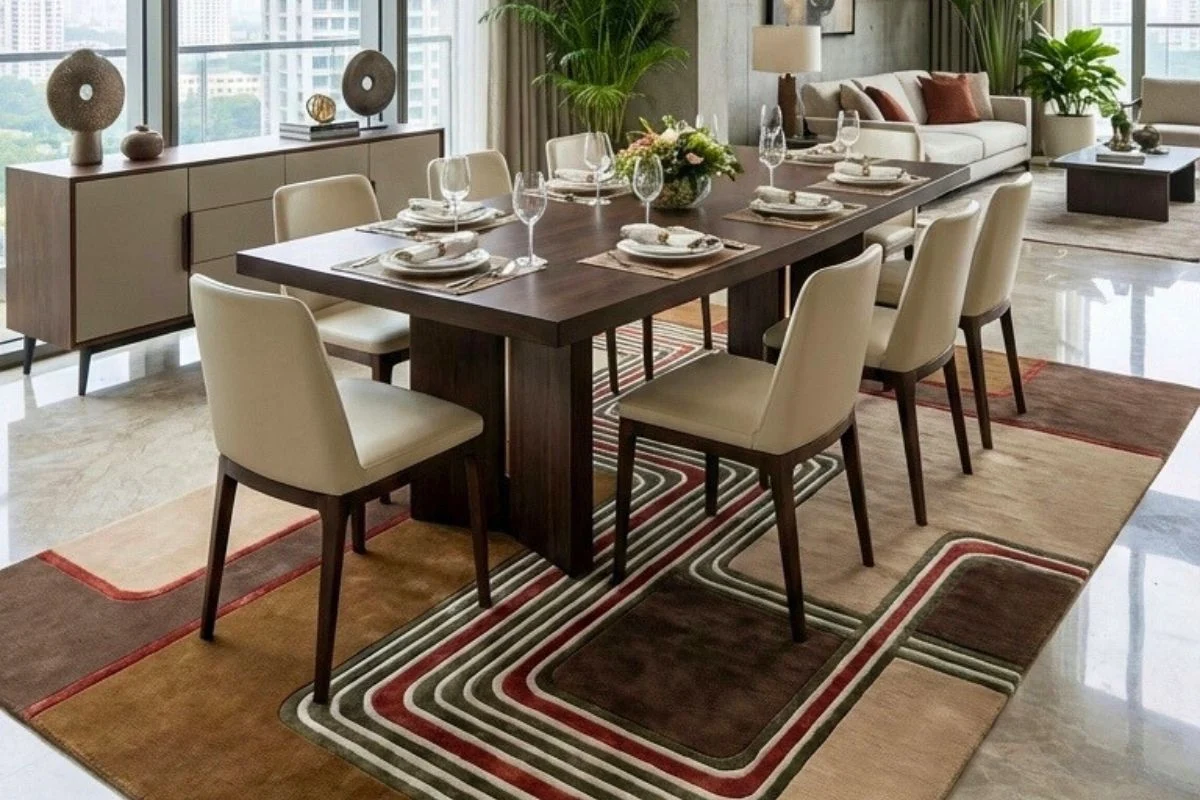
Under a dining table the rule is precise: the rug should extend at least 60 centimetres on each side, about 24 inches, beyond the edge of the table, so the chairs stay on the rug even when pulled back. A 90 x 200 cm table therefore needs a rug of at least 210 x 320 cm. Flatweaves and low piles are best here, as chairs glide over them, in colours that forgive crumbs.
Common living room rug mistakes to avoid
The first mistake, and by far the most common, is a rug that is too small: a rectangle floating in front of the sofa without touching any seat. Next comes centring it on the room rather than on the conversation area, so it never relates to the furniture. Doors are often forgotten too, yet a thick rug in the swing of a door will block it and wear quickly. Another trap is choosing the material on looks alone, like pale viscose in a home with children or sisal in a damp room. The last is skipping the underlay to save a little money on a rug worth hundreds.
To see how the makers who have turned the rug into an authored design actually work, start with our conversations with Mohebban and Nodus, or read about the rug as architecture in Magliocco at EDIT Napoli.
Living room rug FAQs
Should a rug go under the sofa or in front of it?
Ideally under the front legs of the sofa, by 15 to 20 centimetres. That placement connects the seating and gives the room proportion. A rug placed entirely in front of the sofa only works in small spaces, and only if it is at least as wide as the sofa.
What size rug do I need for a three-seater sofa?
For a three-seater of 200 to 240 cm, the ideal living room rug size is 200 x 300 cm with the front legs on the rug, or 250 x 350 cm if you want all the seating on it. In imperial sizes, think 8×10 rather than 5×8. A 160 x 230 cm rug almost always looks too small.
How far should a rug extend beyond the sofa?
At least 15 to 20 centimetres beyond each arm, ideally 30 if space allows. When all the legs sit on the rug, it should also extend at least 20 centimetres behind the back of the sofa.
What is the best living room rug for children and pets?
A low-pile wool rug or a washable synthetic one, in a mid-tone or with a pattern that hides marks. Avoid viscose, silk and deep shag, which are more delicate and harder to clean.
Are living room rugs still in style?
More than ever. The rug is back at the heart of interior design, with organic shapes, multi-level pile, earthy colours and large bespoke formats. Rather than an accessory, it is now treated as an architectural element of the living room.