Shou Sugi Ban in interiors is often described as a simple technique for creating black, highly textured wood. The reality is more precise: the correct Japanese term is yakisugi, a traditional process involving the surface charring of sugi boards, Cryptomeria japonica, historically used as cladding in the vernacular architecture of western Japan. Indoors, this surface …
Shou Sugi Ban in interiors is often described as a simple technique for creating black, highly textured wood. The reality is more precise: the correct Japanese term is yakisugi, a traditional process involving the surface charring of sugi boards, Cryptomeria japonica, historically used as cladding in the vernacular architecture of western Japan. Indoors, this surface can become a wall, ceiling, door, panel or furniture detail, but it requires specific decisions regarding brushing, finishing and soot stabilisation. Above all, it should not be described as automatically fireproof, waterproof or indestructible: performance depends on wood species, depth of charring, final coating, installation and the specific certified product.
Shou Sugi Ban or yakisugi: which is the correct term?
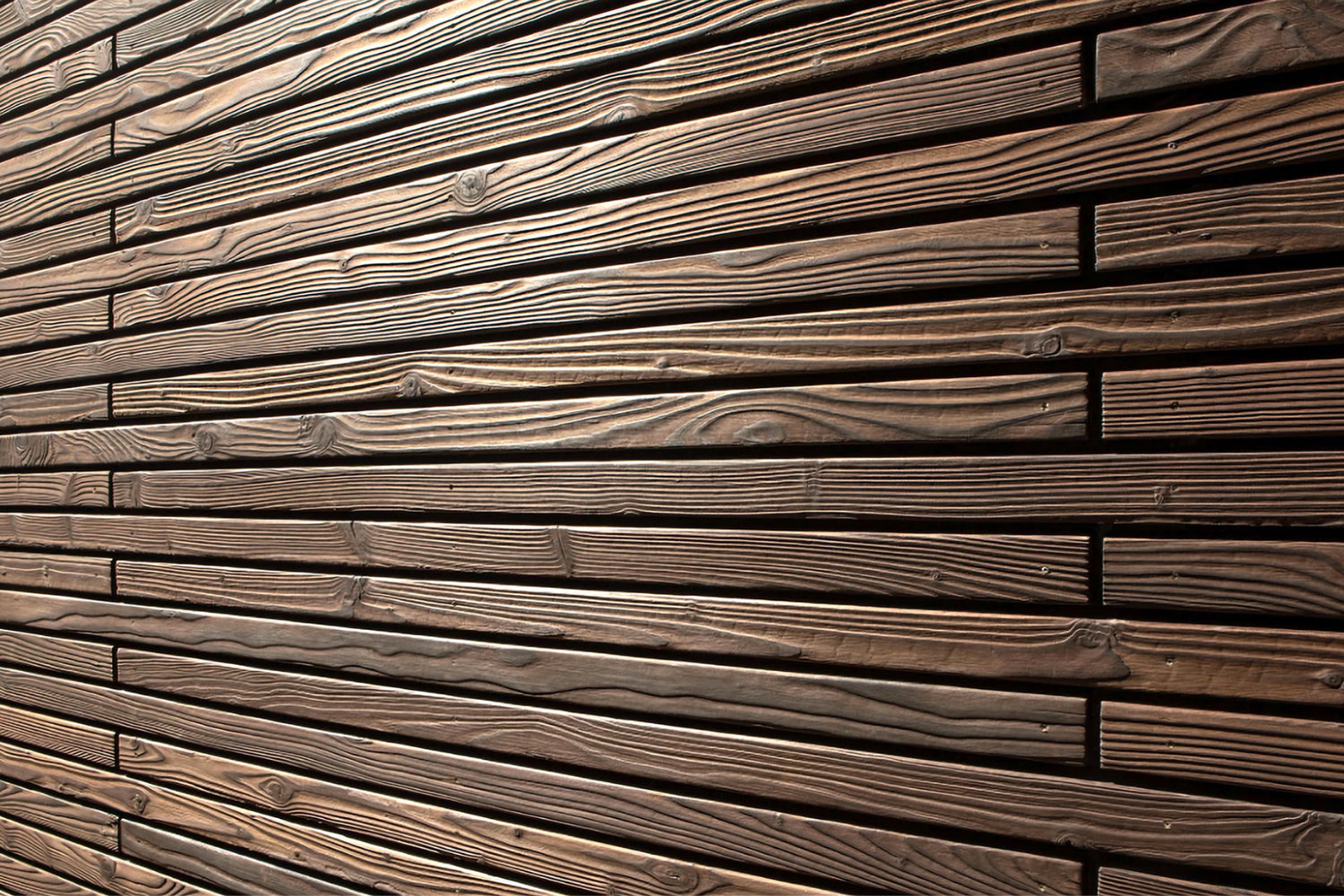
In Japan, the material is known as yakisugi, from yaki, meaning burnt or charred, and sugi, the wood of Cryptomeria japonica. The term may also appear as yakisugi-ita, meaning yakisugi board. “Shou Sugi Ban”, now widely used in Europe and North America, is instead a Westernised reading that became popular outside Japan and is not the traditional term used in the country. Nakamoto Forestry traces it to an improper combination of Japanese and Chinese readings of the characters.
The distinction is not merely linguistic.
Historic yakisugi is associated with thin charred sugi boards used as cladding, a practice documented for centuries, particularly in western Japan and around the Seto Inland Sea. Calling every oak, spruce or pine board blackened with a torch “Shou Sugi Ban” therefore greatly expands the original meaning.
In contemporary interior design, the expression is now useful and widely recognised, but it is more accurate to distinguish between traditional yakisugi and more generic charred woods or charred timber inspired by the same principle.
How the charred surface is created
In the traditional process, three boards are joined together to form a triangular chimney-like structure. A fire is lit inside, and the resulting draught encourages rapid charring of the surfaces facing the flame.
Experimental research into the traditional technique recreated this process using spruce and fir boards: within a few minutes, surface temperatures exceeded 500 °C and a charred layer several millimetres thick formed. The study also shows how strongly the result depends on wood species, temperature, duration and the position of the board during treatment.
Today, industrial methods also use burners, kilns, heated plates and more controlled processes. These can produce more uniform surfaces and, in some cases, less fragile finishes than traditional charring. They are not necessarily inferior; they simply belong to a different production method.
For an interior project, the useful question is therefore not simply “has it been burnt?”, but how it was charred, which species was used and what treatment was applied afterwards.
From deep black char to brushed grain: texture can vary dramatically
Charred wood does not have a single appearance.
A surface left with its char layer almost intact can develop a black, irregular and fragile texture, often resembling reptile scales. Grazing light emphasises cracks, flakes and differences in depth.
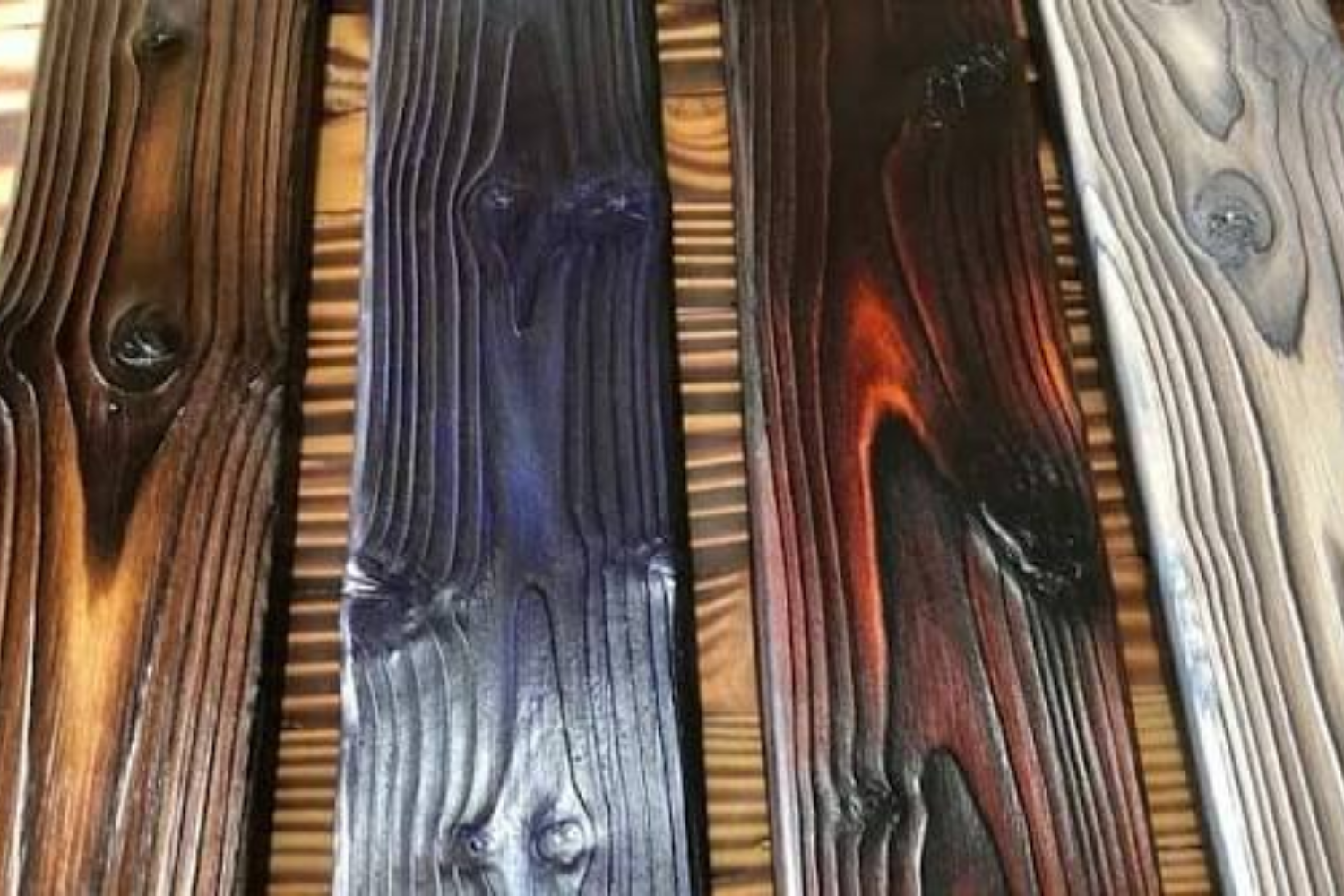
When the most friable layer is instead brushed, the grain of the timber becomes visible again and the black can give way to browns, greys and contrasts between charred wood and lighter fibres.
Within its own production, Nakamoto Forestry distinguishes between surfaces where the char is retained, versions brushed once and variants brushed further to reveal more of the grain. This classification belongs to a specific manufacturer, but it illustrates the principle clearly: the amount of char removed largely determines the final appearance.
Indoors, this distinction is crucial. The more char and soot the surface retains, the greater the need to control contact and finishing.
Shou Sugi Ban in interiors: where it works best
The simplest way to use the material is as vertical wall cladding, particularly on a selected surface.
A black wall behind a sofa, a screen in a corridor or the backdrop to a dining area can introduce depth without turning the entire home into a dark interior. Char reacts to light differently from ordinary black paint: it absorbs a great deal of light, but irregularities in the grain generate close shadows and subtle reflections.
In A House of Small Talks by WARP Architects, a large freestanding charred timber wall becomes the backdrop around which the living area and staircase are organised. The contrast with concrete, natural timber, white walls and planting allows the dark material to work as an orienting element rather than an isolated decorative surface.
In commercial spaces, the effect can be taken much further. At Leña Marbella by Astet Studio, references to fire and charring extend across walls, ceilings and furniture to create an almost entirely black interior. It is coherent with the restaurant concept, but far more difficult to transfer literally into a home.
Walls, doors and furniture require different treatments
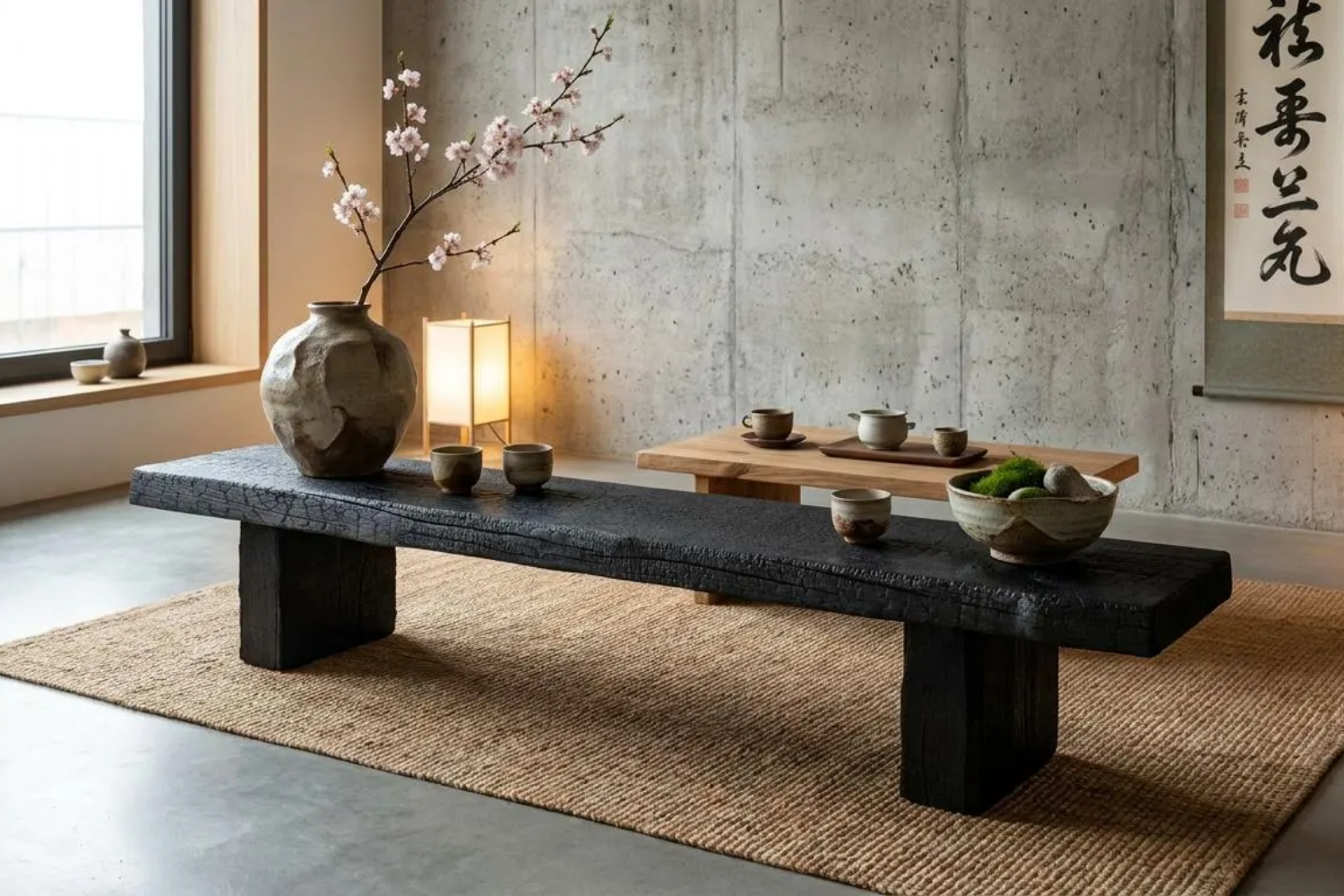
A wall positioned away from circulation can tolerate a highly tactile texture. A door, cabinet front or piece of furniture that is touched constantly requires a more stable surface.
For interior applications, Nakamoto Forestry generally recommends finishes capable of binding any residual soot to the surface; it also offers products with unbrushed char protected by specific coatings and brushed versions with finishes suitable for interior panelling.
This point is often overlooked in the most dramatic photographs.
A completely raw finish can mark hands, fabrics and adjacent surfaces if it retains unstabilised particles. The same manufacturer recommends removing any residual material with appropriate cleaning after installation and, for many indoor applications, using a treatment that stabilises the surface.
For wall panelling behind a bed or a high wall, a more pronounced texture may therefore be appropriate; for cabinet fronts, integrated handles, doors and low furniture, specifying a brushed or protected surface is generally more practical.
Does the wood have to be black to be authentic?
Not necessarily.
The most recognisable image of yakisugi is deep black char, but brushing, oxidation and oils can change the colour substantially. Some surfaces become dark brown, grey or streaked, revealing more of the underlying grain.
Time also changes the material, particularly outdoors. Indoors, evolution is slower because rain and continuous direct exposure to sunlight are absent, but finishes, cleaning and abrasion still form part of the life of the surface.
Wood simply darkened with pigment, stain or paint can reproduce the colour without having a carbonised surface. It is not a “fake” solution if described correctly: it is simply burnt-effect stained timber, technically different from yakisugi.
Which wood species are used?
The traditional technique is associated with sugi, Cryptomeria japonica, a conifer native to Japan. The Nara National Museum describes sugi as a lightweight, relatively soft, straight-grained wood historically used for numerous wooden objects and structures.
The international spread of Shou Sugi Ban has, however, led to many other species being charred.
Experimental studies have examined spruce and fir, while contemporary architecture also includes examples using pine, larch, cypress and other local timbers.
They do not all respond in the same way. Density, resin content, grain orientation and wood anatomy influence charring rate, cracking, dimensional stability and absorption.
For this reason, a European charred spruce panel may produce an excellent design result, but it should not automatically be presented as traditional Japanese yakisugi.
Fire resistance: why “burnt” does not mean fireproof
This is perhaps the most important myth to correct.
The presence of a charred layer can alter the way wood behaves when exposed to heat, but it does not automatically make a board fire-resistant or compliant with a specific reaction-to-fire classification.
A study by the USDA Forest Products Laboratory compared several commercially charred products with untreated wood. The results did not show a consistent improvement in ignition resistance or fire performance: some samples improved, while others did not. The authors concluded that charring should not be considered a universal guarantee of better fire behaviour.
More recent research indicates that the thickness and uniformity of the char layer can materially affect performance, but for exactly this reason, superficial decorative charring is not equivalent to an engineered fire-resistant system.
In interiors, particularly hospitality, retail and public spaces, the required product classification and complete build-up must therefore be verified against the applicable regulations.
Nor is charred wood automatically waterproof
Charring can reduce surface wettability and water absorption under certain conditions.
Studies on spruce have found greater hydrophobicity in charred surfaces and reduced water and vapour absorption. Other experiments, however, have produced different results depending on species and treatment conditions. The charred layer also remains porous and can contain cracks through which water can reach the timber underneath.
Describing it as “waterproof” is therefore an overstatement.
In dry interiors, the issue is generally limited. In bathrooms, near basins or in other areas exposed to splashing, substrate, finish, joints and the manufacturer’s instructions need to be assessed, just as they would for any other timber cladding.
How to combine it without turning the home into a Japanese-themed interior
Charred timber does not require tatami, lanterns or other decorative references to Japan.
In fact, the most convincing combinations often treat yakisugi simply as a dark, textured material.
Paired with pale oak, ash or birch, it creates a clear contrast between two expressions of the same material. Combined with concrete and steel, it shifts the interior towards a more mineral palette. With travertine, lime finishes and rough textiles, it softens the industrial quality of the black surface.
At A Window to Korea Store by Canter & Gallop Design, a charred timber wall is combined with stainless steel, metallic surfaces and textured panels, focusing particularly on the transition between light and dark areas.
The Ronin Bar by studio…nutto, meanwhile, combines yakisugi with granite, concrete, metal and corrugated glass; inside, an almost entirely black palette allows planting and lighting to stand out most strongly.
In a home, far fewer elements are often enough: a dark wall and a light floor can already create the necessary contrast.
Light is part of the texture
A charred wall changes dramatically depending on how it is lit.
Frontal lighting tends to flatten the black surface, while a side light reveals grain, cracks and differences in depth. A highly textured surface can therefore become almost three-dimensional under grazing light.
This makes Shou Sugi Ban interesting even on relatively small surfaces: a niche, the back of a bookcase or a wall behind a lamp may be enough.
The opposite effect should also be considered. Large quantities of very dark timber visually absorb light and can make an already dim room feel heavier. In this case, pale surfaces, windows, bright ceilings and indirect lighting need to rebalance the composition.
How to clean and maintain charred wood indoors
Maintenance depends mainly on the finish.
On stabilised or coated surfaces, the coating manufacturer’s instructions should be followed. On brushed, uncoated timber, aggressive abrasion should be avoided because it can selectively alter the texture.
One of the main considerations remains residual soot. For interior use, Nakamoto Forestry recommends a final clean with a clean cloth or sponge and, for many applications, finishes that bind residual particles to the surface.
There is therefore no universal maintenance routine for “burnt wood”. A charred surface left almost intact and a brushed wall protected with an acrylic coating may feel similar to the touch but behave very differently in practical use.
Authentic yakisugi or simply a burnt-wood effect: which should you choose?
The choice depends on the aim of the project.
If the priority is the historic technique, its relationship with sugi and the specific charred structure, it makes sense to look for yakisugi produced through documented processes and to verify its origin, wood species and treatment.
If the main interest is instead the visual language — very dark timber, pronounced grain and an irregular surface — a charred local species, an industrial panel or even stained timber may be more appropriate alternatives for the budget and application.
The problem arises when different materials are presented as though they were equivalent.
Shou Sugi Ban in interiors becomes most interesting when it loses the exotic aura with which it is often presented. Yakisugi originated as a practical building material, not as ritual decoration. Brought indoors, it can become a tactile wall, a piece of furniture, a door or a simple black detail, but it should retain the same precision: wood species, charring, finish, contact, lighting and safety requirements should all be verified before the aesthetic effect.
Perhaps this is the most contemporary aspect of the technique: fire is not used to turn timber into a miraculous material. It is used to transform the surface, leaving process, irregularity and materiality visible.