The life of Vincent van Gogh, from his early years to the Yellow House in Arles and his final days in Auvers, his most famous works and the bedroom he painted three times.
In October 1888, in Arles, a thirty-five-year-old Dutch painter stops in front of an ordinary room: a wooden bed, two chairs, a small table with a washbasin, a window with green shutters. It is neither a landscape nor a portrait. It is his own bedroom, and he decides to paint it. He explains to his brother Theo that looking at it should rest the mind and that, this time, colour has to do everything.
It is a less spectacular scene than the swirling skies of The Starry Night, yet it says more about who Vincent van Gogh was: a man who spent his whole life looking for a home. From the parsonage in Zundert to the psychiatric hospital in Saint-Rémy, from the Yellow House to the last rented room in Auvers, his biography reads well through the spaces he lived in and, when he could, tried to design. That is the thread of this article: the life, the works and a bedroom he painted three times.
Who was Vincent van Gogh
Vincent van Gogh was a Dutch Post-Impressionist painter, born in Zundert on 30 March 1853 and died in Auvers-sur-Oise on 29 July 1890, aged 37. He took up painting only in 1880 and, in under ten years, produced about 2,100 works, including around 860 oil paintings, most of them in the last two years of his life. In Dutch the surname sounds roughly like “van Khokh”, with a guttural “kh” close to the Scottish “loch”. He sold very little during his lifetime; today he is among the best-loved and most recognisable artists in the world.
From his early years to Paris, before Arles
Vincent was born in Zundert, in the Dutch province of North Brabant, the son of a Protestant minister. Before becoming a painter he was many other things: from 1869 to 1876 he worked for the art dealers Goupil & Cie in The Hague, London and Paris, then he taught in England, tried theology and, in 1878, went to preach among the miners of the Borinage in Belgium. Only in 1880, at 27, did he decide to become an artist, supported financially by his younger brother Theo, who also worked in the art trade.
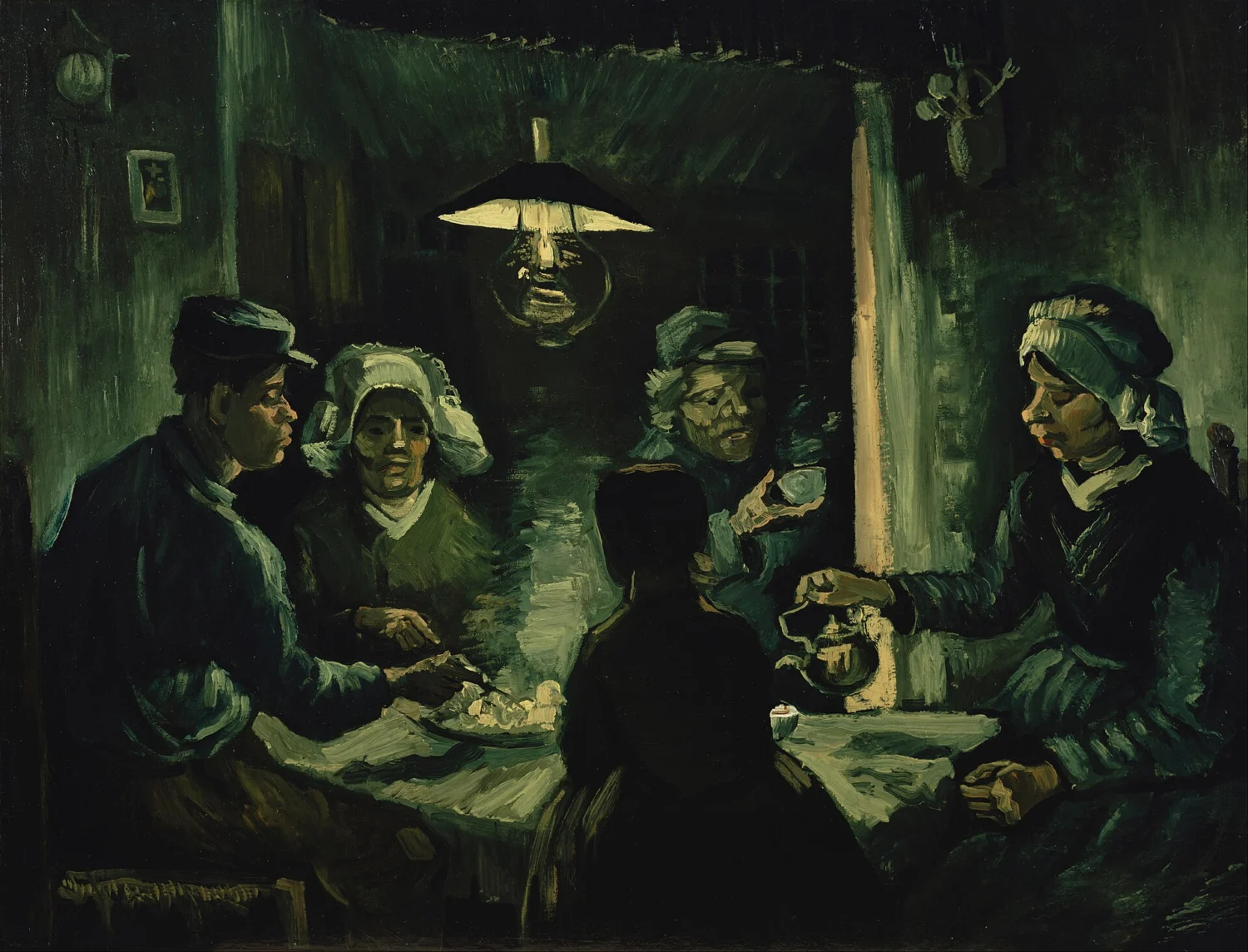
His Dutch years are dark and earthy, devoted to peasants and labour. In Nuenen, where his parents had moved, he painted weavers and farm labourers, and in April 1885 he arrived at The Potato Eaters: five figures around a table under the light of an oil lamp, in a deliberately sombre palette. He wanted to show hands that had worked the land, not a picturesque scene.
In March 1886 he joined Theo in Paris and stayed until February 1888. It was the decisive passage: he looked at the Impressionists, met Toulouse-Lautrec, Émile Bernard, Camille Pissarro and Paul Signac, discovered pure colour and began collecting Japanese prints. By the time he left the city his palette had lightened and his brushwork had become freer.
Arles and the Yellow House: a home turned into a project
Van Gogh arrived in Arles on 20 February 1888, drawn by the light of the South and by the idea of founding a small community of artists. On 1 May he rented four rooms in Place Lamartine, in a house with a yellow façade that he himself compared to the colour of fresh butter. This was the Yellow House: he furnished it with simple wooden furniture, hung his own paintings on the walls and slept there from the following September.
He did not think of the house as mere lodging but as a decorative scheme, a cycle of paintings conceived for its rooms. In August 1888 he painted four versions of the Sunflowers in a single week for the bedroom intended for Paul Gauguin, who joined him on 23 October. Their life together lasted about nine weeks and ended in December 1888: after days of acute tension with Gauguin, on the evening of 23 December Vincent suffered a very serious crisis and injured his left ear. He was admitted to the hospital in Arles and Gauguin left the town.
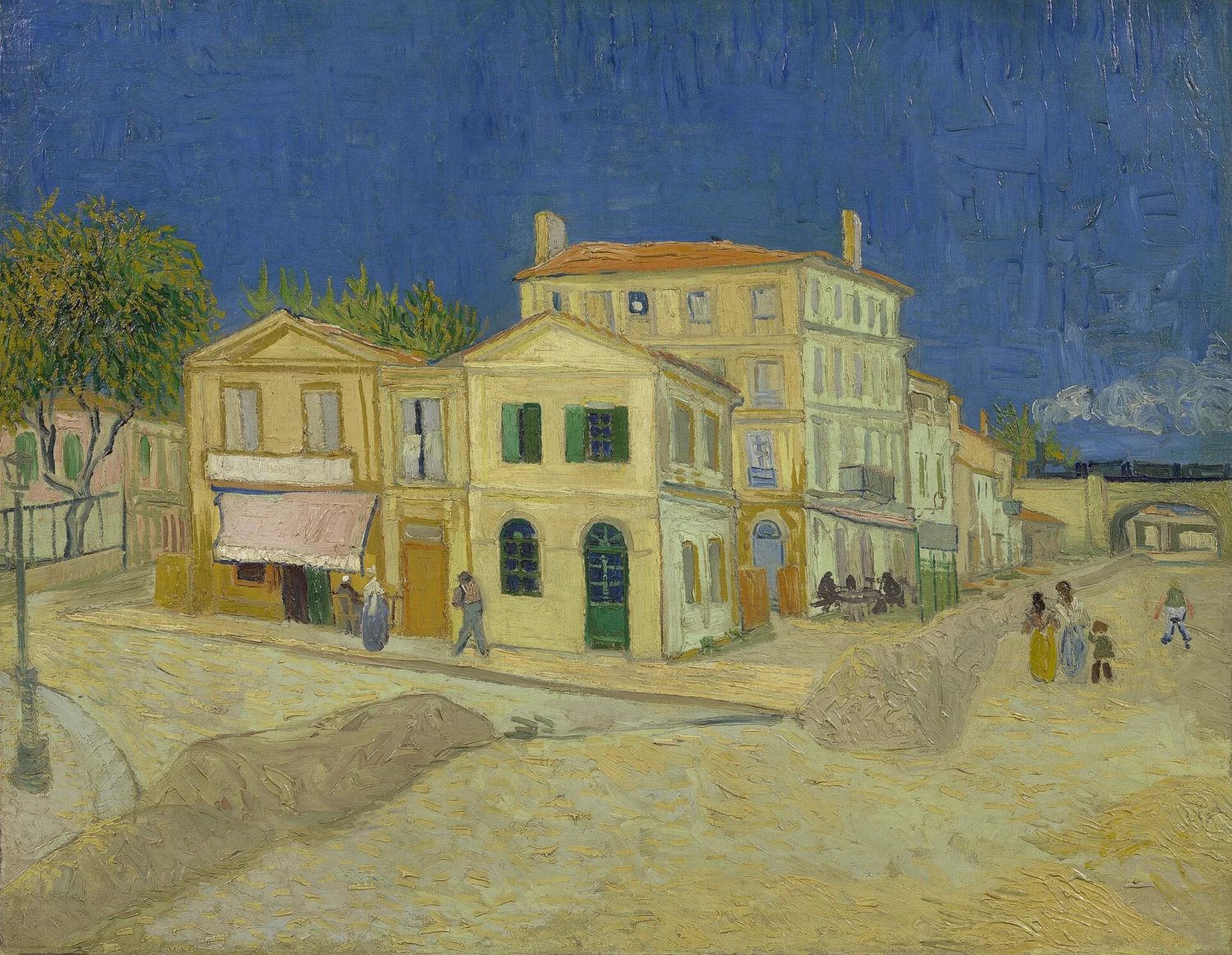
The house no longer exists, as the Van Gogh Museum also points out: it was badly damaged by Allied bombing on 25 June 1944 and then demolished. What remains is the painting that shows it on the corner of the square, with its butter-coloured façade and green shutters.
Vincent’s Bedroom in Arles
Van Gogh began painting the bedroom on 16 October 1888 and two days later wrote to Theo that it was finished. In his letter of 16 October he describes the colours one by one: pale violet walls, a floor of red tiles, a bed and chairs the yellow of fresh butter, very light lemon-green sheets and pillows, a scarlet bedspread, a green window, an orange table with a blue basin, lilac doors. He removes cast shadows and lays the colour down in flat areas, as in the Japanese prints he collected. What matters to him is that the picture conveys rest.
Read through the eyes of someone who designs interiors, the Bedroom is a small manifesto: a few pieces of light wooden furniture, walls in a single tone, a play of repeated accents (the yellow of the bed echoes that of the façade, the red of the bedspread recalls the floor) and a sharply foreshortened perspective that draws the room in around the bed. There is nothing decorative in the bourgeois sense. There is an idea of home as a place where colour does the work of objects.
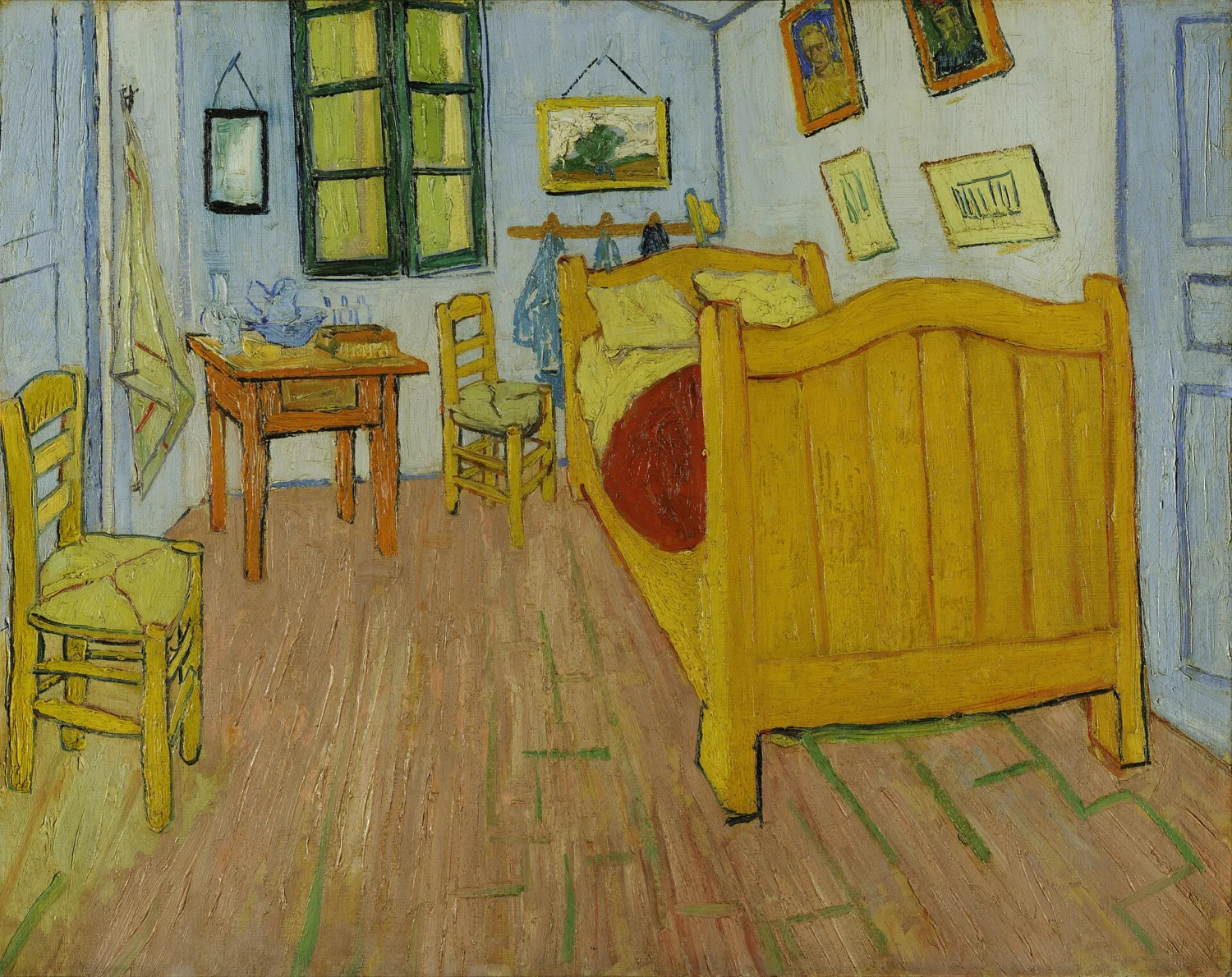
The painting had a complicated history. In the spring of 1889 the first version was damaged by damp after the Rhône flooded, while Vincent was in hospital. From Saint-Rémy he asked Theo to have the canvas relined; Theo suggested making a copy first, and in September 1889 Vincent painted the second version, identical in size, now at the Art Institute of Chicago. Three weeks later he made a third, smaller one for his mother and his sister Willemien, now at the Musée d’Orsay. In the copies he even changed the pictures hanging on the wall.
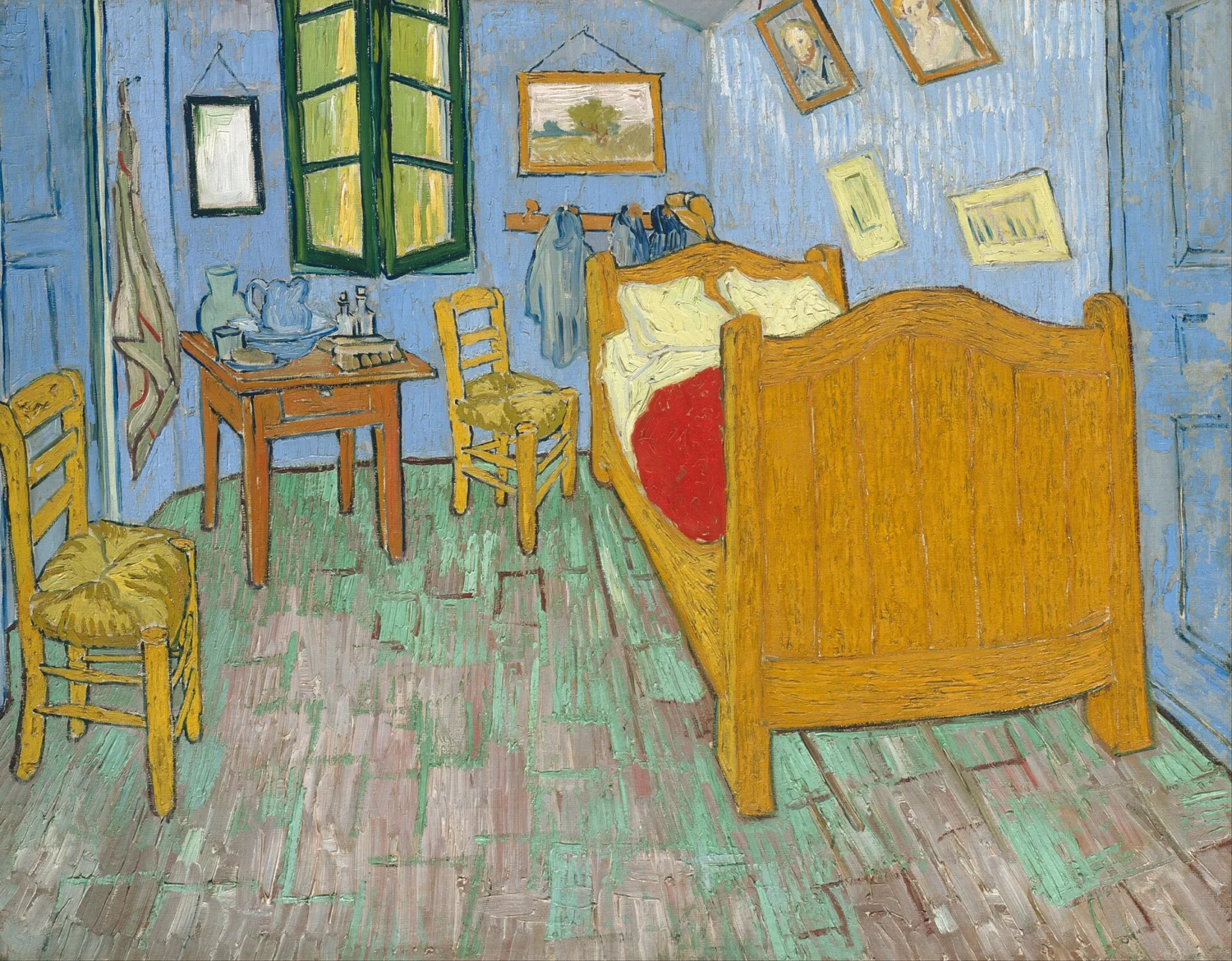
One more detail will interest anyone who works with colour: the walls we see today are blue, but they were not always so. As the Van Gogh Museum’s REVIGO research project has documented, Van Gogh mixed his blue with an unstable red lake that has faded in the light: walls and doors were violet, the floor a more intense red. Colours, like houses, grow old.
Saint-Rémy: The Starry Night and the cypresses
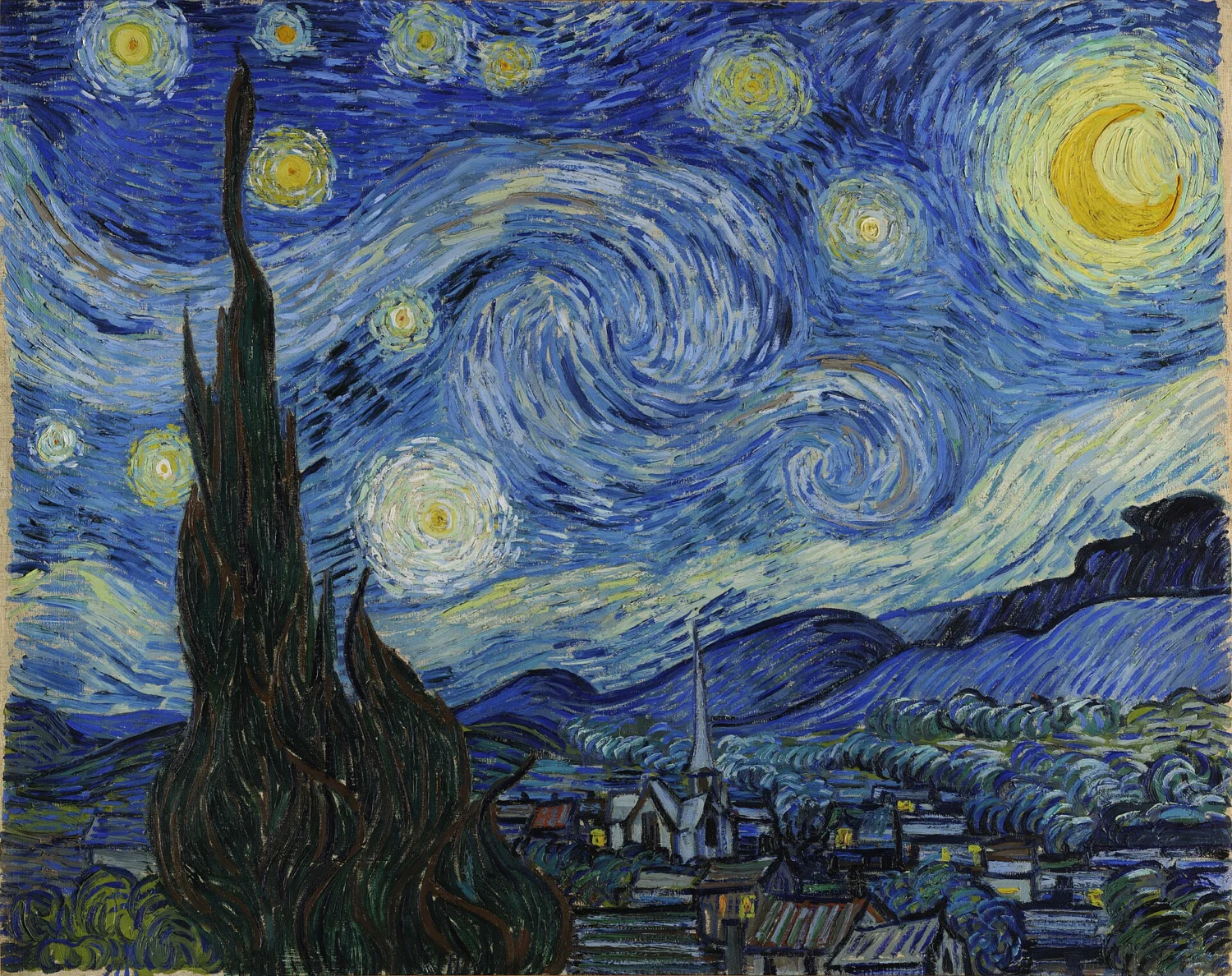
After the crisis in Arles, Van Gogh decided to have himself admitted. On 8 May 1889 he entered the psychiatric hospital of Saint-Paul-de-Mausole in Saint-Rémy-de-Provence, where he stayed for a year. He painted in the garden and in the surrounding fields whenever he was allowed, and in June he made The Starry Night, inspired by the view from the window of his room, which faced east, shortly before dawn: the village is invented (the church spire recalls the Netherlands) and the large star is perhaps Venus, the morning star.
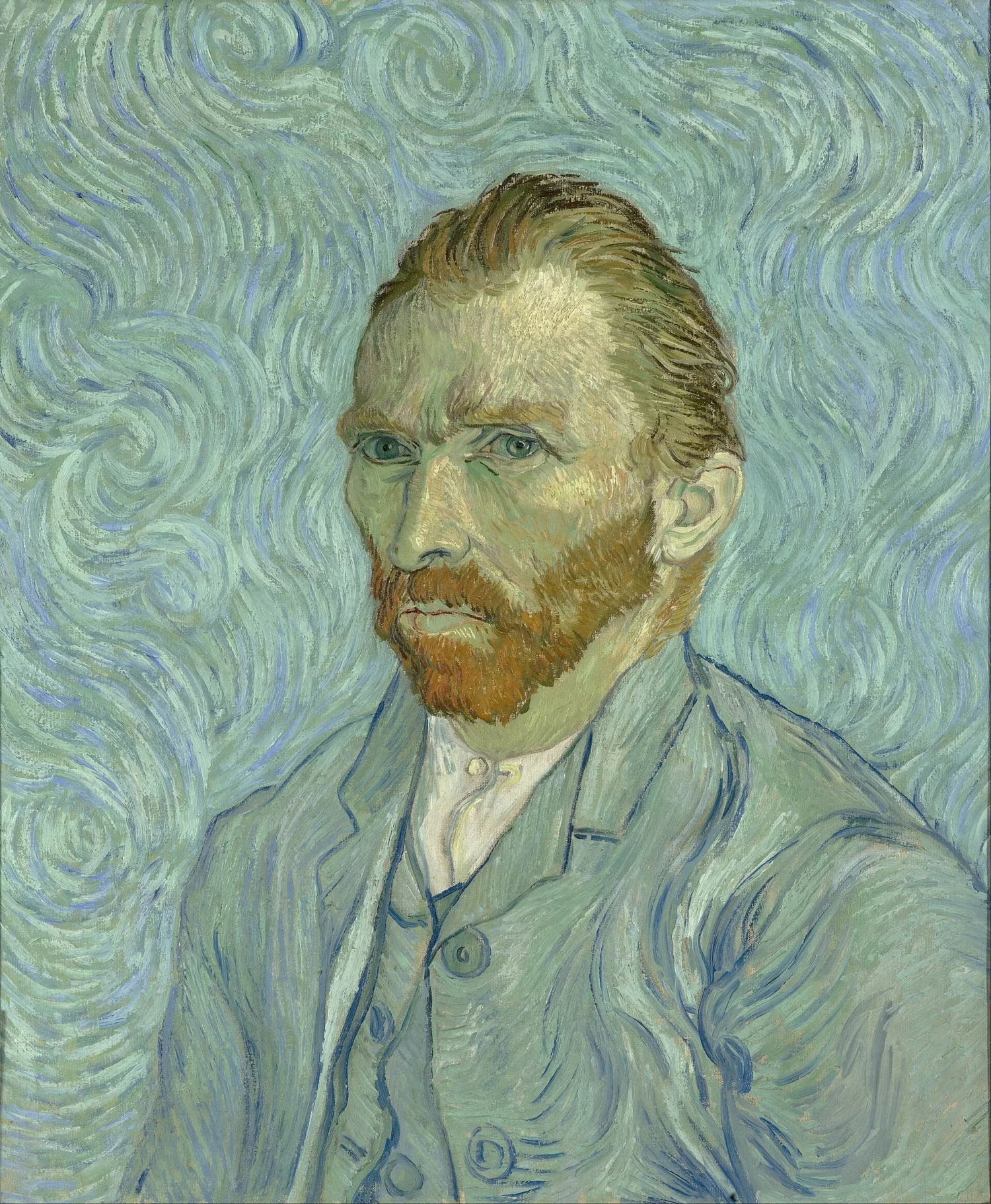
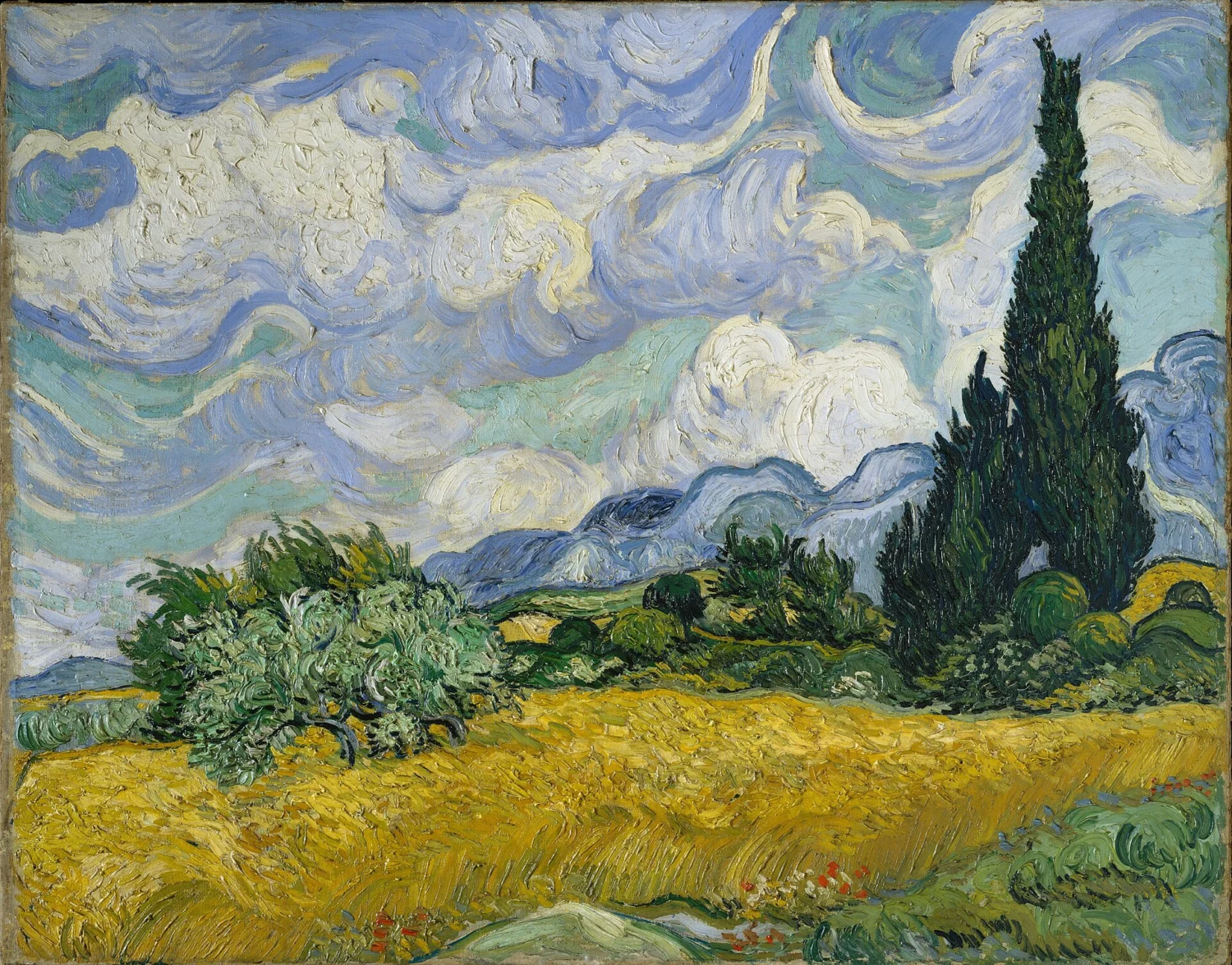
During those same months cypresses became an obsession: he compared them, for the beauty of their lines and proportions, to an Egyptian obelisk, and made them a subject in their own right. Wheat Field with Cypresses, from 1889, is according to the Metropolitan Museum the first study from nature of a composition that Van Gogh later repeated in other versions; a husk of wheat left in the paint confirms that he painted it outdoors. From the same period come the Irises, now in the Getty Museum in Los Angeles, and the Self-Portrait in the Musée d’Orsay that opens this article.
Auvers-sur-Oise: the last seventy days
On 16 May 1890 he left Saint-Rémy and, after a stop in Paris with Theo, his wife Jo and their newborn son, settled in Auvers-sur-Oise, north of the capital, where Paul Gachet followed him as his doctor. He rented a room at an inn and in just over two months painted more than seventy canvases, including landscapes, portraits and large double-square canvases such as Wheatfield with Crows.
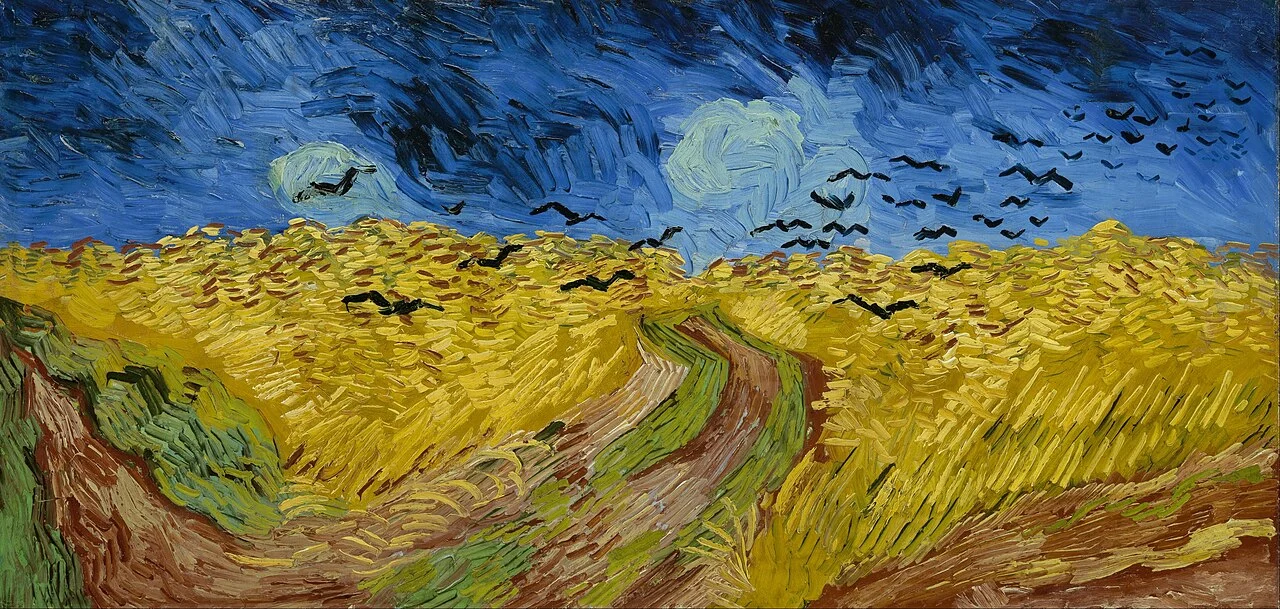
Popular culture has loaded this painting with an almost prophetic meaning, naming it for decades as his last. Van Gogh Museum research has corrected the story: the canvas dates from July 1890, but from more than two weeks before his death, and his last work was most probably Tree Roots, which was left unfinished.
On 27 July 1890 Van Gogh seriously injured himself in a field near the village. He died two days later, on 29 July, with Theo at his side, and was buried in the cemetery at Auvers. The most widely accepted reconstruction is that it was a suicidal act, although some scholars still debate the exact circumstances. Theo survived him by only six months: he died in January 1891.
Van Gogh’s style: colour, brushwork and Japan
Van Gogh’s language grows out of three debts. From the Impressionists he took light and freedom of touch; from the pointillism of Signac and Seurat the idea of placing complementary colours side by side; from Japanese prints the flat areas of colour, the sharp outlines, the cropped framing. On top of all this he built a brushwork of his own, thick and directional, in which colour is emotion before it is description.
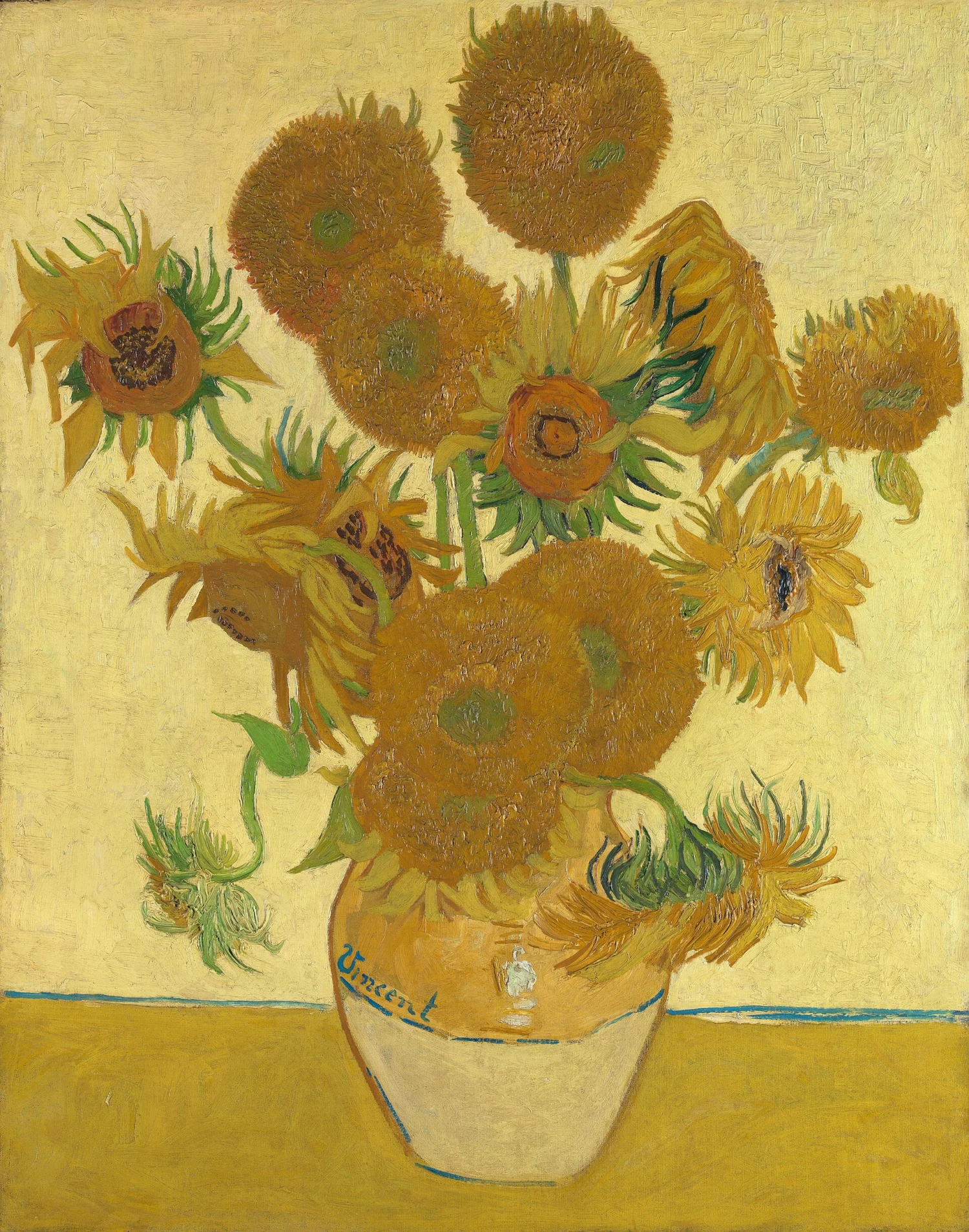
The Sunflowers are the synthesis of this work. The version in the National Gallery in London, from August 1888, is one of the canvases made for Gauguin’s room: flowers at every stage of life, from bloom to decay, in a range of yellows on a yellow ground. Van Gogh repeated several versions at the start of 1889.
Van Gogh’s most famous paintings
If the answer has to fit in one line, the most famous painting is The Starry Night (1889, MoMA, New York). Alongside it come the Arles Sunflowers (1888, among others at the National Gallery in London and the Van Gogh Museum), Vincent’s Bedroom in Arles (1888 and 1889, in the museums of Amsterdam, Chicago and Paris) and Café Terrace at Night (1888, Kröller-Müller Museum, Otterlo). Among the earlier works The Potato Eaters (1885) and Avenue of Poplars in Autumn (1884) stand out; among the last, Wheatfield with Crows (1890), all at the Van Gogh Museum in Amsterdam.
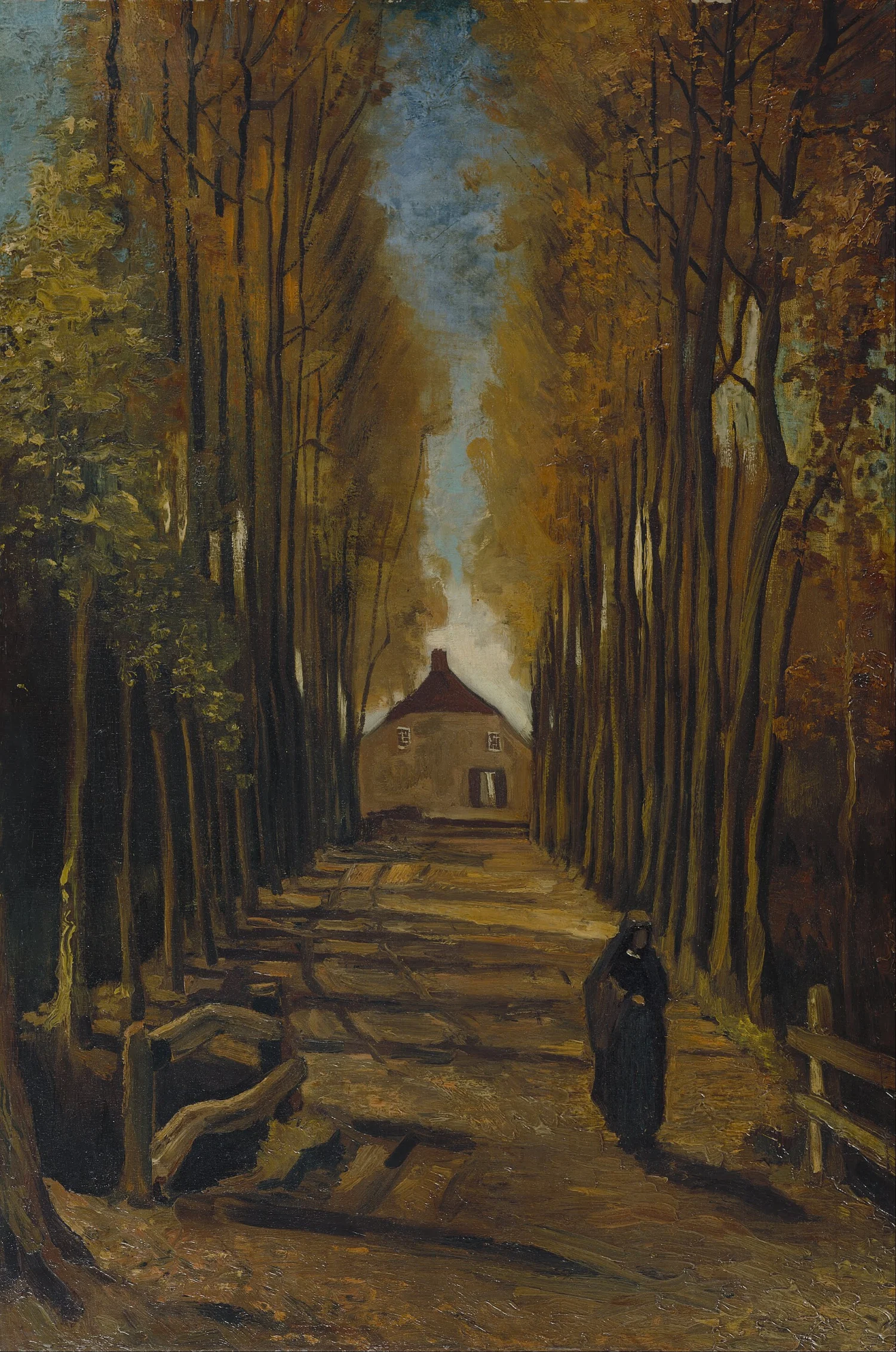
Avenue of Poplars in Autumn deserves a place of its own. Painted in Nuenen in October 1884, when Vincent had not yet discovered the full colour of the South, it offers a deep perspective, a path, a row of poplars in autumn leaf and a distant figure. It is a good starting point for understanding how far he travelled in six years.
The letters to Theo and fame after death
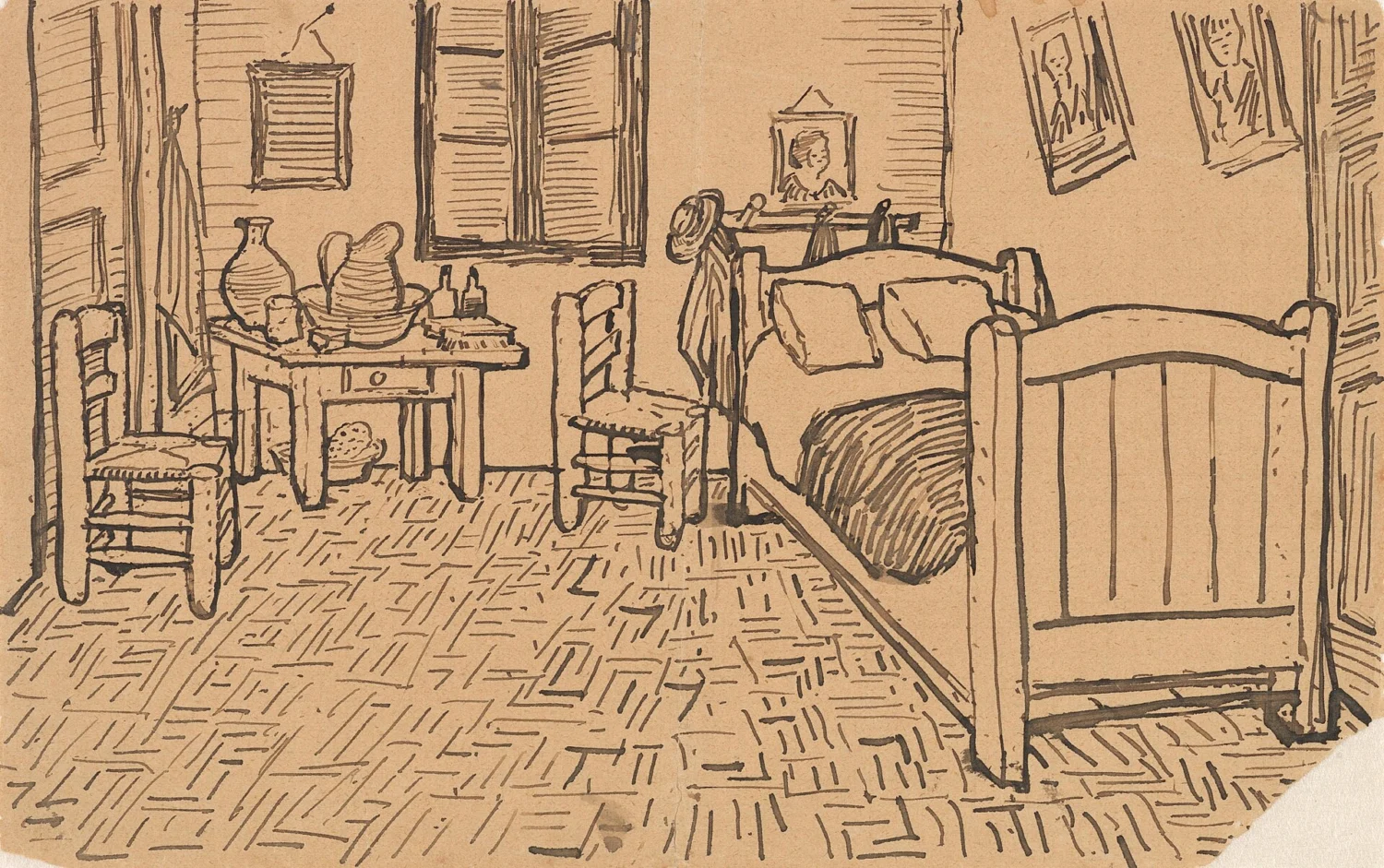
Much of what we know about Van Gogh comes from his letters: hundreds of pages written mainly to Theo, in which he describes his paintings, colours, debts and hopes. The bedroom in Arles passes through here too: the sketch that accompanies the letter of 16 October 1888 is kept at the Van Gogh Museum.
On Vincent’s death the paintings stayed with Theo and, after his brother’s own death, with Jo van Gogh-Bonger, the sister-in-law who looked after them, lent them to exhibitions and edited the publication of the letters, which appeared in 1914. It is partly thanks to her that the painter went from obscurity to being a reference point of modern art. Since 1973 the Van Gogh Museum in Amsterdam has housed the world’s largest collection of his paintings and drawings.
Where to see Van Gogh’s works
The place to start is the Van Gogh Museum in Amsterdam. Then the Kröller-Müller Museum in Otterlo in the Netherlands, the Musée d’Orsay in Paris, MoMA and the Metropolitan Museum in New York, the Art Institute in Chicago and the National Gallery in London. In France the places themselves are worth visiting: Arles, with Place Lamartine; Saint-Rémy-de-Provence, where the cloister of Saint-Paul-de-Mausole is open to visitors; Auvers-sur-Oise, with the inn where he lived and the cemetery where he rests beside Theo.
Van Gogh on screen
The painter has been portrayed on screen many times. Best-known titles include Lust for Life (1956) by Vincente Minnelli, with Kirk Douglas; Vincent & Theo (1990) by Robert Altman; Van Gogh (1991) by Maurice Pialat; Loving Vincent (2017) by Dorota Kobiela and Hugh Welchman, painted entirely by hand frame by frame, and At Eternity’s Gate (2018) by Julian Schnabel, with Willem Dafoe.
Frequently asked questions about Vincent van Gogh
What disorder did Vincent van Gogh have?
There is no certain diagnosis. Doctors of his day spoke of epilepsy, while scholars today have put forward different hypotheses, from bipolar disorder to other psychiatric or organic causes, none of them proven. What the sources document are the crises of December 1888 and the following months, the hospital stays and the periods of clarity in which he went on painting and writing.
What is Van Gogh’s most famous painting?
The Starry Night, painted in Saint-Rémy in June 1889 and held at MoMA in New York. The Sunflowers and Vincent’s Bedroom in Arles are also highly recognisable.
Why did Van Gogh cut off his ear?
The sources offer no certain explanation. They describe an episode of acute crisis rather than a lucid decision, and place it on the evening of 23 December 1888, after days of tension with Gauguin. The exact extent of the injury is still debated by scholars.
From the bedroom in Arles to today’s homes
The bedroom in Arles leaves a lesson that still holds for anyone decorating: a few colours, chosen by a rule, are enough to give a room character. If you want to think about the bedroom starting from light and orientation, our guide to bedroom colours is the place to begin; if blue appeals to you, which in the painting is also an effect of time, you will find nine pairings in colours that go with blue in interiors.