A sunlit bakery by morning, an intimate wine bar after dark, and always a record spinning on the turntable. Designed by On Form Studio, Frissón brings the allure of the listening bar to Rome and gives it a distinctly Mediterranean accent, with textured plaster, bespoke wood panelling and amber light that shifts with the hours. …
A sunlit bakery by morning, an intimate wine bar after dark, and always a record spinning on the turntable. Designed by On Form Studio, Frissón brings the allure of the listening bar to Rome and gives it a distinctly Mediterranean accent, with textured plaster, bespoke wood panelling and amber light that shifts with the hours.
As night falls, the shopfront of Frissón glows like a lantern on the darkened street. Through the glass you glimpse walls clad in richly grained wood, a ribbon of amber light running beneath the ceiling, and bottles softly veiled by slim metal blinds. Step inside and you instinctively lower your voice. At the far end of the room, a vast backlit wall of vinyl frames two monumental speakers and a DJ console resting on a block of pale stone.
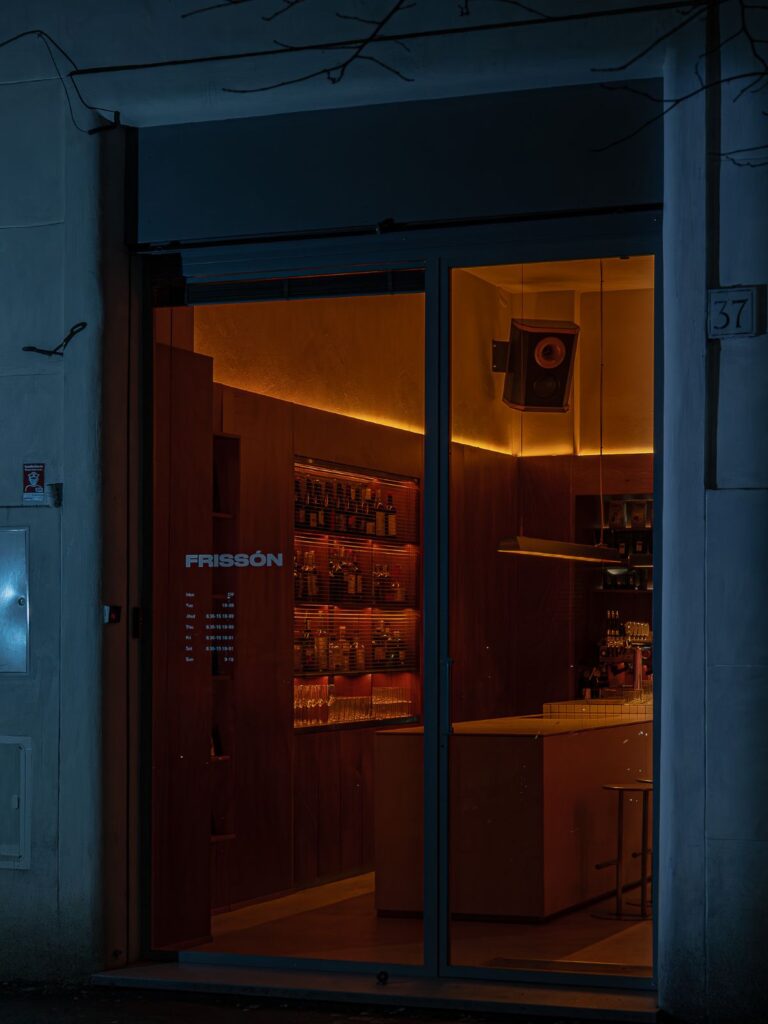
Here, music is as much a part of the design as material and light.
Two Souls, One Mood
Frissón changes character as the day unfolds. In the morning and early afternoon it is a light-filled bakery, where specialty coffee, seasonal viennoiserie and pastries reinvented daily celebrate the pleasure of breakfast. Natural light filters through the blinds, glides across the pale plaster and lends the space an almost domestic ease.
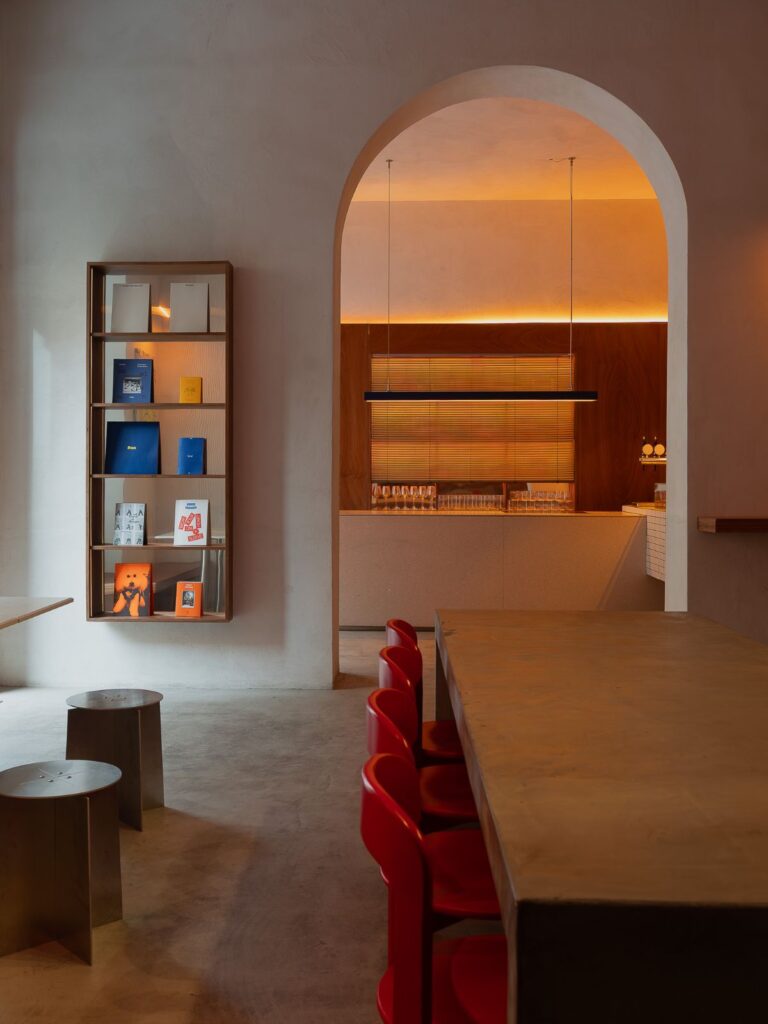
After dark, however, the palette warms. Frissón becomes a wine bar, serving a seasonal menu built on local ingredients in a more intimate setting. There is no change of scenery. Instead, softer light, a different volume and a slower rhythm are enough to turn the same room into an evening hideaway.
From Tokyo’s Jazz Kissa
The idea of a place made for listening has deep roots. In early twentieth-century Japan, kissa emerged as cafés devoted to recorded music: Café Lion, opened in Tokyo in 1926 and dedicated to classical music, is widely regarded as the first. After the war, jazz took centre stage. Live concerts were rare and imported American records were prohibitively expensive, so jazz kissa became small sound libraries open to all, where new releases from across the Pacific could be discovered over a cup of coffee.
By the mid-1970s, Japan counted around 600 of them. They were cultural hubs for musicians, critics and devotees alike. Among their owners was a young Haruki Murakami, who ran his own bar, Peter Cat, from 1974 to 1981 while writing his first three novels.
The imagery has endured: dark, cocooning rooms, vintage audio equipment, records stacked to the ceiling, well-worn wood, a coffee or a whisky. In other words, an invitation to deep listening, far from the distracted flow of endless playlists.
A Global Phenomenon
In recent years, the Japanese model has won over cities around the world. As the speakeasy wave lost its shine, listening bars multiplied from New York to Chicago and from Portland to Los Angeles, and Resy’s 2026 dining trends report named them among the movements of the year. What began as a passion for audiophiles has become a new way of experiencing hospitality.
The design world has caught on, too. Artist Devon Turnbull installs his handbuilt sound systems in galleries and furniture showrooms, turning them into true listening rooms and elevating the sound system to collectible object.
The real secret, though, lies in the acoustics. Dan Wissinger, co-owner of New York’s Eavesdrop, is clear: without proper acoustic treatment, a venue cannot call itself a listening bar. This is precisely where Frissón begins.
The Listening Wall
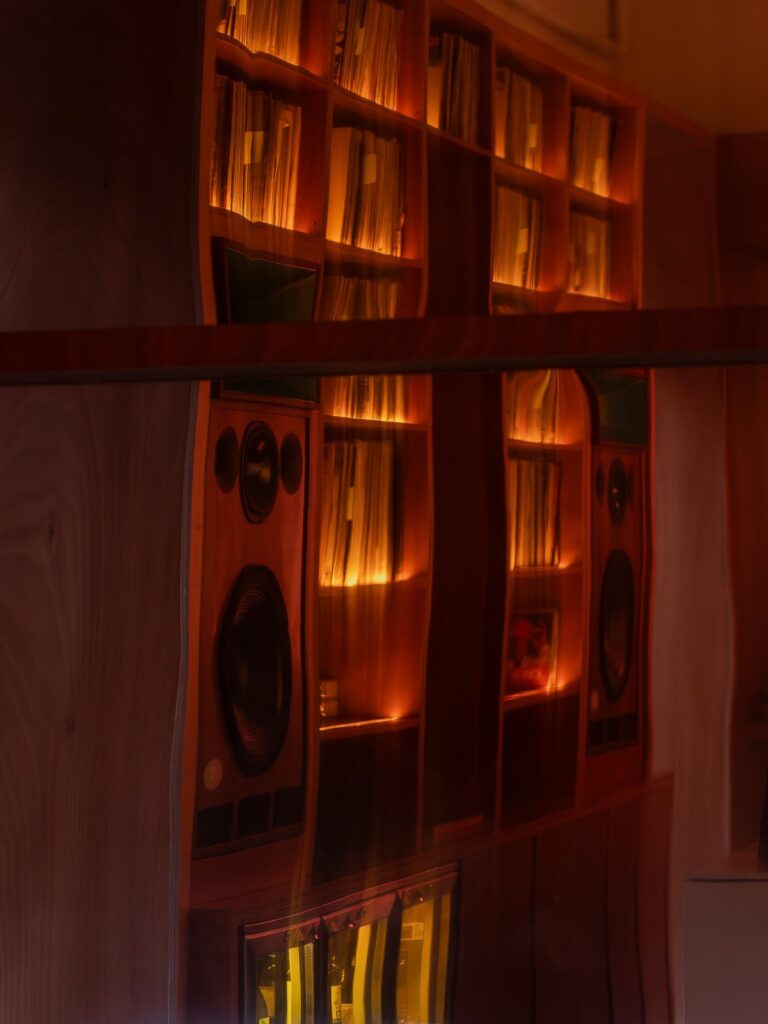
At the heart of Frissón lies a bespoke hi-fi system designed for vinyl, which On Form Studio has turned into architecture. Set into a generous wood boiserie, the speakers are presented as pieces of furniture, with horn tweeters above and large woofers below, all on display. Around them, open shelves hold the record collection, lit from below by a warm glow that brings the colourful sleeves to life.
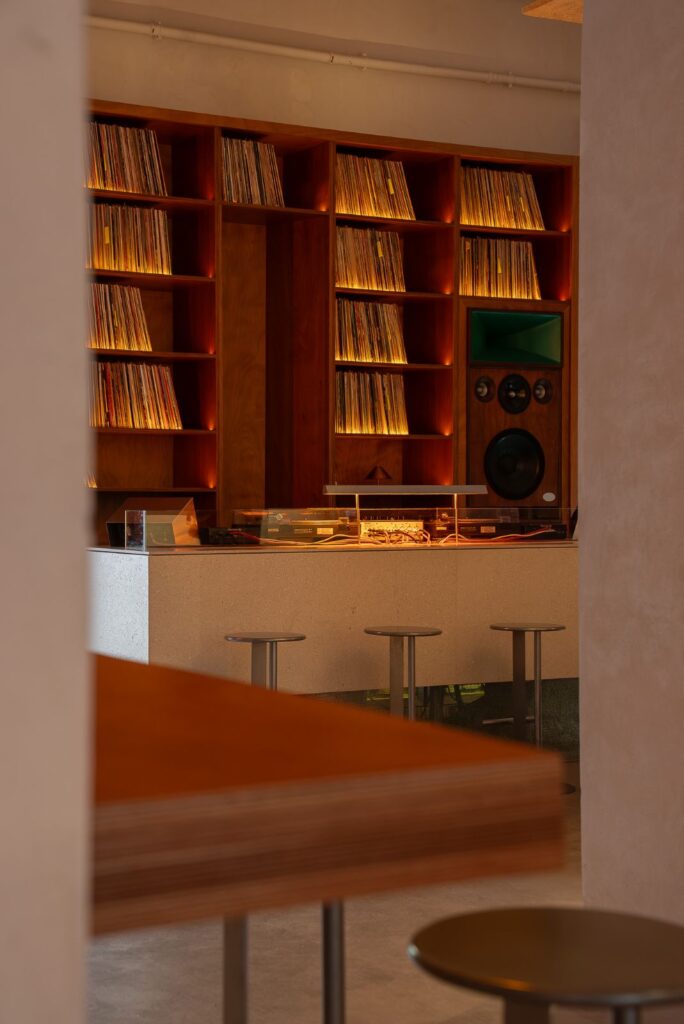
The wall takes the place of the traditional back bar and becomes the room’s scenic backdrop. In front, the turntables, protected by a clear cover, sit on a monolithic counter in pale, fine-grained stone, flanked by pared-back metal stools. The result is a symmetrical, almost ritual composition that invites guests to sit down and let the music carry them.
Designed for the Ear
In a listening bar, every surface also works for the ear. In the listening room, suspended ceiling panels with a porous texture and warm tones tame the sound while drawing a graphic pattern overhead. Meanwhile, textured plaster walls, in places worked into deep vertical ridges, add tactility and break up smooth surfaces. The wood of the panelling, shelving and furniture, in turn, warms the eye and softens the sound.
Acoustics thus become part of the material palette, and this is what sets a true interior design project apart from a mere fit-out.
Material and Contrast
A balance of opposites is Frissón’s signature. On one side there is raw matter, with irregular plaster, a seamless grey floor and stone counters treated as pure volumes. On the other, there is the precision of fine joinery, with panelling, shelving and benches in custom-made wood, crisp detailing and carefully judged proportions.
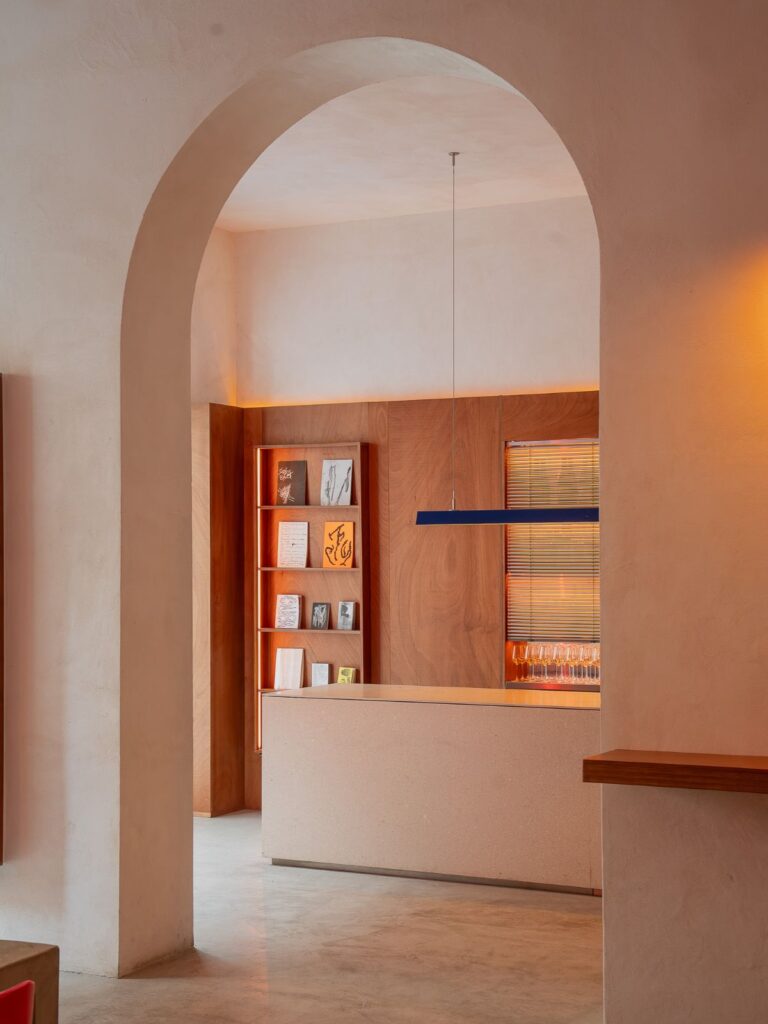
Moving from one room to the next, grand round arches with a Mediterranean sensibility frame the bar like a theatre set. Beyond the arch appear the wood-panelled wall, the back bar veiled by blinds and a long linear pendant cutting horizontally across the scene. As a result, every table offers a different perspective.
Amber Light
If sound is the soul of the project, light is its stage director. By day, natural light prevails, filtered by the blinds and diffused by the pale plaster. By night, a scheme of grazing and indirect lighting takes over. An amber line runs around the perimeter above the panelling, tracing the boundary between wood and plaster; the vinyl and magazine shelves glow from within; and bottles and glasses shimmer behind metal slats that turn light into a vibrant texture.
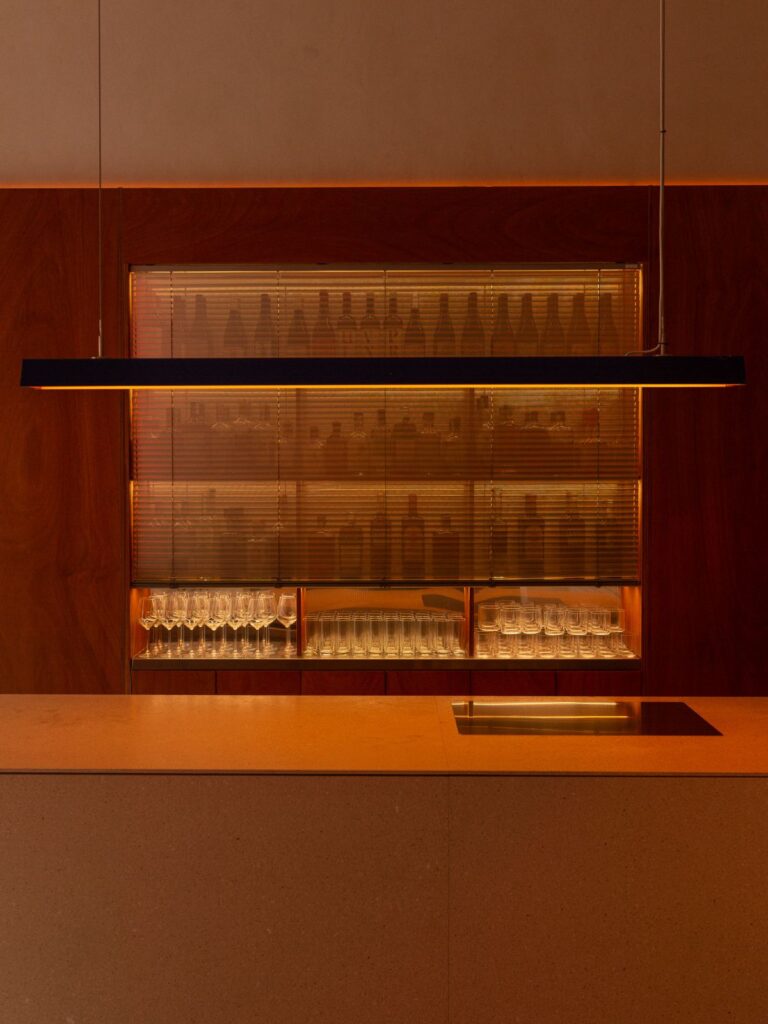
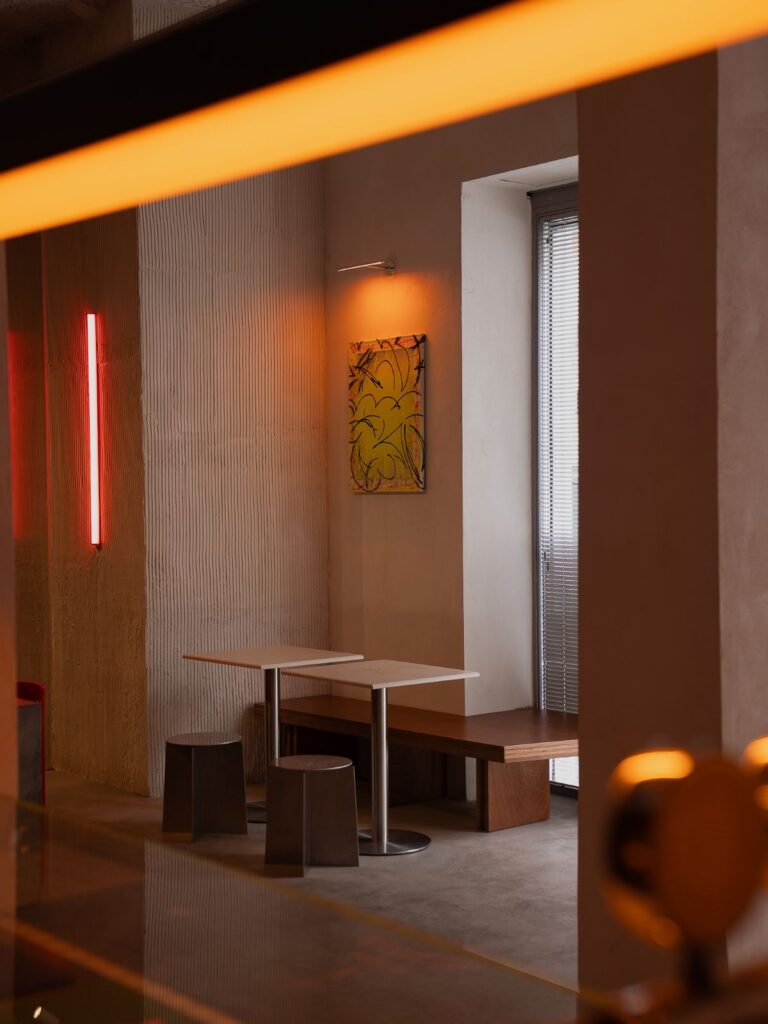
A few precise touches complete the picture: a wall light singling out an artwork, a slender bar of red light in one corner, long linear pendants above the counter. Altogether, the lighting carves out zones, creates intimacy and carries the day from the first coffee to the last glass.
Pops of Colour
The palette plays on warm neutrals, enlivened by a few well-judged accents. Softly curved red chairs lined up along the long communal table add a pop note, while a blue pendant sweeps across the space like a brushstroke. Metal stools, stone-topped tables on steel bases and wooden benches complete a restrained vocabulary in which every piece converses with its setting without ever demanding attention.
Art and Print
Rounding out the story is a curated selection of artworks and independent magazines, displayed on backlit wooden shelves like a small bookshop. It is a nod to the spirit of the jazz kissa, which were also places of discovery. Guests come in for a coffee or a glass of wine and stay to browse, look and listen, somewhere between food, music and visual culture.
The Pleasure of Slowing Down
Ultimately, the rise of listening bars speaks to a desire to escape background noise and infinite playlists. Frissón answers it with an identity all its own, brighter and more convivial than the Japanese model, and able to live from breakfast through to late evening.
Rome thus gains an address where design is at the service of the experience, a place to sit, slow down and truly listen.
Credits
Architecture and interior design: On Form Studio (@onformstudio)
Photography: Giovanni Peyrone (@gianni.jpeg2000)