Le Bon Marché Rive Gauche: the meaning of its name, the Boucicauts, LVMH ownership, architecture, Atelier Pomone and its relationship with La Grande Épicerie.
Walking into a store without having decided what to buy is a freedom that now seems ordinary. At Le Bon Marché, that possibility belongs to the history of the modern department store, but also to its architecture: daylight, routes through the building and places where people can linger.
Le Bon Marché Rive Gauche is the LVMH department store at 24 rue de Sèvres, in the seventh arrondissement of Paris. Its modern identity dates to 1852, when Aristide and Marguerite Boucicaut transformed an earlier business. Its name refers to the French expression bon marché, meaning inexpensive or good value: a memory of its commercial origins, not a description of today’s prices. Nearby La Grande Épicerie de Paris, at number 38, is the food business and should be distinguished from the department store.
For a reader interested in design, the selection of brands is only one part of the story. There is a building assembled through successive interventions, an atelier devoted to furniture and tableware, and artworks that occupy the same space as everyday retail activity. The store is also a place where an idea of domestic life is formed.
What does Le Bon Marché mean?
The name preserves an idea of affordability even as the business changes its positioning, merchandise and audience. Understanding that distinction matters. The original promise belonged to a model of distribution that widened choice and made purchasing conditions explicit. It cannot tell us the price of a contemporary object.
Rive Gauche means the left bank of the Seine, identifying the store’s urban setting rather than a department or product line. The two expressions tell different stories: one concerns commerce, the other the geography of Paris. Together, they connect an internationally recognised name with a particular address.
1838 and 1852: the origins and the Boucicaut transformation
The European Fashion Heritage Association’s account distinguishes a novelty shop established in 1838 from its transformation in 1852. Both dates are relevant, but they refer to different moments. Treating them as interchangeable would obscure the change brought about by Aristide and Marguerite Boucicaut.
Fixed prices, the possibility of returning purchases, free admission and delivery helped redefine the relationship between the customer and the store. Browsing could become an activity in its own right. Visitors could compare goods and walk through departments without having committed themselves to a transaction at the threshold.
That commercial freedom has spatial consequences. Wider routes, visible levels and areas for display become essential when visitors move independently. The history of iconic department stores is therefore also a history of circulation: how the building makes choice possible, draws people onwards and gives them reasons to pause.
Who owns Le Bon Marché?
Le Bon Marché Rive Gauche belongs to LVMH, within the group’s selective retailing activities. Ownership should not be confused with the store’s assortment. A department store presents products from many businesses; their presence on a shelf does not mean that every represented brand belongs to the same corporate group.
This distinction allows us to read the store as a retail institution rather than a single manufacturer’s showroom. Its identity comes from selection, presentation and the relationship between departments. The way goods are arranged matters as much as the individual names attached to them.
Architecture: why the building cannot be attributed to Eiffel alone
The present complex is the result of several phases. Construction between 1869 and 1872 developed the corner of rue de Sèvres and rue Velpeau; by 1888 the store occupied the block, while work in 1905 unified the façades. These dates describe a process rather than one finished building conceived in a single moment.
Architectural contributions associated with Laplanche and Louis-Charles Boileau must be distinguished from the metal structures involving the Moisant and Eiffel workshops. The familiar shortcut of calling Le Bon Marché “an Eiffel building” conceals that division of responsibilities. Structural engineering and the authorship of the whole architectural complex are not the same thing.
Later design interventions, including those associated with Ruhlmann and Andrée Putman, add other chapters. Looking for a single original author would miss what makes the store interesting: successive generations have adapted its interior while working with an already established spatial identity.
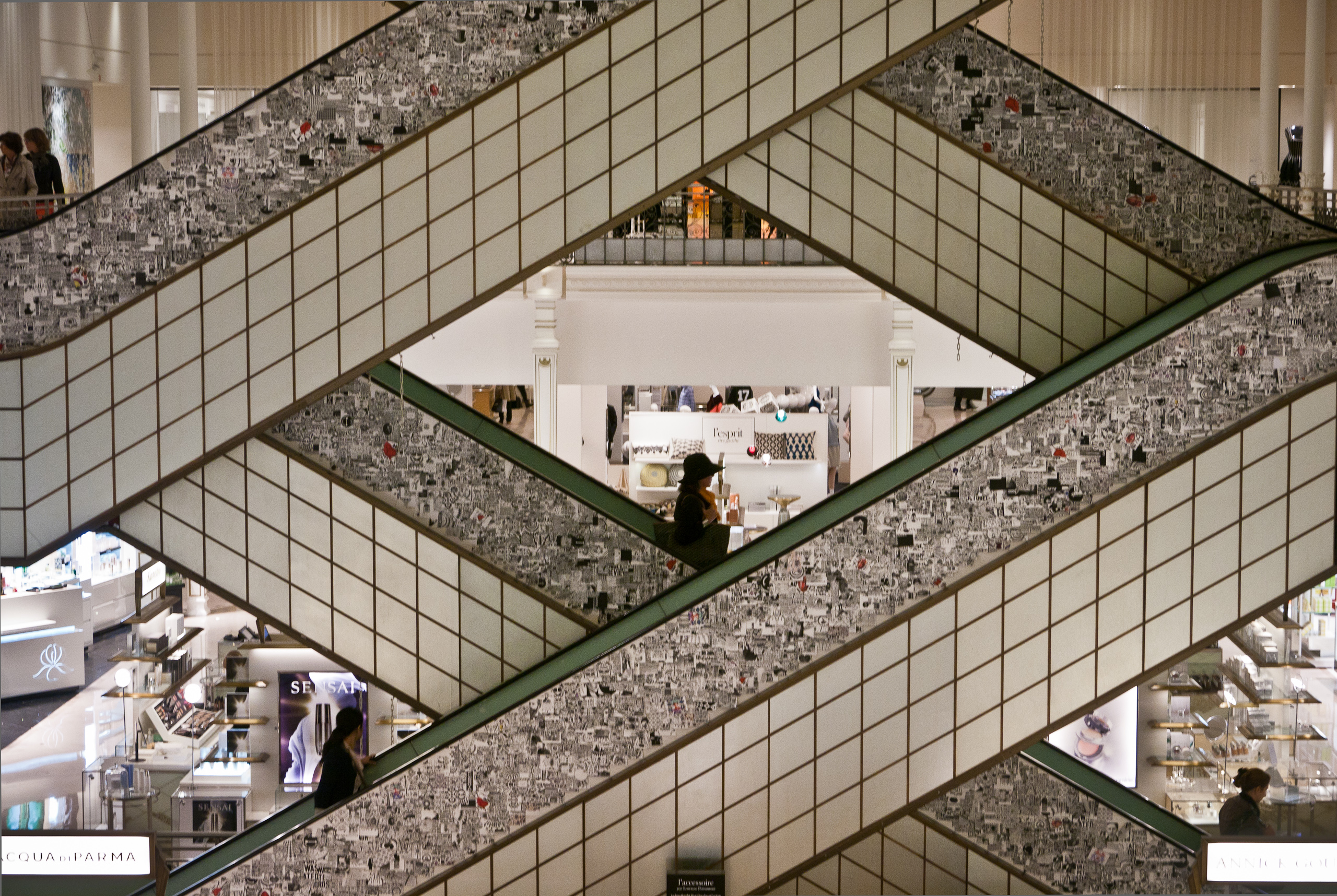
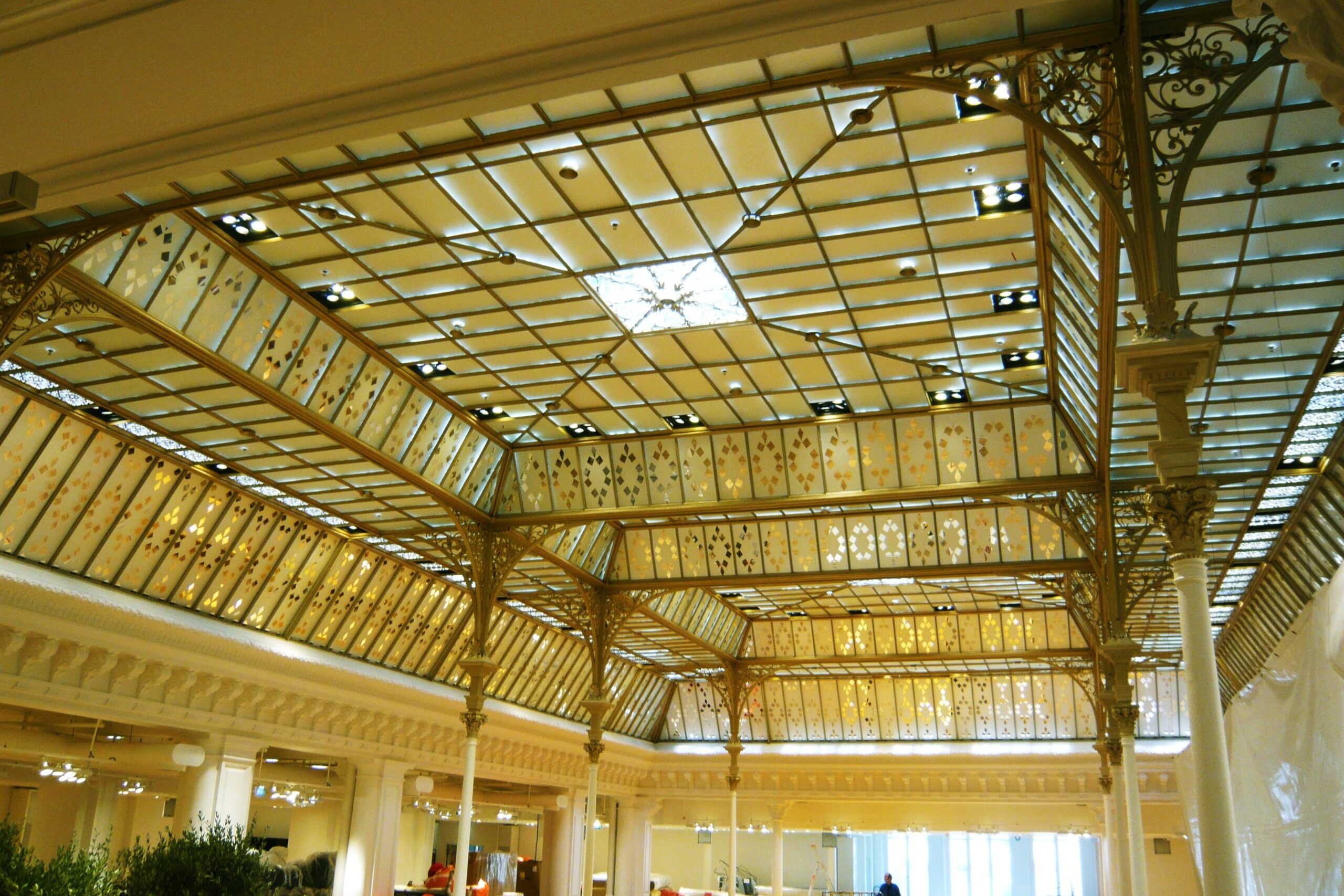
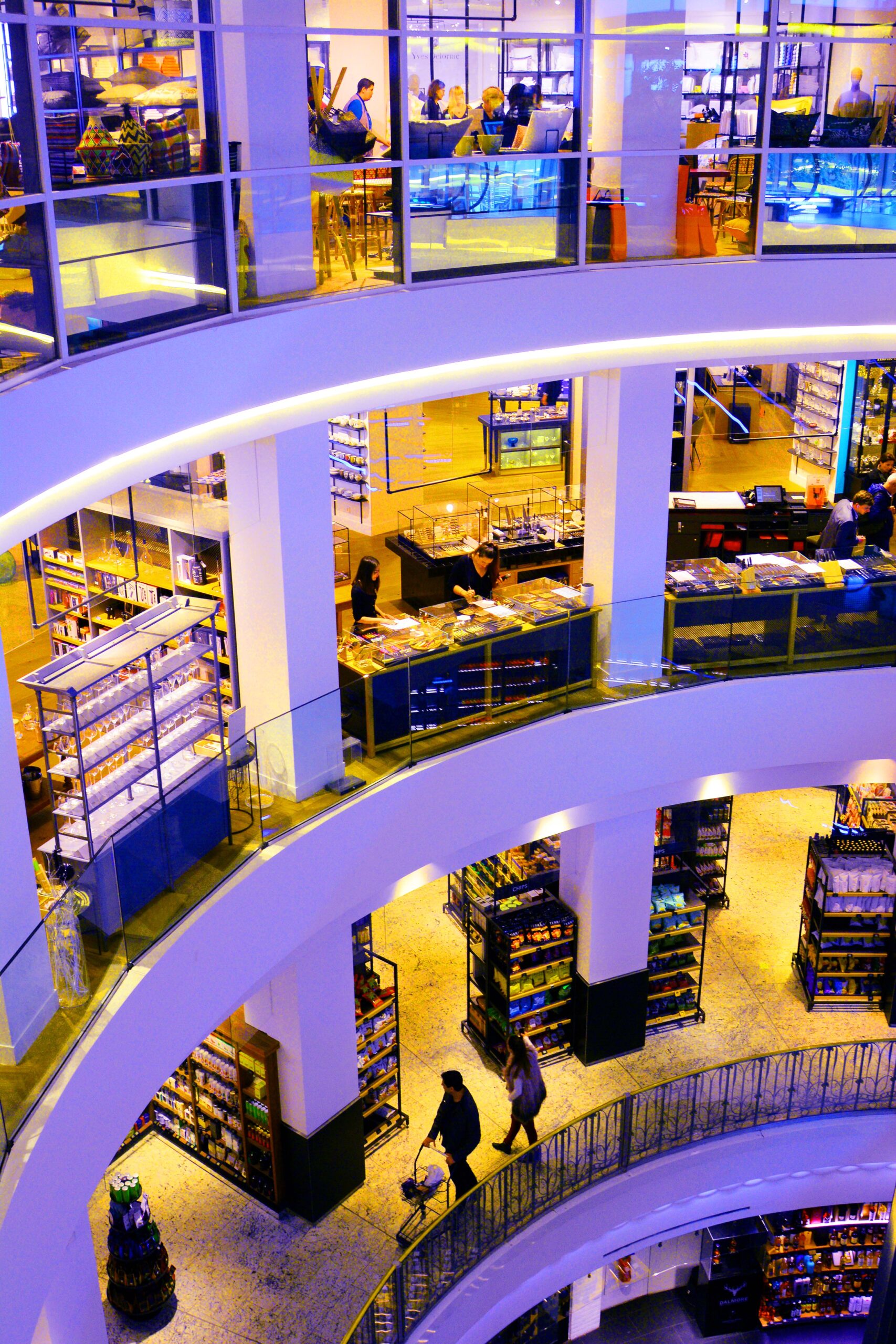
Glass roofs bring light into the building, while stairs, escalators and views between floors make circulation visible. The escalator is not simply a machine for reaching another department. Its movement puts visitors in relation to the space, offering changing views of the central volume and the merchandise around it.
Atelier Pomone: from furniture to the art of the table
Founded in the 1920s, Atelier Pomone connects the commercial selection of objects with their design. Its history includes figures such as Paul Follot, René Prou and Albert Guénot. Furniture and decorative arts were not just accessories to the fashion departments: they helped establish a domestic world inside the store.
The name returned in 2024 with a tableware project involving French-Swiss designer Julie Richoz and specialist manufacturers. This revival is best understood as a new design chapter, not as an unchanged catalogue carried forward from the interwar years.
One example is a Bernardaud milk jug whose bandana motif creates a trompe-l’œil effect on white porcelain. A familiar textile becomes an image on a different material. The interest lies in that transfer, in the relationship between what the object is and what its surface suggests.
It is a useful comparison with the history of Alessi: tableware can carry a manufacturer’s identity, a designer’s decisions and a ritual of use at the same time. The table is not merely a place to arrange objects. It is where their proportions, surfaces and handling are tested together.
La Grande Épicerie de Paris is a different business
Le Bon Marché is at 24 rue de Sèvres; La Grande Épicerie Rive Gauche is at number 38. Their proximity explains why they are often associated, but the food business has its own history. LVMH’s centenary account traces its origins to 1923 and the adoption of the Grande Épicerie name to 1979.
The interior places products, preparation and service in a shared visual field. Food retail becomes more than a sequence of shelves: counters, displays and glimpses of production establish different rhythms of attention. The visitor moves between packaged goods and activities that make the business tangible.
A comparison with Eataly helps identify the differences rather than erase them. Both invite readers to think about food, retail and spatial experience, but their histories, formats and relationships to production are distinct. One should not be presented as a Parisian version of the other.
Art Deco details along an everyday route
The entrance canopy and the gilded ceiling of the vestibule introduce another scale of observation. Details associated with the 1930s do not need to dominate an entire room to shape the experience of arrival. They mark the passage between the street and the interior.
These surfaces reward looking up as well as looking ahead. A retail visit usually follows signs, counters and products at eye level. The architecture adds a second route: a sequence of materials, light and decorative details that can be noticed without separating oneself from ordinary activity.
Art at Le Bon Marché: a collection and changing installations
The relationship with art reaches back to the picture gallery established by the Boucicauts in 1875. Today, it remains important to distinguish the collection from temporary installations. A work encountered in a past exhibition is not necessarily available to see on the next visit.
In 2024, Daniel Buren’s Aux Beaux Carrés, travaux in situ engaged with the glazed roof, the central space and the escalators through a two-phase installation. Squares, stripes, black and white elements and the existing architectural grid redirected attention towards parts of the building that a hurried visitor might overlook.
Song Dong’s Objets divers et variés ran from 10 January to 22 February 2026. Objects and chandelier-like assemblages framed the central escalators, with an interactive dimension to the visitor’s encounter. Those dates are past: the installation should be described as an episode in the store’s programme, not advertised as a current attraction.
In both examples, architecture is more than a neutral backdrop. Movement changes the view, and the work changes the perception of movement. The everyday route through a commercial building becomes part of the way an artwork is experienced.
Visiting Le Bon Marché with a design eye
Begin by distinguishing the two addresses on rue de Sèvres. Inside the department store, alternate broad views with close observation: the relationship between floors, the roof structure, an entrance detail, then the proportions of an object on display. This prevents either architecture or merchandise from becoming the entire story.
Check current opening hours, access arrangements and temporary exhibitions before travelling. The historical photographs in this article document particular moments; they do not guarantee that today’s displays or installations are identical. The building’s continued use is precisely what makes it subject to change.
The comparison with Rinascente reveals a shared question: how does a department store belong to its city while constantly updating its offer? The 10 Corso Como concept store provides a different scale of comparison, where selection itself becomes a strongly authored environment.
A department store that also shapes an idea of home
Le Bon Marché’s design interest does not depend on treating shopping as a cultural obligation. It comes from observing how architecture, objects and art share a place. The same route can connect a nineteenth-century commercial innovation, an interwar decorative detail and a contemporary tableware project.
That coexistence is the point. A store can change its merchandise without becoming an entirely different space, and a familiar space can be seen anew through a single object or installation. Le Bon Marché makes that relationship visible, one level, surface and pause at a time.