The threshold as the first project of the season: how to choose the size and materials of a fresh, dried or minimal wreath, and how to dress the entrance inside and out.
The front door is the first design project of the festive season: guests see it before the tree, before the table, before anything else. A well made wreath says in one gesture what kind of Christmas lives behind that threshold.
A Christmas wreath for the front door is the only decoration that belongs to the home and the street at the same time. It sits on the line between public and private, seen by neighbours, couriers and guests alike, and so it works as a small temporary façade. Decorating the entrance at Christmas therefore means designing a threshold rather than hanging an object: proportion, materials, light and continuity with whatever lies just beyond the door.
Our editorial view is that the entrance has become the most interesting place for Christmas decoration. Homes are smaller, trees more restrained, and many people now concentrate their decorative energy on a few strong moments. The door is the first of them: a fresh, dried or pared back wreath expresses, in a few centimetres, a sensibility, a season and a way of welcoming people in.
Where does the Christmas wreath tradition come from?
Circular garlands of foliage are ancient, but the form we know owes a great deal to nineteenth century Germany. In 1839 the Hamburg theologian Johann Hinrich Wichern hung a large wooden wheel in the prayer hall of the Rauhes Haus, the home for boys he had founded in Hamburg, with red candles for weekdays and white ones for the Sundays of Advent, lit one at a time. Over the years the wreath shrank, gained a covering of fir and moved into homes with its four candles.
From the Advent table to the front door was a short step, especially in the English speaking world, where the wreath on the door became the most recognisable sign of a domestic Christmas. The circle, with no beginning and no end, has a graphic strength that explains its success: it is a perfect shape, legible from a distance, that holds up in any material. For a designer it is an ideal format, because it sets a clear limit and leaves complete freedom within it.
What size should a Christmas wreath for the door be?
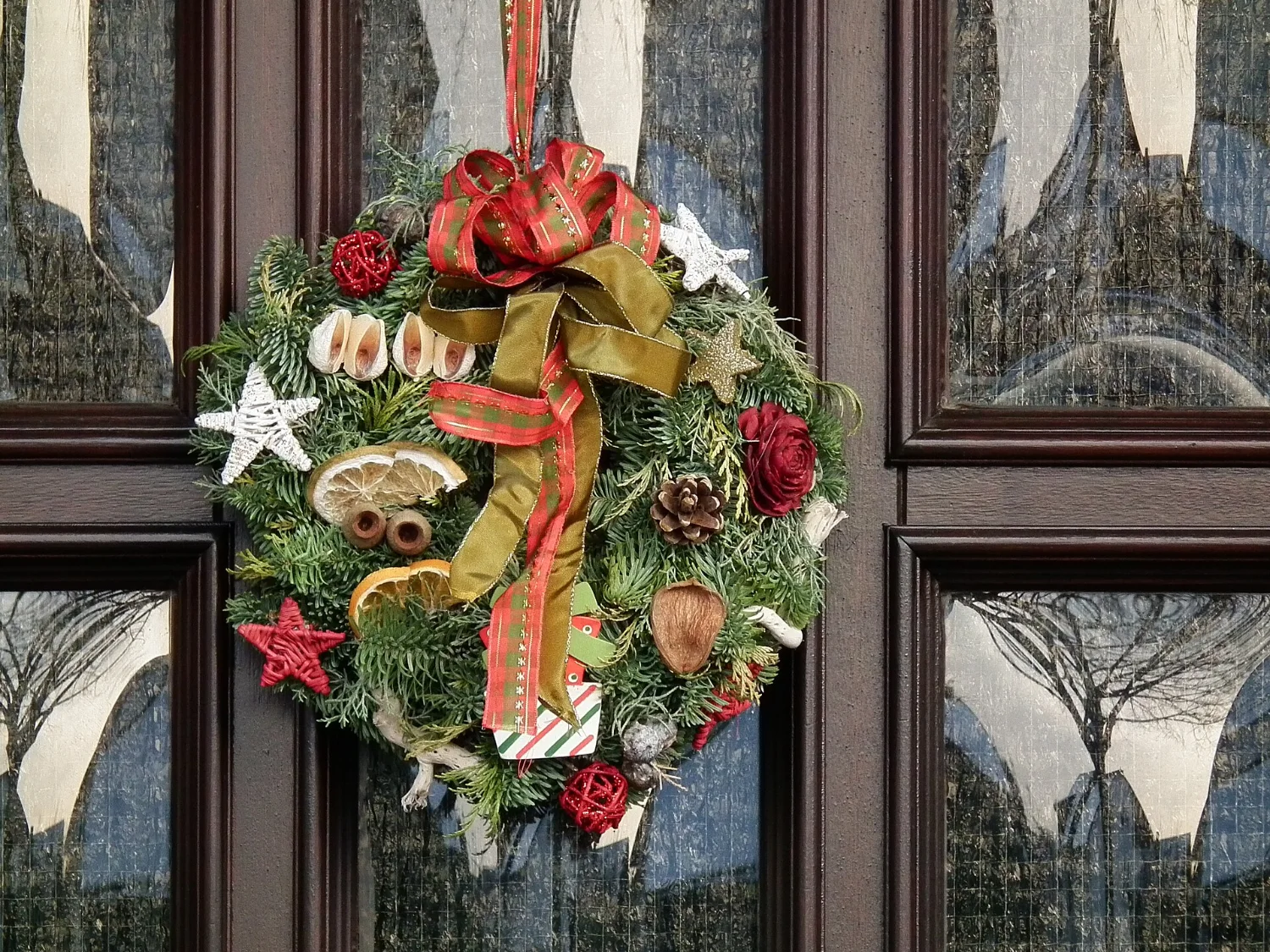
The right size takes up roughly a third of the width of the door leaf, a ratio we consider the safest starting point. On a standard door a wreath of 40 to 50 centimetres in diameter works both up close and from the street; on a tall, imposing front door you can go larger, while a wreath that is too small looks forgotten and one that is too large overwhelms the door.
Height matters too. The centre of the wreath should sit around eye level, or slightly above if there is a knocker or spyhole below. On a double door you can use matching wreaths, one on each leaf, or a single wreath centred on the meeting stile with a long ribbon falling to half height. If you use a ribbon, keep it to one colour and a real material, velvet, linen or silk, because synthetic ribbon gives itself away at close range.
Should you choose a fresh, dried or minimal wreath?
It depends on where the door is, and that is the key question. A fresh foliage wreath of fir, pine, cypress or eucalyptus is the most beautiful and the most fragrant, but it only thrives outdoors or in a cold hallway: with the heating on it sheds needles within days. For a door exposed to the weather it is the natural choice, and an occasional mist of water keeps it going until Epiphany.
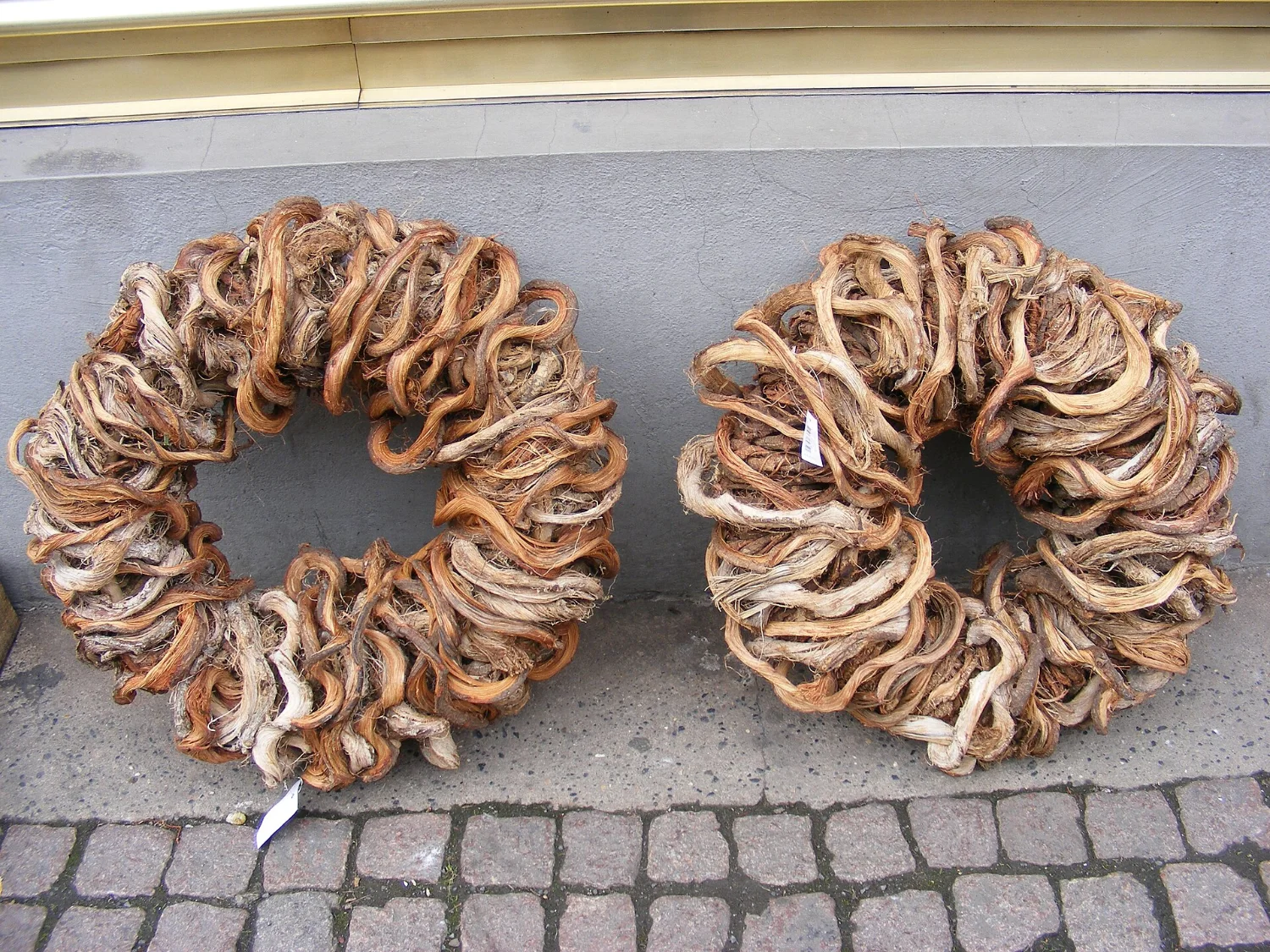
A dried wreath made of grasses, seed heads, dried flowers, berries and preserved leaves is the answer for an inner apartment door or for anyone who wants to keep it for years. Its palette is softer, beige, rust and sage, which sits well with contemporary interiors and with the natural colours that keep returning in recent Christmas trends. Keep it away from damp and direct sunlight, which fades its colours.
The third route is the most design led. A minimal wreath is a ring of metal, brass or burnished iron, or of bent wood, left largely empty, with a single bunch of foliage tied at an asymmetric point. It is the version closest to Scandinavian and Japanese design, and it suits modern doors, lacquered or glazed, where a full wreath would look out of scale. If that restraint appeals, you will find the same spirit in our feature on Japandi style.
How do you choose foliage and plants for a wreath?
Choose for longevity and contrast of texture rather than colour. Noble fir and pine hold their needles well, cypress and juniper bring a blue grey note, eucalyptus adds softness and scent. Berries, small cones and magnolia leaves, with their tobacco coloured undersides, add depth without any need for artificial decoration.
We recommend buying branches and greenery from a florist rather than foraging: some classic Christmas plants, such as butcher’s broom and holly, are protected in several Italian regions and wild harvesting is regulated. For a wider look at the plants of the season, from poinsettia to hellebore, we have a dedicated guide to Christmas plants, many of which look wonderful beside the front door.
How do you decorate the entrance at Christmas beyond the door?
Think of the threshold as a sequence: outside, door, inner hallway. Outside, space permitting, two planters with small firs or tall branches either side of the door frame the wreath like a picture. A lantern on the ground with an LED candle, or a warm light already fitted above the door, completes the scene without any need for light strings. If you have a terrace or garden, our guide to outdoor Christmas decorations has more ideas.
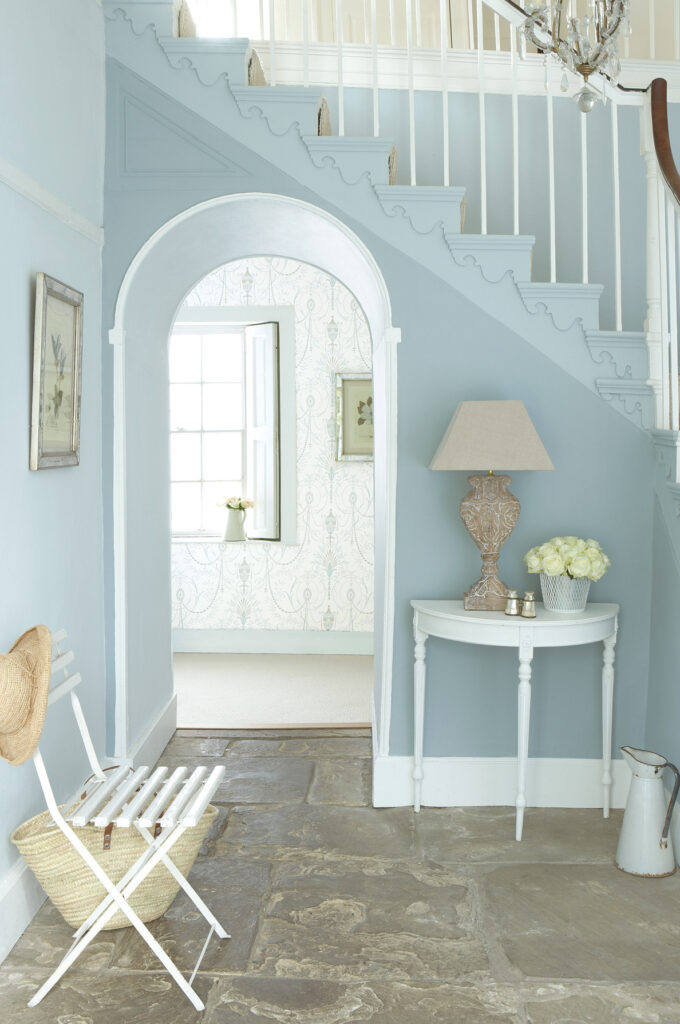
Inside, the hallway is often the most neglected space in the home, and at Christmas it becomes the most rewarding one to dress. A console or shelf with a vase of branches, a dish for keys, a candle or a small warm lamp is enough to echo the wreath and prepare the eye for the rest of the house. The year round basics are in our article on how to furnish an entrance corner.
The rule that ties everything together is consistency. If the wreath is eucalyptus with a linen ribbon, the hallway should pick up the same materials, perhaps in a small glass vase; if it is a brass ring, brass can return in a candle holder. For quality decorations and accessories, our selection of the best Christmas decoration brands is a good place to start.
How do you hang a wreath without damaging the door?
Without nails or screws, using a metal over door hook or a ribbon that runs over the top of the leaf and is fixed on the inside. An over door hook is the neatest option on solid wood and lacquered doors, but choose a slim one so the door still closes. Suction cups or removable adhesive hooks work on smooth surfaces such as glass and metal, as long as the wreath is light.
On the clad security doors common in apartment buildings, we suggest light wreaths, dried or minimal, with a ribbon fixed inside: it avoids scratches and respects building rules, which often govern what can be displayed in shared areas. If the door faces the sun, avoid fresh berries and flowers that stain as they drop.
Frequently asked questions about Christmas wreaths for the front door
When should you hang a Christmas wreath on the door?
Traditionally at the start of Advent, so between late November and early December. It usually comes down after Epiphany.
How big should a front door wreath be?
As a guide, about a third of the width of the door leaf: 40 to 50 centimetres in diameter on a standard door.
How long does a fresh wreath last?
Outdoors, in the cold and with an occasional mist of water, it can last until Epiphany. In a heated space it sheds needles within days.
Can you hang a wreath on an inner apartment door?
Yes, ideally a light dried one, hung on an over door hook or a ribbon fixed inside. It is worth checking the building’s rules.
What is an alternative to a classic wreath?
A minimal ring of metal or wood with a single bunch of foliage, or a horizontal branch above the door. Both suit modern doors.