The 1928 LC4 by Le Corbusier, Jeanneret and Perriand: Perriand’s contribution, Thonet and Cassina production, continuous adjustment and authenticity clues.
A curved steel tube sliding over a black base, a hair-on-hide mattress, no adjustment mechanism: designed in 1928 by Le Corbusier, Pierre Jeanneret and Charlotte Perriand, LC4 is the machine for resting that the twentieth century never stopped copying. Its history, structure, manufacturers and the signs of an authorised original.
Paris, autumn 1929. At the Salon d’Automne, among glass tables and metal storage units, an object appears unlike any conventional living-room furniture of the period: Le Corbusier’s chaise longue, designed the previous year in the rue de Sèvres atelier with Pierre Jeanneret and Charlotte Perriand. A steel curve more than a metre and a half long rests on a black support; it tilts with a push of the hand and stays in the selected position.
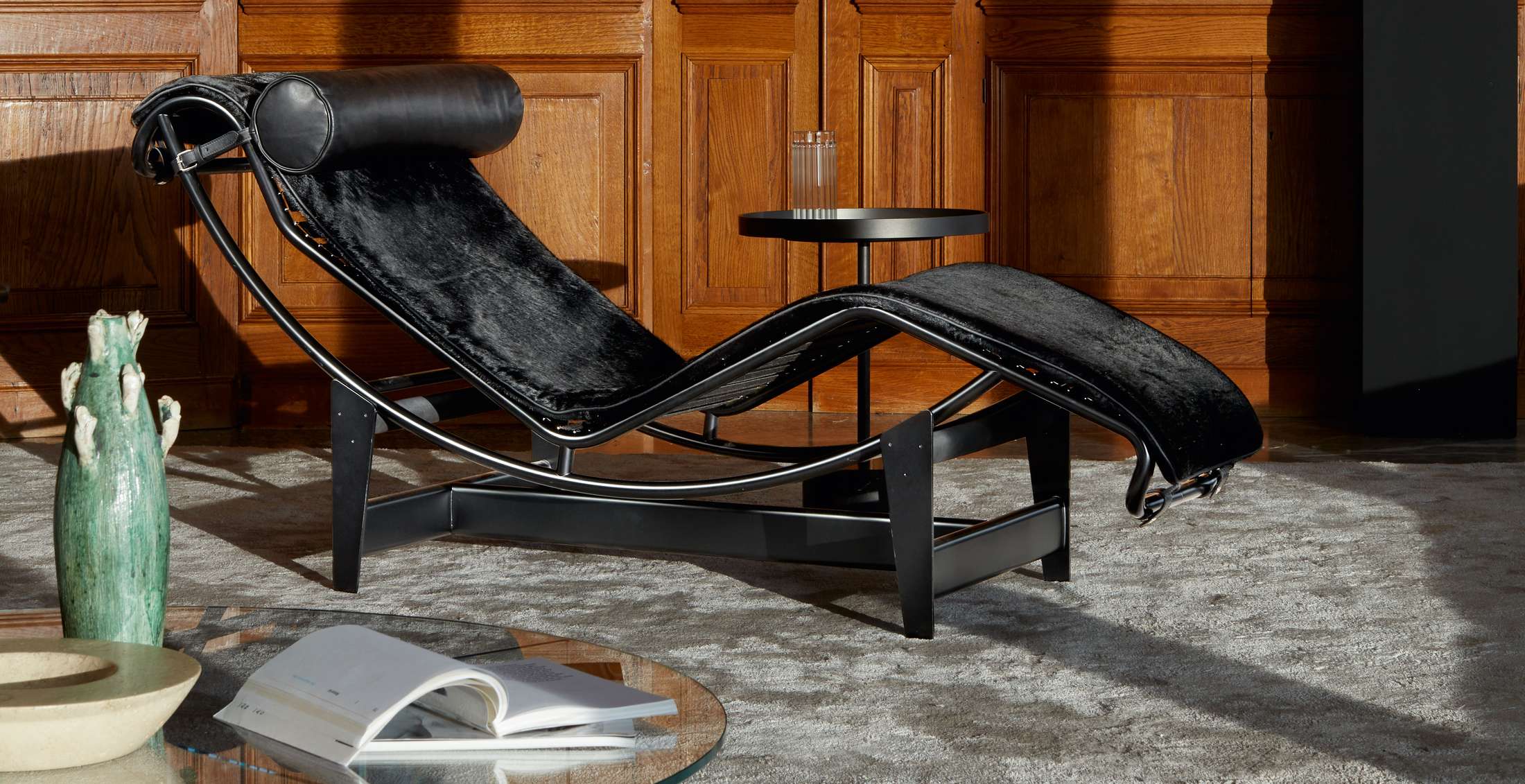
Today, we know it by the LC4 designation in Cassina’s catalogue, associated with its production since the mid-1960s, and find it in the collections of New York’s Museum of Modern Art and London’s Victoria and Albert Museum. At first, however, it was far from a commercial success: just over 170 examples sold, high costs and a limited market. Its story is that of an idea ahead of its time, and an attribution that for decades overshadowed the designer who helped make it possible. The Italian original reconstructs this history through the Fondation Le Corbusier, Centre Pompidou and the museums that hold examples.
Who designed Le Corbusier’s chaise longue?
The LC4 chaise longue was designed in 1928 by Le Corbusier, Pierre Jeanneret and Charlotte Perriand. The Fondation Le Corbusier, MoMA and Victoria and Albert Museum attribute it to all three. It is not a piece by Le Corbusier alone, although that remains its familiar shorthand name.
Its setting was the rue de Sèvres atelier, where Le Corbusier worked with his cousin Pierre Jeanneret. In the late 1920s, the practice was designing Purist villas, from Villa La Roche to Villa Church, and developing the language that would culminate in Villa Savoye at Poissy. Those buildings needed consistent furnishings: lightweight, industrial and conceived as equipment rather than decoration. The three designers called this équipement de l’habitation, equipment for the home. Our Italian-language portrait of Le Corbusier’s life, style and buildings provides the wider context of the Swiss-born architect’s career.
| Reference information | LC4 chaise longue |
|---|---|
| Name | Chaise longue à réglage continu; Thonet B306 (1930); Cassina LC4, now 4 Chaise longue à réglage continu |
| Designers | Le Corbusier, Pierre Jeanneret, Charlotte Perriand |
| Design year | 1928 |
| First presentation | Salon d’Automne, Paris, 1929 |
| Historical production | Thonet from 1930: 172 examples sold through 1935, according to the Fondation Le Corbusier; subsequently Embru-Werke, Wohnbedarf and Bigla in Switzerland; reissues initiated by Heidi Weber from 1959 |
| Current manufacturer | Cassina, from 1964, with exclusive rights from 1965; Cassina I Maestri collection |
| Structure | A cradle of chromed tubular steel resting on an H-shaped painted steel base with an ovoid profile |
| Adjustment | Continuous, through friction between the tube and rubber-covered crossbars, without an adjustment mechanism |
| Materials of the V&A example | Chromed tubular steel, painted sheet metal, metal springs, rubber and pony-skin upholstery |
| Indicative dimensions | 67 x 58.4 x 158.4 cm (MoMA’s Thonet example); 70 x 55 x 160 cm (Centre Pompidou) |
| Museums | MoMA, New York (223.1950); Victoria and Albert Museum, London (W.11-1989) |
What was Charlotte Perriand’s role in the chaise longue?
Charlotte Perriand was responsible for the atelier’s furnishings and, according to the Centre Pompidou dossier, devised the mechanical system that allows continuous adjustment of the chaise longue. She translated into an object a programme that Le Corbusier had formulated in broader terms.
Born in Paris in 1903, Perriand attracted attention at the 1927 Salon d’Automne with Bar sous le toit, metal and glass furnishings for her apartment on Place Saint-Sulpice. Sources differ on the exact date she joined rue de Sèvres: London’s Design Museum and Cassina give 1927, with Cassina specifying October, while the Centre Pompidou dossier describes her appointment as an associate in 1928. She remained at the practice until 1937.
She explains her role in her autobiography Une vie de création, published by Odile Jacob in 1998: her responsibility was not architecture but equipment for the home. She also describes a clear division of work. During the day, she and Pierre Jeanneret studied full-scale drawings, which Le Corbusier reviewed in the evening. When prototypes stalled, she approached craftspeople, selected materials and supervised finishes.
The invention of continuous adjustment
The Centre Pompidou credits Perriand with inventing an entirely mechanical system for a chaise longue that adjusts without fixed steps: friction between the steel tube and a rubber-covered metal support holds its position. The museum cites contemporary medical chairs and Thonet’s bentwood rocking chair as inspirations. The Victoria and Albert Museum also suggests a Viennese rocking chair dating from around 1880 as a possible model.
The base required experimentation too. Perriand recalled how much difficulty the chaise longue’s support had caused them. The solution came by connecting its design to the glass-topped table at Villa Church, using an ovoid profile in lacquered sheet steel discovered by chance in an aviation catalogue. This produced the teardrop section, resembling a wing, which the Fondation Le Corbusier also describes in the supports of the tables exhibited in 1929.
From the 1929 Salon d’Automne to Thonet: LC4’s first life
The chaise longue debuted at the 1929 Salon d’Automne in the installation Équipement intérieur d’une habitation. It entered Thonet’s catalogue in 1930 as B306. Sales were disappointing: the Fondation Le Corbusier records 172 examples sold across Europe between 1930 and 1935.
The 1929 stand was a declaration of method. The Fondation describes a double-height space of approximately 90 m², containing chromed tubular structures, glass tables on wing-profile supports, and modular metal-and-glass storage units. The tilting-back chair and Grand Confort armchair belonged to the same furniture family, all designed in 1928.
From 1930, Thonet produced the models under all three designers’ names. Yet the chaise longue was industrial only in appearance. The Victoria and Albert Museum notes that it required three types of metal and numerous welds: an expensive process that limited its reach. The Fondation likewise points to a narrow market. After Thonet, production passed to Swiss companies including Embru-Werke, Wohnbedarf and Bigla; the design then remained marginal until the reissues of the late 1950s.
How LC4 works: the base, cradle and continuous adjustment
LC4 comprises two independent parts: a fixed H-shaped base and a mobile tubular steel cradle resting on it, which slides to assume different inclinations. This is the meaning of its French name, chaise longue à réglage continu: a continuously adjustable chaise longue.
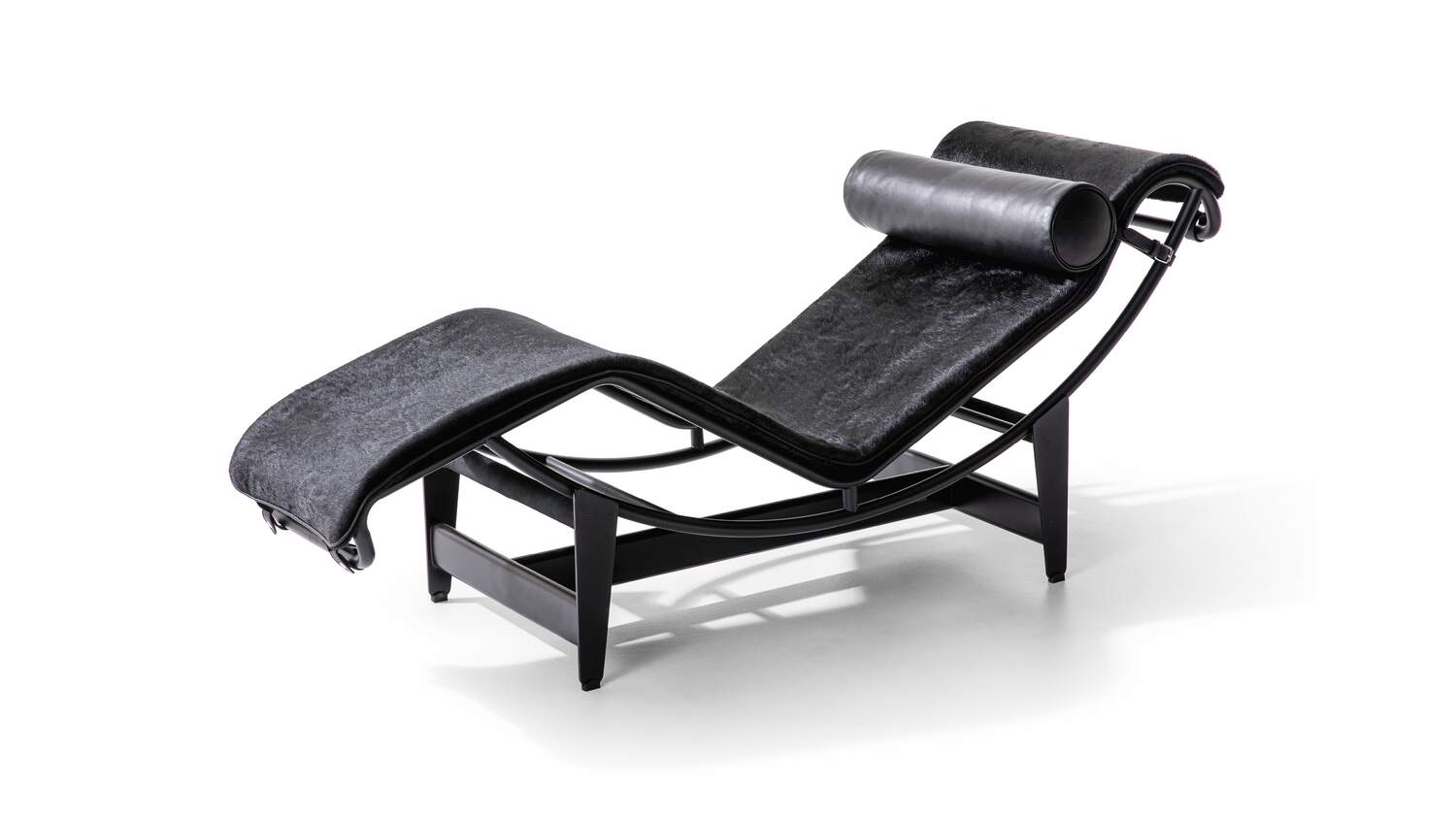
The cradle consists of two parallel curved tubes joined by crossbars, following the outline of a reclining body: rising beneath the knees, dipping under the pelvis and lifting towards the neck. A mattress supported by springs rests on this frame, completed by a cylindrical headrest. The black-painted steel base has two rubber-covered crossbars on which the curve sits. Sliding the cradle changes its point of contact and therefore its angle, from an almost seated position to a reclined one with the legs raised. Friction from the rubber holds it in place.
The Fondation Le Corbusier records the designers’ description of it as a machine à repos, a machine for resting, capable of serving as an armchair, resting seat, chaise longue or rocking chair without an adjustment mechanism. The phrase echoes Le Corbusier’s idea of the house as a machine for living: comfort becomes the geometry of the body rather than simply padding.
Cassina LC4: production, exclusive rights and I Maestri
Cassina’s LC4 emerged from the authorised reissue history of Le Corbusier’s furniture. According to the Fondation, the Meda company began manufacturing it in 1964 and acquired exclusive production and distribution rights in 1965. From then on, the chaise longue became an international success.
The intermediate stage was the reissues initiated in 1959 by Swiss gallery owner Heidi Weber, who subsequently subcontracted manufacturing to Cassina. The move to Italian industry, shortly before the architect’s death in August 1965, changed the scale of production. Cassina manufactured the first four models: the tilting-back chair, the two Grand Confort versions and the chaise longue, numbered LC1 to LC4. They formed the nucleus of the collection named Cassina I Maestri from 1973, then curated by Filippo Alison and devoted to reissues of major twentieth-century architects’ furniture. Our Italian-language history of Cassina and its icons explores that collection.
The Victoria and Albert Museum notes a distinction worth remembering: versions produced from the late 1950s differ in construction from the Thonet originals and do not reproduce their appearance exactly. Today’s LC4 is therefore an authorised reissue, faithful to the design while adapted to industrial processes. In 2025, Cassina celebrated sixty years of LC collection production with a limited-time series.
Materials and variants of the LC4 chaise longue
LC4 is recognisable through its combination of a polished chromed steel frame, black base and leather or hair-on-hide mattress. Different finishes and materials have appeared over time. The underlying structure remains consistent, while upholstery and colours vary.
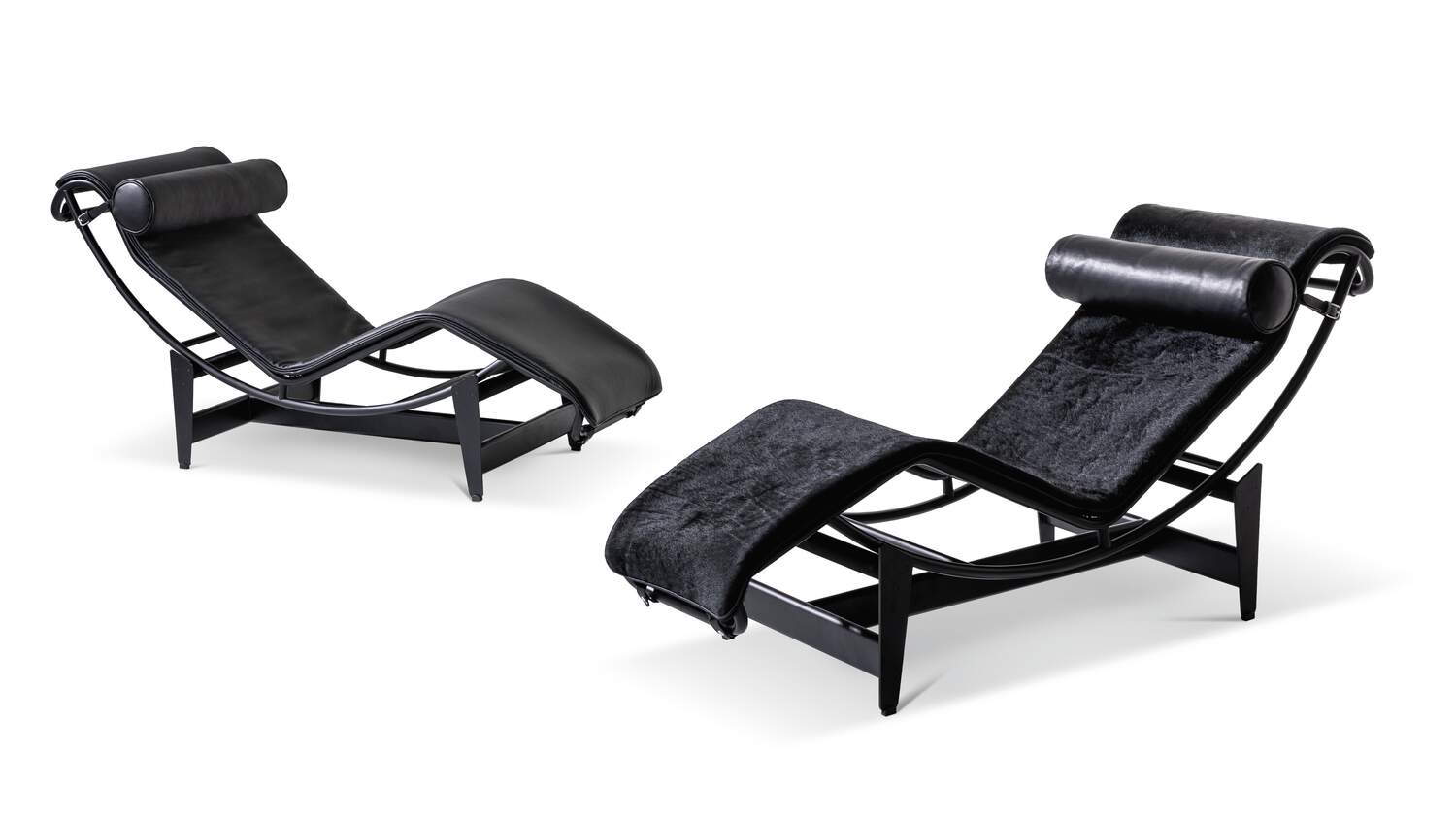
The most recognisable covering is hair-on hide, described as pony skin on the historical Thonet example at the Victoria and Albert Museum. Alongside it, the current catalogue offers several leather qualities, from Extra leather to natural leathers, with a coordinating cylindrical headrest. According to the company’s specification, the durable version uses recycled polyester fibre padding and an internal hook-and-loop fastening that simplifies disassembly and separation of materials.
For the sixtieth anniversary, the cradle was offered in glossy red, blue or green painted steel with a self-supporting leather mattress in a matching tone. Colour on the structure is not simply a recent whim: in our editorial interpretation, it recalls the architectural polychromy Le Corbusier used to shape space within his houses. In the projects covered by our team, the classic black-and-white hair-on-hide version remains a frequent choice, relating to leather and wood without dominating the room.
Where an LC4 works best
At approximately 160 cm long, the chaise longue needs space around it, whether in a reading corner or a study. Our editorial observation is that it is particularly effective when seen in profile, because the cradle’s line communicates the design. Our Italian-language selection of iconic design armchairs offers a comparison with other authored seating.
How to recognise an original LC4
An authorised Cassina LC4 carries the Cassina I Maestri mark, the designers’ signatures and a sequential production number engraved on its frame, and is accompanied by a certificate. Cassina’s LC collection catalogue describes these identifiers and states that rights to the designs are protected by the Fondation Le Corbusier. Such identifiers should be checked against reliable provenance rather than treated as sufficient proof on their own.
The chaise longue is among the most frequently copied furniture designs. Beyond its markings, welding and chrome quality, frame finish and leather characteristics matter. The vintage market also requires three categories to be distinguished: rare 1930s Thonet examples, now often museum pieces; Swiss production and the reissues initiated by Heidi Weber from 1959; and Cassina production from 1964 onwards. For a period piece, request provenance documentation and, where doubt remains, the opinion of an expert in twentieth-century design.
Why Le Corbusier’s chaise longue remains an icon
Le Corbusier’s chaise longue remains an icon because it solves a functional problem, resting in different positions, through a single structural idea without an adjustment mechanism or ornament. It is a manifesto of the Modern Movement that can be used every day.
There is the clarity of its design: one curve and one support. There is its relationship to the body, which Le Corbusier would explore further in the 1940s with the Modulor, his measurement system based on human stature. And there is its ability to move between settings, from a Rationalist villa to a contemporary apartment, like the works discussed in our guide to twentieth-century architectural masters.
Finally, there is the history of its attribution. For many years, it was simply Le Corbusier’s chaise longue. Today, museums and foundations name all three designers, and the Design Museum’s 2021 exhibition devoted to Perriand brought her contribution back to the centre. Looking at LC4 also means considering how design history is written.
The Fondation Le Corbusier’s entry on the 1928 chaise longue and MoMA’s entry on its Thonet example, donated by Thonet Industries in 1950, are starting points for further research.
Frequently asked questions about the LC4 chaise longue
Who designed the LC4 chaise longue?
LC4 was designed in 1928 by Le Corbusier, Pierre Jeanneret and Charlotte Perriand in the Paris atelier on rue de Sèvres. The Fondation Le Corbusier, MoMA and Victoria and Albert Museum attribute it to all three. The Centre Pompidou credits Perriand, who oversaw the practice’s furnishings, with inventing the distinctive continuous adjustment system.
Why is it called LC4?
The LC4 designation comes from Cassina’s catalogue, which numbered the first four furniture pieces by Le Corbusier, Jeanneret and Perriand LC1 to LC4 in connection with their mid-1960s production. Its original name is chaise longue à réglage continu, meaning continuously adjustable chaise longue. In Thonet’s 1930 catalogue, it was B306. Cassina now presents it as 4 Chaise longue à réglage continu.
When was it first presented?
The chaise longue was presented at the 1929 Salon d’Automne in Paris in the installation Équipement intérieur d’une habitation, credited to the three designers. The double-height stand showed a home equipped with chromed tubular furniture, glass tables and modular storage. Thonet began production in 1930, with modest commercial results.
How is LC4’s inclination adjusted?
LC4 has no adjustment mechanism. Its curved tubular steel cradle rests on two rubber-covered crossbars on the base. Sliding it changes the contact point and therefore its inclination, from a semi-seated position to one with the legs raised. Friction maintains the position. According to the Fondation Le Corbusier, it can also serve as a rocking chair.
How can an original LC4 be recognised?
Cassina-produced LC4s have the Cassina I Maestri logo, designers’ signatures and a production number engraved on the frame, and come with a certificate. Chrome and weld quality and leather characteristics also matter, but none of these alone guarantees authenticity. Older pieces predating Cassina require provenance documents and an expert assessment.
Which museums hold Le Corbusier’s chaise longue?
The Museum of Modern Art in New York holds an example manufactured by Thonet Frères, donated by Thonet Industries and catalogued as 223.1950. London’s Victoria and Albert Museum owns a 1928-1929 Gebrüder Thonet example with pony-skin upholstery. The Centre Pompidou in Paris also discusses the chaise longue in its Charlotte Perriand dossier.