Terraces, balconies and gardens at Christmas deserve to be designed like an extra room: a few warm lights, real potted evergreens and safe wiring, from IP ratings to outdoor sockets.
Christmas outdoors is not measured in metres of fairy lights. It is designed like a small winter landscape, with a few warm lights, real evergreens and wiring that leaves nothing to chance.
Outdoor Christmas decorations have become the place where the gap between decorating and accumulating shows most clearly. Balconies smothered in light-up reindeer and cascades of blue LEDs speak of a shopping-centre idea of celebration; a terrace with three lanterns, a potted fir and a garland of real branches speaks of a home. Our view is that in December the outdoor space should be treated as an extra room, with a lighting plan, a palette of materials and a sense of direction.
There is a cultural reason too. In recent years terraces and balconies have turned into summer living rooms, furnished with outdoor pieces that are ever closer to interior design, so it is only natural that winter should claim them as well. Outdoor space does not switch off in October: it becomes a backdrop, seen from the sitting room through the French windows, and it deserves to be composed like one.

How do you choose outdoor Christmas lights without tipping into kitsch?
There is one rule: few sources, warm light, points of light that draw the architecture rather than bury it. Choose a warm colour temperature, between 2700 and 3000 kelvin, and avoid cold white and flashing effects, which flatten any facade. A string of micro LEDs wound with discipline around the trunk of an olive tree, a row of lanterns on the windowsill and a single lamp beside the seating are worth more than any curtain of lights.
The second principle is hierarchy. A lighting scheme, even for a four-metre balcony, separates a focal point such as the door, a tree or the table from soft ambient light and a few minor accents. Work this way and you get depth; scatter lights everywhere and you get visual noise. The same logic applies indoors, as we explain in our guide to Christmas lights at home.
Then there are designer outdoor lamps that work just as well in December, because they are made to stay outside all year. The Tolomeo Lampione Outdoor by Artemide, designed by Michele De Lucchi and Giancarlo Fassina, encloses the light source in a transparent IP65-rated housing and recalls the old oil street lamps: hung above the terrace table, it becomes a contemporary lantern. These are pieces you do not take down on 7 January, and that alone is a measure of sustainability.
Which evergreens should you plant in pots on a terrace or balcony in winter?
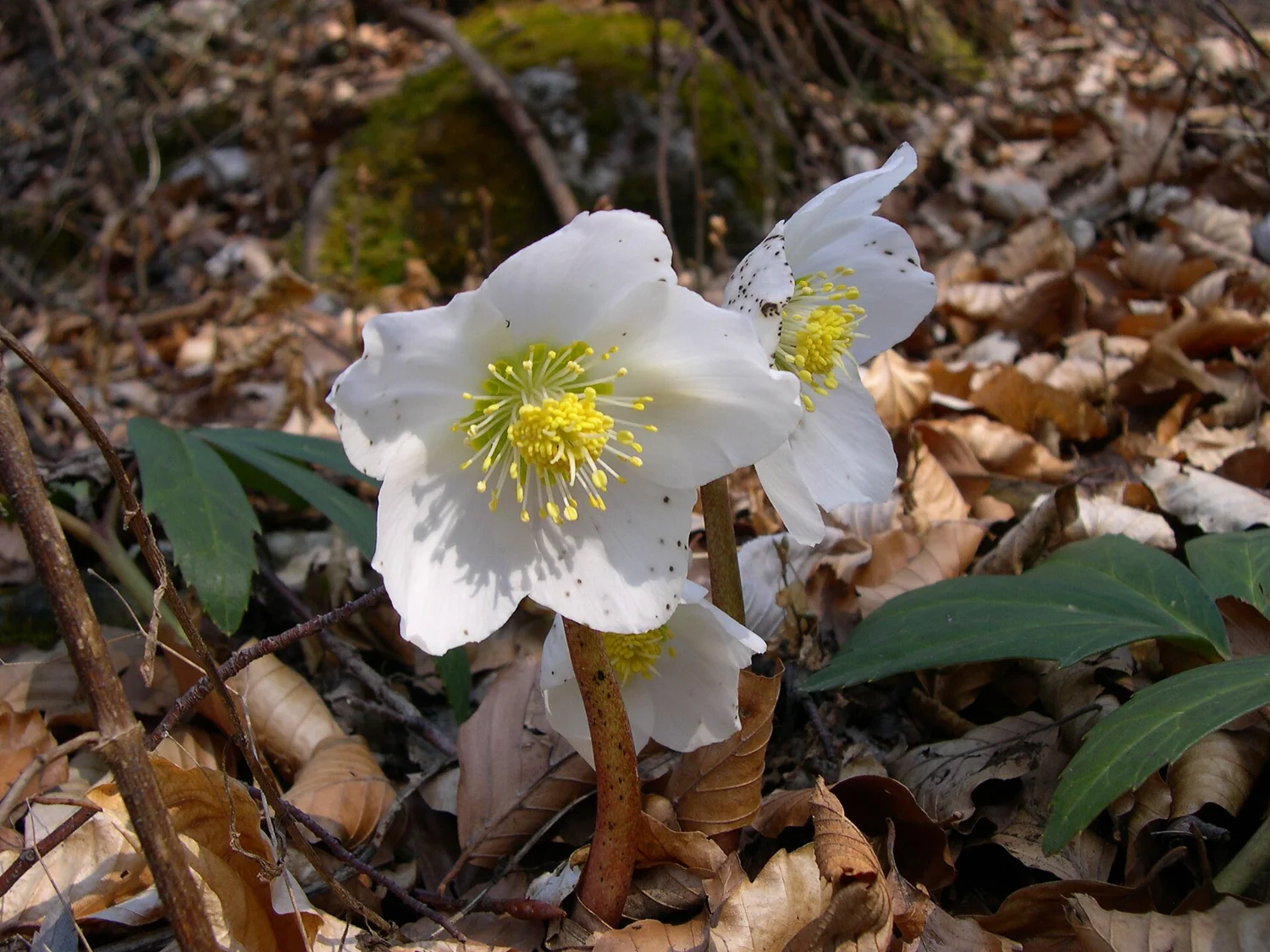
The most reliable choices are hardy conifers, holly, box and hellebores, which stay green through winter or even flower. A real fir in a pot, chosen from the dwarf or slow-growing varieties suited to containers, copes with the cold better than any artificial tree and simply stays put after the holidays. Holly brings the red of its berries without any added ornament, bearing in mind that berries only appear on female plants. The white Christmas rose, Helleborus niger, flowers right in the festive season and prefers a cool, sheltered spot in light shade, in very free-draining compost.
The pot matters as much as the plant. Terracotta, stoneware or painted metal, ideally in two or three sizes from the same range, create rhythm; glossy plastic bowls and gilded pot covers break it. Outdoors the container must drain well, because standing water that freezes is the first enemy of roots in winter. Grouping pots against the wall of the house or under a canopy shelters the plants from wind and the hardest frosts.
How do you decorate a small balcony for Christmas?
On a small balcony you work vertically and around a single focal point. A garland on the railing or the French windows, one tall plant in a corner and a warm light at floor level are enough to change how the space reads, even from inside. The same rules apply to small interiors, as we show in our guide to Christmas decorations for a small home.
The railing is the real surface to design. Fir branches tied with natural twine, a few berries and a single colour of velvet ribbon make a decoration that reads from the street without raising its voice. Fix everything with ties that will not scratch the paintwork, because the December wind is unforgiving. The front door deserves a scheme of its own, and our ideas for a Christmas wreath for the front door start precisely from natural materials.
How do you light a garden for Christmas with a proper lighting scheme?
In the garden, light should reveal the shapes that are already there: a tree, a stone wall, a path. The most effective technique is uplighting that grazes a trunk or a hedge from below, adding volume and depth with no need for further ornament. A tree properly lit from below becomes the sculpture of the garden; the same tree wrapped in strings of lights becomes a sign.
Paths should be marked with low, evenly spaced lights, which on winter evenings, when darkness falls very early, also serve a real safety purpose. Ground lanterns, step lights and LED candles inside heavy glass hold up to the wind better than real candles and leave no wax on the stone. Our advice is to switch off anything you do not need before going to bed: a timer is the simplest solution and respects the neighbours’ darkness too.
What safety rules apply to outdoor Christmas lights?
The first rule is to use only products the manufacturer declares suitable for outdoor use, with an IP rating that matches where they will be installed. The IP code has two digits: the first indicates protection against solid objects and dust, the second against water. An IP44 product is protected against splashing water from any direction and suits sheltered spaces, while exposed terraces, gardens and facades call for at least IP65, which is protected against water jets. Lights labelled “for indoor use only” should never go outside.
| IP rating | Protection | Where to use it |
|---|---|---|
| IP44 | Solid objects over 1 mm, splashing water from any direction | Covered balconies, porches, sheltered entrances |
| IP54 | Limited dust ingress, splashing water | Partly covered terraces |
| IP65 | Dust-tight, water jets | Exposed terraces, gardens, facades, paths |
| IP67 | Dust-tight, temporary immersion | Ground-level fittings where water may collect |
Beyond the IP rating, check for the CE mark, which is mandatory but not enough on its own, and ideally the mark of an independent testing body such as IMQ in Italy; the packaging should give the manufacturer’s name and address. Extra-low-voltage LED lights with a separate transformer reduce the risk of electric shock and overheating, provided the transformer is also rated for outdoor use if it stays outside.
Sockets deserve the same care. Outdoors, use sockets and extension leads designed for outdoor use, with connections kept off the ground and away from puddles and gutters. One plug per socket, no stacked adaptors, cables kept clear of walkways; if the terrace has no outdoor socket, the right answer is to have one fitted by a qualified electrician, not to run an extension lead under the French windows. The circuit should be protected by a working RCD, and if in doubt a check by an electrician is the best investment of the season.
Then there is maintenance: test the lights before putting them up, replace anything damaged rather than patching it with tape and unplug at once any transformer that runs very hot or smells of burning plastic. When the holidays are over, store everything dry, with cables loosely coiled; where there is no socket within reach, battery or solar lights are a sensible alternative.
Which materials and colours make an elegant festive outdoor space?
Natural materials and a restrained palette: the deep green of conifers, wood, iron, glass and a single accent colour. The red of berries, the white of hellebores or the bronze of a few lanterns are enough to set the tone, without plastic and glitter that the rain ruins within a week. Many of the makers we selected in our guide to the best Christmas decoration brands offer glass and metal pieces that work on a windowsill too.
Outdoor furniture stays centre stage in winter as well. A stone or metal table with a centrepiece of branches and lanterns, two seats with outdoor cushions and a throw brought in at night turn the terrace into a place for a hot drink in your coat. It is the same spirit as in Alpine towns, where public space stays alive in December, as we describe in our guide to the Bolzano Christmas market.
Frequently asked questions about outdoor Christmas decorations
What IP rating do outdoor Christmas lights need?
IP44, which protects against splashing water, is enough for covered balconies and sheltered entrances. For exposed terraces, gardens and facades, at least IP65, protected against water jets, is recommended.
Can indoor Christmas lights be used on a balcony?
No. Lights rated for indoor use are not protected against moisture and can short-circuit outdoors. The reverse is fine: outdoor lights can also be used inside.
Which plants survive the cold on a terrace at Christmas?
Dwarf conifers in pots, holly, box and hellebores are the most dependable choices. They need a free-draining pot and a position sheltered from the wind.
When should outdoor Christmas decorations go up?
In Italy tradition has them go up on 8 December, the Feast of the Immaculate Conception, and come down after Epiphany, although many people start in late November. Designer outdoor lamps, on the other hand, can stay out all year.
How do you avoid kitsch in outdoor Christmas decorations?
A few warm points of light, no flashing, natural materials and a palette of two or three colours. Lighting the architecture and the plants, rather than covering them in lights, is the rule that makes the difference.