Radios, portable lamps, speakers and clocks in which technology serves a recognisable design: from Zanuso and Sapper’s radio.cubo to Flos’ Bellhop, the tech gifts that never date.
Technology ages fast, good design does not: the gifts that last are the ones where the electronics hide inside a form that can stay on the sideboard for decades.
Design tech gifts are the hardest category to get right at Christmas, because every year the market offers hundreds of novelties that look dated within two seasons. Yet there is a family of objects that escapes this rule: radios, lamps, speakers and clocks in which technology serves a recognisable design, often signed by a great designer and sometimes conceived more than sixty years ago.
Our view is that the best tech gift today is a piece of interior design. In increasingly connected homes, where music streams from a phone and light changes with a gesture, what remains visible is the object itself: the shell of a radio, the shade of a portable lamp, the face of an alarm clock. This guide is deliberately focused and sits alongside our selection of design gifts for Christmas 2026, looking only at objects in which electronics and design live together.
What turns a tech object into a design gift?
A tech object becomes design when its form stays valid even after the technology inside has changed. That is what separates an icon from a gadget: the first is reissued, updated in its components and still desired, the second ends up in a drawer. The clearest examples come from the golden age of Italian industrial design, when companies such as Brionvega entrusted their televisions and radios to architects and designers.
The test is therefore twofold. On one side there is the design, which needs a history or at least a clear coherence; on the other the technical substance, because a beautiful object that cannot be recharged, updated or repaired betrays the promise of design. The products below answer both questions.
Which design radios make the best gifts?
The design radio par excellence is Brionvega’s radio.cubo, created in 1964 by Marco Zanuso and Richard Sapper. It consists of two hinged cubic modules, one holding the speaker and the other the electronics: open, the radio unfolds and plays; closed, it becomes a compact coloured block. It is in the collections of MoMA in New York and the São Paulo Museum of Modern Art, and David Bowie owned one too.

The radio.cubo 50° reissue updates the inside without touching the design: DAB+ digital radio, FM, Bluetooth, an alarm, a lithium battery and a remote control, with the shell in ZAMAK metal alloy as on the original, in snow white and sun yellow finishes. For something even more theatrical, Brionvega has reissued the rr126 radiogram designed in 1965 by Achille and Pier Giacomo Castiglioni, whose front of knobs and dials recalls a smiling robot.
For a quieter gift, consider the Model One by Tivoli Audio, an AM and FM table radio with a wooden cabinet, a large tuning dial and a handful of analogue controls: an object you understand at first glance, ideal for anyone who would rather not use an app.
Which portable speaker has a design that lasts?
The Beosound A1 by Bang & Olufsen is one of the most accomplished portable speakers in formal terms. It was designed by the Danish designer Cecilie Manz around the idea of a pebble: a rounded aluminium form, pleasant to hold and compact enough to slip into a bag. Manz aimed for an object that is clear and uncomplicated, in which function and aesthetics carry equal weight.
The third generation comes in six colours, from neutrals such as Warm Granite and Natural Aluminium to warmer shades such as Honey Tone and Rustic Red. Our advice is to choose the colour as you would an accessory, thinking about the room where the speaker will spend most of its time, because an object like this stays on show even when it is switched off.
Which portable or smart lamp should you give?
The rechargeable portable lamp is perhaps the most successful design tech gift of recent years, because it takes light wherever it is needed, from the dining table to the terrace, without cables. The Bellhop by Flos, designed by Edward Barber and Jay Osgerby, was created in 2016 for the restaurant at London’s Design Museum and became an industrial product in 2018. The Bellhop Unplugged version charges via USB-C and has a long life, replaceable battery, an integrated dimmer, three colour temperatures and an IP54 rating against dust and splashes.
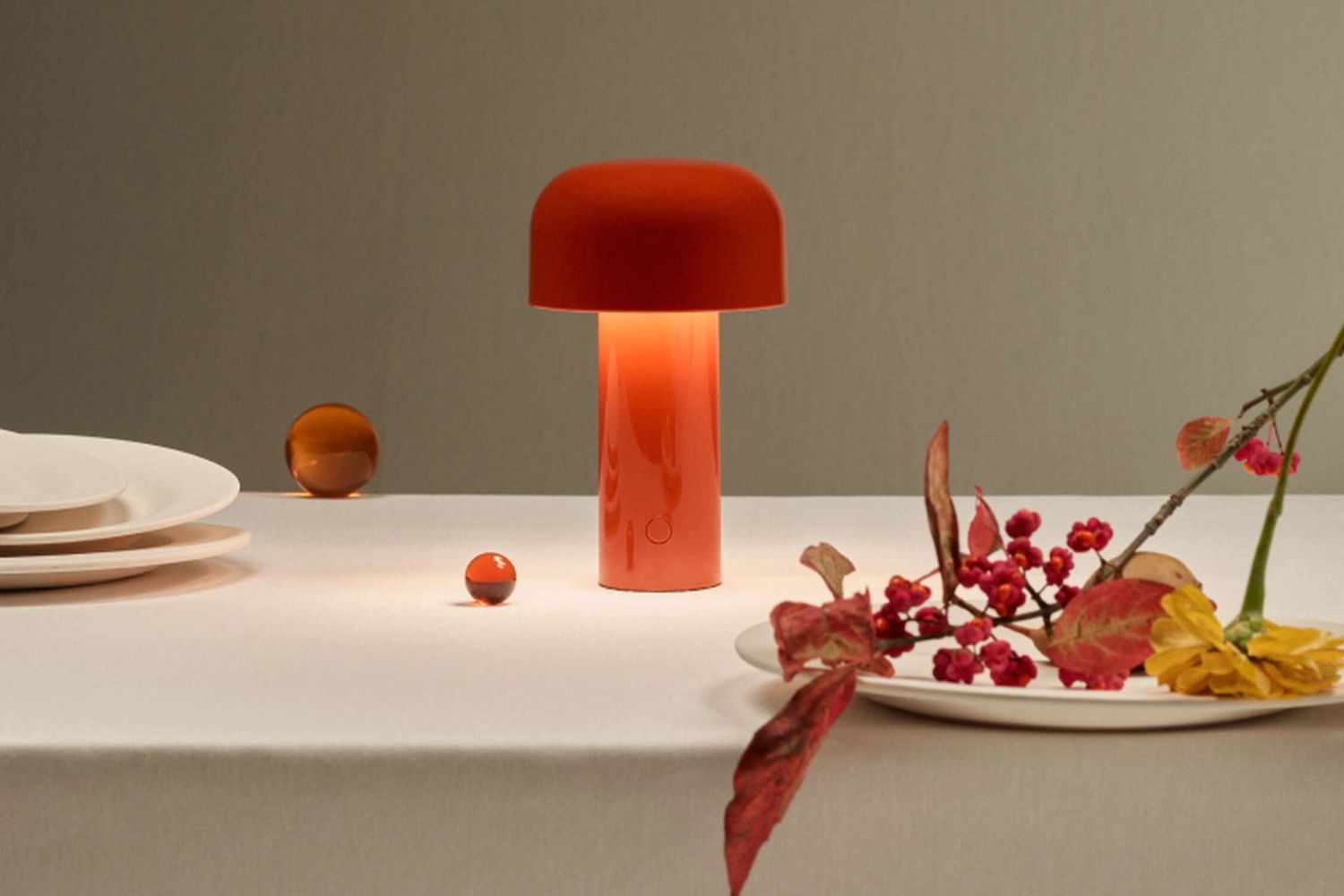
The Panthella Portable by Louis Poulsen is a smaller take on Verner Panton’s famous lamp, with its dome shade resting on a flared stem: it runs on a battery, charges via USB and has been on sale since 2020. Placed on the festive table it creates a soft island of light, and it is a clever way to give a piece of design history at domestic scale. To go further, our survey of iconic lamps tells the story of the masterpieces behind these versions.
Truly smart lighting, managed through scenes and app settings, is a design project rather than a gift: manufacturers such as Artemide develop control systems for their own fittings, but it is best considered when planning the lighting scheme, as we explain in our guide on how to furnish a home.
Clocks and small appliances: where does design make the difference?
The difference shows in the objects we use every day, such as the alarm clock on the bedside table or the kettle in the kitchen. The Braun BC02 travel alarm clock descends from the AB 1 designed by Dietrich Lubs in the late 1980s: a legible dial, luminous tipped hands, the yellow second hand that has become a signature of the brand, a quiet quartz movement and a crescendo alarm. It measures just a few centimetres and makes a perfect gift for anyone who travels.
In the kitchen, Alessi’s Plissé electric kettle, designed by Michele De Lucchi, turns an anonymous appliance into a sculptural object: the pleats of its body are inspired by the pleated fabrics of haute couture. The temperature control version heats water below boiling point, useful for tea and infusions, and has a digital display. For more tableware and kitchen objects, see our guide to the best design homeware brands.
How do you choose a design tech gift that will not date?
Choose objects with standard charging, a replaceable battery and materials that age well. USB-C charging does away with dedicated chargers that inevitably go missing, a replaceable battery, like the one in the Bellhop Unplugged, extends the life of the object beyond that of its cells, and aluminium, metal and wood weather the years far better than glossy plastic.
A second clue is the product’s history. When a company reissues a fifty year old piece and updates its insides, as with the radio.cubo, it proves that the design has outlived several technological generations, and it is a safe bet that it will outlive the next one too. Our advice is to give fewer objects, but to choose them by this standard.
Frequently asked questions about design tech gifts
What is the most iconic design radio to give?
Brionvega’s radio.cubo, created in 1964 by Marco Zanuso and Richard Sapper and held by MoMA. The radio.cubo 50° reissue adds DAB+, Bluetooth and a battery.
Which design portable lamp is rechargeable?
Flos’ Bellhop Unplugged by Barber and Osgerby charges via USB-C and has a replaceable battery and a dimmer. Louis Poulsen’s Panthella Portable also charges via USB.
Who designed the Beosound A1 speaker?
The Danish designer Cecilie Manz, who conceived it as an aluminium pebble to hold in the hand and carry in a bag.
What makes a tech gift a design object?
A form that remains valid when the technology changes, quality materials and components that can be updated or recharged. Reissues of historic pieces are the proof.
Which design tech gift suits someone who travels?
The Braun BC02 travel alarm clock, derived from the model designed by Dietrich Lubs, or a compact speaker such as the Beosound A1.