Completed in 2026, PRA’s Chun’an Distillery on Qiandao Lake brings whisky production and visitor experience together under four roofs, turning 3,000 cubic meters of excavated soil into rammed earth walls.
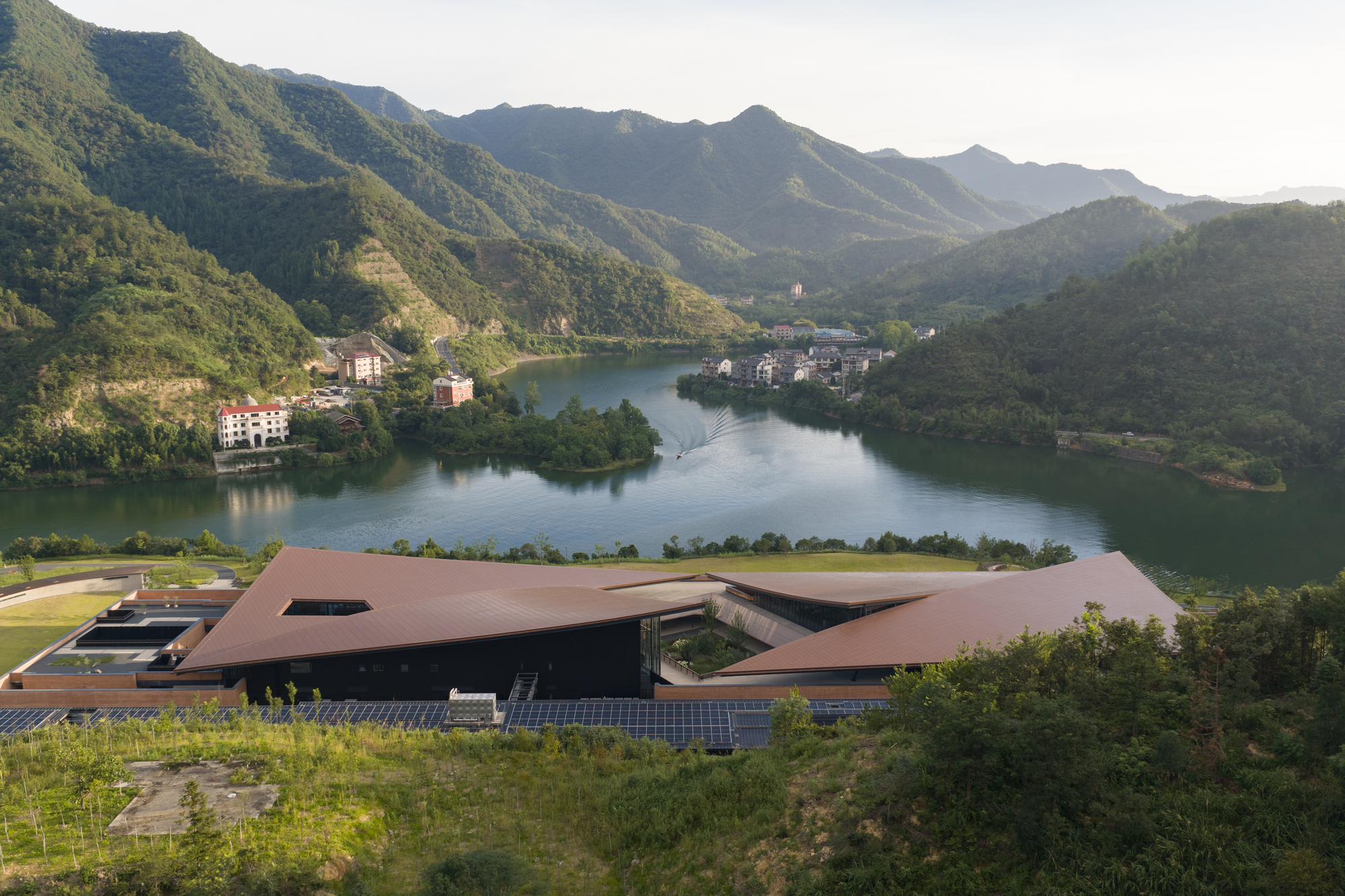
Completed in 2026 on a peninsula of Qiandao Lake in China’s Zhejiang province, the Chun’an Distillery makes no attempt to hide its industrial nature. Instead, it lays production out along a sequence of courtyards, passages and process volumes that makes the slow time of whisky legible without turning the factory into a stage set. Designed by PRA – Project for Research and Architecture, published by ArchDaily on November 6 and also presented by the studio itself, the 23,433-square-meter complex is the first production site with a visitor experience that Angus Dundee Distillers has built outside Scotland.
The timeline is worth clarifying: the commission dates back to early 2022, the building is listed as completed in 2026, and the recent news concerns the release of the final project documentation. That close reading is precisely what makes the project timely. After years in which wineries, coffee roasters and manufacturers have become destinations, Chun’an shows that the relationship between production and the public is not solved by putting a glass wall in front of the production line. It calls for architecture that can separate flows, safety and technical systems, while also creating pauses and a clear sense of orientation.
A Distillery You Understand by Walking Through It
Four pitched roofs clad in a copper tone rise and fall as a single figure. Beneath them, production areas and visitor spaces are not split into two separate worlds: they are linked by outdoor corridors that narrow, open onto courtyards and then tighten again. PRA says it drew on the spatial logic of Hui architecture, the traditional building style of southern Anhui — pale walls, dark roofs, winding passages and voids that matter as much as solid masses — while avoiding any literal reproduction of its vocabulary.
The most interesting result is not the image of the roofs, recognizable as it is, but the way the route sets a rhythm. Whisky maturation becomes a narrative device here: waiting, intervals and transformation are translated into distances, thresholds and glimpses of the lake. This is the studio’s interpretation rather than a technical requirement of the process, and it works because it does not erase the complexity of the plant. Process design was entrusted to Forsyths Ltd, while PRA handled architecture, landscape, interiors, branding and wayfinding.
For anyone designing production sites open to the public, the takeaway is practical. The experience does not begin in the tasting room; it begins with how visitors understand where they are, how close they can get to the work, and when the landscape takes over again. The theme is already evident in the Italian wineries where wine and design combine to create a destination; at Chun’an it takes on the scale of a true industrial complex.
Rammed Earth Walls: 3,000 Cubic Meters of Soil Stay on Site
The most significant material fact about the Chun’an Distillery is the reuse of 3,000 cubic meters of soil from the excavations, compacted to form its rammed earth walls. The figure comes from the architects and is repeated in the published documentation; in the sources consulted, it is not accompanied by a life-cycle assessment. It would therefore be wrong to read it automatically as a “low-impact” certification. It does, however, point to a measurable design decision: a substantial share of the excavated material is treated not as waste to be hauled away but as a resource to be refined on site.
Rammed earth consulting was provided by On earth studio. The layers remain visible, giving the surfaces a depth that shifts with the light. Alongside the earth come stone, steel, concrete and copper-colored metal roofing: not a single-material manifesto, then, but a hybrid system in which each material answers to different performance needs and scales.
For builders and manufacturers, this choice carries a lesson that is less photogenic but more useful. Reusing excavated soil requires characterization, testing, moisture control, mix design, formwork, waterproofing and skilled crews. The value lies not simply in having earth available, but in the ability to turn a local variable into a reliable building component. It is the same step that separates a circular-economy story from an actual specification.
When a Factory Becomes a Destination
Chun’an sits in a fragile landscape: Qiandao Lake is a large protected freshwater reservoir, and the building aligns with the ridge that slopes down toward the shore. The broad roofs seek continuity with the terrain, while courtyards, gardens and reflecting pools draw visitors into a slower sequence than the usual walk through a factory. An independent review published by ONUP highlights precisely these in-between spaces as the project’s strongest idea.
There is a tension here that should not be glossed over. Opening a production plant to visitors also means turning production into brand communication. The architecture is convincing when that narrative grows out of real operations — flows, materials, the relationship with the topography — rather than from a veneer applied after the fact. In this sense, the Chun’an Distillery offers a useful case study for architects and companies alike: it builds identity into the structure of the experience, yet lets the factory go on declaring itself a factory.
That is where its relevance lies. At a time when many companies expect buildings to produce goods, reputation and hospitality all at once, PRA shows that these functions can coexist without being confused. Excavated earth becomes walls, the roof orients the complex, and the route makes the work visible. On its own, this is not enough to prove the sustainability of the whole project; it is enough, however, to shift the conversation from iconic form to the quality of the decisions behind it.
Sources
- PRA – Chun’an Distillery and studio profile, primary sources on the project.
- ArchDaily, “Chun’an Distillery / PRA”, published November 6, 2026: data, credits and the architects’ description.
- ONUP, “Chun’an Distillery by PRA at Qiandao Lake”, independent editorial review.