From November 14, 2026, the third Sharjah Architecture Triennial brings 35 participants to a former school, a vegetable market, a buried village and other sites across the emirate. The newly announced program shifts attention from the standalone building to the relationships, rituals and everyday structures that make collective life possible.
What is left of architecture if, for a moment, you take the building out of the picture? The Sharjah Architecture Triennial 2026, the event’s third edition, starts from that question and answers it with a geography of schools, markets, landscapes, films, performances and temporary structures. Titled Architecture Otherwise: Building Civic Infrastructure for Collective Futures, the Triennial opens on November 14, 2026 in Sharjah, United Arab Emirates, and runs until April 14, 2027. The opening program, announced on November 5, takes place from November 14 to 19 and brings together 35 participants.
The timeline matters. The participants and the overall theme have been public since July; what is new is the detailed opening week, with talks, tours, screenings and live performances, followed on November 18 and 19 by an international conference. Curated by writer and anthropologist Vyjayanthi Rao with associate curator Tau Tavengwa, the Triennial reads civic infrastructure not only as transport networks, facilities or public works, but as the set of practices, knowledge and exchanges that allow a community to function.
A Triennial spread across the places the city already uses
The program does not sit inside a single venue. It unfolds across Al Qasimiyah School, the Al Jubail Vegetable Market, the Al Madam Buried Village, the Sharjah Museum of Islamic Civilization and other locations in the emirate, while the closing conference will be held at Africa Hall. This is more than urban stagecraft. Each venue brings its own existing use, memory and community into the project, forcing the installations to engage with different rhythms and audiences.
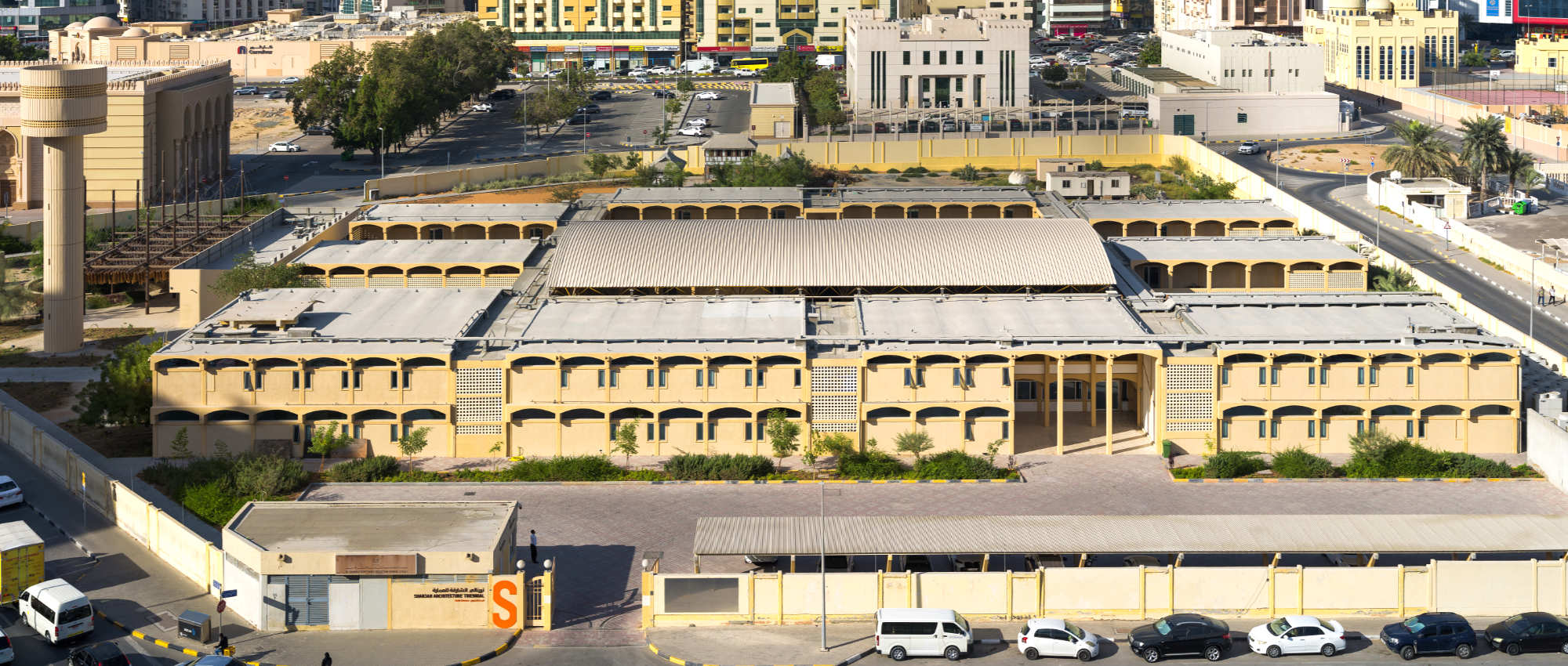
Al Qasimiyah School is the clearest example. Built in 1981 to a prototype by Khatib & Alami that was repeated across many school complexes in the Emirates, it is organized around interconnected courtyards, covered walkways and modular classrooms. Cross-ventilation, north light and open loggias responded to the climate long before these ideas became the mandatory vocabulary of sustainability. Decommissioned by the Ministry of Education, the building has been the Triennial’s home since 2018, with galleries, a library, a conference hall and offices.
Here, adaptive reuse does not erase the building’s earlier civic identity; it extends it. A school designed to organize learning, shade and encounter has become a cultural institution that keeps doing the same with different tools. For anyone working on existing buildings, the lesson is practical: whether an old and a new use are compatible does not depend only on available floor area. What counts is the original structure’s capacity to support wayfinding, places to pause, accessibility, ventilation and different forms of public presence.
Infrastructure can be a gesture, a sound, a shared rule
Many of the announced projects deliberately avoid monumental scale. Tumblespace (or What Binds Us?) by Aslıhan Demirtaş, Ali Cindoruk and Dilşad Aladağ is a nomadic structure designed to generate temporary encounters; rather than fixing a function once and for all, it follows people and their movements. Lalla Alwyia, Khalwa, by Ziad Jamaleddine and Makram el Kadi with Iheb Guermazi and Beya Othmani, reinterprets the khalwa, a secluded space associated with Sufi contemplation, and during the opening week it will be in dialogue with Omar Rajeh’s choreography Origami Bodies.
The film program also treats infrastructure as a social question. The Tower: A Concrete Utopia by Filip De Boeck and Sammy Baloji looks at self-organized ways of building space in Kinshasa; Housing Agency: Incremental Mumbai by Cassim Shepard examines the incremental building practices that emerged in India’s informal settlements. The cases differ, but they share a thesis: cities are not produced solely by plans and professionals. They are constantly reshaped by everyday adaptations, economies, rituals, maintenance and negotiation.
For architects and public administrations, this reading widens the brief. Before designing a new civic facility, you need to understand which networks already sustain a place, who maintains them and who is left out. It is an approach close to the idea that architecture is not a neutral container but a generator of relationships: form matters, but it matters together with the conditions of use it makes possible.
What the Sharjah Architecture Triennial means for design practice
The Triennial does not offer a manual, and on its own it does not prove that an installation or a week of events can produce lasting civic effects. That limitation is worth keeping in mind. The real test will come after the opening: whether the spaces remain accessible, whether the communities involved have a genuine role, and whether the research finds its way into design, management and public decision-making.
Still, the program brings three professional questions into focus. The first concerns the site: a market or a school is not an empty backdrop but an infrastructure with its own rules, flows and memories that must be understood. The second concerns time: a temporary structure can be civic if it sparks relationships that can be replicated, while a permanent building can fail if it lacks the resources to operate. The third concerns authorship: working with local knowledge means acknowledging who produces that knowledge and how they are involved, not simply borrowing its image.
This is where Architecture Otherwise feels timely. At a moment when the word “infrastructure” is mostly associated with scale and spending, Sharjah brings it back to the capacity to sustain collective life. A shaded walkway, a kitchen, a radio station, a form of hospitality or a shared rule may be small elements, but they are what turn space into an institution. For designers, the question is not only what to build. It is which relationship to make possible, for whom and for how long.
Sources
- Sharjah Architecture Triennial, opening week program and press release archive, primary sources for dates, curatorship and the program announced on November 5, 2026.
- Sharjah Architecture Triennial, Al Qasimiyah School and UAE Ministry of Culture, institutional sources for the building’s history, reuse and climate-responsive features.
- ArchDaily, “Sharjah Architecture Triennial 2026 Announces Opening Programme”, published November 5, 2026, independent confirmation of the program and projects.
- ArtReview, announcement of dates and participants, published July 1, 2026, independent context on the curatorial approach.