Modern cement tiles work in contemporary interiors when they are treated as a genuine design surface rather than a shortcut to creating a vintage atmosphere. The result depends on material, pattern scale, colour palette, the amount of surface covered and the relationship with the other elements in the room. The first distinction is technical: an …
Modern cement tiles work in contemporary interiors when they are treated as a genuine design surface rather than a shortcut to creating a vintage atmosphere. The result depends on material, pattern scale, colour palette, the amount of surface covered and the relationship with the other elements in the room. The first distinction is technical: an authentic cement tile is a pigmented cement-based tile, hydraulically pressed and not fired; cement-look porcelain stoneware is instead a ceramic product that interprets its graphics, colours and irregularities. The two can appear similar, but porosity, maintenance and performance are different. Understanding this distinction makes it easier to choose the right material and use it without automatically turning the interior into a retro reference.
What are authentic cement tiles?
Traditional cement tiles, often referred to as hydraulic tiles, are cement-based elements produced without high-temperature firing.
The artisanal process documented by specialist manufacturers such as Cimenterie de la Tour involves a decorative layer made from white cement, marble powder and pigments, arranged inside a divider mould that separates the different colours of the pattern. Cementitious layers forming the body of the tile are then added, before the piece is compacted using a hydraulic press and left to cure.
The colour, therefore, is not simply printed onto the surface. It forms part of the upper layer of the tile.
Hand production also results in tonal differences and small variations from one piece to another. These characteristics are consistent with the manufacturing process and contribute to the visual depth of the finished surface.
It is precisely this slightly irregular material quality that distinguishes an authentic cement tile from the perfect repetition expected from a fully standardised industrial product.
Authentic cement tiles or cement-look porcelain tiles: they are not the same
Today, the term “cement tiles” is often also used for porcelain stoneware or ceramic tiles decorated with patterns inspired by traditional cement tiles.
Marazzi, for example, offers several collections explicitly described as cement-tile-effect porcelain stoneware: D_Segni and D_Segni Blend reinterpret the patterns, shading and irregularities of handmade production through an industrial ceramic product. Ragno also clearly distinguishes its porcelain and ceramic collections inspired by traditional cement tiles.
The difference is substantial.
| Authentic cement tile | Cement-look porcelain tile | |
|---|---|---|
| Material | Cement, marble powder, pigments and aggregates | Porcelain stoneware or ceramic |
| Production | Hydraulic pressing, without firing | Industrial ceramic process |
| Surface | Natural, porous, with artisanal variations | Decoration that interprets the appearance of cement tiles |
| Treatment | Requires suitable protection against absorption and staining | Performs according to the technical characteristics of the specific ceramic surface |
| Appearance | Genuine variation between individual pieces | Patterns and variations designed industrially |
Porcelain stoneware can therefore be the more coherent choice when the aim is to achieve the graphic appearance of cement tiles with the performance characteristics of porcelain. Authentic cement tiles, by contrast, are particularly interesting when materiality, variation and the artisanal process are integral to the design.
Presenting porcelain stoneware as though it were simply a more “technological” version of a cement tile risks confusing two different products.
Why cement tiles can feel contemporary without looking nostalgic
The contemporary use of cement tiles is not limited to historically accurate restoration projects in period apartments.
In July 2026, ArchDaily gathered fifteen Brazilian interiors using cement tiles not only in bathrooms and kitchens, but also in living areas, bedrooms and circulation spaces, showing how many different roles the material can play in contemporary design.
The key is to separate cement tiles from the automatic combination of design codes that makes them appear vintage.
A geometric floor does not necessarily need to be paired with retro furniture, antiqued brass, cream walls and period accessories. It can work just as effectively with monolithic kitchens, natural timber, steel, clean-lined furniture and almost undecorated walls.
The pattern remains visible, but its context completely changes the way it is perceived.
Patterns and colours: how to avoid the “recreated period home” effect
Historic cement tiles are often associated with highly elaborate compositions, borders and repeated floral or geometric motifs. A contemporary approach can begin with the same decorative principle while reducing its complexity.
An effective strategy is to use cleaner geometric patterns and restricted colour palettes: two or three colours, tonal variations, abstract designs or compositions in which the motif becomes visible only when several tiles are viewed together.
Contemporary industrial collections clearly reflect this evolution. Alongside more decorative motifs, Marazzi offers combinations in grey, green, earth, charcoal and bone tones, together with graphic patterns designed to create more abstract surfaces.
Even with handmade cement tiles, however, the design can remain extremely restrained. The material does not require a historically styled pattern.
The useful question is: should the cement tiles become the focal point, or simply create a background rhythm?
The intensity of the pattern should follow from that decision.
Full cement-tile flooring or a patterned tile rug?
Covering an entire room and creating a limited decorative area produce very different results.
A continuous floor works when the pattern has a sufficiently controlled scale to perform across a large surface. In open-plan interiors, it can become a continuous field connecting the kitchen, dining area and living room.
A so-called cement-tile rug, by contrast, concentrates the pattern within a defined area. Historically, hydraulic tiles were also used in central fields and borders that echoed the structure of a rug; in contemporary projects, the same principle can be simplified by removing ornamental edging and working with a clear change of material or pattern.
A decorated area beneath a dining table, in front of a kitchen or within an entrance can therefore define a function without creating a physical division.
The result becomes more architectural and less decorative when the patterned area corresponds to the actual organisation of the space.
Modern cement tiles in the kitchen: one precise gesture works better than too many references
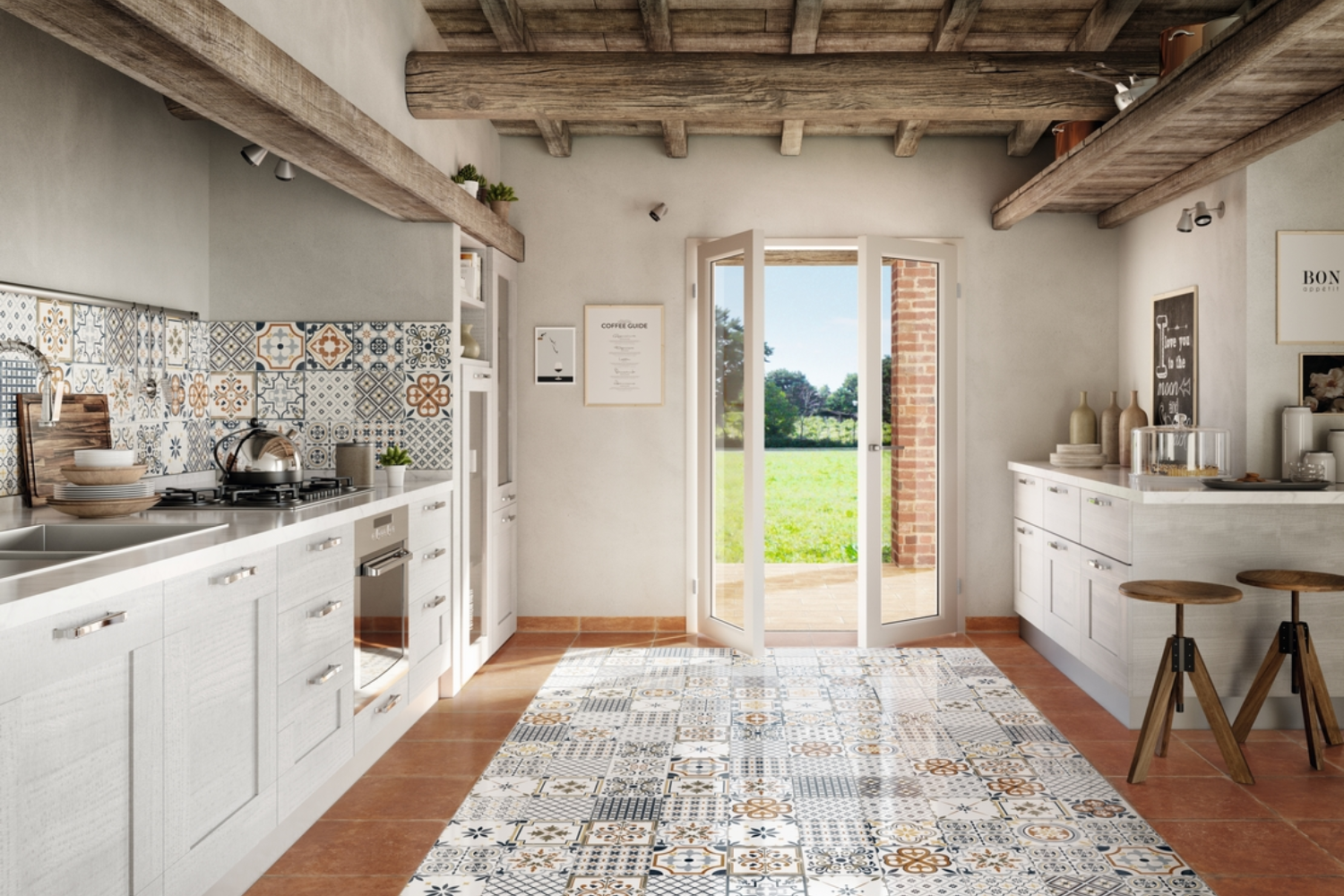
The kitchen is one of the spaces where cement tiles are used most frequently, both on floors and as wall coverings.
To avoid an overly retro appearance, it is generally better to allow just one element to carry the decoration.
If the floor is strongly graphic, smooth cabinet fronts in timber, lacquer or solid colours can keep the composition balanced. If the kitchen already has a strong chromatic identity, the wall covering can use a more restrained pattern.
A project published by Architectural Digest, for example, shows how a cement-tile floor can coexist with contemporary volumes and colour blocking without turning the entire interior into a quotation from the past.
Contrast with stainless steel, natural stone or monochromatic surfaces can also move cement tiles away from a more traditional interpretation.
Cement tiles in the bathroom: separating decoration from performance
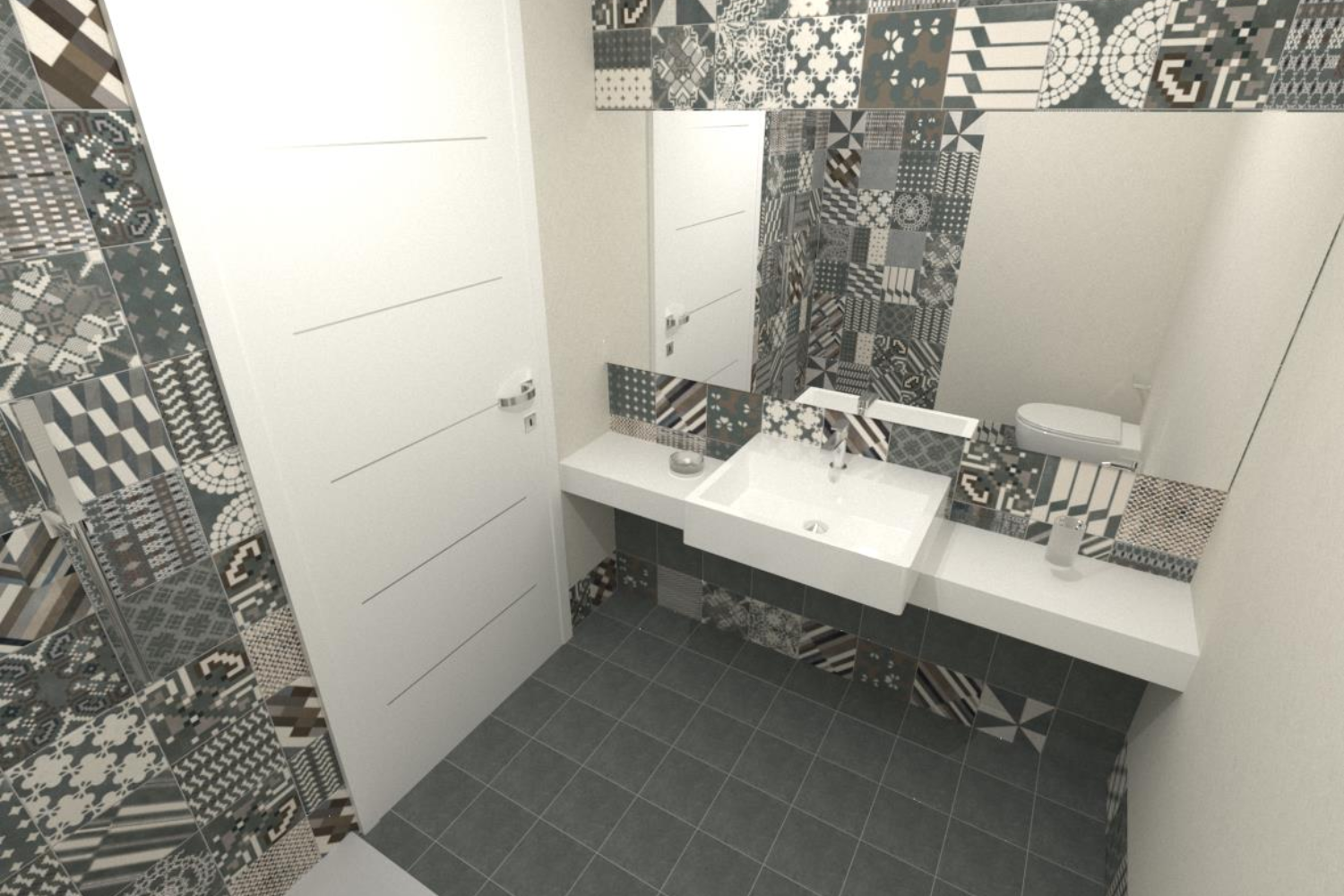
In bathrooms, cement tiles can work on floors, walls or as a limited decorative field.
With authentic cement tiles, however, aesthetics must be accompanied by a technical assessment. Cement tiles are porous and require suitable protective treatment; Demosaica explicitly states that its cement tiles need sealing and recommends neutral cleaners while advising against acidic products, bleach and ammonia.
This does not mean that every cement tile and every treatment is automatically suitable for any wet area. Showers, surfaces exposed to continuous water and other demanding conditions need to be evaluated according to the specific tile, the system recommended by the manufacturer and the installation design.
Cement-look porcelain stoneware, by contrast, follows the technical characteristics of the chosen ceramic collection. Marazzi, for example, offers porcelain products suitable for both floors and walls and emphasises the material’s low porosity.
Entrances and circulation areas: pattern can organise the space
The entrance offers another interesting opportunity because cement tiles can be used as a visual threshold.
A patterned floor can identify the entrance area before giving way to timber flooring, stone or a continuous surface throughout the rest of the home. The change of material becomes a tool for organising the interior without building walls.
The same principle can work in a corridor or between the kitchen and living area.
To maintain a contemporary language, the junction with the adjacent material should be considered as part of the overall composition rather than reinforced with additional frames, borders and decorative motifs.
What to pair with modern cement tiles
The most effective combinations are often those that introduce a material with a very different visual presence.
With oak, ash or walnut, the graphic quality of the tiles meets the natural variation of timber. Stainless steel produces a sharper, more technical contrast. Mineral plasters and textured walls, by contrast, reduce the number of graphic elements within the room.
Solid colours can also work particularly well.
Green-and-cream cement tiles can be paired with a deep green kitchen; a black-and-ivory pattern can continue into anthracite cabinetry; terracotta and pink can be balanced by dark woods or burgundy tones.
The principle remains the same: do not repeat every colour in the cement tile across every element of the furniture. The pattern should contribute to the palette rather than turning it into an exercise in colour matching.
How to clean and maintain authentic cement tiles
Maintenance is one of the areas where the difference from porcelain stoneware becomes most apparent.
Authentic cement tiles should be protected according to the manufacturer’s specific instructions. Cimenterie de la Tour and Demosaica document treatments designed to reduce absorption and protect the surface; both also recommend pH-neutral cleaners and avoiding acidic or aggressive products.
A sealer does not, however, turn a cement tile into a completely waterproof or stain-proof material. It works as a protective treatment for the surface and should be understood as part of the system specified for that particular product.
The frequency of any subsequent treatments should not be generalised either: it depends on the product used, the intensity of use and the manufacturer’s instructions.
Mistakes that make modern cement tiles look retro
The first is choosing a highly complex historic pattern and then designing the entire room around the same period reference.
The second is using too many patterns at the same time: a decorated floor, wallpaper, geometric textiles and graphic wall coverings eventually compete with one another.
The third is confusing authentic cement tiles with cement-look porcelain stoneware. They are different materials and should be chosen according to the requirements of the project rather than treated as interchangeable simply because they share a similar visual language.
The fourth is assuming that “handmade” means perfectly uniform. In authentic cement tiles, variations and small differences are part of the material itself.
The fifth is choosing the pattern before deciding how much surface it will actually cover. A design that works beautifully across a few square metres can become dominant when repeated throughout an entire open-plan interior.
Modern cement tiles work best when the design controls their decorative impact. They can form a continuous floor, a graphic tile rug, a bathroom wall or an accent in the kitchen, but they do not need to turn the entire interior into a historical stage set. Their presence in contemporary projects in 2026 demonstrates precisely this: cement tiles can retain materiality, colour and craftsmanship without giving up a contemporary architectural language.