From her training in the visual arts to her experiences in fashion and theatre, through to a sculptural research that explores the body, transformation and memory. With Aphros_26, previewed at Arte in Nuvola 2026 in Rome, Roberta Morzetti returns to the myth of Aphrodite to explore the moment when form comes to life.
From her training in the visual arts to her experiences in fashion and theatre, through to a sculptural research that explores the body, transformation and memory. With Aphros_26, previewed at Arte in Nuvola 2026 in Rome, Roberta Morzetti returns to the myth of Aphrodite to explore the moment when form comes to life.
An artist’s path is often shaped by encounters, experiences and cross-pollinations that, over time, help define a personal vision. Roberta Morzetti’s path develops precisely through a dialogue between different languages: from the visual arts to fashion, from theatre to sculpture. Seemingly distant experiences, yet united by a constant interest in form, materials and the expressive possibilities of matter. It is within this interweaving that a personal artistic research takes shape. In it, the human body becomes the starting point for investigating identity, memory and transformation.
Roberta Morzetti’s training: visual arts, fashion and theatre
Born in Tarquinia in 1979, Morzetti graduated with honours in 2005 from the Accademia di Belle Arti Lorenzo da Viterbo. The early years of her professional activity were marked by particular attention to design and to experimentation with materials. In fashion, she devoted herself to creating clothing lines made from recycled materials. This developed her interest in recovery, transformation and the expressive potential of unconventional elements.
In Rome she entered the world of theatre, taking part in productions staged in major theatres of the capital. Fashion and theatre are different experiences. Yet both are linked to the construction of form, to visual perception and to the ability to turn an idea into a concrete presence. They are significant steps for understanding the sensibility that would characterise the artist’s later sculptural research.
It is in sculpture, however, that these experiences find a more personal synthesis. Here the body is not merely a figure to be represented, but becomes the starting point of an investigation involving matter, memory and processes of transformation.
The body as the origin of form
Since 2012, Roberta Morzetti has developed a way of working in which the cast of her own body plays a central role. From this physical matrix emerge works that are then elaborated through resins, assemblages, organic elements and interventions that also involve fire.
The process moves away from the traditional idea of sculpture as the construction of an ideal volume. Here the form is born from a real presence, undergoes successive transformations and changes through the artist’s direct intervention. The body thus becomes a kind of material origin of the work, a trace from which new configurations can develop.
The human figure is not rendered through a faithful imitation of anatomy. Instead, a series of interventions alter its surface, accentuate certain aspects and modify its perception.
Imperfections are not hidden. Discontinuities, cavities, irregularities and seemingly unfinished parts all contribute to the construction of the image. The material retains the memory of what it has been through and makes visible the process that led to the final form.
Fire plays an important role in Morzetti’s poetics. Combustion modifies the surfaces and acts on the structure of the work, introducing outcomes that are not always predictable. Fire becomes part of the creative process, a tool capable of altering what exists and of opening up new formal possibilities.
Sculpture thus develops through a balance between design and transformation, between control and the intervention of matter. The result does not necessarily seek a harmonious conclusion: it often retains the appearance of something still in the making.
Aphros_26: the myth of Aphrodite reinterpreted through matter
It is from this perspective that Aphros_26 should be seen, previewed from 20 to 22 November 2026 at Arte in Nuvola in Rome, in the space of Teldil Art Gallery.
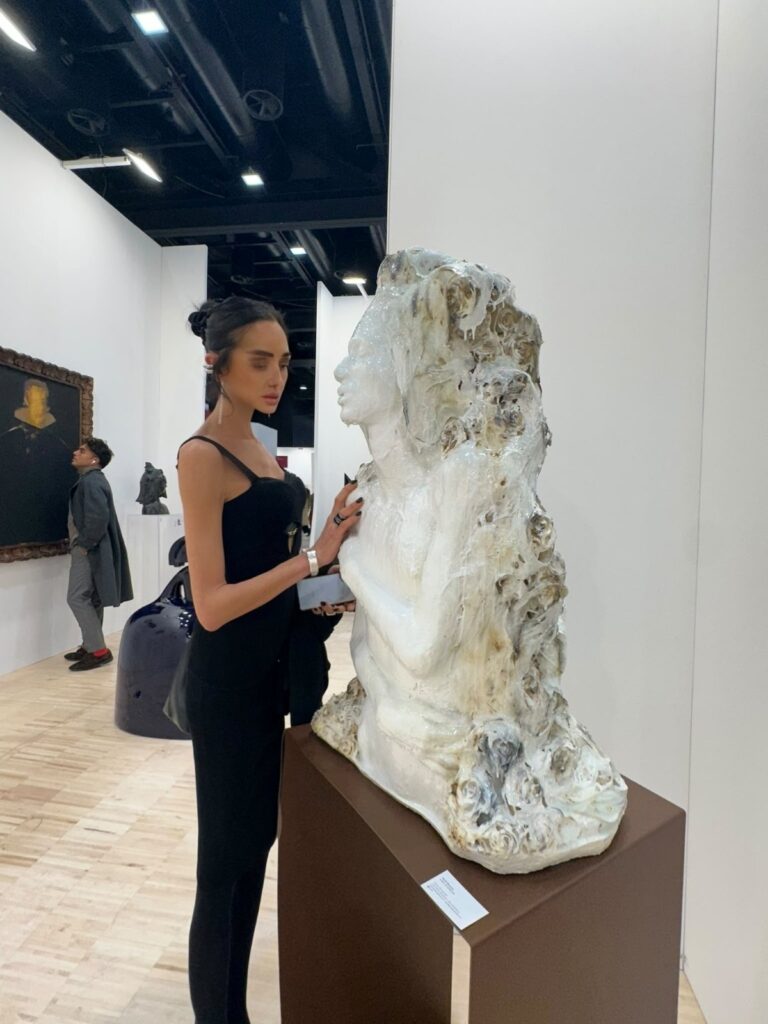
The work marks a significant moment in the artist’s path because it tackles one of the most recognisable subjects of the classical imagination: the birth of Aphrodite, the Greek goddess of love and beauty.
Morzetti refers to the account in Hesiod’s Theogony, in which the goddess emerges from the waters after Uranus is mutilated by Cronus. From the sea foam, indicated by the Greek word aphrós, arises a figure destined to become one of the greatest archetypes of female beauty in Western culture.
Morzetti engages with this symbolic heritage without simply reproposing its traditional iconography. Her interest seems to focus above all on the passage that precedes the full manifestation of the goddess: the moment when the figure separates from the original matter and begins to acquire an individuality of its own.
A figure still taking shape
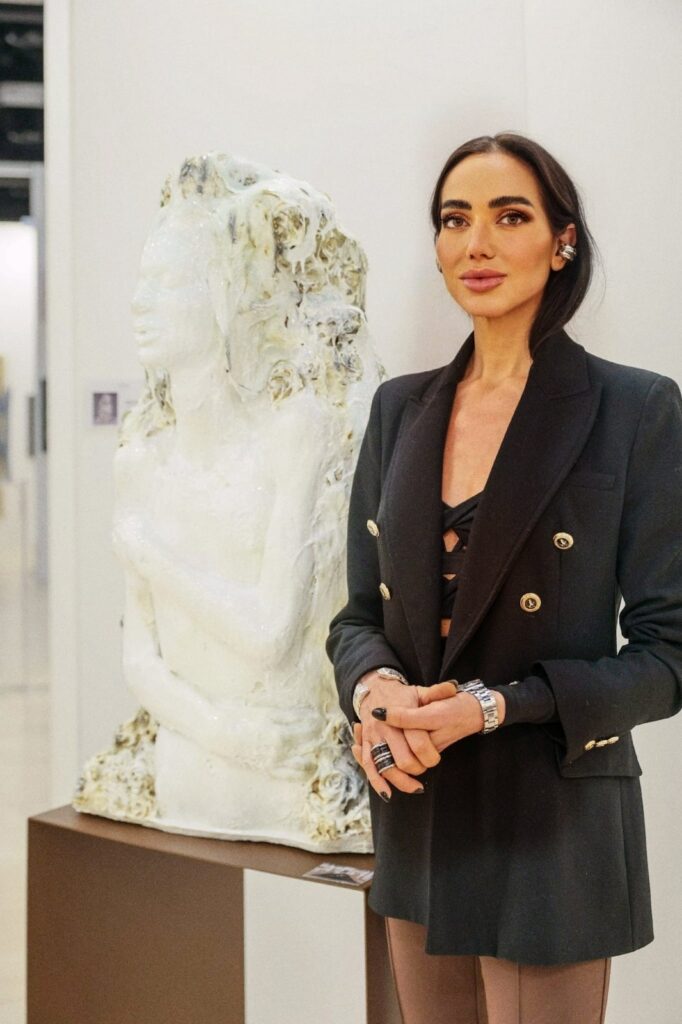
The sculpture presents a white female figure, developed from the head down to the groin. Deliberately partial, the composition suggests a body not yet fully defined, as if the birth were a process still under way.
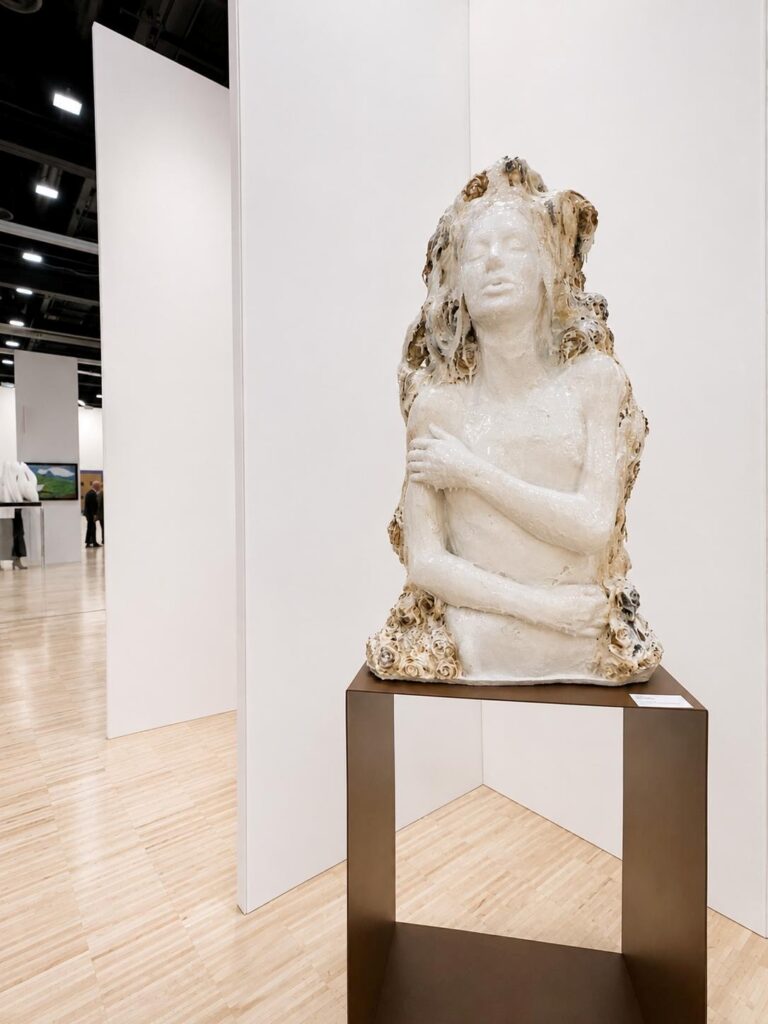
The arms crossed in front of the torso introduce a gathered movement that gives the figure an intimate dimension. This is not an openly celebratory pose, but a gesture that can be read as protection, introspection and a gradual awareness of one’s own presence.
The surface also contributes to this interpretation. Its light colour visually recalls the marble tradition, but the workmanship departs from the smoothness of classical sculpture. The material shows roughness, reliefs and cavities that interrupt the continuity of the surfaces. This makes the image closer to a process of formation than to a definitively finished figure.
The element of greatest visual expansion is the hair, which surrounds the face through a complex articulation of organic volumes. Its forms recall the movement of sea foam, evoking the primordial substance from which, according to the myth, Aphrodite originates.
Shells and white roses
Shells and white roses appear within the composition. The former refer to the goddess’s aquatic origin and to the generative dimension of the sea; the latter introduce references to love, youth and purity.
Choosing these elements goes beyond iconographic quotation and helps build a symbolic setting in which body, nature and myth intertwine, making birth an event that is at once physical and metaphorical.
In Aphros_26 beauty is not presented as something already achieved, but as a condition that develops through transformation. The figure is not yet a goddess in the monumental and idealised sense of the tradition: it is a presence in the process of taking shape.
It is precisely this shift in perspective that makes Morzetti’s reinterpretation so interesting. The focus is not on the finished image of beauty, but on its origin and on the process that allows an identity to emerge.
Myth as a tool to read the present
The use of mythology is a recurring component of Roberta Morzetti’s work. Ancient characters are not treated as mere subjects to be reproduced, but as figures through which to address questions that are still relevant today.
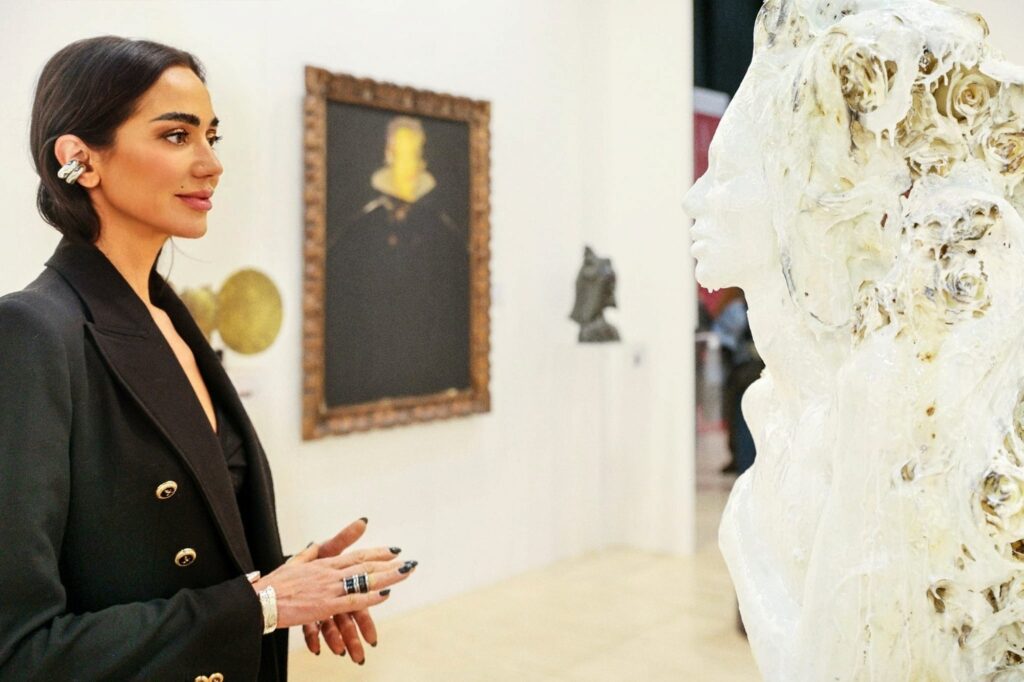
In Narciso_24, the myth of the young man in love with his own image becomes an opportunity to reflect on the dynamics of the gaze and on the relationship with others. Identity confronts the risk of remaining trapped in its own representation, to the point of losing the ability to recognise what exists outside itself.
With Feronia_24, the reference is to the Italic goddess associated with fertility and liberation. It opens up a reading linked to the possibility of rediscovering oneself after experiences of oppression. Here the theme of rebirth takes on a dimension that concerns both the individual and the collective sphere.
In Icaro_24, on the other hand, the story is that of the young man who falls after flying too close to the sun. Here it is reinterpreted through the fragility of human existence. The fall becomes an image through which to address the tragedy of childhood caught up in conflicts, wars and migrations.
These are different references, united by the desire to use the symbolic language of the past to address the issues of the present. Myth thus becomes an open narrative structure, capable of taking on new meanings through a contemporary sensibility.
The bond with Etruria
The bond with the territory adds a further element to this research. Morzetti lives and works in Tuscania, in the area of ancient Etruria. There, the female presence has left significant traces in figurative and funerary culture.
In Etruscan civilisation, women often enjoyed greater public visibility than in other contexts of the ancient Mediterranean. Their representation is a possible cultural reference for a research that frequently returns to question the role and representation of the feminine.
This is not a formal revival of Etruscan art, but rather an ideal closeness to a territory in which the past continues to offer tools for interpreting the present.
A research that goes beyond the boundaries of the feminine
Although the female body occupies a central position in Morzetti’s work, it would be reductive to trace all of her activity back to a reflection exclusively on gender.
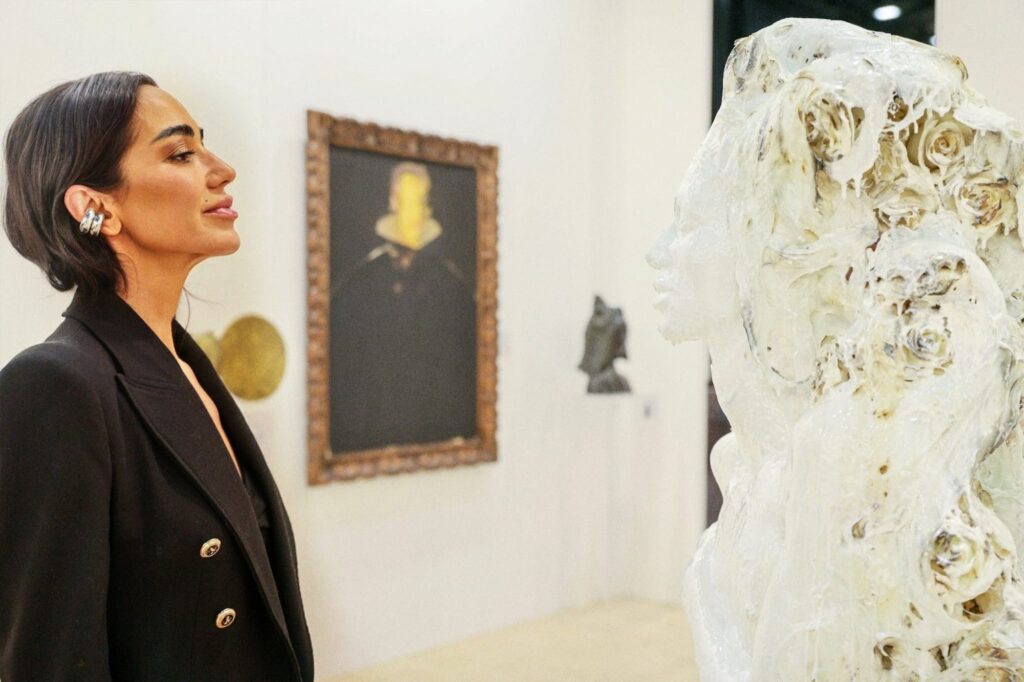
Her works address broader questions concerning the human condition: fragility, loss, memory, suffering and the possibility of transforming a difficult experience into a new form of awareness.
A significant example is PAX_22, an exhibition project presented in 2022 in the church of Sant’Agostino in Tuscania. On that occasion the artist’s research engaged with the theme of peace and the vulnerability of human beings. It developed a narrative in which fragility was interpreted not only as weakness, but also as a possibility of resistance.
This attention to the inner dimensions of existence runs through her work and is expressed in the choice of a sculptural language that does not try to hide the contradictions of the human figure.
Matter thus takes on a narrative value. Its physical consistency, its resistance and the transformations it undergoes make it possible to translate into visible forms concepts that belong to the immaterial sphere of experience.
Sculpture thus becomes a meeting place between what appears and what remains hidden, between the body and the memory that runs through it.
The exhibition path and an ever-evolving research
Over the course of her career Roberta Morzetti has taken part in numerous exhibitions. Among them, Arte in Nuvola in Rome is one of the recurring appointments. Her participation in the event since 2020 bears witness to her ongoing dialogue with the contemporary art scene and with the public.
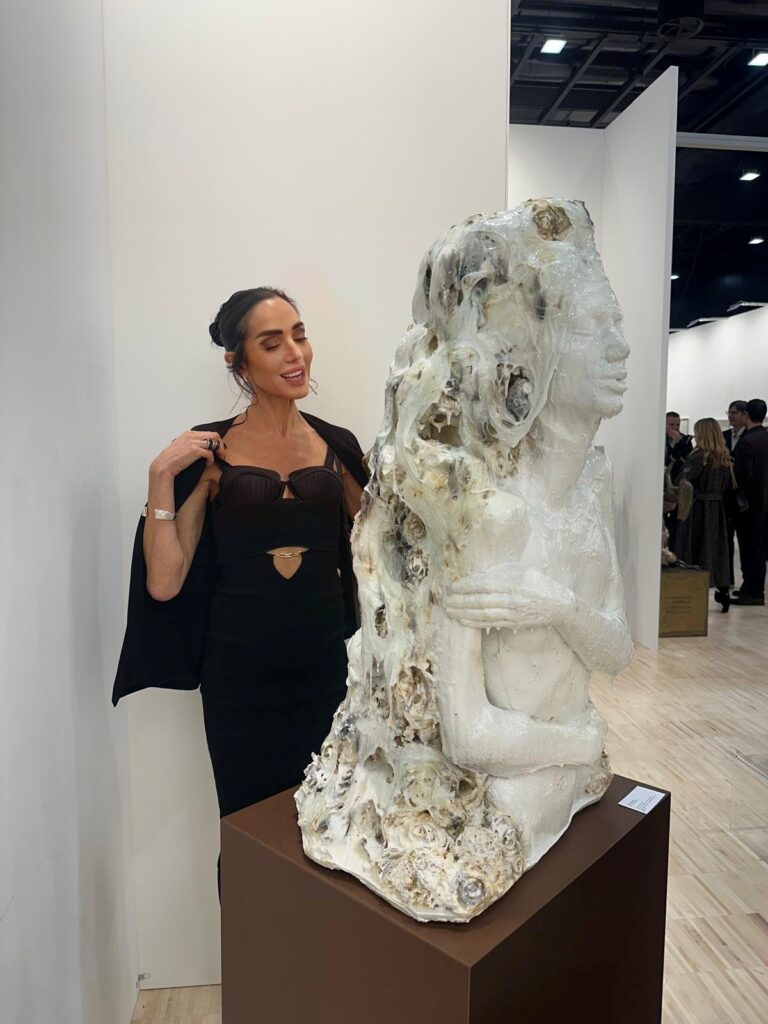
Within this path, the preview of Aphros_26 at the 2026 edition takes on a particular significance. The work brings together several elements of her research: the interest in the body as a creative matrix, the use of unconventional materials and surfaces, the dialogue with mythological heritage and the attention to the processes through which a form changes and acquires meaning.
Choosing Aphrodite also makes it possible to engage with a figure that, for centuries, has been used to define models of female beauty. Morzetti shifts the focus from the ideal representation to the original dimension, concentrating on a presence that has not yet reached its definitive configuration.
It is a perspective that invites us to look at the body not as an image to be judged, but as a reality in constant evolution.
With Aphros_26, Roberta Morzetti thus returns to an ancient myth to address a deeply current question: the way in which a presence takes shape and gains its own individuality.
The foam of Hesiod’s tale is not only the legendary origin of a goddess. In her interpretation it becomes a metaphor for matter as a generative principle, a space in which forms can still change, dissolve and recompose.
It is in this tension between what matter preserves and what it can still become that the most interesting core of Roberta Morzetti’s research can be found: a sculpture that does not merely give form to reality, but explores the possibilities of transformation that it holds.