Sculptural lighting refers to lighting fixtures that maintain a strong spatial presence even when switched off: they define an area, introduce a recognisable form and alter the relationship between light, furniture and architecture. Their selection, however, should not begin with silhouette alone. A dramatic pendant that causes glare, an oversized floor lamp or a luminous …
Sculptural lighting refers to lighting fixtures that maintain a strong spatial presence even when switched off: they define an area, introduce a recognisable form and alter the relationship between light, furniture and architecture. Their selection, however, should not begin with silhouette alone. A dramatic pendant that causes glare, an oversized floor lamp or a luminous object unable to perform the required function remains an incomplete decorative solution. The design should therefore consider light distribution, scale, position, material, sightlines and the physical presence of the fixture together. It is precisely this overlap between lighting performance and sculptural quality that distinguishes a well-integrated statement light from an object that is simply eye-catching.
What does it really mean to choose a sculptural light?
In interior design, a lamp can be described as sculptural when its form plays a clear role in the composition of the space.
This does not necessarily mean it has to be large, complex or expensive. It may be a pendant composed of multiple elements, a floor lamp with a highly recognisable structure or a small table lamp that creates presence through material and proportion.
Design history offers an almost literal precedent in the Akari Light Sculptures by Isamu Noguchi, designed from 1951 onwards. Vitra documents a family that grew to include more than one hundred table, floor and ceiling models, made from washi paper with bamboo and metal-wire structures. Noguchi himself chose the word Akari, which in Japanese evokes both light and lightness. Here, the idea of luminous sculpture does not come from formal exuberance, but from the relationship between volume, material and the diffusion of light.
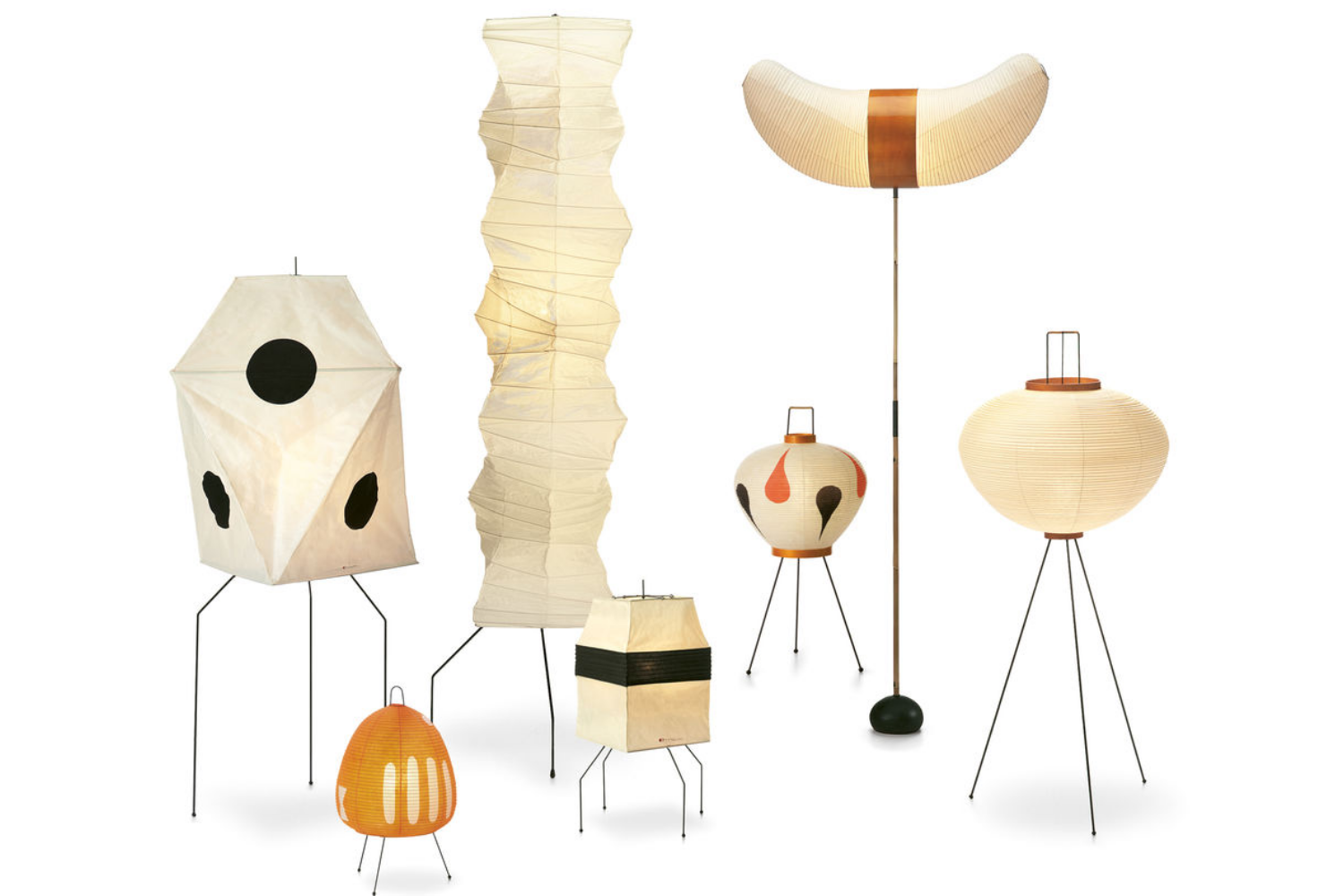
A sculptural lamp can therefore be monumental or almost immaterial. What matters is the role it takes on within the space.
Visual presence and lighting function need to work together
The first mistake is assuming that a statement light can be assessed separately from the quality of the light it produces.
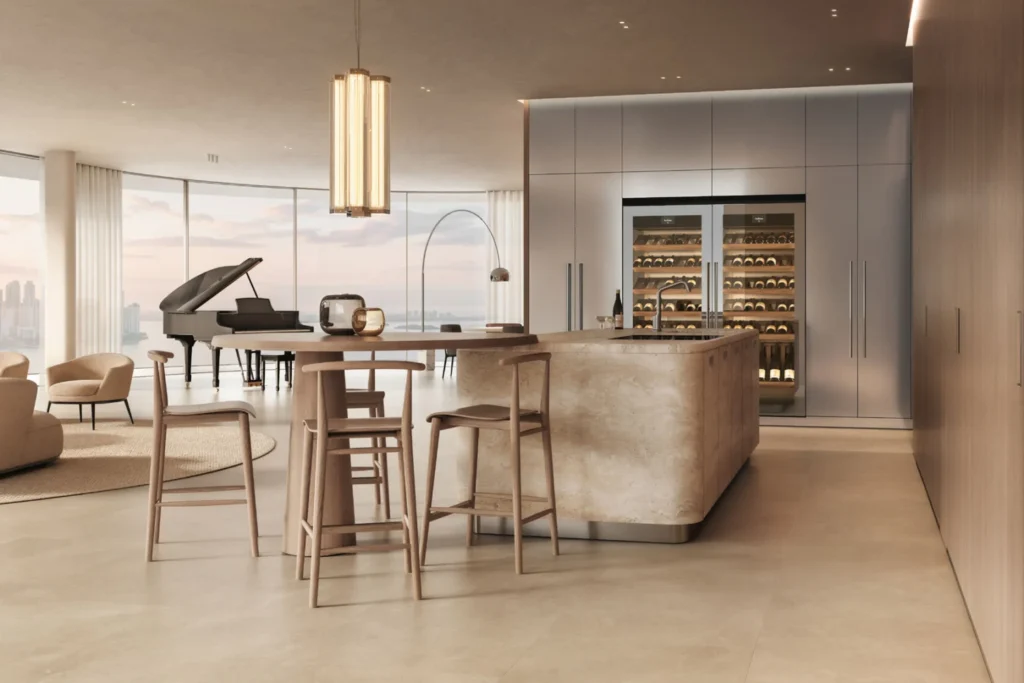
A living room usually needs several lighting functions: general orientation, light near seating, possible reading light, and illumination for artworks or surfaces. A single lamp, however large, should rarely be expected to perform all of them.
Contemporary professional practice also focuses on designing the lighting system rather than simply selecting objects. In a 2026 feature on lighting designers, Architectural Digest describes their work as involving daylight, controls, testing, architectural integration and atmosphere, extending far beyond the choice of fixtures.
A sculptural light can therefore become the focal point without becoming the only light source.
It is often more effective to combine it with discreet architectural lighting, reading lamps or accent lighting, allowing the main fixture to retain a strong presence without being overloaded with functions.
Scale should be judged against the room, not just the table
A very large lamp is not automatically out of proportion, just as a small pendant is not automatically more elegant.
Scale depends on at least four elements: room volume, ceiling height, furniture dimensions and the distance from which the fixture is viewed.
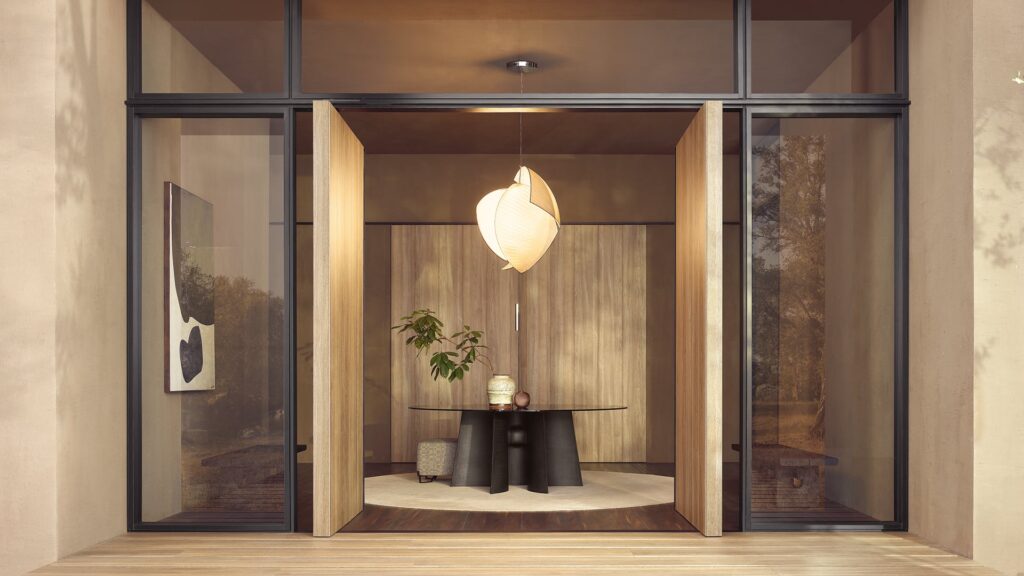
Above a dining table, a substantial pendant can hang lower because the furniture prevents people from walking directly underneath it. In an entrance or along a circulation route, the same solution needs to preserve clear sightlines and movement.
The Akari family demonstrates how widely a single design idea can vary in scale: Vitra documents models ranging from approximately 24 to 290 cm across table, floor and ceiling versions.
There is therefore no universal proportion. The useful exercise is to understand the fixture’s actual volume within the room, rather than looking only at the diameter listed on the product sheet.
In many cases, a cardboard mock-up, a suspended outline or a correctly scaled 3D model placed in the room reveals more than an atmospheric product photograph.
Pendant lights: when lighting becomes part of the ceiling architecture
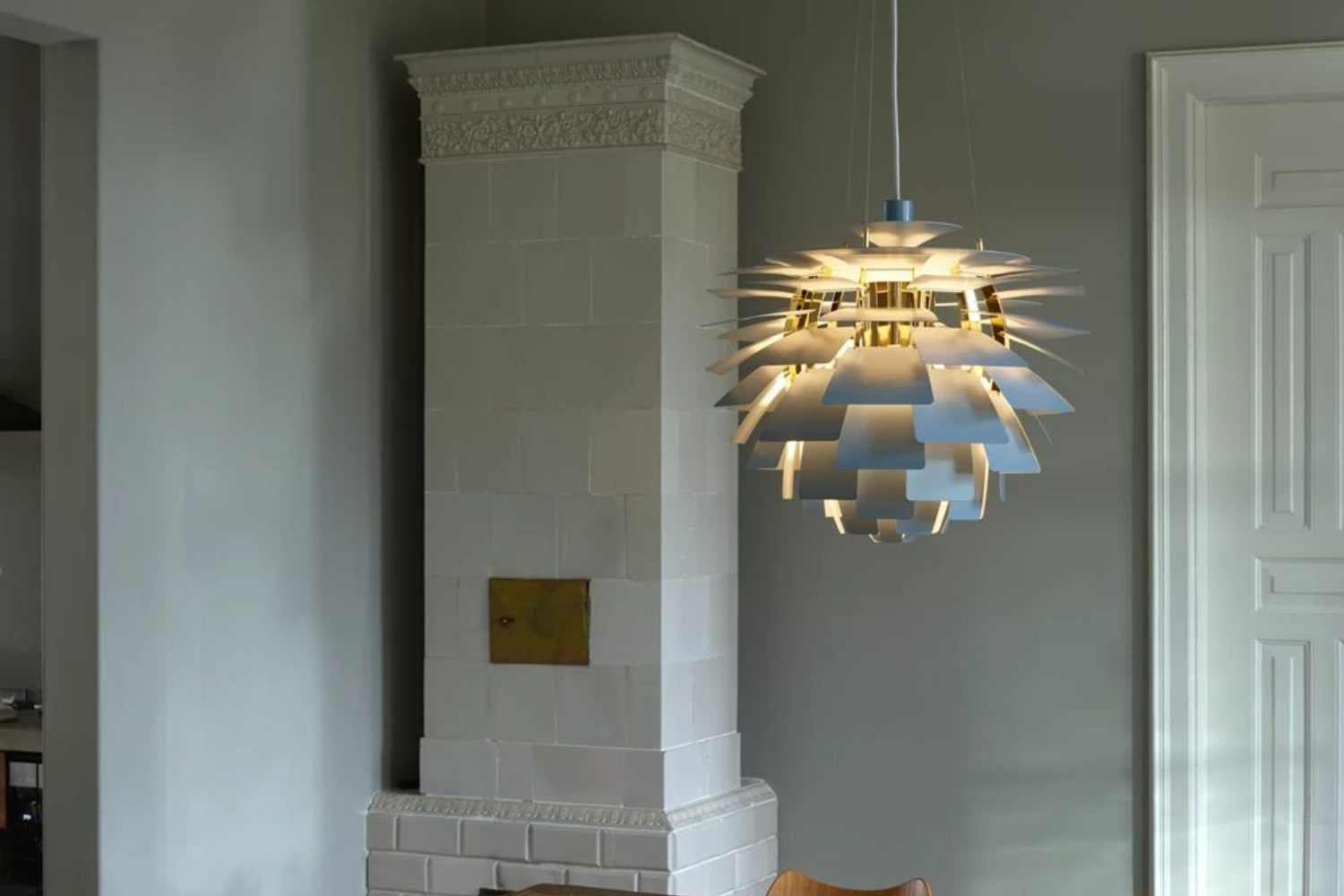
Pendant lighting is probably the category in which sculptural character becomes most immediately visible.
A pendant can occupy the geometric centre of a room, sit off-axis in relation to the floor plan, follow a table, mark a double-height void or create a vertical composition.
The PH Artichoke by Poul Henningsen, designed in 1958 for the Langelinie Pavilion in Copenhagen, remains a particularly useful example because form and light control coincide. Its 72 metal leaves are arranged in twelve rows, and Louis Poulsen describes the system as designed to shield the source and distribute light while avoiding glare from different viewing angles.
The sculptural complexity is therefore not added on top of a conventional diffuser: the geometry itself determines how the light behaves.
A different logic appears in Bocci’s 28 series. The glassblowing process creates glass spheres with internal cavities that capture and diffuse light; the family can be used as a single element or grouped into compositions, turning the number and position of pendants into part of the spatial design.
A floor lamp can reshape the room without touching the ceiling
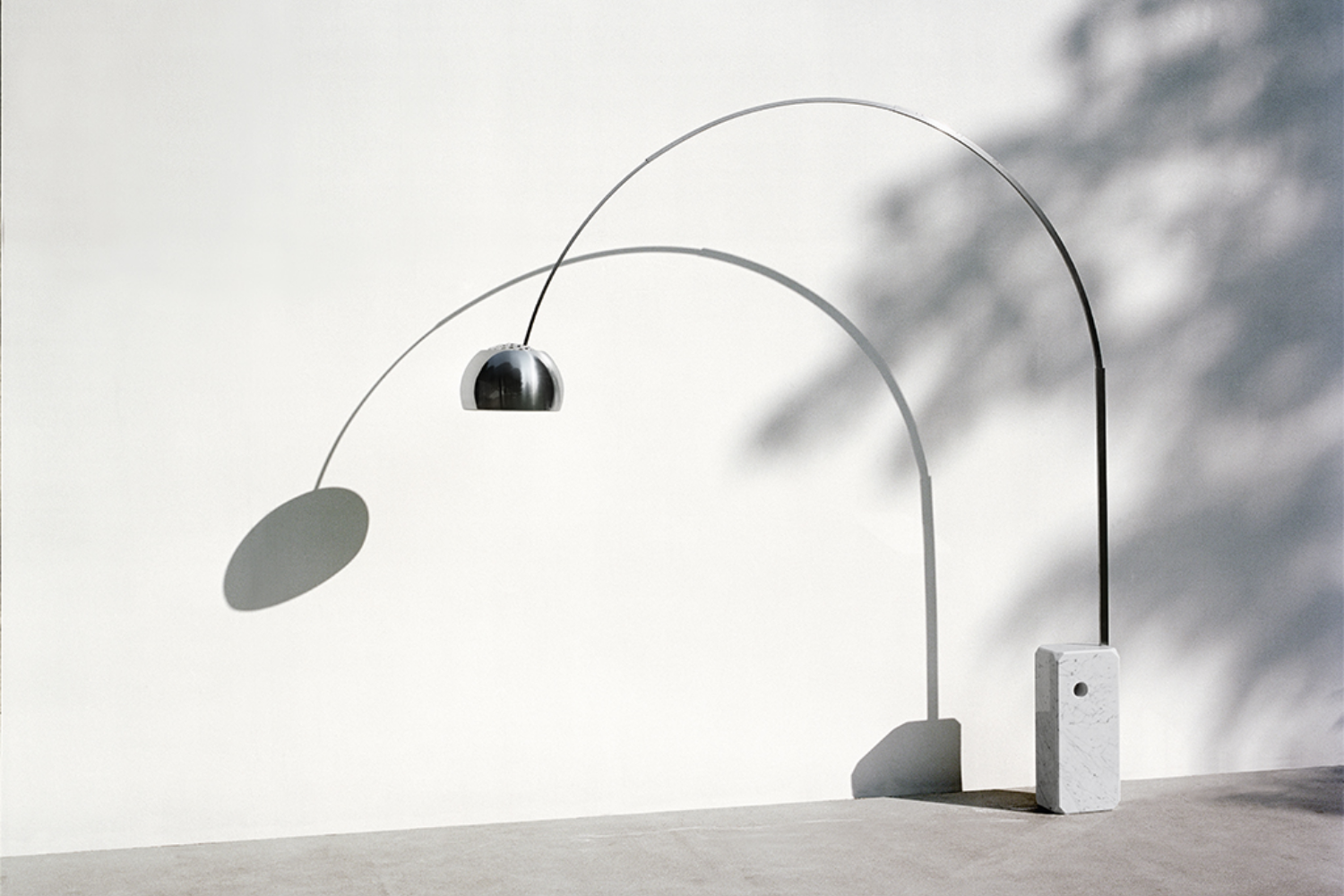
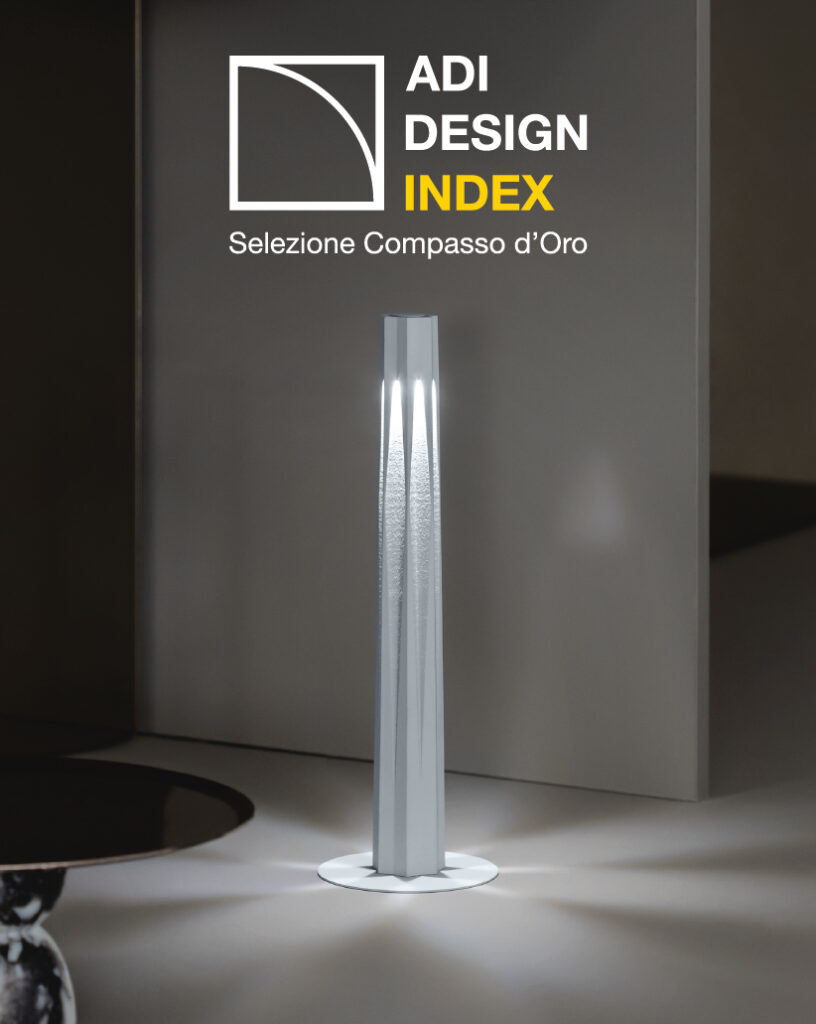
A floor lamp is often the most flexible solution when there is no ceiling connection in the required position or when the composition is not intended to be permanent.
Arco by Achille and Pier Giacomo Castiglioni, designed in 1962 and produced by Flos, makes this principle clear: a Carrara marble base supports a telescopic steel stem that carries an adjustable reflector far away from the point where the lamp touches the floor. It provides direct light while its structure simultaneously creates a large arc through the room.
Here, physical footprint is part of the design.
A lamp of this type cannot be selected by looking at the base alone. The trajectory of the stem, the height of the reflector, pedestrian movement and the relationship with sofa, table or armchair all need to be considered.
A more recent example is SuperWire by Formafantasma for Flos. The floor version, presented in 2024, stacks hexagonal modules made from planar glass and aluminium; the light source runs along the structure and is designed to be removable and replaceable. The SuperWire S3 pendant version is dated 2025 in Flos documentation.
In this case, the source is not concealed inside the sculpture: the luminous line becomes the visual structure itself.
Table lamps work best when the light remains genuinely useful
The risk with sculptural table lamps is turning bedside tables, consoles and desks into pedestals.
If the object occupies too much space, creates uncomfortable reflections or directs light to the wrong area, the balance between sculpture and function is lost.
A table lamp can instead have a highly recognisable form while maintaining controlled light output. Foscarini describes Chapeaux by Rodolfo Dordoni as a system in which a transparent body supports a luminous core, while different diffusers alter both the appearance and the distribution of light. In the Chapeaux M version, the metal diffuser reflects light onto the surface while the fixture also provides diffuse illumination.
The design principle remains straightforward: above a desk or beside an armchair, the form should not prevent light from reaching the surface that actually needs to be illuminated.
A wall can also host a sculptural lighting element
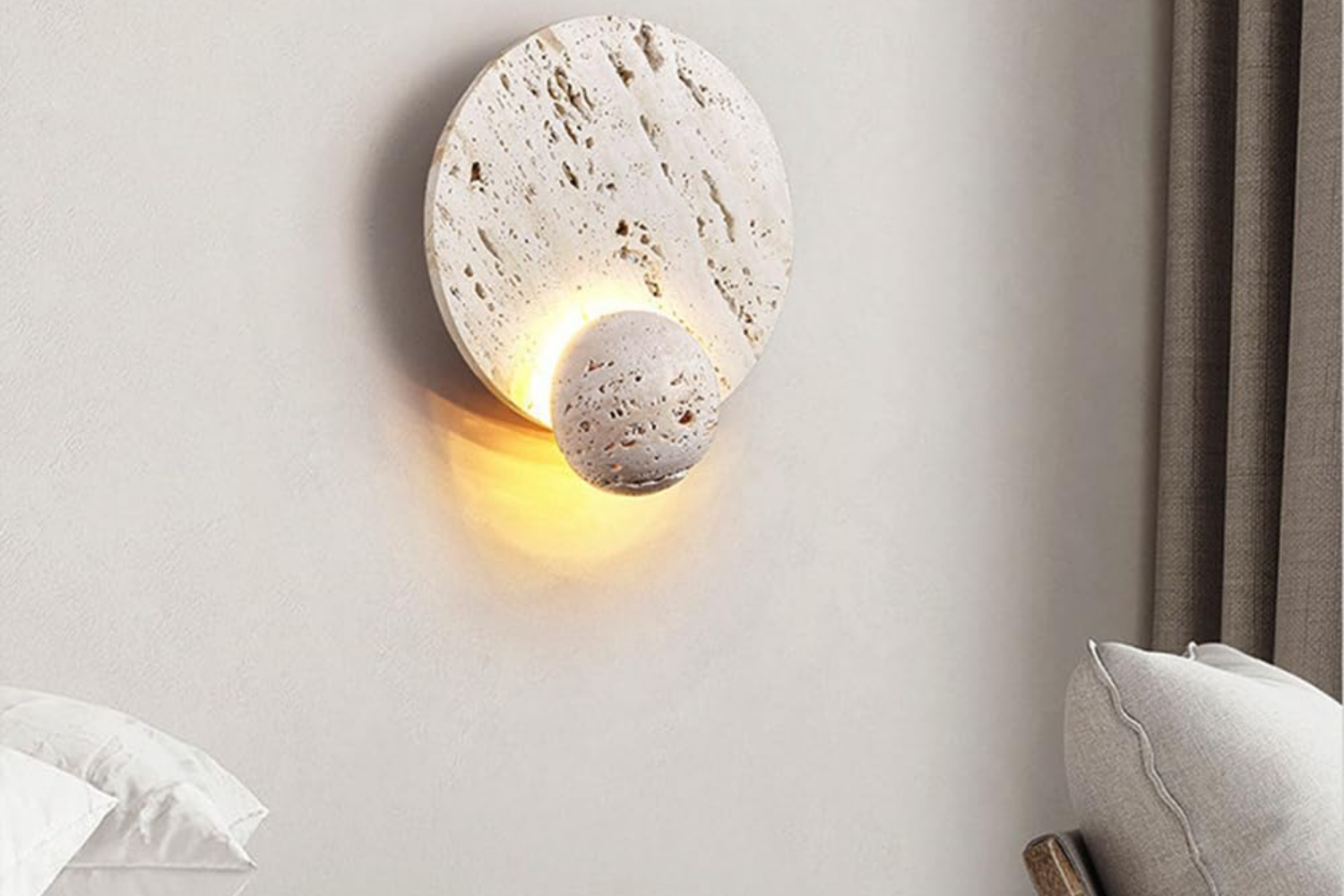
Wall lights are often treated as secondary elements, but they can have a far more decisive role.
In small interiors, they make it possible to introduce a strong form without occupying floor or table space. They can also work with the wall itself, producing shadows, reflections or a halo of light that visually extends the object.
Within its 28 series, Bocci offers individual blown-glass elements that can be mounted directly to a wall or ceiling. The possibility of moving the same visual language from suspension to surface demonstrates that sculptural character does not necessarily depend on the size of the fixture.
In these situations, positioning in relation to eye level becomes crucial. A very bright source placed directly in front of the viewer can be more problematic than a large pendant seen from a shielded angle.
Glare: a beautiful lamp can still be uncomfortable to look at
Glare is not a technical detail to be checked only at the end of the design process.
The CIE uses the Unified Glare Rating, UGR, as one of the tools for assessing discomfort glare in interior environments and stresses that the result also depends on viewing position and direction. The CIE has also highlighted that LED sources with highly non-uniform luminance can require more complex evaluation than traditional models.
This is particularly relevant to sculptural lighting, where LEDs, globes or luminous surfaces may remain directly visible.
This does not mean every domestic lamp should be chosen according to a single UGR value. It means that a technical data sheet cannot replace checking the fixture in its real position.
The important question is where the light will be seen from: sitting on the sofa, lying in bed, standing at the entrance or working at a table.
Colour temperature and colour rendering should not be chosen by slogan
A spectacular form can feel completely different when the light has characteristics that do not suit the space.
Correlated colour temperature, CCT, expressed in kelvin, describes a chromatic characteristic of the source relative to the Planckian reference; on its own, it does not measure quality, comfort or the ability to render colours accurately. The definition is formalised by the CIE.
The same applies to colour rendering. The traditional general CRI or Rₐ remains widely used, but in its 2025 position statement the CIE recommends that the lighting community begin adopting the newer CIE General Colour Fidelity Index Rf as well, temporarily maintaining both systems during the transition.
For a residential interior, the practical consequence is clear: there is little value in choosing a lamp simply because it is described as “warm” or “high colour rendering”.
The data for the exact version of the fixture should be checked, because the same product family may offer different sources, colour temperatures and control systems.
Transparent, reflective and diffusing materials change the character of light
A sculptural lamp is perceived through two materials: the physical material itself and the light that passes through or strikes it.
The washi paper of the Akari filters the source and creates very light luminous volumes. The PH Artichoke’s system of metal leaves works instead through shielding and reflection. Bocci’s 28 series uses blown glass and internal cavities. Skynest by Marcel Wanders for Flos replaces the traditional lampshade with an interwoven textile structure in which luminous and non-luminous elements participate in the same pattern.
Choosing between “glass, metal or textile” purely to match the furniture is therefore reductive.
Material also determines transparency, diffusion, reflections, shadows and the visibility of the light source.
Small spaces need greater precision, not necessarily a smaller lamp
A compact room can still accommodate a substantial statement light.
The difference lies in how the space is occupied. A relatively large pendant above a table can feel less intrusive than a smaller floor lamp positioned within a circulation route.
In a small living room, it can be more effective to choose one fixture with a strong form and allow the other light sources to remain integrated or visually discreet. Walls and ceilings can also become useful supports, freeing up usable floor area.
Scale should still remain legible. If every element — lamp, sofa, coffee table, artwork and rug — tries to become the focal point, the light loses its ability to organise the room.
From historic icons to sculptural lighting in 2026
The relationship between lighting and sculpture does not belong to a single period of design.
Akari dates from 1951, PH Artichoke from 1958 and Arco from 1962. They are very different projects, but all demonstrate how form can emerge from a precise reflection on light.
That research continues in contemporary design.
At Salone del Mobile.Milano 2026, Edra presented Dilly by Jacopo Foggini, made from hand-worked polycarbonate and designed for both indoor and outdoor use. Edra explicitly describes it as a luminous sculpture in which light passes through the material to produce contrasts of transparency and shadow; the fixture also features adjustable lighting.
In its report from Milan Design Week 2026, Architectural Digest included Dilly among the examples in which weaving, material and light become structure, alongside other contemporary experiments with glass and fixtures with a strong sculptural presence.
There is no need, however, to turn this into a seasonal rule. A successful sculptural light should continue to work even when attention moves on from a particular form or material.
The most common mistakes when choosing sculptural lighting
The first is choosing the lamp only by looking at it switched off. Product photography can communicate form and material, but the design depends above all on what happens once the light is on.
The second is ignoring real dimensions. A fixture photographed in a very tall showroom can appear completely different in scale once placed in an apartment.
The third is relying on a single source for the entire living room. A statement lamp can create atmosphere, but it does not necessarily need to replace reading light, task lighting and accents.
The fourth is ignoring glare. Looking directly at an intense light source for long periods can make even the most interesting object uncomfortable.
The fifth is confusing colour temperature with overall light quality.
The sixth is accumulating too many iconic forms. A PH Artichoke above the table, a large sculptural floor lamp and several decorative lights on the same axis can turn the interior into a sequence of competing objects with no hierarchy.
The seventh is forgetting the ceiling. Ceiling rose, cables, electrical points and their relationship with beams, wall panelling or suspended ceilings are just as much part of the result as the diffuser itself.
Sculptural lighting works best when it remains recognisable without becoming detached from the architecture. It can hang at the centre of a room, extend above a sofa, transform a wall or become a small luminous object on a console. The decisive question is not how spectacular the fixture looks, but whether scale, light output, material, sightlines and lighting function all work in the same direction. When they do, the lamp stops behaving like an accessory added at the end of the design process and becomes one of the tools through which the space itself is shaped.