Bathroom renovation cost in 2026: from 2,500 euros for a refresh to 9,000-16,000 for a full redo in Italy, with a cost breakdown, timings, permits and tax credits.
What does bathroom renovation cost in 2026? Price bands for a typical 4-6 square metre bathroom, every cost item explained, timings, permits and the tax incentives available in Italy. Written from the designer’s side of the table, not the showroom’s.
The bathroom is the smallest room in the home and, per square metre, the most expensive to redo. Plumbing, waterproofing, surfaces, sanitaryware and lighting all crowd into a few metres, and every poor decision stays there for twenty years. That is why the bathroom renovation cost only makes sense once you see where the money actually goes. The figures in this guide refer to the Italian market, in euros and including Italy’s reduced 10% VAT on home renovation work. Elsewhere in Europe the logic is the same, but labour rates, VAT and permits change the totals.
Here is the short answer. For a bathroom of around 4-6 square metres, a cosmetic refresh without demolition costs roughly 2,500 to 6,000 euros. A full standard renovation, with new plumbing, new tiles, wall-hung sanitaryware and a shower enclosure, usually lands between 9,000 and 16,000 euros. A designer bathroom, with large-format slabs, statement taps, a bespoke vanity and a proper lighting plan, starts at about 18,000 euros and easily goes past 30,000. These are editorial estimates built by cross-checking regional price lists, industry surveys and real quotes. The lower figures often quoted online tend to leave out VAT, fixtures or design fees.
How much does a complete bathroom renovation cost?
A bathroom stripped back and rebuilt in full typically costs 9,000 to 16,000 euros in Italy for 4-6 square metres. “Complete” means removing floor and wall tiles, renewing waste pipes and water supply, upgrading the wiring, relaying the screed, waterproofing, laying new surfaces, fitting sanitaryware, taps, shower, vanity, mirror and lights, replacing the door and repainting.
The range is wide for three reasons. First, location: in Milan or Rome labour costs noticeably more than in smaller towns. Then there is the starting point: a 1970s bathroom with galvanised steel pipes almost always hides surprises under the floor. The third factor is fixtures, where the gap between builder’s-grade ceramic and large-format porcelain, or between a basic mixer and a designer one, is measured in thousands. If you are weighing a wider project on the whole home, our analysis of whether to renovate or buy new in 2026 offers a useful frame.
Bathroom renovation cost, item by item
The most honest way to read a quote is to break it down. This table summarises indicative bands for a bathroom of about 5 square metres, with around 20-25 square metres of tiled walls, VAT included. The low end reflects simple fixtures and standard installation, the high end premium materials and more complex work.
| Cost item | Indicative range | What moves the price |
|---|---|---|
| Demolition and waste disposal | 800 – 2,000 € | Double layers of flooring, upper floors without a lift, landfill fees |
| Plumbing and waste pipes | 1,500 – 3,500 € | Relocating fixtures, soil stack, level-access shower |
| Electrics | 500 – 1,500 € | Number of light points, backlit mirror, electric towel rail |
| Screed and waterproofing | 500 – 1,500 € | Thickness, liquid or sheet membrane, shower area |
| Floor and wall tiles (supply and fit) | 1,500 – 5,000 € | Tile format, tiling height, slabs or microcement |
| Sanitaryware | 500 – 2,500 € | Wall-hung or floor-standing, brand, frames and flush plates |
| Taps and mixers | 300 – 2,000 € | Concealed, thermostatic, special finishes |
| Shower or bath | 600 – 3,500 € | Made-to-measure tray, fixed glass or enclosure, freestanding tub |
| Vanity unit and mirror | 500 – 3,500 € | Size, stone or ceramic top, bespoke joinery |
| Lighting | 150 – 1,000 € | Recessed spots, LED profiles, illuminated mirror |
| Door | 300 – 1,500 € | Hinged or pocket sliding door with frame |
| Painting | 150 – 500 € | Anti-mould paint, water-based enamels, ceiling |
| Designer and permits | 500 – 2,000 € | Interior design, permit filing, site supervision |
Demolition, services and screed: the part you never see
The invisible part of a bathroom often accounts for a third of the total. Demolition covers stripping floor, walls, fixtures and screed, carrying away rubble and paying for disposal. Plumbing is the most variable line. Renewing supply and waste pipes while keeping fixtures in place costs far less than moving the WC to another wall, because a waste pipe needs precise falls and diameters. Electrics must follow the rules for wet rooms, with safety zones around shower and bath and residual current protection; across Europe these zones derive from the same international wiring standard, adopted locally. Screed and waterproofing are where you never cut corners: a well-laid membrane under the shower prevents leaks that would cost more than the whole bathroom.
Floors, walls and seamless surfaces
For floors and walls, the cost is material plus labour. Good porcelain stoneware starts at a few tens of euros per square metre and climbs beyond a hundred for large slabs and marble-effect surfaces. Fitting costs rise with the format, because slabs need special tools and skilled hands. Tiling walls to the ceiling rather than to 120 centimetres changes the bill considerably. Seamless finishes such as microcement remove grout lines but need specialist applicators. For formats and finishes of the moment, see our piece on bathroom tile trends.
Sanitaryware, taps, shower and bath
This is where the spread is widest. A pair of good-quality white ceramic wall-hung pieces, with concealed frames, sits at a few hundred euros; signature collections from the big names can be worth five times as much. The same goes for taps, where the brass body, the cartridge and the finish make the difference. To understand what you pay for as the price rises, start with our guide to the best bathroom sanitaryware brands.
In the shower zone, a composite tray with a fixed glass panel or a single-door enclosure remains the most balanced choice. A level-access shower with a linear drain needs a lowered screed and meticulous waterproofing, so it costs more to install: the options are covered in our guides to the walk-in shower and to floor-level shower trays. A bath, especially a freestanding one, brings both the cost of the tub and that of floor-mounted taps; alternatives are explored in our overview of bathtub brands.
Vanity, mirror, lighting, door and paint
A vanity unit with an integrated or countertop basin ranges from a few hundred euros for modular systems to several thousand for bespoke pieces with stone tops. The right dimensions for keeping circulation space are set out in our guide to bathroom furniture sizes and materials, while the makers worth knowing feature in our selection of bathroom furniture brands. Lighting costs little compared with the rest but changes everything. A central downlight and a mirror with good frontal light beat a theatrical pendant, because a face needs light from the front, not from above. A pocket sliding door wins precious space, as long as the frame goes in during demolition. Paint closes the job: in a bathroom choose a washable, breathable finish, ideally with anti-mould additives.
Labour and design fees
Labour is not a separate line so much as part of every other one. In a full renovation it often represents 40 to 60% of the total, because a bathroom needs a builder, plumber, electrician, tiler, decorator and fitters in sequence. Contractors who coordinate every trade tend to cost a little more, but they cut downtime and mistakes. The designer, whether architect, surveyor or interior designer, usually adds between a few hundred and a couple of thousand euros for design, permits and supervision. It is the fee that most often saves money elsewhere.
How much does it cost to redo a 5 square metre bathroom?
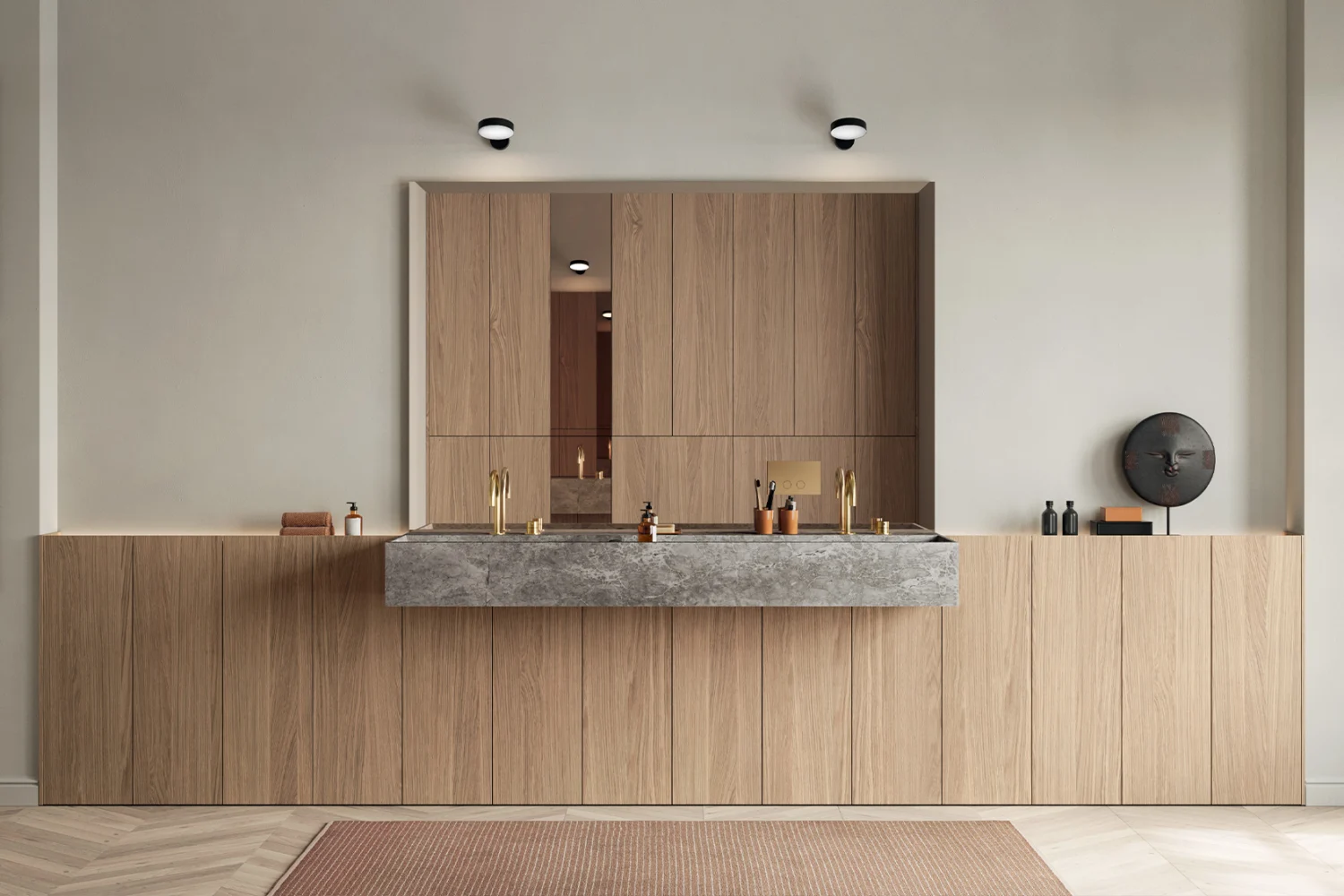
For a 5 square metre bathroom, the most common figure for a full mid-range renovation in Italy is around 10,000-13,000 euros including VAT. Drop to 4 square metres and the price does not fall proportionally: services, sanitaryware and labour are almost identical, only a few square metres of tiles change. Go up to 7-8 square metres, with shower and bath or a double basin, and you easily pass 15,000 euros.
Cost per square metre or fixed price?
Cost per square metre is a poor yardstick for bathrooms. A full renovation easily reaches 1,800-3,000 euros per square metre, figures that look alarming only because fixed costs, services and sanitaryware, are spread over very little floor area. Many contractors therefore prefer a fixed-price quote for the finished job. That works well, provided it comes with a detailed bill of quantities, listing quantities, brands and models, so you can compare quotes and know what happens if anything changes.
How long does a bathroom renovation take?
A full renovation usually takes two to four weeks on site. The first days go on demolition, services and screed; the screed must then dry before tiling, and that is the one stage never to rush. Waterproofing, tiling, fitting sanitaryware, shower and vanity, painting and cleaning follow. A cosmetic refresh without demolition is often done in a few days. Allow time before work starts, too: design, choosing fixtures and deliveries, especially for enclosures and bespoke vanities, can take longer than the build itself.
How to save without compromising the result
Smart savings come from work avoided, not from the cheapest material. The first lever is tiling over existing tiles: if the floor is sound and well bonded, thin tiles or porcelain slabs just a few millimetres thick can be laid on top, saving demolition, disposal and days on site. Pros and limits are explained in our article on installing new flooring over existing floors.
The second lever is leaving the waste pipes where they are, which avoids the most expensive part of the plumbing. A third is wall-hung sanitaryware, slightly dearer than floor-standing models but giving a continuous floor that is easier to clean and visually lighter. The fourth, if you only want a new colour, is tile paint: two-part coatings that can transform a sound, well-prepared wall in a weekend. They are not forever in wet zones, but they work as a bridge. Finally, buying all fixtures at once and agreeing a clear specification prevents mid-project changes, the main reason budgets overrun.
Where it pays to spend more
Some items are paid for once and enjoyed for twenty years. The first is everything under the floor and inside the walls: pipes, waste, waterproofing and reliable concealed cisterns, because opening a wall for a repair costs more than the part. Next come taps, used several times a day: a good thermostatic shower mixer changes daily comfort. The third is installation: mid-range porcelain laid perfectly looks more expensive than a precious material laid badly. Trends deserve a lighter touch, invested in replaceable elements such as accessories, mirrors and lights. The same principle, applied to the whole home, is at the heart of our piece on smart renovations.
Do you need a permit to renovate a bathroom in Italy?
It depends on the scope. In Italy, replacing floor and wall tiles and sanitaryware, and renewing services without changing their layout, normally counts as ordinary maintenance, which is permit-free building work. This is set by the Consolidated Building Act, Presidential Decree 380/2001, and clarified by the glossary of permit-free works, Ministerial Decree of 2 March 2018, which lists the repair, replacement and renewal of interior flooring, wall coverings, plumbing and electrics.
Moving partition walls, creating a new bathroom or substantially changing the layout of services is extraordinary maintenance, which in Italy generally requires a CILA, a notice of works certified by a qualified professional and filed with the municipality before work starts. Structural work brings further requirements. Local building codes can add their own rules, for instance on ventilating windowless bathrooms. Outside Italy, the threshold between free and permitted works varies country by country, so always check with a local professional or the municipality.
Tax incentives for bathroom renovations in Italy
For expenses incurred in 2026, Italy’s renovation tax credit is 50% for a main residence and 36% for other properties, on a maximum spend of 96,000 euros per unit, recovered over ten years. This is confirmed by the updated guide of the Italian Revenue Agency on building renovations. For individual flats the credit applies to extraordinary maintenance: a bathroom redo that changes services or partitions qualifies, a simple swap of tiles and fixtures usually does not. Payments must be made by a dedicated bank transfer quoting the legal reference, the beneficiary’s tax code and the contractor’s VAT number. For individuals the payment date is what counts.
On top of this, reduced 10% VAT applies to maintenance work in homes, with a special rule for so-called significant goods, sanitaryware and taps among them. Those renovating a bathroom within an eligible project can also claim the furniture bonus, which in 2026 covers 50% of up to 5,000 euros of spending.
What could change in 2027?
Under current law, for expenses incurred in 2027 the credit would fall to 36% for a main residence and 30% for other properties. The Italian government has repeatedly mentioned a possible extension of the current rates, but no text has been approved yet: the 2027 budget law will be presented and debated in Parliament in the coming weeks. Anyone planning work across the year end should budget on current rates, check the outcome through official channels and, where possible, make the main payments by December.
How to read a quote and avoid common mistakes
A good bathroom quote describes every task with quantities and units, names brands and models, separates labour from materials, states who handles disposal and permits, and sets out timings and payment terms. Be wary of vague lines such as “complete bathroom renovation” without detail: those are the ones that generate extras. Comparing at least three quotes on the same specification is the simplest way to find the fair price in your area.
The most frequent mistakes repeat themselves. Choosing fixtures after signing the quote, only to discover the model you want costs twice as much. Underestimating ventilation and light, which separate a pleasant bathroom from one that constantly steams up. Forgetting sockets and water points for a washing machine or dryer, now often housed in the bathroom inside a tall unit or a dedicated niche. And above all, saving on waterproofing or on a contractor without references, the one saving you always pay for twice.
Bathroom renovation cost: frequently asked questions
How much does it cost to renovate a small bathroom?
In Italy, a full renovation of a small 3-4 square metre bathroom costs roughly 8,000 to 12,000 euros including VAT. The price does not fall in line with the floor area, because services, sanitaryware and labour stay almost the same.
How much does a plumber charge to redo a bathroom?
To renew the supply and waste pipes of a standard bathroom, an Italian plumber typically charges 1,500 to 3,500 euros for labour and materials, depending on the city, the condition of existing pipes and whether fixtures are moved. Final fitting of sanitaryware and taps is often included.
Is a shower or a bath cheaper?
A shower with a standard tray and fixed glass is usually the most affordable option and takes up the least space. A simple built-in bath costs about the same, while a freestanding tub or a level-access shower with a linear drain costs more to install.
Can you renovate a bathroom without demolition?
Yes, if floor and walls are sound and services are in good order. Thin slabs laid over existing tiles, tile paint and new sanitaryware and vanity give you a new bathroom in a few days, often for under 6,000 euros.
Does a bathroom renovation qualify for Italian tax credits?
Yes, when it counts as extraordinary maintenance, for example renewing and changing services or moving partition walls. Simply replacing tiles and fixtures in a single flat is ordinary maintenance and usually does not qualify.