How to light your home at Christmas the way designers do: warm light, three layers, precise accents, candles in the right place and a few iconic Italian lamps.
At Christmas a home does not need more light, it needs better light: warmer, lower and placed with intent. This is lighting design applied to the festive season, and it works far better than any string of fairy lights bought in a last minute rush.
Christmas lights at home are nearly always treated as an accessory: bought in December, wrapped round the tree and switched on together with the ceiling light, which leaves rooms glaring and oddly impersonal. Anyone genuinely asking how to light a home at Christmas should start from the opposite end: switch off, dim down, then add light only where it earns its place. It is exactly how a lighting designer approaches a restaurant or a boutique hotel, and it translates beautifully to a living room.
Our editorial view is simple. The festive season is the one time of year when we happily live in our homes almost entirely after dark, with friends, long tables and slow evenings. Designing that light means designing the mood of Christmas itself, far more than any choice of baubles. Indoor Christmas lighting becomes a small, temporary lighting scheme with clear rules: colour temperature, layers, accents, flame and safety.
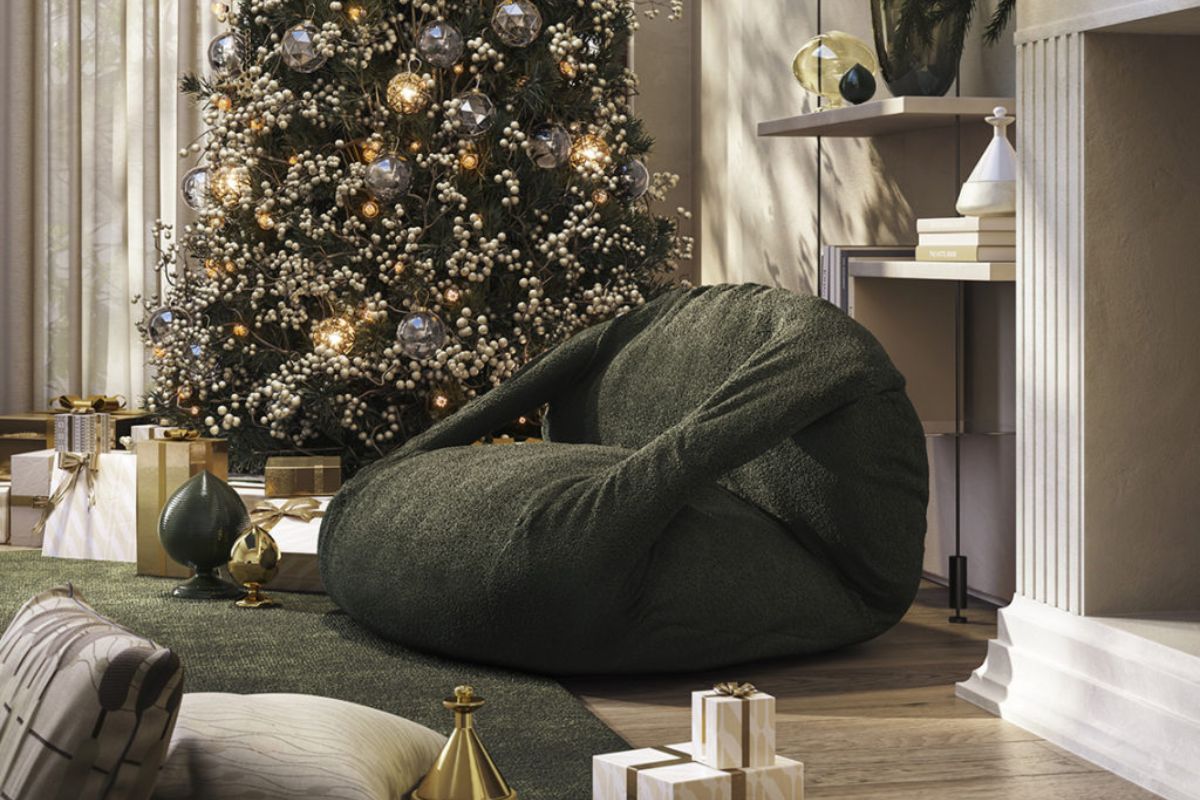
What colour temperature should Christmas lights at home be?
Warm, around 2,700 kelvin or lower, for every source switched on at the same time. Colour temperature describes whether light leans towards yellow or blue: old incandescent bulbs sat around 2,700 kelvin, a candle flame drops below 2,000, while the neutral white of 4,000 kelvin belongs in offices and working kitchens. A string of cool white LEDs next to a warm table lamp creates a visible rift that the eye reads as a mistake, even when it cannot say why.
We suggest checking the box before buying and looking for wording such as “warm white” or “extra warm”, ideally with the kelvin value stated. Colour rendering matters too: cheap LEDs tend to dull reds and greens, precisely the colours of the table and the foliage. Wherever possible every light in the room should share the same tone, from the floor lamp to the tree’s light string, so the home reads as one space rather than a collection of sources.
How do you build a lighting scheme for the festive season?
In three layers: very low general light, task light where people read, cook or eat, and accent light that tells the story of the season. The first move is to bring the general level down. The central pendant, if there is one, should stay off or dimmed to a minimum in December, because it flattens shadows and erases everything that has been carefully decorated.
Task light is still essential, but it needs to be contained. A reading lamp by the armchair, under cabinet lighting in the kitchen, a pendant over the table set low: each one lights its own job without spilling into the rest of the room. If you want to go deeper into how these layers fit together, our guide to living room lighting covers the basics, which at Christmas simply need a more intimate reading.
The third layer is the one that changes everything. Accent lighting is precise and almost theatrical: it picks out the tree, a shelf of fir branches, the centrepiece, a painting. The pools of shadow between one accent and the next are not a flaw, they are what gives the room depth. A dimmer on the main sources and a couple of timer sockets are enough to control the whole scheme with a single gesture.
Where should decorative lights go so they do not look like an afterthought?
Inside things, not on top of them. On the tree a light string performs far better when it starts at the trunk and runs out along the main branches, instead of being spiralled across the surface: the light seems to come from within the tree and the branches gain volume. Choose fine wires in dark green or clear, and steady micro lights, without the flashing modes that grow tiresome within minutes.
Away from the tree, indoor Christmas lights work best where there is already a structure worth highlighting. A bookcase, a window frame, a garland of branches along the mantelpiece, a tall glass vase of birch twigs. Where there is a fireplace, a real flame can carry the room on its own and decorative lights should make room for it.
At the table the rule changes: light should sit below eye level, so guests can see one another and nobody is dazzled. Low candles, small portable lamps and a pendant set to a soft output make a table that feels warm and easy to read. We have gathered composition ideas in our guide to the Christmas centrepiece.
Real candles or LED candles?
Real candles remain unbeatable for the quality of their flame, but they belong only where they can be watched, which means the table and never near the tree. Italy’s national fire service, the Vigili del Fuoco, advises against candles on the tree and recommends keeping it away from heat sources such as fireplaces and open flames. Dry branches, ribbon and paper catch quickly: distance is the first design rule.
Everywhere else, flickering LED candles are now genuinely convincing, especially those in real wax with a very warm tone. We like to group them in odd numbers, at different heights, on a metal or stone tray that holds them together as a single object. Placed in spots that are hard to reach, such as window sills and high shelves, they give the effect of a flame without the risk.
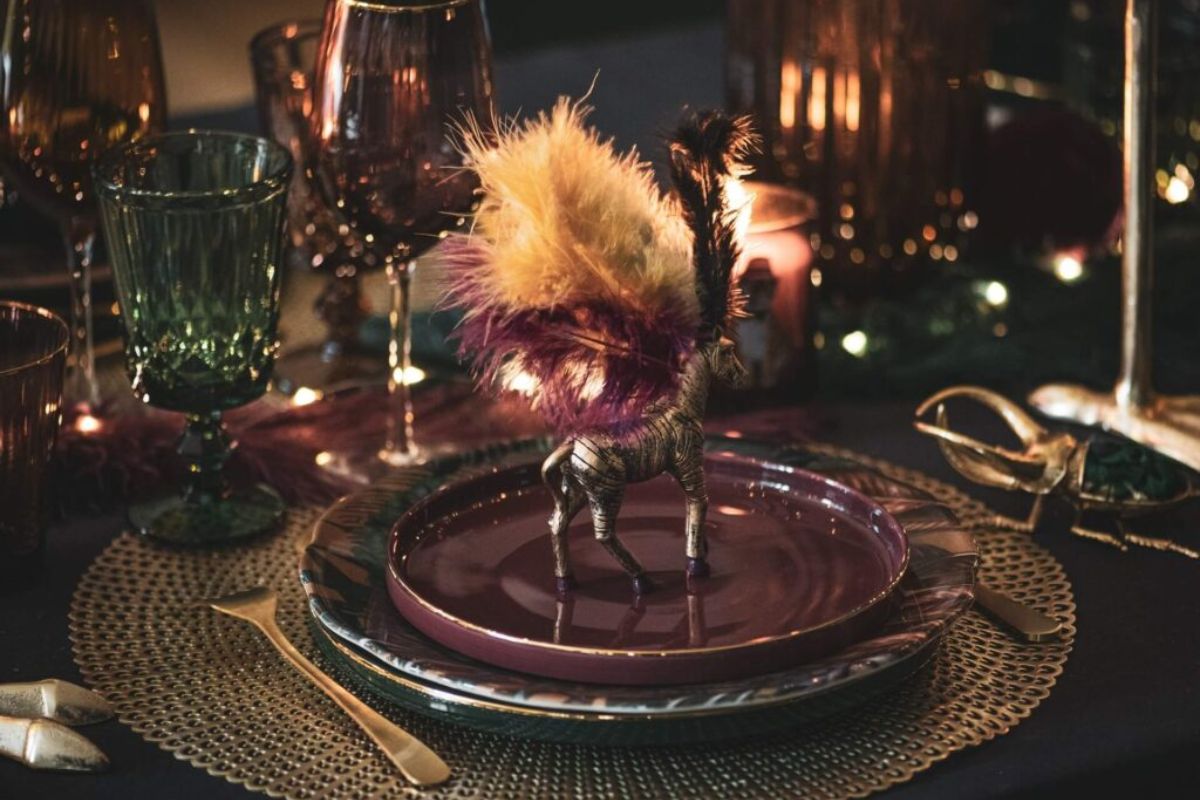
Which design lamps help create a festive atmosphere?
Small, warm, movable lamps that can build points of light exactly where they are needed. Several classics of Italian design could have been made for the job. Vico Magistretti‘s Eclisse for Artemide, designed in 1965 and awarded the Compasso d’Oro in 1967, lets you adjust the beam by rotating its inner shell: open on a shelf, half closed on a bedside table, it is a small lesson in measured light.
Gae Aulenti‘s Pipistrello for Martinelli Luce, from 1965, brings a soft, diffused glow to a sideboard through its opal white shade, perfect alongside branches and candles. For complete freedom there is the Bellhop by Edward Barber and Jay Osgerby for Flos, created in 2016 for the restaurant at London’s Design Museum: the rechargeable version charges via USB-C and moves from table to terrace without a cable, with three colour temperatures.
And for those who prefer poetry, Ingo Maurer’s Lucellino, the light bulb with goose feather wings designed in 1992, may be the most Christmassy object ever made without being a Christmas object at all. We have covered more masterpieces in our selection of iconic lamps in lighting design. A lamp like this is also an investment: it stays on display after Epiphany, when the decorations go back into the loft.

How can you use Christmas lights safely and efficiently?
Buy CE marked light strings, never overload sockets and switch everything off at night or when you go out. That is the advice of the Vigili del Fuoco, who also recommend limiting multi socket adaptors and using good quality extension leads rather than improvised connections. Lights for a balcony or terrace need an ingress protection rating suitable for outdoor use, shown on the label as an IP code.
On energy, LEDs have solved most of the problem: a string of micro lights draws a fraction of the power of old bulbs, stays cool and is safer near branches. A timer or smart plug means the lights are never left on by mistake and lets you schedule the mood. To take the same approach outdoors, our guide to outdoor and terrace Christmas decorations covers lights, foliage and weatherproof materials. And to see light treated as art, nothing beats Turin’s Luci d’Artista.
Frequently asked questions about Christmas lights at home
Should Christmas lights at home be warm or cool white?
Warm, around 2,700 kelvin or lower. Cool light, from 4,000 kelvin upwards, makes domestic spaces feel stiff and clashes with lamps and candles lit in the same room.
How many lights does a Christmas tree need?
There is no fixed number: distribution is what counts. One string of warm micro lights worked into the branches, from trunk to tips, beats several strings wrapped across the surface.
Can tree lights be left on overnight?
No. The Vigili del Fuoco advise switching them off at night and whenever you leave the house. A timer makes it easy to remember.
How do you light a home at Christmas without a ceiling light?
With several low, warm points of light: a table lamp, a dimmable floor lamp, the tree and a few candles on the table. It is the closest thing to a proper lighting design scheme.
Are LED candles safe near the tree?
They are far safer than real candles because they have no flame and stay cool. Choose CE marked ones and switch them off when nobody is at home.