Kitchen trends 2027 from EuroCucina 2026: dark woods, sculpted stone, monolithic islands, green fronts, invisible induction and how to update your kitchen.
The kitchen trends 2027 were set in April 2026, in the halls of EuroCucina and the showrooms of Milan Design Week. Dark woods, sculpted stone, monolithic islands, greens and earth tones on cabinet fronts, technology that vanishes beneath the worktop: what will actually reach our homes, and how to bring it into a kitchen you have no intention of ripping out.
EuroCucina takes place in even-numbered years. That gives the kitchen an almost astronomical calendar. What the industry shows in Milan in April takes roughly a year to move from catalogues to building sites, from architects’ drawings to signed orders. The kitchen trends 2027 are therefore already written. We saw them in Rho from 21 to 26 April 2026, when EuroCucina and FTK, its kitchen technology section, brought together 106 exhibitors from 17 countries. They were part of the 64th Salone del Mobile, which closed with 316,342 visits.
Our reading, as designers, is clear. The 2027 kitchen no longer wants to look like a well-dressed appliance. It is going back to being interior architecture: a volume built from real materials, which opens when needed and closes when the room becomes a living space again. This is the end of the smooth, neutral minimalism of the past decade. In its place come tactile surfaces, warm colours and technology that works without being seen.
What are the kitchen trends for 2027?
The kitchen trends for 2027 come down to six directions. Authentic, tactile materials: dark woods, travertine, marble and quartzite, steel and titanium. Colour on cabinet fronts, in greens and earth tones. Sculptural islands, curved or monolithic. Kitchens that hide behind pocket doors and walk-in pantries. Integrated technology, with invisible induction and extraction. And an ever closer bond with the living room.
We had glimpsed these directions a year ago in our kitchen trends for 2026. EuroCucina has turned them into product. The table translates them into design terms.
| 2027 trend | What it means in the project | Who it suits |
|---|---|---|
| Dark wood and thermo-treated oak | Fronts in tobacco oak, walnut or smoked veneers, often with vertical grooves or fluting | Anyone who wants warmth and a kitchen that talks to the floor and the living area |
| Exposed stone and integrated worktops | Worktop, splashback and sometimes doors in the same marble, travertine or sintered stone, with the sink carved into the material | Open-plan spaces where the kitchen is the showpiece |
| Steel and warm metals | Brushed or aged stainless steel worktops and fronts, bronze, copper and titanium finishes | Keen cooks who want durability, hygiene and a professional edge |
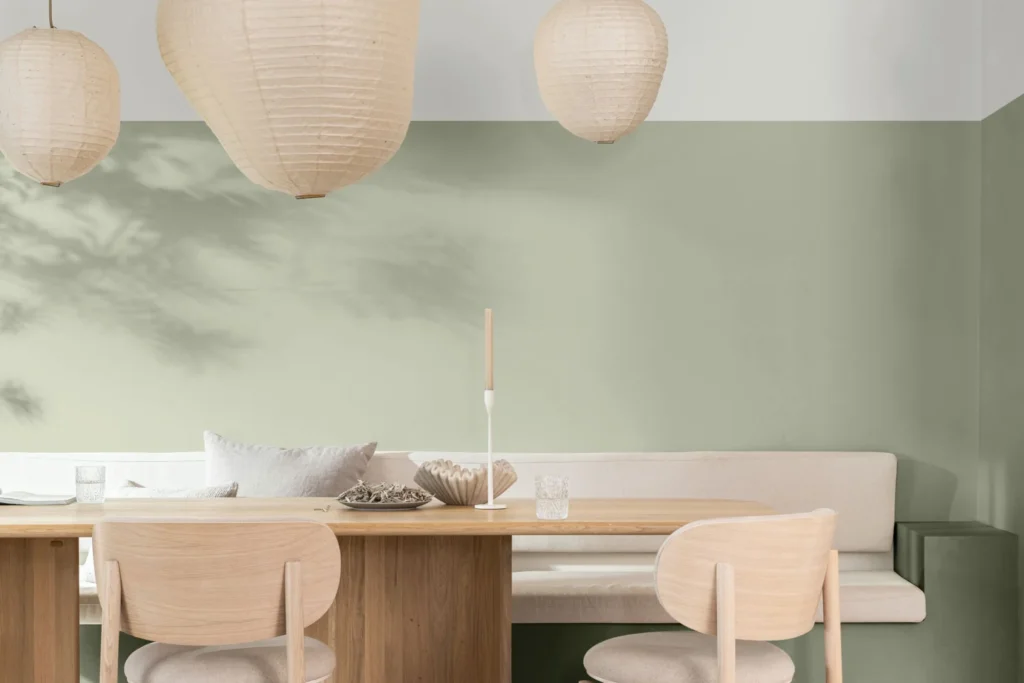
| Colour on the fronts | Base units or tall units in sage, olive, earth tones and dusty pinks, with a pale worktop | Anyone tired of white and grey who wants character without excess |
| Sculptural island | A monolithic or curved volume, with full-height side panels or raised on slender legs | Generous rooms, with at least 1 metre of clearance on each working side |
| Hidden kitchen and back kitchen | Retractable doors, tall units concealing sink and small appliances, a pantry or scullery behind the kitchen | Homes where kitchen and living room share one space, frequent hosts |
| Invisible technology | Under-worktop induction, hob-integrated or flush-ceiling extraction, ovens with sensors and cameras | Minimal schemes and anyone who wants a clear worktop |
What we saw at EuroCucina 2026, and why it matters for 2027
Across the EuroCucina halls and the Fuorisalone showrooms, the most visible trend was soft forms. Rounded corners, curved end units, peninsulas finished with circular breakfast tops. Scavolini played with concave and convex elements. Ernestomeda revisited the curves of the 1970s. Cesar took its Tangram system towards variable-radius geometries and a new worktop edge called Palmier. Alongside the curves came their apparent opposite: the monolithic volume, an island that looks carved from a single block. Boffi presented XPL by Piero Lissoni, a pure volume with a chamfered side, the evolution of a system first designed in 1972. Euromobil brought back Marc Sadler’s Sei, with worktops and sides in 6 mm steel.
The second signal concerned materials. Matt and velvety finishes are now standard. High-gloss lacquer has all but disappeared from the stands, and wood is moving towards deeper tones. The third signal was technological, and at FTK technology became discreet. Hoods hidden beneath a panel in the same material as the worktop. Induction hobs that disappear under a continuous mineral surface. Voice and gesture controls. For the full picture of the Milan week, read our report on the 2027 interior trends seen at the Salone. The run-up to the fair, with the return of the biennial shows, is covered in our preview of Raritas, EuroCucina and contract.
Kitchen materials for 2027: dark wood, stone and steel
Material is the real protagonist of the 2027 kitchen, and the key word is authenticity. After years of uniform surfaces, fronts once again tell the story of what they are made of. Grain, grooves, thickness, reflections.
Brown woods and thermo-treated oak
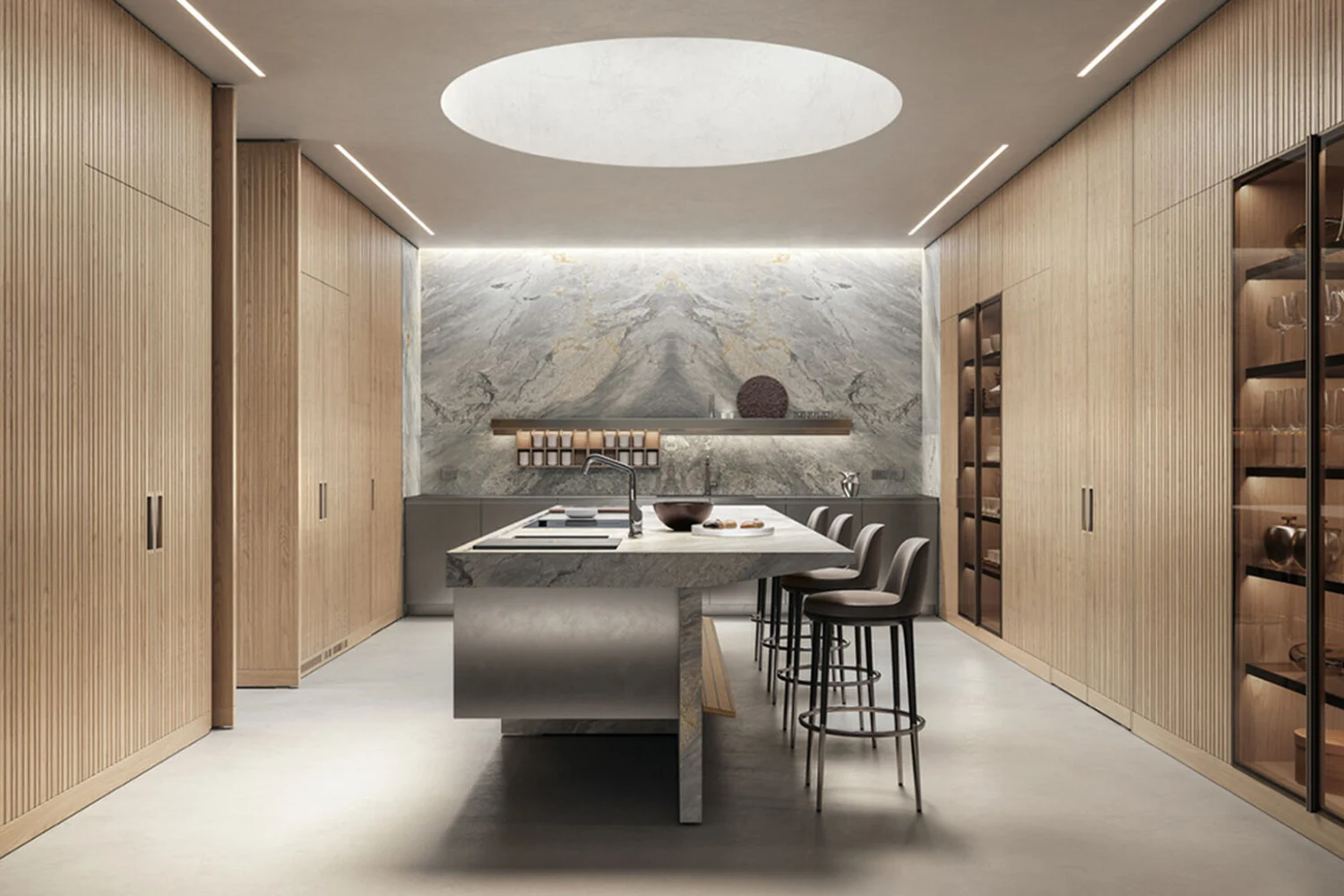
Wood remains the best-loved material, but it is changing colour. Tobacco oak, cocoa oak, American walnut, eucalyptus, smoked and thermo-treated woods, darkened by heat rather than stain, have replaced the pale natural oak of the Nordic decade. Cesar dressed its new Tangram composition in Rovere Cortado oak. Stosa worked with cocoa oak and a muddy walnut. Snaidero chose a fluted American walnut. Wood is also worked in relief. Vertical grooves, fluting and reeding add depth to the doors and hide the joints between modules.
Natural stone, sintered surfaces and integrated worktops
Stone is no longer just the worktop. It becomes splashback, side panel, door, a sink carved from the block. Modulnova built its Twenty Lab kitchen around a warm, layered travertine, worked so that the door stays light while still reading as a solid block. Cesar showed a monolithic island in Notre Dame marble for its N_Elle kitchen. At the same time, large ceramic slabs and thin sintered stone are gaining ground. They resist heat and scratches, and they allow worktop, splashback and doors to share one continuous vein.
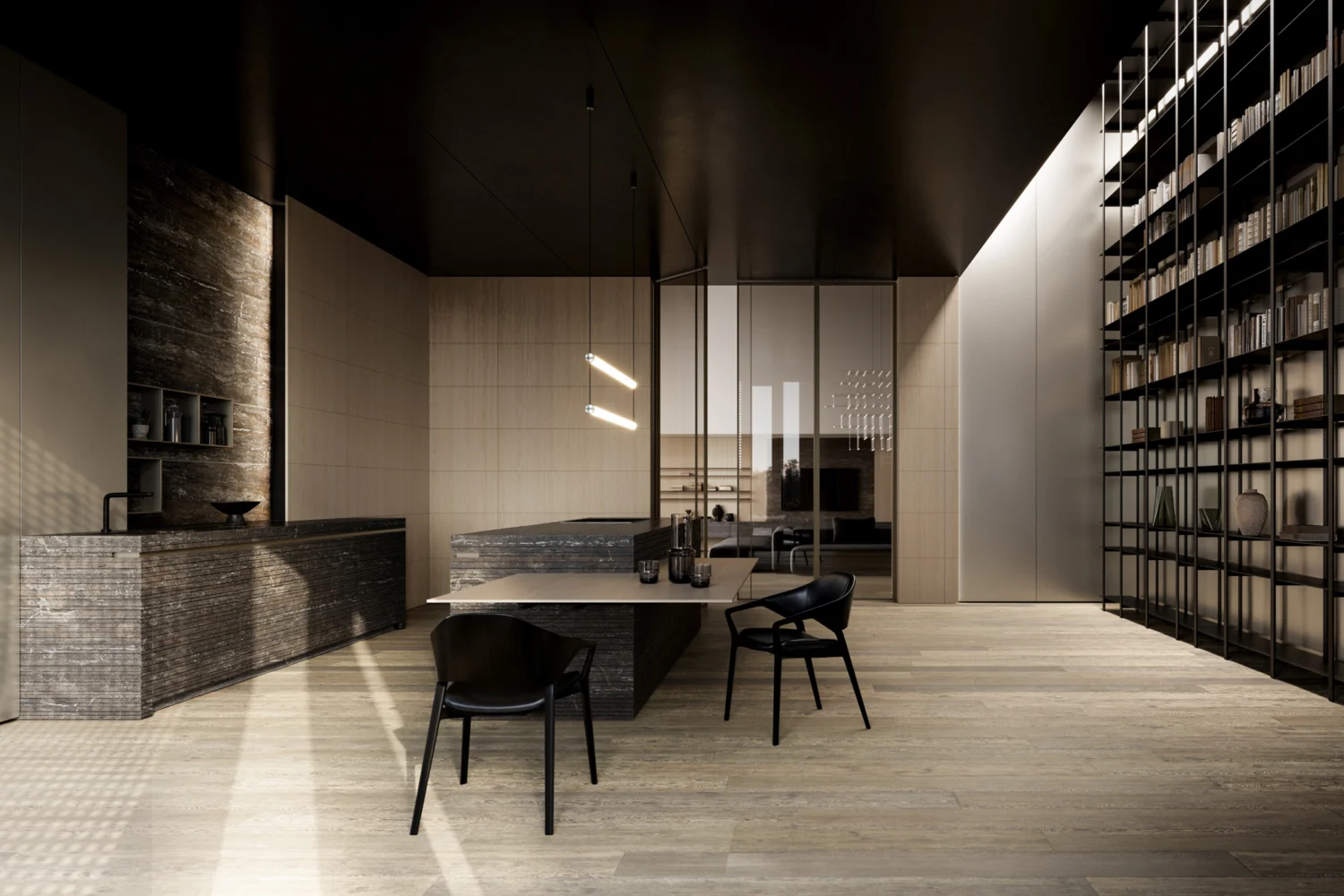
Steel, titanium and warm metals
Steel is leaving the professional kitchen behind to become a noble material. Hand-brushed, aged, mirror-polished. Abimis bends and welds it into doors that catch the light. Steel Cucine colours it in solid RAL shades. Valcucine introduced, for the first time in its system, doors in real iridescent titanium. Warm metals join the cool ones: bronze, copper, burnished brass, almost always matt. To use it without a laboratory feel, see our guide to stainless steel in interior design.
Kitchen colours for 2027: greens, browns and earth tones on the fronts
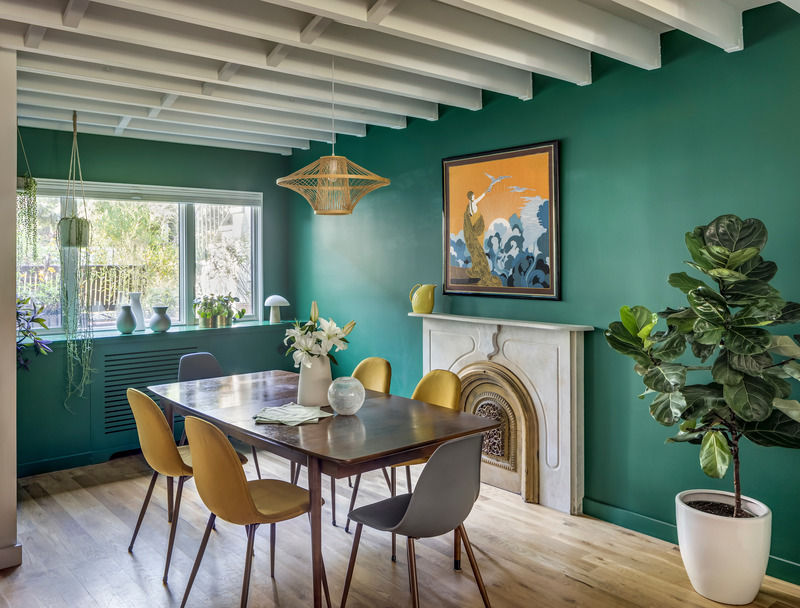
The kitchen colours of 2027 are green, in sage, olive and forest versions, and a family of earthy tones running from sand to clay brown, by way of dusty pinks and terracotta. At EuroCucina green was the dominant colour. Think of the sage in one of the concepts shown by Veneta Cucine with Electrolux, the veined Alpine green of Lago’s Formae kitchen, or the petrol green of Steel Cucine. Alongside the greens came cream, taupe, oxide red and a textured black.
The most interesting point is that colour is returning to the cabinet fronts, not just the walls. Green base units with timber tall units, islands in peach lacquer or Jaipur red, like those Cesar showed in its Milan showroom. Together they mark the end of the equation that modern kitchen means white or grey. This direction matches the 2027 colours of the year already announced by paint makers: Dulux’s sage Soulful Sage, Behr’s olive Grounded, Little Greene’s clay brown Marle. We gathered and discussed them in our piece on wall colours for 2027.
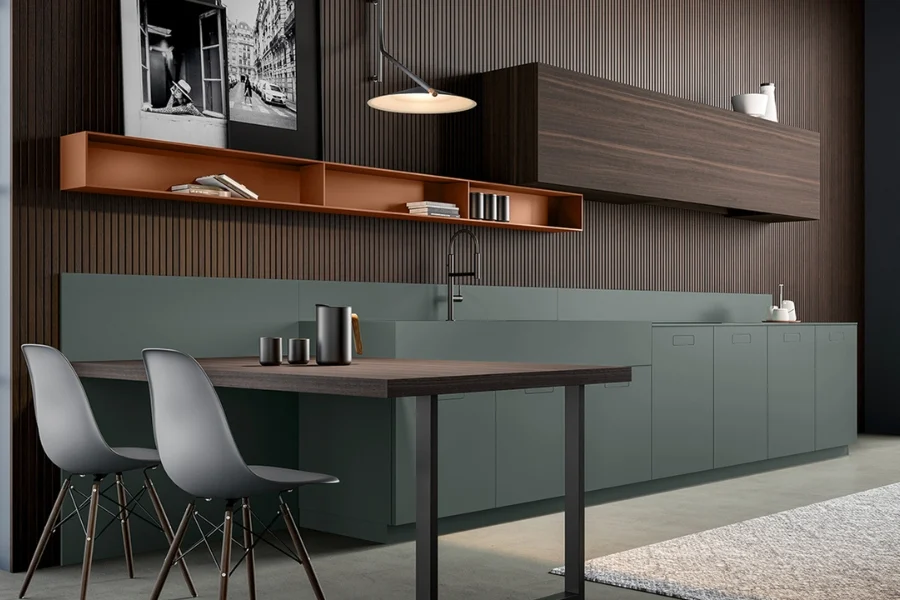
If you prefer to stay neutral, the 2027 white is warm, buttery or porcelain, almost never optical. And black, when it appears, is matt and textured, never high-gloss.
The shape of the modern kitchen in 2027: sculptural islands and integrated handles
The modern kitchen of 2027 has a clear centre of gravity: the island, which stops being a piece of furniture and becomes a sculptural object. It comes in two versions. The first is curved, with rounded ends that ease circulation and breakfast tops that extend or swivel. The second is monolithic: a block of stone, steel or wood that either sits on the floor with full side panels or floats on very slim legs. Either way, the island needs space. Before falling for one, check dimensions and walkways: as a rule, allow at least a metre of clearance on each working side.
The way doors open is changing too. In 2027 fronts are almost always free of visible handles. Think recessed channels under the worktop, finger grips cut into the door edge, slim profiles drawn as architectural details. When a handle does appear, it becomes a strong graphic sign, in burnished metal or in the same material as the door. For a methodical comparison of layouts, openings and worktops, see our guide to modern kitchen layouts, doors and worktops.
Hidden kitchens, pocket doors and back kitchens
The 2027 kitchen knows how to disappear. Pocket doors open and then slide back into the sides of the unit, hiding entire work zones: sink, coffee machine, small appliances, even the hob. Valcucine presented a counterbalanced upward-opening system that handles doors up to 2.40 metres tall. Stosa showed tall units with full-height retractable doors that conceal accessories and small appliances. This is the next step in what we called the invisible kitchen. It pairs naturally with an increasingly common choice, the kitchen without wall units, which leaves the wall clear.
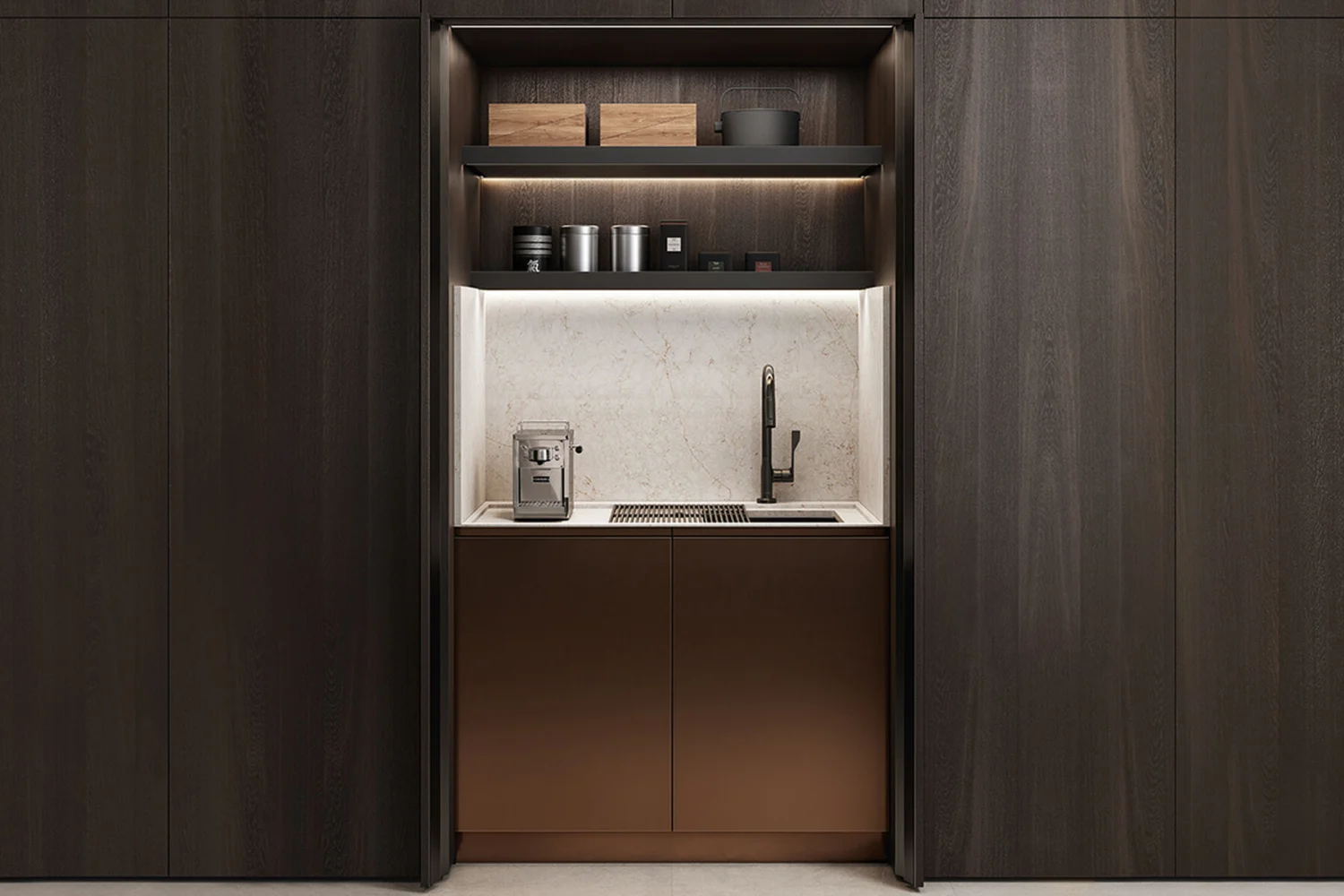
Behind the showpiece kitchen, a second room is appearing: the walk-in pantry, back kitchen or scullery. It is a service space for fridges, dishwashers, provisions and prep surfaces, so the island stays clear even during a dinner party. In Milan, Cesar made it reachable through pass-through doors built into the wall composition. Del Tongo included a storeroom and pantries in its DT01 system, and Marchi Cucine a pantry with built-in appliances. Even a 1.5 metre recess is enough for a domestic version.
Kitchen technology in 2027: invisible induction and integrated extraction
Kitchen technology in 2027 works beneath the surface. The most eye-catching trend is invisible induction, with coils mounted under a stone or ceramic worktop. At Design Week V-ZUG showed an induction hob concealed beneath a continuous mineral surface, and several slab makers have offered similar systems for large-format ceramics for some years. The worktop becomes completely clear. In return, it needs suitable pans, close coordination between the worktop maker and the hob supplier, and a little extra care in use.
Extraction follows the same logic. The most common solutions are hob-integrated extraction, now offered by every major brand, the downdraft hood that rises from the worktop only while cooking, and the flush-ceiling hood. At FTK Falmec showed a hood hidden beneath a panel matching the worktop, and Smeg an island with a motorised retractable hood. Appliances are adding cameras that recognise food, voice and gesture controls, and all-electric, gas-free ranges. Lighting becomes decisive in kitchens without wall units, and we cover it in our kitchen lighting guide.
Sustainability and durability: the kitchen that lasts longer
In 2027 a sustainable kitchen is, above all, one that lasts and can be repaired. On the materials side, timber with forest management certification such as FSC is spreading, together with regenerated laminates and recycled glass. On the appliance side, the rules are changing. The EU Right to Repair Directive 2024/1799 applies from 31 July 2026. It requires manufacturers of dishwashers, fridges and washing machines to offer repairs beyond the legal guarantee and to make spare parts and technical information available.
For the project, this means choosing solid carcasses, quality hardware and standard modules, so a door or an appliance can be replaced without dismantling everything. It is also an argument for steel and stone, materials that age well. In Italy, buyers renovating in 2026 can also claim a 50% furniture tax credit on spending of up to 5,000 euros, provided ovens are at least class A, dishwashers class E and fridges class F. Rules for 2027 will depend on the next Italian budget law.
Kitchen and living room as one
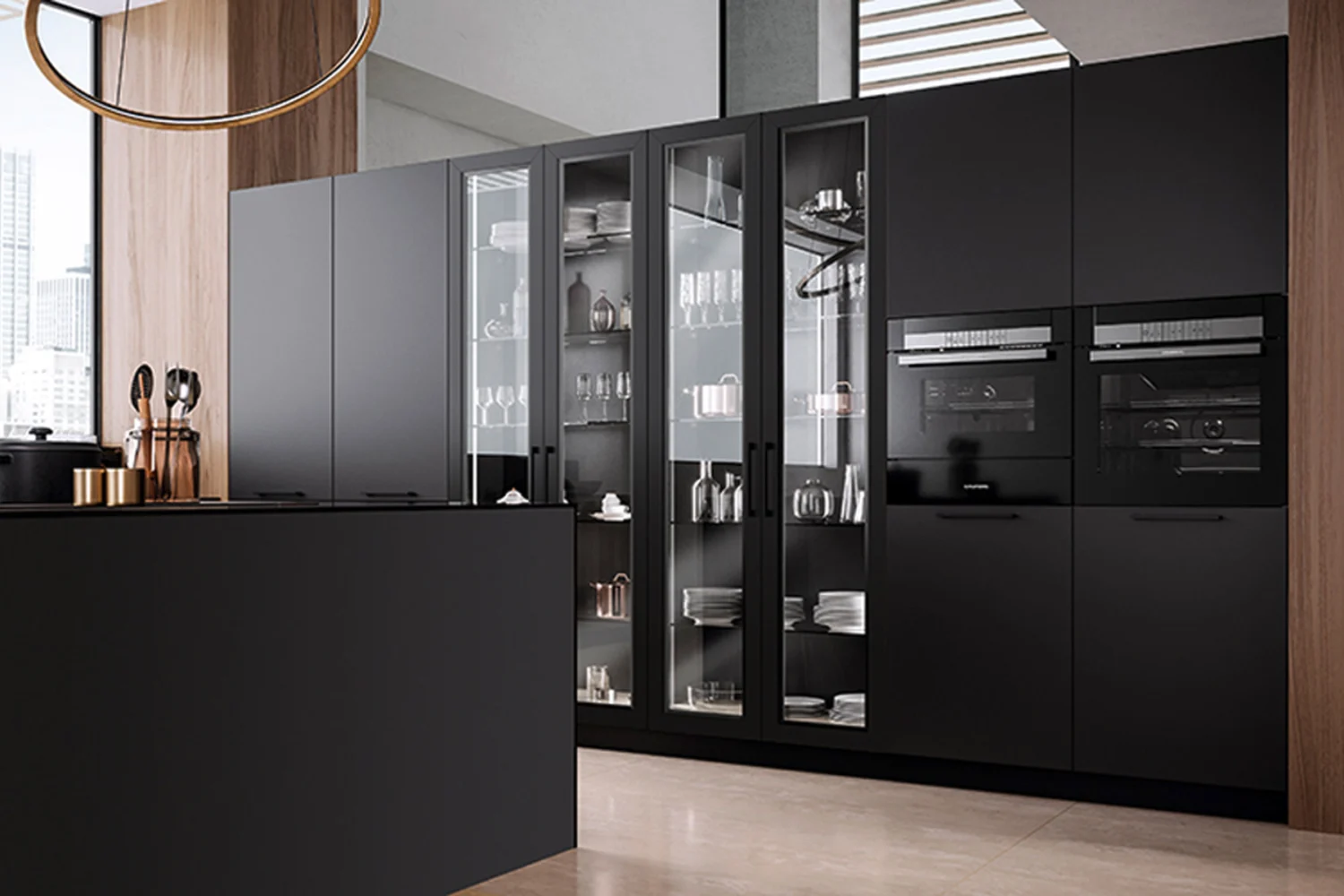
The 2027 kitchen does not end where the last unit ends. Wall panelling that continues into the living area, bookcases in the same wood as the doors, coordinated TV units and sideboards. Kitchen makers now design complete systems for the living area, and they showed it clearly at Design Week, with fitted walls holding appliances, display cabinets and shelves in one seamless run. The result is a single space in which the kitchen is recognisable only when it is in use.
For designers, the rule is to choose a shared palette of two or three materials and repeat it across kitchen and living room. Separate functions with the island, a free-standing panel or a glazed partition rather than a wall.
What is going out of fashion in kitchens in 2027?
In 2027 the main casualties are high-gloss lacquer, optical total white and uniform cool grey, the three signatures of the modern kitchen of the 2010s. Walls of wall units up to the ceiling are also losing ground to shelves, glazed cabinets and tall units. Projecting chimney hoods are giving way to integrated extraction. Very pale Nordic timber is not disappearing, but it is warming up or darkening. Long steel bar handles are making room for integrated grips.
Be careful not to read trends as rules, though. A well-designed white kitchen, with a good stone worktop and warm wood, stays current for years. What ages fast is the combination of glossy surfaces, cold colours and imitation materials that fail to convince.
How to update an existing kitchen with the 2027 trends
You can bring an existing kitchen in line with the 2027 trends without replacing it. Focus on three elements: doors, worktop and light. If the carcasses are sound, new fronts in dark wood, a matt green or a fluted finish transform the look of the room while keeping the cabinets and appliances.
The second step is the worktop. A new top in natural stone, quartz or thin ceramic, with a matching splashback, brings in the material continuity that defines 2027. The third is lighting: LED profiles under the shelves, a sculptural pendant over the island or peninsula, warm light. You can also add new burnished metal handles, swap one wall of wall units for open shelves, or repaint the room in one of the 2027 greens or earth tones. If you are planning a full replacement, our guide to the best Italian kitchen brands is a good place to start.
How much does an on-trend kitchen cost in 2027?
A kitchen that interprets the 2027 trends generally costs more than a standard one. The star materials, stone, solid or veneered wood and steel, are dearer than laminates and lacquers. As a rough guide, a mid-range linear kitchen with wood or matt lacquer fronts starts at a few thousand euros. A composition with a stone island and hidden systems from a high-end brand easily exceeds 30,000 euros, appliances excluded. Luxury kitchens, like those in our selection of the best luxury kitchen brands, can top 100,000 euros in bespoke projects.
The cost drivers are easy to spot. Natural stone worked as a block, under-worktop induction, large pocket doors, hob-integrated extraction. A makeover of doors and worktop, on the other hand, costs a fraction of a new kitchen and keeps the structure and services in place.
Frequently asked questions about kitchen trends 2027
Which colours will be on trend for kitchens in 2027?
The trend colours for kitchens in 2027 are green, especially sage, olive and forest, and earthy tones: sand, taupe, terracotta and clay brown. White remains, but in a warm version, and black only in matt. The novelty is that colour moves onto doors and islands, not just walls.
Will kitchen islands still be fashionable in 2027?
Yes. The island remains the heart of the 2027 kitchen, but its shape is changing. It becomes monolithic, like a block of stone or steel, or curved, with rounded ends and integrated breakfast tops. Where space is short, a peninsula in the same language is an excellent alternative.
Which worktop material should I choose in 2027?
The most requested worktop materials in 2027 are natural stone, especially travertine, quartzite and veined marble, thin ceramic and sintered stone, and brushed stainless steel. The trend is to use the same material for worktop, splashback and sometimes the island sides, for a monolithic effect.
What is a hidden kitchen?
A hidden kitchen is a layout in which the work zones sit behind doors that slide back into the sides of the unit or lift upwards once opened. When closed, all you see is a fitted wall. It is ideal in open-plan homes where kitchen and living room share the same space.
Will white kitchens go out of fashion in 2027?
Optical, glossy white is losing ground. Warm white, paired with wood, stone and matt metals, remains a current and long-lasting choice. To update it for 2027, simply warm it up with a stone worktop, a dark wood island or a few coloured tall units.