Strasbourg opens on 27 November 2026 and Colmar runs from 23 November to 29 December: our guide to the Alsace markets, from the 1570 Christkindelsmärik to the cathedral, the Neustadt and half timbered Colmar.
Strasbourg and Colmar turn Christmas into a lesson in urban history: a market born in 1570 at the foot of a Gothic cathedral and, half an hour away by train, a town of half timbered houses that seems designed for winter.
The Strasbourg Christmas market opens on Friday 27 November 2026, as announced by the city on the official Strasbourg Capitale de Noël website. The Christkindelsmärik, founded in 1570, is one of the oldest Christmas markets in Europe and now spreads across eight squares on the Grande Île. A few days earlier, on Monday 23 November, the Colmar Christmas markets open, running until 29 December 2026.
Our editorial view is that these two towns belong together. Strasbourg offers the monumental scale: the red sandstone cathedral and the dialogue between the medieval centre and the German Neustadt, both UNESCO World Heritage. Colmar offers the domestic scale: painted façades, exposed timber, canals. Between them lies the whole building culture of Alsace.
When do the Strasbourg and Colmar Christmas markets open in 2026?
Strasbourg opens on Friday 27 November 2026; the closing date and full programme are still being finalised by the city. Colmar is already confirmed: from 23 November to 29 December 2026, with the gourmet market, the Ferris wheel and the Place Rapp fair open until 3 January 2027.
| Information | 2026/27 season |
|---|---|
| Strasbourg | Opens Friday 27 November 2026; closing date and hours on the official noel.strasbourg.eu website |
| Colmar | 23 November to 29 December 2026; gourmet market and Ferris wheel until 3 January 2027 |
| Colmar opening hours | Monday to Thursday 11am to 7pm; Friday to Sunday 10am to 8pm |
| Colmar holidays | 24 December 11am to 5pm; 25 and 26 December 10am to 8pm |
| Where | Strasbourg: eight markets on the Grande Île, around Place Broglie, the cathedral, Place Kléber and La Petite France. Colmar: the pedestrian old town |
| Getting there | By train via Switzerland or Paris; by air to Strasbourg or to EuroAirport Basel-Mulhouse |
From Italy the train works well: Strasbourg is reached through Switzerland, changing at Basel, or via Paris on the high speed line. The nearest airports are Strasbourg-Entzheim and EuroAirport Basel-Mulhouse-Freiburg, the latter also handy for Colmar. According to the city, Strasbourg station is a ten minute walk from the markets, and regional trains between Strasbourg and Colmar take about half an hour.
Where is the Strasbourg Christmas market and how is it organised?
Christmas in Strasbourg fills the Grande Île, the river island encircled by the Ill, which is fully pedestrianised during the event. Each of the eight markets has its own character: the historic Christkindelsmärik on Place Broglie, the market around the cathedral and Place du Château, the one at the foot of the Grand Sapin on Place Kléber, La Petite France between Place Benjamin Zix and Place Saint-Thomas, the Quai des Délices on the Rohan terrace, the small Alsatian producers in Square Louise Weiss, the Carré d’Or on Place du Temple Neuf and the Marché OFF on Place Grimmeissen.
The Grand Sapin, the monumental tree on Place Kléber, has been the symbol of the season since 2000. Our advice, in line with the city’s own guidance, is to avoid Saturday afternoons, the busiest slot, and to choose mornings or weekday afternoons, especially Monday, Tuesday and Thursday. Large bags and backpacks are checked at the entrances to the Grande Île.
Why is the Strasbourg Christmas market different?
Because it is a civic institution with almost five centuries of history. The Christkindelsmärik was born in 1570, after the Reformation, replacing the Saint Nicholas market; in the second half of the nineteenth century it merged with a Christmas fair, and since 1871 it has been held on Place Broglie. In 1992 the city turned it into “Strasbourg Capitale de Noël”, making the whole centre an urban stage set.
The difference shows in the architecture. Strasbourg is one of the few European cities where two opposing urban fabrics share the same UNESCO boundary: the Grande Île, inscribed in 1988, and the Neustadt, added in 2017, the new town built under German administration between 1871 and 1918, with a plan that looks to Haussmann and architecture of Germanic inspiration. Walking from Place Broglie into the Neustadt takes you from the Middle Ages to modern town planning in minutes.
Which architecture should you see in Strasbourg and Colmar during the markets?
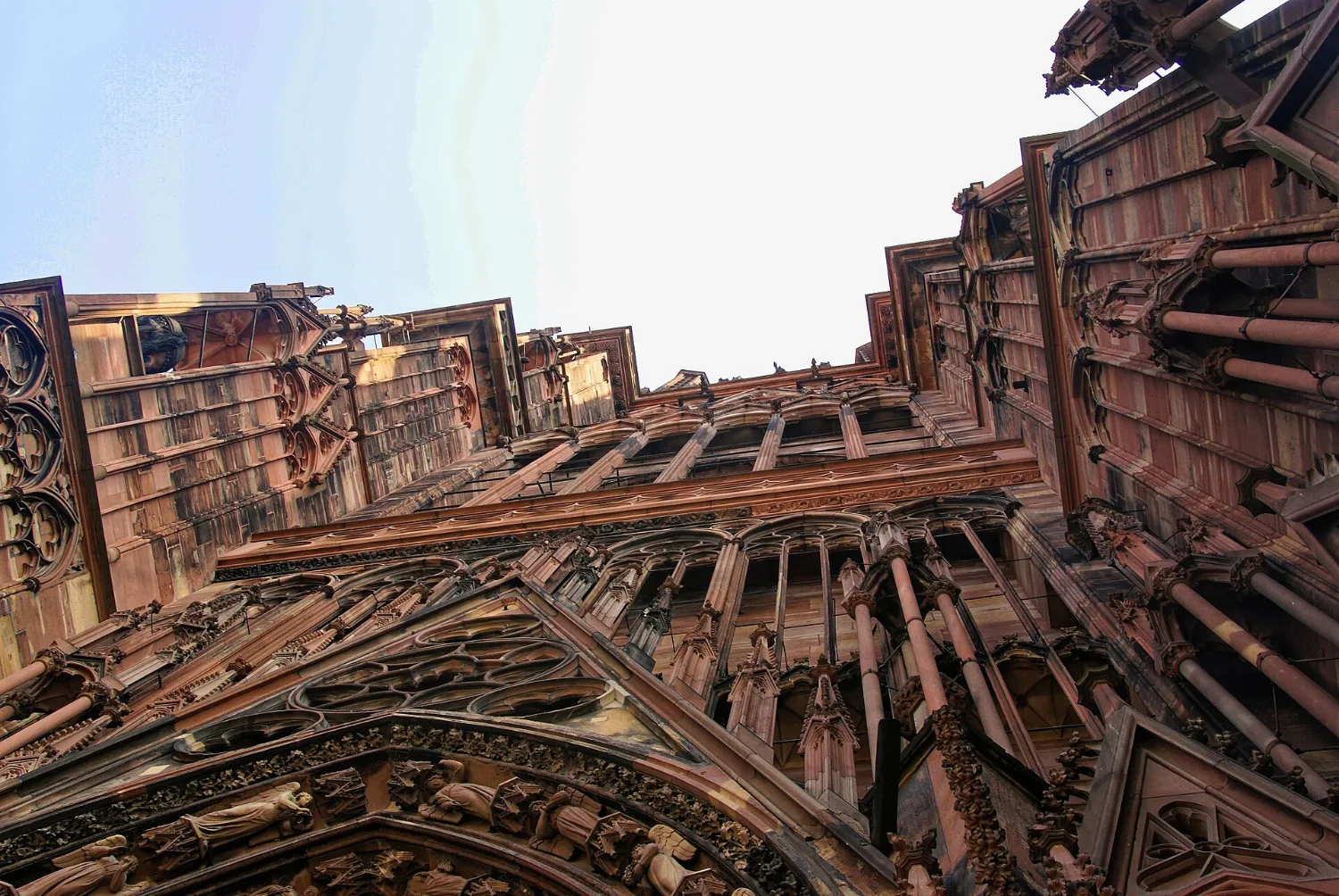
Start with Notre-Dame Cathedral. Its 142 metre spire, completed in 1439, made it the tallest building in the world from 1647 to 1874; the reddish brown sandstone of the Vosges gives it its unmistakable colour, which seems to glow at sunset in December. The south transept houses the astronomical clock, one of its most famous features.
Next door, the Palais Rohan, designed by Robert de Cotte and built between 1732 and 1742, houses three museums: archaeology, decorative arts and fine arts. The Museum of Decorative Arts, with the apartments of the prince bishops, is the ideal companion to the cathedral market. Opening times are on the Strasbourg museums website.
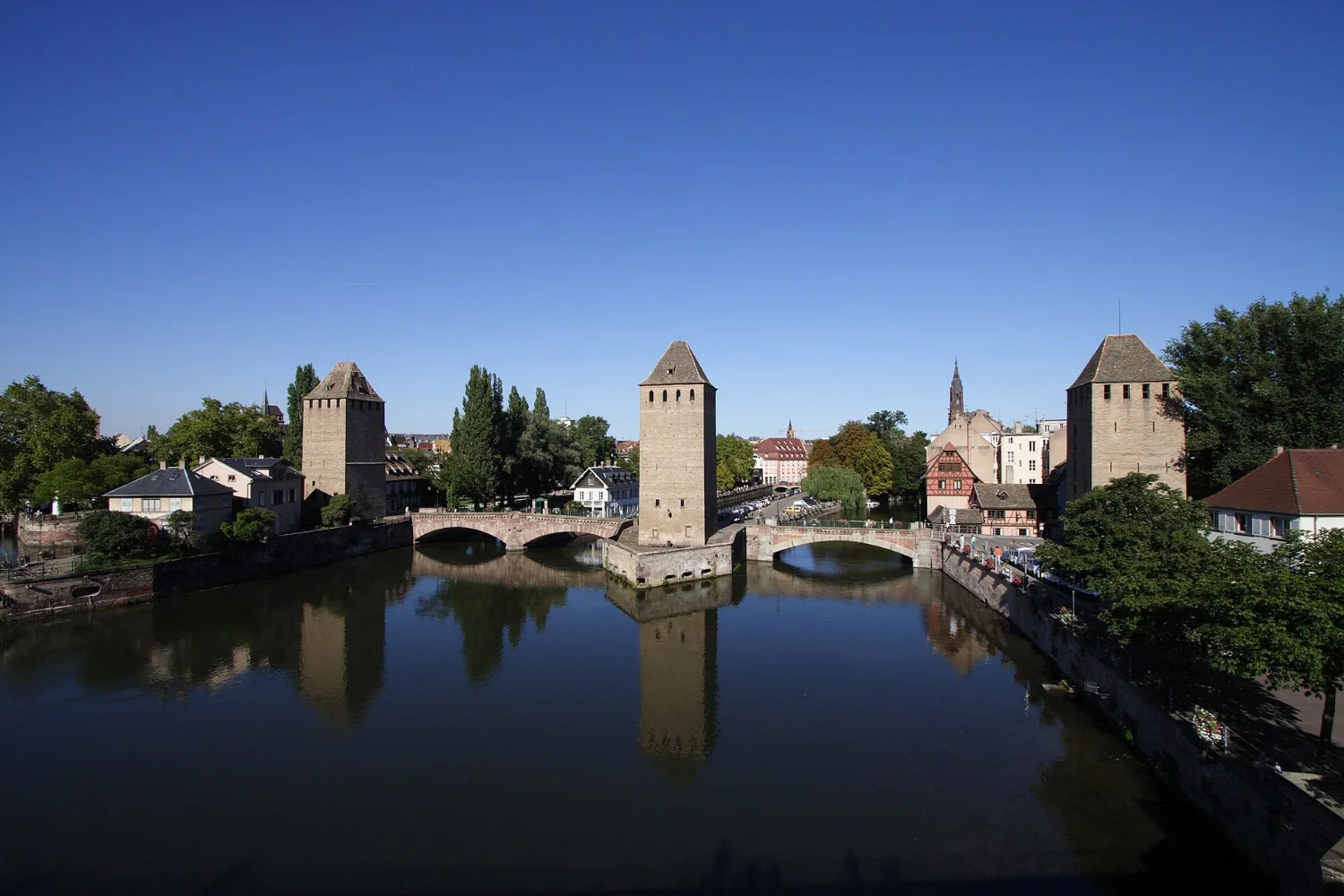
La Petite France is the old quarter of millers and tanners, closed to the west by the Ponts Couverts and their four defensive towers, remnants of the old fortifications. Just upstream, the Barrage Vauban, built in the late seventeenth century to regulate the level of the Ill, has a panoramic terrace that frames the towers and rooftops of the quarter.
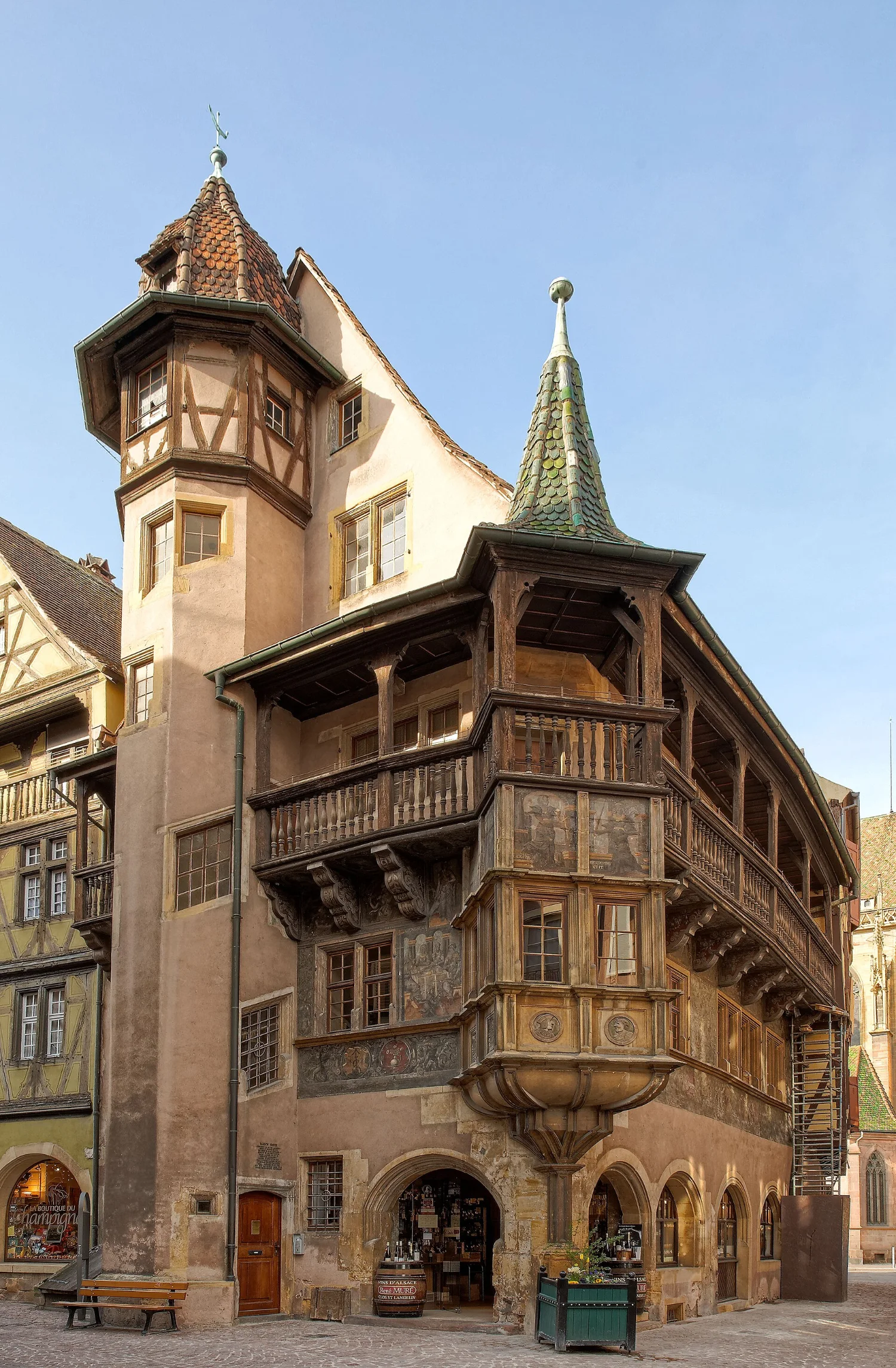
In Colmar the scale changes. The Maison Pfister, built in 1537 for the hatter Ludwig Scherer, has a two storey corner oriel with a wooden gallery and murals of emperors, evangelists and allegories. The Koïfhus, the old customs house begun in 1480, was the administrative and economic heart of the town and keeps its glazed tile roof. For contemporary architecture, the Musée Unterlinden joins a thirteenth century Dominican convent to the Herzog & de Meuron extension opened in 2015, and holds Matthias Grünewald’s Isenheim Altarpiece; details on the Musée Unterlinden website.
The walk ends in La Petite Venise, the quarter along the Lauch where half timbered houses rise straight from the water, and which hosts the children’s Christmas market.
What should you buy at the Strasbourg and Colmar Christmas markets?
Our rule is to reward what truly belongs to the region. Alsace has a strong tradition of ceramics, from terrines to kougelhopf moulds, of printed textiles, glass decorations and Christmas biscuits known as bredele. The small producers’ market in Square Louise Weiss and the craft market at the Koïfhus in Colmar are the best places for authentic pieces.
Skip the kitsch figures and plastic storks and look instead for hand glazed ceramics and earthenware tableware, which hold their own next to a good design object. For an Alsace wine to take home, finish the trip along the wine route just outside Colmar.
Where to stay in Strasbourg and Colmar if you love design?
In Strasbourg, Cour du Corbeau, at 6-8 rue des Couples, occupies a sixteenth century coaching inn a short walk from the Ill: half timbered façades, dark wood, stained glass, an inner courtyard and contemporary furnishings in dialogue with Alsatian architecture. In Colmar, La Maison des Têtes, at 19 rue des Têtes, is a listed historic monument from 1609 whose façade is decorated with 106 carved heads: staying here means living inside one of the town’s most famous buildings.
To compare an Alsatian Christmas with the capitals, read our guides to the Vienna Christmas markets and the Copenhagen Christmas markets. And if Alsace leaves you wanting more slow travel, explore our Italian country houses for autumn.
Frequently asked questions about the Strasbourg and Colmar Christmas markets
When does the Strasbourg Christmas market open in 2026?
The market opens on Friday 27 November 2026. The closing date and programme will be published on the city’s official website.
When are the Colmar Christmas markets in 2026?
From 23 November to 29 December 2026. The gourmet market, the Ferris wheel and the Place Rapp fair stay open until 3 January 2027.
Are the markets open on and after Christmas Day?
In Colmar, yes: 11am to 5pm on 24 December, 10am to 8pm on 25 and 26 December, until 29 December. Strasbourg has not yet published its 2026 holiday schedule.
How do you get to Strasbourg and Colmar?
By train through Switzerland, changing at Basel, or via Paris; by air to Strasbourg or EuroAirport Basel-Mulhouse. Regional trains link the two towns in about half an hour.
How many days do you need for Strasbourg and Colmar?
We suggest three: two in Strasbourg, for the Grande Île, the cathedral and the Neustadt, and one in Colmar, for La Petite Venise, the Maison Pfister and the Unterlinden.