How to design Christmas in a few square metres: wall, tabletop or slim trees, decorations taken up high, multifunctional pieces and a single box to avoid clutter.
In a few square metres Christmas is not accumulated, it is designed. Fewer objects, better chosen and placed where they work hardest: it is the same method you would use to furnish a studio flat, and it leads to a more beautiful festive season than many larger homes manage.
Christmas decorations for a small home are almost always conceived as a scaled down version of those for a large one: a shorter tree, fewer baubles, a few less lights. That is the wrong starting point. A fifty square metre flat does not need a miniature Christmas, it needs a different Christmas, built on the rules that already shape its architecture: verticality, multifunction, a few strong moments and no needless clutter.
Our editorial view is that the small home has become the most interesting testing ground for the festive season. Cities are getting denser, rents push people towards smaller footprints, and many live alone or as couples in spaces where every centimetre already has a job. In that context a two metre tree in the middle of the living room is a legacy of the bourgeois house, not a necessity. Decorating for Christmas in a few square metres forces you to choose, and choosing is the first act of design.

How do you decorate a small home for Christmas without filling it up?
Start by taking things away, not adding them. Before the decoration boxes come out, we suggest clearing, for one month, the surfaces you want to give over to the season: a shelf, the top of a sideboard, the window sill. The everyday objects that live there are put away, and the decorations take their place. That way the overall volume of things in the home stays the same and the room never feels saturated.
The second principle is concentration. Three well dressed moments, say the door, the table and a corner with the tree, are worth more than ten small gestures spread over every surface. The eye needs places to rest, and in a small home those places are few by definition. Anyone who starts from this discipline soon finds that the decorations breathe better and that the home even feels larger.
The third principle concerns the palette. Two colours at most, plus one metal, are enough to hold everything together: deep green and milk white with brass, for example, or the natural tones of wood, linen and dried branches. A coherent set reads as a single design rather than an accumulation of gifts received over the years.
Which Christmas tree works best when space is tight?
Choose a tree that takes up height rather than floor area. There are three strong options: the wall tree, the tabletop tree and the slim tree, which manufacturers often call slim or pencil, with a narrow base and an almost entirely vertical profile. Each solves a different problem, and the right choice depends on where everyday life flows through the home.
The wall tree is the most radical: it never touches the floor and takes not a single centimetre from the circulation space. It can be a horizontal branch hung from two cords, with a few decorations and a string of micro lights falling from it, a composition of branches fixed to the wall in a triangle, or simply a tree outline drawn with a light string on an empty wall. It is also the tree closest to contemporary art, a kind of domestic installation that comes down in ten minutes.
A tabletop tree, between fifty and eighty centimetres tall, lives on a console, a chest of drawers or even a side table next to the sofa. A small real fir in a pot brings scent and can be moved to the terrace after the holidays; alternatively, branches of birch, hazel or eucalyptus gathered in a tall glass or ceramic vase work beautifully with a few light decorations. The slim tree, finally, is for anyone unwilling to give up the classic shape: tall and narrow, it slips into a corner without invading the centre of the room.
How can you use height for Christmas decorations?
Take the decorations up high, where a small home still has free space. Shelves, door and window frames, the tops of bookcases and kitchen units are surfaces nobody uses, and at Christmas they can hold branches, long garlands and small lights. A garland of fir or eucalyptus laid along the highest shelf in the living room brings greenery into the room without taking up a worktop or the floor.
Windows are another valuable resource. A paper star hung in the centre of the glass, in the Scandinavian manner, or a few branches suspended at different heights turn the sill into a display that can be seen from the street. Nordic style, born precisely in compact homes and long winters, has a great deal to teach about this discreet use of decoration: we explore it in our feature on Scandinavian interior style.
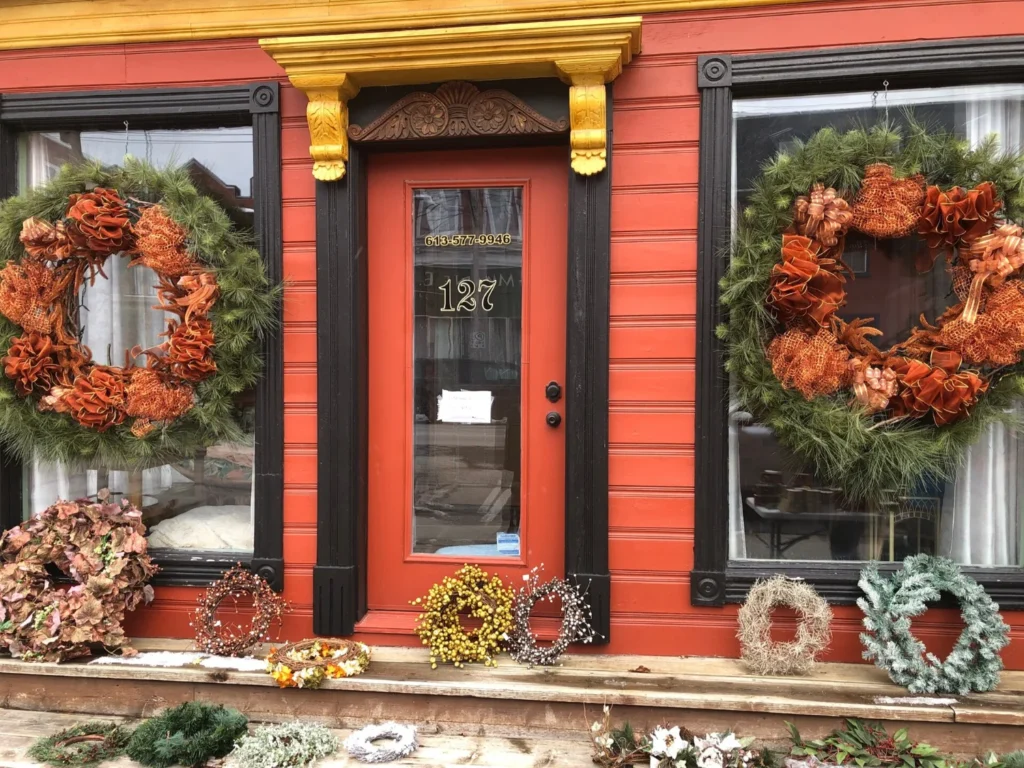
The front door also works vertically and takes space from no one. A well proportioned wreath is often the most effective decoration in a small home, because it welcomes guests and announces the season before they even step inside: ideas for choosing one are in our guide to the Christmas wreath for the front door.
Which multifunctional pieces help at Christmas?
Pieces that have a role all year round and simply change outfit in December. A coffee table with storage can hold the decorations from January to November and become the base for a tabletop tree over the holidays. A large tray turns into a centrepiece, then a stand for candles, then goes back to serving breakfast. A bench in the hallway becomes a place for presents.
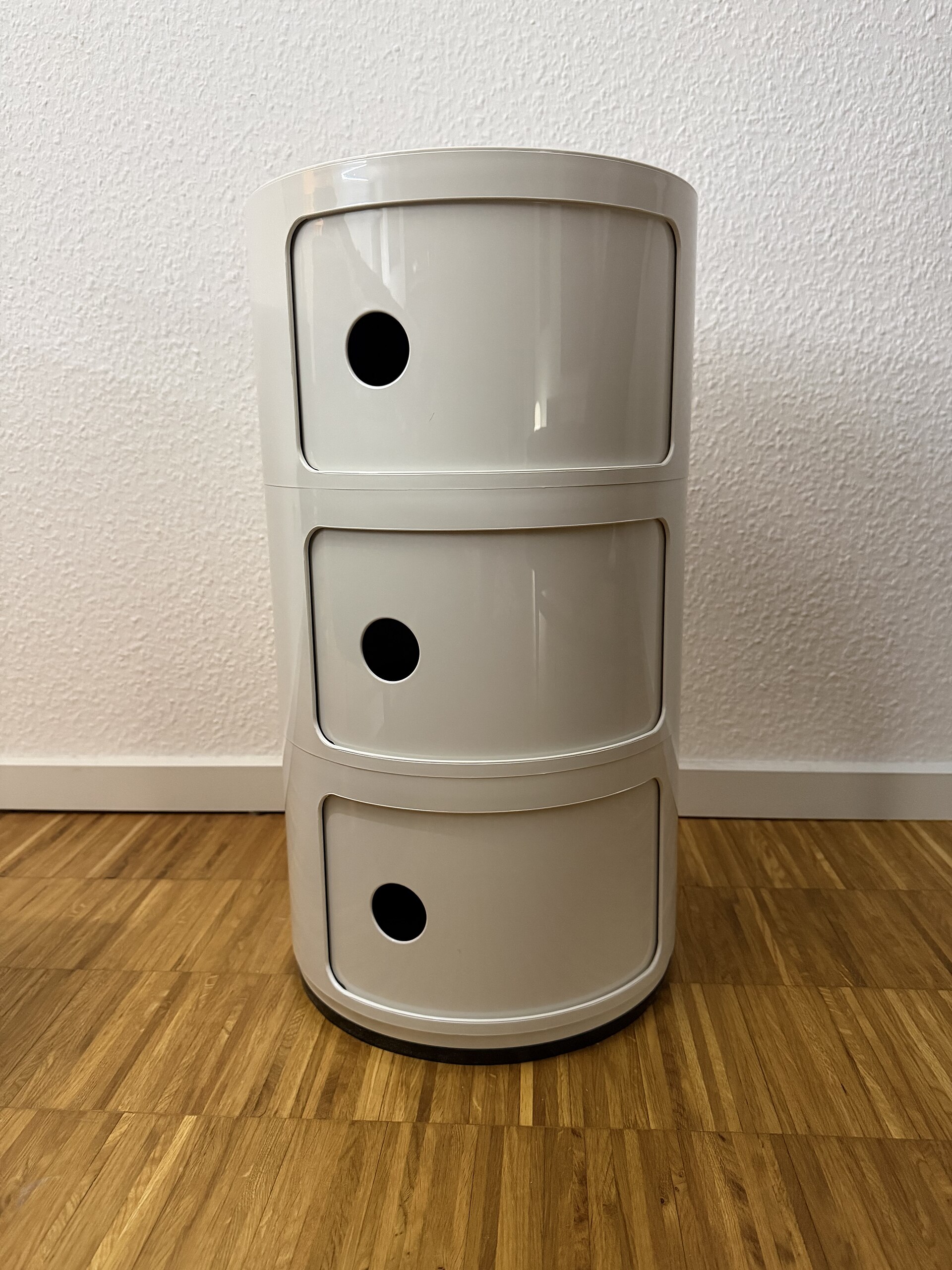
Some design classics were made for exactly this kind of flexibility. Anna Castelli Ferrieri‘s Componibili for Kartell, introduced in 1967, are cylindrical storage units that sit happily in a kitchen, a bathroom or beside the bed: in December they can store ribbon, lights and wrapping paper, while their round top makes a natural base for a small fir or a vase of branches. It is the kind of piece a small home should always favour, because it works in every season.
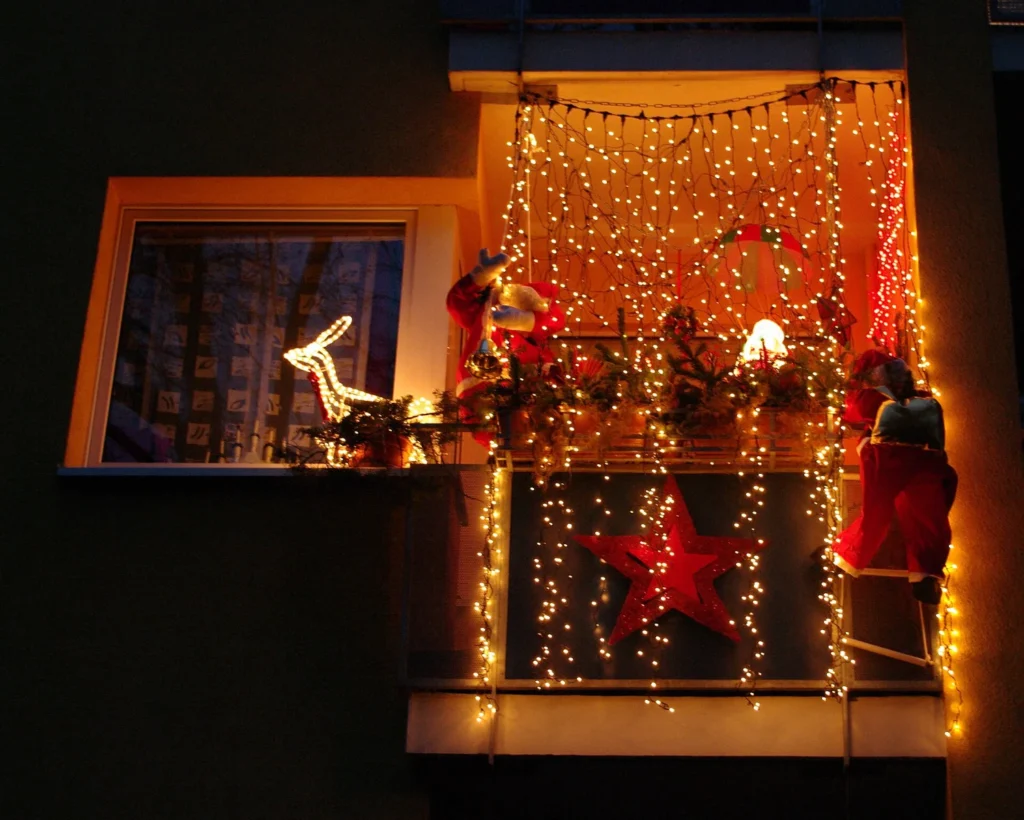
The same goes for light. A portable, rechargeable lamp replaces several light strings and moves from table to bedside, from window sill to terrace. We have a whole guide to Christmas lights at home, covering colour temperature, layers and lamps, which matter even more in a few square metres.
How do you set the Christmas table in a small living room?
Treat the table as the true centre of the celebration, because in a small home it usually is. If the table extends, plan every decoration around its open configuration, leaving the circulation space around it clear. A long, low centrepiece of branches and candles decorates without stealing room from plates and glasses. Better still if the candles vary in height and sit together on a single tray.
When there are more guests than seats, we suggest turning dinner into a buffet: shared dishes on the sideboard, small side tables beside the seating, linen napkins and cutlery gathered in a vase. It is a more informal way to celebrate but no less considered, and it frees the home from a table that simply will not fit. For many it is also the most convivial option.
How do you avoid decoration clutter in a small home?
Set a physical limit: a single box for Christmas decorations, to be filled and never exceeded. Each year, before buying anything new, we recommend taking out one piece you no longer use. This simple exercise forces you to separate what you genuinely love from what you bought on impulse, and keeps the collection alive without letting it grow endlessly.
The quality of what you buy matters too. A few decorations in blown glass, wood, ceramic or natural fabric last for decades and improve with age, while cheap plastic breaks and piles up. To find makers who work these materials well, our selection of the best Christmas decoration brands is a good starting point. And for the year round approach to space, see our guide on how to furnish your home.
Frequently asked questions about Christmas decorations for a small home
What kind of Christmas tree suits a small home?
A tree that takes height rather than floor area: wall mounted, tabletop or slim. A wall tree is the most effective because it never touches the floor.
Where should the tree go in a studio flat?
In a corner away from walkways and heat sources, or on a console or chest of drawers if you choose a tabletop tree.
How many decorations does a small home need?
Few, and concentrated: three strong moments, such as the door, the table and the tree, are worth more than many scattered decorations.
How do you make a wall Christmas tree?
With a horizontal branch hung from two cords, with branches fixed to the wall in a triangle, or with a string of micro lights shaped into a tree.
How do you store decorations when space is short?
In a single box with a fixed limit. Storage pieces used all year can hold ribbon and lights out of season.